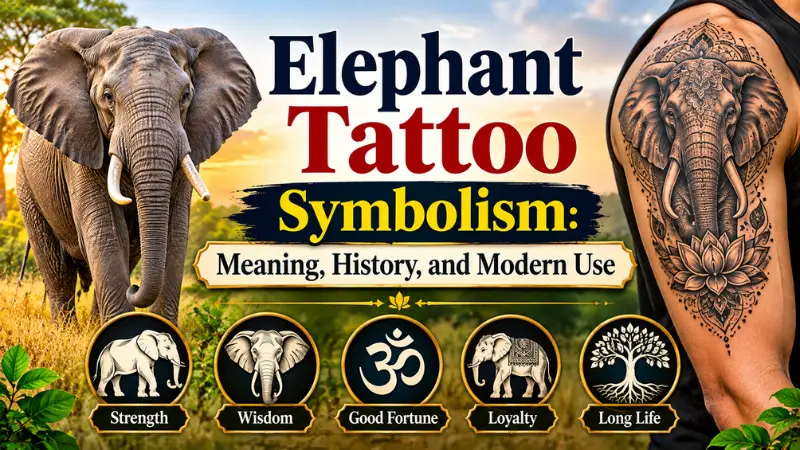
An elephant tattoo is often chosen to represent strength, wisdom, loyalty, family, and emotional resilience. Because elephants are known for their intelligence, close family relationships, protective behavior, and impressive physical presence, they carry meanings that extend beyond their appearance. In modern American tattoo culture, elephant tattoo symbolism frequently reflects personal values, family connections, remembrance, and the ability to overcome difficult experiences.
Unlike designs chosen simply for their visual appeal, elephant tattoos often communicate something meaningful about the person wearing them. Some people associate the animal with a protective parent or grandparent, while others see it as a reminder to remain patient, confident, and steady during challenging periods.
The elephant also has a long cultural and religious history. It appears in Hindu and Buddhist traditions, African artistic practices, Asian royal imagery, and American political symbolism. Understanding these different associations helps explain why the elephant remains such a recognizable subject in contemporary tattoo art.
Quick Answer: What Does Elephant Tattoo Symbolism Mean?
Elephant tattoo symbolism most commonly represents strength, wisdom, family loyalty, protection, patience, and resilience in modern American culture. Historically, elephants have also represented royal authority, prosperity, spiritual protection, and sacred wisdom in several Asian and African cultural traditions.
TL;DR
- Strength: Represents physical power, confidence, and the ability to overcome obstacles.
- Wisdom: Reflects intelligence, patience, experience, and thoughtful decision-making.
- Family: Symbolizes parental protection, loyalty, and close family relationships.
- Protection: Represents security, guidance, and standing up for loved ones.
- Spirituality: Connects with Ganesha, Buddhism, prosperity, and religious traditions.
- Remembrance: Serves as a personal tribute to loved ones and meaningful life experiences.
1. What an Elephant Tattoo Represents
Rebel Muse Tattoo – Our Artist
Graceful Elephant Tattoo Ideas | OSCO
10
An elephant tattoo represents several qualities that people admire in the animal itself. Its enormous size suggests strength, while its social behavior provides associations with family, cooperation, and protection.
For many Americans, the elephant is a symbol of someone who remains dependable when circumstances become difficult. It can represent a person who takes responsibility, protects family members, and approaches problems with patience rather than aggression.
The most common interpretations include:
- Inner strength: Staying emotionally steady through difficult circumstances.
- Loyalty: Remaining committed to family, friends, and personal relationships.
- Intelligence: Valuing knowledge, experience, and careful judgment.
- Patience: Understanding that meaningful progress sometimes takes time.
- Protection: Providing safety and support to people who matter.
- Resilience: Recovering from setbacks without losing personal direction.
The exact meaning depends on the individual. Someone who chooses an elephant after becoming a parent might associate it with responsibility and protection. Another person might choose the same design after recovering from a difficult experience.
This flexibility is one reason elephants work well as personal tattoos.
2. Strength and Resilience: The Most Recognizable Meaning
Strength is among the most recognizable meanings associated with elephant tattoos.
An adult elephant possesses remarkable physical power. Its size, muscular body, strong legs, and ability to move through challenging environments make it a natural representation of endurance.
However, the meaning is not limited to physical strength.
In tattoo culture, an elephant can represent emotional strength: the ability to continue after losing someone, facing disappointment, rebuilding a life, or overcoming personal obstacles.
For example, someone who has experienced a difficult period might choose an elephant walking forward as a reminder that progress does not require rushing. Moving steadily can be more important than moving quickly.
An elephant tattoo may communicate:
- Confidence without arrogance.
- Courage without unnecessary aggression.
- Emotional stability during uncertainty.
- Determination when facing obstacles.
- The ability to recover after difficult experiences.
A large elephant tattoo with its head raised or trunk extended can emphasize confidence and presence. A walking elephant may communicate perseverance and continued personal growth.
3. Wisdom, Intelligence, and Patience
Elephants are highly intelligent mammals with sophisticated social behavior, communication skills, and long-term relationships.
These characteristics have contributed to their association with wisdom in different cultures.
An elephant tattoo can represent someone who values learning from experience rather than making decisions impulsively. It may also reflect maturity, thoughtful judgment, and the ability to remain calm when dealing with complicated situations.
Patience is another important interpretation.
Elephants do not need to appear aggressive to communicate strength. Their size and physical presence already make them commanding animals. This creates an interesting symbolic contrast: an animal capable of tremendous force can also display gentleness and social cooperation.
People who choose this meaning may connect their tattoo with:
- Learning from past mistakes.
- Becoming more mature with age.
- Thinking before reacting.
- Respecting different perspectives.
- Maintaining calm during stressful situations.
A realistic elephant portrait is particularly suitable for this interpretation because it emphasizes the animal’s facial details, eyes, and natural expression.
4. Family, Motherhood, and Loyalty
Tattoo uploaded by Sergio Fernandez • Tattoodo
Forbidden Images Tattoo Art Studio : Tattoos : Black and Gray : Mamma and kid
9
Family is one of the most personal meanings behind elephant tattoos.
Elephants live in close social groups, and female elephants often maintain long-lasting relationships with relatives. In many populations, family groups are organized around experienced older females known as matriarchs.
These matriarchs help guide the group, recognize familiar individuals, and contribute valuable knowledge about resources and environmental conditions.
This behavior makes elephant family tattoos especially meaningful.
A mother elephant walking beside her calf may represent:
- Motherhood and unconditional care.
- The relationship between parents and children.
- Family unity and belonging.
- Protection during difficult times.
- The importance of guidance and experience.
Some people choose three small elephants to represent themselves, their partner, and their child. Others choose a group of elephants to symbolize siblings, grandparents, or an extended family.
A mother-and-baby design can also serve as a tribute to someone who provided protection and emotional support throughout childhood.
Importantly, elephant family tattoos do not have one universal meaning. Their significance comes from the relationships the wearer wants to honor.
5. Elephant Tattoos as Symbols of Protection
Elephants are large animals capable of defending themselves and protecting members of their social groups.
Their protective behavior has contributed to their use as symbols of guardianship, safety, and responsibility.
In tattoo design, an elephant may represent the desire to protect loved ones or the feeling of being protected by someone important.
Some people choose this design after becoming parents. Others associate it with a grandparent, older sibling, or close friend who provided guidance during difficult periods.
Certain artistic choices strengthen this interpretation:
- A mother elephant with a calf: Parental protection and care.
- An elephant with its trunk raised: Confidence, alertness, and celebration.
- A large elephant portrait: Security and dependable strength.
- An elephant with ornamental patterns: Spiritual protection or cultural inspiration, depending on the design.
Protection does not necessarily mean physical defense. It can also represent emotional safety, encouragement, and the commitment to remain present for others.
6. Historical Origins of Elephant Symbolism
Elephants have appeared in human art, religious imagery, royal ceremonies, and political traditions for thousands of years.
Their symbolic importance developed partly from their physical characteristics. Their extraordinary size made them impressive animals, while their intelligence and social behavior encouraged associations with dignity and wisdom.
In ancient South Asian societies, elephants were connected with kingship, military power, prosperity, and religious life.
Indian rulers used trained elephants in warfare, royal processions, and ceremonial displays. Their presence communicated authority and prestige.
Elephant imagery also appeared in sculptures, paintings, architecture, and religious objects.
In Hindu traditions, the elephant-headed deity Ganesha became one of the most recognizable representations of wisdom and the removal of obstacles. The Metropolitan Museum of Art+2
In Buddhist artistic traditions, elephants became associated with important stories concerning the Buddha’s birth and previous lives.
These historical associations eventually influenced how elephant imagery traveled across different regions and entered modern decorative and tattoo art.
The modern elephant tattoo is not simply a continuation of one ancient tradition. It brings together animal symbolism, cultural imagery, individual experience, and contemporary artistic choices.
7. Hindu and Buddhist Meanings of Elephant Tattoos
Elephants have important religious associations in Hinduism and Buddhism, although their meanings differ between traditions.
Hindu symbolism and Ganesha
The elephant-headed deity Ganesha is widely worshiped in Hindu traditions.
Ganesha is associated with wisdom, learning, prosperity, and the removal of obstacles. Many people honor him before beginning important activities, seeking guidance and success.
His elephant head is an important part of his divine identity.
An image of Ganesha in tattoo art may therefore communicate devotion, spiritual guidance, knowledge, or the desire to overcome difficulties. The Metropolitan Museum of Art+2
However, Ganesha is not simply an artistic elephant design. He is a sacred Hindu deity, and people considering this tattoo should understand the religious significance of the image.
Buddhist symbolism
Elephants also appear in Buddhist stories and artwork.
A well-known tradition describes Queen Maya dreaming of a white elephant before the birth of Siddhartha Gautama, who later became the Buddha.
White elephants consequently developed associations with auspiciousness, purity, and spiritual importance in several Buddhist cultural settings.
Elephant imagery in Buddhist art can also connect with mental discipline, patience, and the cultivation of wisdom. nhb.gov.sg+1
A Buddhist-inspired elephant tattoo should be understood within its particular religious and cultural context rather than treated as a generic good-luck design.
8. Elephant Symbolism in African Cultures
African elephant symbolism is not identical across the continent. Different communities have developed their own artistic traditions and interpretations.
In some Central and West African cultural settings, elephant imagery has been connected with leadership, authority, transformation, and ceremonial life.
For example, among the Bamileke kingdoms of Cameroon’s Grassfields region, elephant masks have been associated with leadership and royal authority.
The National Museum of African Art also documents elephant imagery in masquerades and ceremonial practices among several communities, including the Kuba and Igbo.
In certain traditions, elephant masks appear in ceremonies connected with life transitions, funerals, community identity, and social status. National Museum of African Art
These examples demonstrate that African elephant imagery cannot be reduced to a single meaning.
Someone interested in an African-inspired elephant tattoo should research the specific community, artistic tradition, and meaning behind the intended design.
Using a culturally specific ceremonial mask simply because it looks attractive can remove the image from its original context.
9. What Elephant Tattoos Mean in American Culture
Elephant tattoo: what does it mean, designs and styles | VEAN TATTOO
In the United States, elephant tattoos are generally interpreted through personal identity, family relationships, nature appreciation, and individual experiences.
Unlike some traditional religious symbols, an ordinary elephant tattoo does not have one fixed meaning for American wearers.
Its interpretation often depends on the design and the story behind it.
For example, a small elephant tattoo might represent a child, while a realistic adult elephant could symbolize personal strength or maturity.
Elephant tattoos also have an interesting American cultural association that people sometimes overlook: the Republican Party.
The elephant became associated with the Republican vote through political cartoonist Thomas Nast’s 1874 illustration in Harper’s Weekly. The image eventually became one of the most recognizable symbols of American political identity. National Museum of American History+1
This does not mean every elephant tattoo represents Republican political beliefs.
Nevertheless, a tattoo featuring a red, white, and blue elephant, Republican lettering, or recognizable campaign imagery may communicate a political message.
For people who want their tattoo to express family, strength, or personal growth, a naturalistic or decorative elephant design can make that intention clearer.
10. Popular Elephant Tattoo Designs and Their Meanings
Different elephant tattoo styles communicate different ideas. The following designs are particularly recognizable in contemporary tattoo art.
Realistic Black And Grey Animal Tattoos DALL·E Prompt | PromptBase
Realistic elephant tattoo
Represents strength, wisdom, confidence, and respect for nature. Detailed portraits emphasize the animal’s physical presence and expression.
Micro elephant tattoo located on the wrist,
Small elephant tattoo
Often represents family, affection, loyalty, or a private personal memory. Its simple appearance makes it suitable for subtle tattoos.
Sacred Geometry Tattoos NYC | Red Baron Ink
Mandala elephant tattoo
Combines elephant imagery with geometric and ornamental patterns. Depending on its influences, it may suggest balance, spirituality, concentration, or cultural appreciation.
Mother and baby elephant tattoo
Represents motherhood, parental love, family bonds, and protection.
Symbolism and Beauty of Elephant Tattoos
Watercolor elephant tattoo
Uses flowing colors to express creativity, individuality, optimism, and emotional expression.
Tattoo. Elephant with African sunset. | Tatuaggi elefante, Idee per tatuaggi, Tatuaggi di animali
Elephant silhouette tattoo
Offers a simple visual representation of family, freedom, remembrance, or appreciation for wildlife.
The design should support the intended meaning rather than dictate it. A simple outline can be just as meaningful as a highly detailed tattoo.
11. Elephant Tattoo Placement and Its Personal Meaning
Ivory Tattoo Berlin UG (haftungsbeschränkt) in 13187 Berlin-Pankow
Image result for elephant shoulder tattoo | Elephant tattoos, Watercolor elephant tattoos, Tattoos
Elephant Tattoos: Meaning, Significance & Symbolism (78 Designs) – HBTat2
11
Tattoo placement can influence how people experience and present their elephant design.
Although there are no universal rules connecting body placement with elephant symbolism, certain locations offer practical and personal advantages.
| Placement | Common Personal Interpretation | Design Suitability |
|---|---|---|
| Forearm | Confidence and visible personal identity | Small or medium elephants |
| Upper arm | Strength and protection | Realistic elephant portraits |
| Shoulder | Responsibility and personal resilience | Medium and large designs |
| Wrist | Remembrance and personal connection | Minimalist elephants |
| Back | Individual expression and family symbolism | Large detailed compositions |
| Ankle | Personal memories and subtle affection | Small silhouettes |
Some people prefer visible placements because they want their tattoo to remain a regular reminder of an important value.
Others choose less visible areas because the design represents something private, such as a family relationship or personal experience.
The best placement depends on the tattoo’s size, artistic detail, and the wearer’s preferences.
12. Color Symbolism in Elephant Tattoos
Color can add another layer of meaning to an elephant tattoo.
Although color associations vary between cultures and individuals, certain interpretations are common in contemporary tattoo design.
| Color | Common Symbolic Association | Design Effect |
|---|---|---|
| Gray | Stability, maturity, and realism | Natural elephant appearance |
| White | Purity, peace, and spiritual significance | Often associated with Asian traditions |
| Black | Strength, remembrance, and seriousness | Bold and classic appearance |
| Blue | Calmness, trust, and reflection | Peaceful or artistic effect |
| Gold | Prosperity, success, and celebration | Decorative and ceremonial appearance |
| Red | Passion, courage, and vitality | Strong visual emphasis |
A white elephant can carry particular religious and cultural importance in South and Southeast Asia. It should not automatically be treated as simply a lighter-colored version of an ordinary elephant.
Similarly, a gold elephant inspired by traditional South Asian artwork may communicate cultural or ceremonial ideas rather than wealth alone.
Ultimately, color should complement the story behind the tattoo.
13. Emotional and Psychological Meaning
Elephant tattoos can communicate emotions that are difficult to express through words.
For some people, the animal represents a dependable presence. For others, it becomes a reminder of someone who helped them through a difficult chapter of life.
One particularly meaningful association is remembrance.
Elephants are known for recognizing familiar individuals and maintaining long-lasting social relationships. Their responses to deceased companions have also attracted scientific and public interest.
This behavior has helped make elephants recognizable symbols of memory and connection.
A person might choose an elephant tattoo to honor:
- A deceased parent or grandparent.
- A childhood relationship.
- A family member who provided guidance.
- A personal experience that changed their outlook.
- A loved one whose influence remains important.
An elephant tattoo can also represent emotional recovery. A person who has experienced grief, separation, or personal hardship might see the animal as a reminder to continue living with patience and determination.
It is important to distinguish personal symbolism from scientific claims. Elephants demonstrate complex social behavior, but a tattoo’s meaning ultimately belongs to the person wearing it.
14. Modern Uses, Cultural Sensitivity, and Common Misunderstandings
Elephant imagery appears in contemporary tattoo studios, jewelry, clothing, home decoration, artwork, and digital illustrations.
Social media has also helped popularize combinations of elephants with flowers, geometric shapes, mandalas, family silhouettes, and inspirational lettering.
These designs allow people to combine traditional animal symbolism with personal experiences.
However, several misunderstandings are worth considering.
Not every elephant tattoo is religious.
A regular elephant portrait does not automatically represent Hinduism or Buddhism. Religious meaning depends on the specific imagery and the wearer’s intention.
Not every elephant tattoo represents good luck.
Prosperity and auspiciousness are important in certain cultural traditions, but American wearers may choose elephants for entirely different reasons.
The raised trunk does not have one universal meaning.
It is commonly marketed as a sign of good fortune in decorative art, but this is not a universal religious or historical rule.
Ganesha should not be treated as an ordinary animal illustration.
A tattoo depicting Ganesha represents a sacred religious figure. Respecting the deity’s identity and religious context matters.
African ceremonial imagery deserves cultural understanding.
Traditional masks and royal symbols can have specific community meanings. Copying them without understanding their origins risks turning meaningful cultural objects into generic decoration.
Another important consideration is wildlife conservation. Elephants have faced serious threats from habitat loss, illegal killing, and ivory trafficking. Some people choose elephant tattoos to express appreciation for wildlife and support conservation.
This connection can make the design a statement about protecting endangered animals rather than simply admiring their appearance.
15. How Elephant Tattoo Symbolism Has Evolved
The meaning of elephant imagery has changed as it has moved between societies and artistic traditions.
In ancient South Asian settings, elephants were closely connected with royal authority, warfare, religious imagery, and prosperity.
In Hindu traditions, Ganesha gave the elephant an enduring sacred identity associated with wisdom and the removal of obstacles.
Buddhist traditions incorporated elephants into stories and artwork connected with the Buddha’s life and spiritual development.
In different African communities, elephants appeared in ceremonial art and visual expressions of leadership, status, and community identity.
In the United States, the animal also developed a separate political identity during the nineteenth century through Thomas Nast’s cartoons.
Modern tattoo culture combines these historical influences with personal meanings.
Today, an elephant tattoo might represent a family relationship, a personal achievement, religious devotion, wildlife conservation, or an individual’s appreciation for strength and intelligence.
This evolution explains why the same animal can communicate different ideas without having one universally correct interpretation.
FAQs
1. What does an elephant tattoo symbolize spiritually?
An elephant tattoo can represent wisdom, protection, patience, prosperity, and spiritual guidance. In Hindu traditions, Ganesha is especially associated with knowledge and the removal of obstacles, while Buddhist elephant imagery has connections with auspiciousness and important religious stories.
2. Is an elephant tattoo a symbol of good luck?
Yes, elephants are considered auspicious symbols in several South and Southeast Asian cultural traditions. However, the belief that every elephant tattoo brings good luck is a modern generalization rather than a universal cultural rule.
3. What does a mother and baby elephant tattoo mean?
A mother and baby elephant tattoo usually represents parental love, family unity, protection, and the relationship between generations. Some people also use this design to honor their mothers or celebrate becoming parents themselves.
4. What does an elephant tattoo with its trunk up mean?
An elephant with its trunk raised is commonly associated with celebration, optimism, confidence, and good fortune in modern decorative imagery. Its interpretation depends on the artistic style and the personal meaning assigned by the wearer.
5. Are elephant tattoos associated with Hinduism?
They can be, especially when the design depicts Ganesha, the elephant-headed Hindu deity. However, ordinary elephant portraits, silhouettes, and family designs do not automatically have Hindu religious meanings.
6. What does a small elephant tattoo symbolize?
A small elephant tattoo often represents affection, family loyalty, remembrance, wisdom, or a meaningful personal connection. Its smaller size can make it an appealing choice for someone who prefers subtle body art.
7. Is an elephant tattoo considered positive or negative?
Elephant tattoos are generally associated with positive qualities such as strength, intelligence, loyalty, protection, and prosperity. However, particular religious, political, or cultural designs can carry more specific meanings depending on their imagery and context.
Conclusion
Elephant tattoo symbolism brings together several meaningful ideas, including strength, wisdom, patience, family loyalty, protection, and resilience. Its historical associations with Hindu and Buddhist traditions, African ceremonial art, royal authority, and American political culture have given the animal a wide range of interpretations.
In modern American tattoo culture, an elephant can represent almost anything from honoring a parent to celebrating personal growth or expressing appreciation for wildlife. The design, colors, cultural influences, and personal experiences behind it all contribute to its meaning.
Ultimately, the most meaningful elephant tattoo is one that reflects something genuine about the person wearing it. Whether it represents family, faith, remembrance, or the determination to keep moving forward, its significance comes from the story attached to the design.