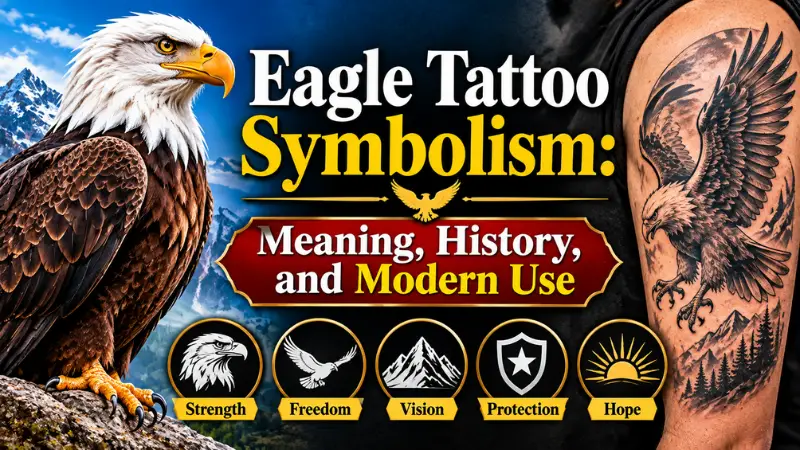
An eagle tattoo is often chosen to represent freedom, strength, courage, and independence. In American tattoo culture, eagle tattoo symbolism is particularly connected to patriotism, military service, personal resilience, and the desire to live without unnecessary limitations. The bird’s ability to soar high above the landscape makes it a natural image of ambition, perspective, and self-determination.
However, an eagle tattoo does not communicate the same message in every design. A bald eagle carrying an American flag has a different cultural meaning from an eagle with spread wings, an eagle clutching a snake, or a detailed eagle head. Its position, colors, accompanying objects, and the wearer’s personal experiences all influence its interpretation.
The eagle also has a long history in mythology, religion, national emblems, and military traditions. Understanding these connections helps explain why this bird remains such a recognizable choice in contemporary American tattoo art.
Quick Answer
Eagle tattoo symbolism commonly represents freedom, strength, courage, independence, and patriotism in modern American culture. Historically, eagles have also represented divine authority, military victory, spiritual elevation, and leadership, making them meaningful images of personal identity and national pride.
TL;DR
- Freedom: Represents independence, personal choice, and overcoming limitations.
- Strength: Communicates courage, determination, and the ability to face adversity.
- Patriotism: The bald eagle often expresses American identity and national pride.
- Military heritage: Can honor service, sacrifice, loyalty, and fallen comrades.
- Spiritual meaning: Connects with divine protection, vision, and higher perspective.
- Personal transformation: Can represent recovery, ambition, and a fresh beginning.
1. What Does an Eagle Represent in Tattoo Art?
The eagle is a large bird of prey recognized by its hooked beak, powerful talons, broad wings, and ability to fly at considerable heights. Its appearance alone suggests alertness, physical capability, and control of the surrounding environment.
In tattoo art, these physical characteristics become visual expressions of human qualities.
The most common interpretations include:
- Freedom and independence: Open wings suggest the ability to move beyond restrictions and make independent decisions.
- Strength and courage: The eagle’s hunting ability and commanding appearance represent confidence and resilience.
- Vision and wisdom: Its reputation for keen eyesight makes it a natural symbol of awareness, foresight, and clear judgment.
- Leadership and authority: Its prominent position in national emblems and military insignia connects it with responsibility and command.
- Protection and loyalty: An eagle can represent defending family, country, personal values, or people who depend on you.
Not every eagle tattoo carries all these meanings. Someone might choose the image to commemorate military service, while another person might associate it with overcoming a difficult period in life.
The bird’s posture often determines which interpretation becomes most noticeable.
2. Freedom and Independence: The Most Recognized Meaning
Freedom is among the strongest associations of an eagle tattoo, particularly in the United States.
An eagle flying across an open sky provides a straightforward visual representation of independence. Unlike a bird sitting on a branch or remaining inside a cage, an eagle in flight suggests movement, opportunity, and the ability to choose its own direction.
For tattoo owners, this meaning can represent several experiences:
- Leaving a restrictive environment.
- Becoming financially or emotionally independent.
- Starting a new chapter after a difficult relationship.
- Making personal decisions without seeking constant approval.
- Pursuing ambitions despite criticism or obstacles.
A flying eagle can also represent the desire to maintain personal identity during periods of change.
For example, someone who has rebuilt their life after addiction, a difficult career transition, or a major personal loss might choose an eagle to mark the beginning of a more independent future.
In this context, the tattoo is less about escaping responsibility and more about gaining control over one’s choices.
3. Strength, Courage, and Personal Resilience
An eagle tattoo can communicate strength without requiring an aggressive or threatening design.
Its physical characteristics contribute to this association. Powerful feet, sharp talons, a hooked beak, and controlled flight make the bird an effective predator. These features have encouraged people in different societies to associate eagles with bravery, military ability, and authority.
In contemporary tattoo culture, strength can have both physical and emotional meanings.
A person might choose an eagle to represent:
- Surviving a serious personal challenge.
- Standing up for family or personal beliefs.
- Recovering after a difficult experience.
- Developing confidence and self-respect.
- Remaining determined when circumstances become unfavorable.
An eagle diving toward its target can suggest decisiveness and determination. A perched eagle with an alert expression may communicate patience, discipline, and readiness.
There is also an important distinction between strength and aggression. Some people choose eagle tattoos to express the ability to protect others rather than the desire to dominate them.
That difference becomes particularly noticeable when the eagle appears alongside a shield, family name, or meaningful date.
4. The Historical Origins of Eagle Symbolism
The eagle became an important emblem in several ancient civilizations long before the United States adopted the bald eagle.
In ancient Greece, the bird was closely associated with Zeus, the chief deity of the Greek pantheon. Its ability to rise high into the sky connected it with divine authority and the realm of the gods.
Ancient Romans also used the eagle as an emblem of military and political power. The Roman legion’s aquila, or eagle standard, represented the identity and honor of a military unit. Losing such a standard was considered a serious disgrace.
These traditions helped establish the eagle as a recognizable image of authority, victory, and military loyalty.
Christian imagery later developed additional interpretations. The eagle became associated with St. John the Evangelist and, in some Christian traditions, with spiritual elevation and the relationship between earthly life and divine understanding.
In other words, the eagle’s symbolic meaning was never limited to physical strength. It also became an image of religious authority, higher vision, and spiritual aspiration.
These historical associations help explain why eagle designs remain common in military, patriotic, religious, and personal tattoos today.
5. What the Bald Eagle Means in American Culture
American National Symbol Bald Eagle with Wings Spread on Sunny Day Isolated by Sky
File:Great Seal of the United States (obverse).svg – Wikimedia Commons
6
The bald eagle has a particularly important place in American identity.
On June 20, 1782, the Second Continental Congress selected the bald eagle for the Great Seal of the United States. The choice came during the early years of American independence, when the new country needed recognizable national imagery.
The eagle appeared on the seal holding an olive branch in one talon and arrows in the other. These objects represented the country’s relationship with peace and military defense.
The bird subsequently became a familiar feature of American government, currency, military insignia, official documents, and public monuments.
An important modern development occurred in December 2024, when Congress formally designated the bald eagle as the national bird of the United States. Its national symbolic status had existed for more than two centuries, but this legislation gave it that specific official designation.
For Americans, an eagle tattoo can therefore express:
- Pride in the United States.
- Appreciation for American history.
- Respect for military service.
- Commitment to independence and constitutional ideals.
- Connection with national heritage.
However, an American eagle tattoo does not automatically indicate a particular political position. Some people choose it for cultural or family reasons, while others simply appreciate the bird’s appearance.
Its meaning depends on the complete design and the individual wearing it.
6. Military Service, Honor, and Sacrifice
American traditional eagle – Etsy België
The eagle has a long association with military identity, making it a familiar subject in American military tattoo art.
Its appearance on military insignia, unit emblems, official seals, and patriotic artwork has connected it with courage, discipline, duty, and national service.
The United States Navy also documents how patriotic tattoos developed among American sailors. By the late nineteenth century, designs featuring flags, slogans, and large eagles had become recognizable elements of military-inspired tattoo culture.
For some tattoo owners, an eagle represents:
Service: A personal connection to the armed forces or a military career.
Brotherhood: Loyalty to fellow service members and the relationships developed during service.
Sacrifice: Recognition of people who lost their lives while serving.
Honor: A commitment to duty, responsibility, and personal integrity.
Remembrance: A permanent tribute to a family member, friend, or fellow service member.
An eagle paired with military dog tags, dates, or a name banner can become a memorial tattoo. The bird may represent the qualities the wearer associates with the person being remembered.
It is worth remembering that military-inspired eagle tattoos are not restricted to veterans. Civilians may choose similar designs to honor relatives, military history, or a general appreciation for service.
7. Spiritual and Religious Interpretations
Eagles appear in several religious and spiritual traditions, although their meanings differ considerably.
In Christianity, the eagle can represent spiritual renewal, divine protection, and the ability to rise above earthly concerns. Biblical passages also use the eagle as an image of renewed strength and God’s care.
In Christian artistic tradition, the eagle is particularly associated with St. John the Evangelist. The connection reflects the spiritual elevation and theological character traditionally attributed to his Gospel.
Other traditions have their own interpretations.
In Hindu tradition, Garuda is a great mythical bird associated with Vishnu. Garuda is not simply another name for an ordinary eagle, but its birdlike form and association with flight have contributed to wider interpretations involving protection, divine service, and the struggle against harmful forces.
For some people, an eagle tattoo therefore represents:
- Faith and spiritual commitment.
- Protection during difficult circumstances.
- A connection with divine guidance.
- Personal renewal after hardship.
- The pursuit of wisdom and understanding.
A religious eagle tattoo may include a cross, rays of light, scripture, or other meaningful imagery.
The important consideration is that the religious message should come from the specific tradition or personal belief being represented rather than an assumption that every eagle has the same spiritual meaning.
8. Eagle Symbolism in Indigenous North American Traditions
Why Is the Bald Eagle America’s National Bird? – Proud & Free
Eagles hold important cultural and spiritual significance in numerous Indigenous North American communities.
However, there is no single Native American interpretation that applies to every tribe. Traditions differ across nations, regions, languages, and ceremonial practices.
In some communities, eagles are associated with prayer, spiritual communication, courage, wisdom, and relationships between human beings and the natural world. Eagle feathers can have ceremonial importance and may be presented or worn according to specific cultural protocols.
For example, some Pueblo traditions connect eagle feathers with prayer and ceremonial relationships with the natural world. Certain communities in the Pacific Northwest have also incorporated eagle imagery into artistic, ancestral, and ceremonial traditions.
These meanings should not be confused with the general American interpretation of the bald eagle as a national emblem.
There is also an important distinction between drawing an ordinary eagle and reproducing culturally specific ceremonial imagery.
A tattoo that incorporates tribal designs, sacred regalia, or eagle-feather headdresses may carry cultural implications beyond the bird itself. People considering such imagery should learn about its origins and avoid treating sacred traditions as generic decoration.
The cultural importance of eagle feathers is also recognized in federal policy. The U.S. Fish and Wildlife Service operates the National Eagle Repository, which provides eagle remains and feathers to eligible members of federally recognized tribes for religious and cultural purposes.
This history demonstrates that the eagle’s significance in North America extends far beyond its role in American patriotism.
9. What Different Eagle Tattoo Designs Symbolize
The design itself can change the message considerably. Two tattoos featuring the same bird may communicate completely different ideas depending on posture, surrounding objects, and artistic style.
Eagel head tattoo by Jacob Sheffield | Post 19684
775+ Usa Flag Tattoo Ideas – BlackInk AI
11
Here are some common interpretations:
| Eagle tattoo design | Common symbolic meaning | Personal association |
|---|---|---|
| Eagle with spread wings | Freedom and independence | Starting a new chapter |
| Flying eagle | Ambition and opportunity | Personal growth |
| Eagle head | Awareness and leadership | Confidence and judgment |
| Diving eagle | Courage and determination | Taking decisive action |
| Perched eagle | Patience and vigilance | Discipline and preparation |
| Eagle with American flag | Patriotism and national identity | Pride in American heritage |
| Eagle with a shield | Protection and responsibility | Defending family or values |
These interpretations are not fixed rules. A person might choose a particular design because it represents a memory, an important achievement, or a connection with someone they love.
The most meaningful design is often the one whose visual details match the owner’s intended message.
10. The Meaning of Eagle Tattoo Colors
Color influences how an eagle tattoo is perceived. Traditional designs often use bold colors, while contemporary tattoos may rely on black-and-gray shading or realistic details.
Different color choices can emphasize different aspects of the image.
Black and gray: Often creates a serious, classic appearance. It can emphasize strength, experience, remembrance, and realism.
Red, white, and blue: Connects the eagle with American patriotism, national identity, and military heritage.
Gold and yellow: Can suggest achievement, leadership, confidence, and distinction. These associations are artistic interpretations rather than universal color meanings.
White: May communicate peace, purity, spiritual renewal, or hope.
Dark or black eagle designs: Can create a more dramatic appearance and emphasize authority, mystery, or personal resilience.
Natural brown and white: Often emphasizes the actual appearance of the bald eagle, creating a connection with wildlife, nature, and American heritage.
Color is only one part of the overall message. A realistic black-and-gray eagle can be patriotic, while a colorful eagle can represent a completely personal experience.
11. Eagle Tattoos Combined With Other Symbols
Eagles are frequently combined with other images to create a more specific personal statement.
The additional symbols help explain what the wearer wants the tattoo to communicate.
Some common combinations include:
- Eagle and American flag: Represents national pride, independence, and appreciation for American heritage.
- Eagle and clock: Can symbolize the importance of time, a significant life event, or remembering someone who has passed away.
- Eagle and rose: Combines strength with love, affection, beauty, or remembrance.
- Eagle and cross: Connects courage and protection with Christian faith.
- Eagle and skull: Can represent mortality, survival, courage in the face of danger, or acceptance of life’s uncertainty.
- Eagle and shield: Emphasizes protection, responsibility, loyalty, and defense.
- Eagle and mountains: Suggests ambition, endurance, freedom, and overcoming obstacles.
- Eagle and snake: Can represent conflict, victory, and opposing forces, but its cultural meaning depends heavily on the composition.
One particularly important combination is the eagle with a snake and cactus.
In Mexican national imagery, this composition represents the Mexica tradition associated with the founding of Tenochtitlan, the city that became present-day Mexico City. It is not simply a generic image of an eagle defeating an enemy. The eagle, serpent, and nopal cactus together have a specific historical and national meaning.
For someone choosing a combined tattoo, understanding the origin of each element prevents an unintended message.
12. Eagle Tattoo Styles and Their Visual Messages
The artistic style influences the personality of an eagle tattoo just as much as its subject.
Different approaches appeal to different preferences.
American traditional: Uses strong outlines, limited colors, and recognizable shapes. This style connects particularly well with classic sailor tattoos and patriotic imagery.
Realistic: Focuses on accurate feathers, facial details, and natural proportions. It often emphasizes respect for wildlife, strength, and the bird’s physical beauty.
Blackwork: Uses solid black areas and bold contrast. It creates a striking image that can communicate determination and authority.
Geometric: Incorporates lines, shapes, and symmetrical patterns. Some people choose it to represent balance, discipline, and a structured approach to life.
Minimalist: Uses simple outlines or a small silhouette. It can express independence or personal freedom without requiring a large, elaborate tattoo.
Tribal-inspired: Uses decorative patterns and strong visual shapes. Because specific Indigenous and other cultural tattoo traditions have their own histories, this style should not be treated as a collection of interchangeable patterns.
The right style depends on the intended message, personal taste, and the artist’s ability to execute the design properly.
13. Emotional and Psychological Meaning of an Eagle Tattoo
An eagle tattoo can serve as a personal reminder of qualities someone wants to maintain throughout life.
Psychologically, people often use meaningful images to connect their current identity with important experiences, relationships, and future goals.
For one person, an eagle might represent the courage needed to leave an unhealthy situation. For another, it might commemorate military service or a family member who taught them to be independent.
The bird can also express a particular attitude toward challenges.
A person who chooses an eagle in flight may identify with progress and opportunity. Someone who prefers a watchful, perched eagle might value preparation, awareness, and patience.
There are several emotional reasons people choose this tattoo:
A reminder of survival: The image represents getting through a difficult period without abandoning personal values.
A symbol of confidence: It reminds the wearer to trust their abilities and decisions.
A connection to family: The eagle can represent protecting loved ones and accepting responsibility.
A memorial: It provides a lasting tribute to someone whose strength or character influenced the wearer.
A statement of identity: It communicates independence, ambition, patriotism, or personal beliefs.
There is no psychological rule that assigns one fixed meaning to an eagle tattoo. Its emotional importance comes primarily from the personal experience attached to it.
14. Controversies, Misunderstandings, and Misuse of Eagle Imagery
Although the eagle is widely recognized as a positive symbol, its use has not always been associated with freedom, courage, or national pride.
Historically, European empires and political regimes also used eagles to communicate authority, conquest, and military dominance.
Some Nazi-era German emblems incorporated a distinctive heraldic eagle alongside a swastika. Modern extremist groups have also adopted modified versions of this imagery.
However, an ordinary eagle tattoo should not automatically be interpreted as extremist. Eagles appear in national flags, government seals, military insignia, sports logos, and traditional artwork across many countries.
The surrounding details matter.
A recognizable Nazi-era design, associated symbols, slogans, and political context can give an eagle image a very different meaning from a conventional bald eagle tattoo.
There are other misunderstandings worth considering:
Assuming every eagle tattoo is patriotic: Some represent personal freedom, nature, spirituality, or family rather than the United States.
Treating all Indigenous eagle imagery as interchangeable: Different Indigenous nations have distinct cultural traditions, and sacred ceremonial designs should not be separated from their original context.
Assuming an eagle always represents aggression: The bird can also symbolize peace, spiritual guidance, protection, and patience.
Confusing national symbols: The American bald eagle and the eagle featured in Mexico’s national coat of arms have different cultural and historical associations.
A thoughtful interpretation considers the complete artwork rather than judging the tattoo by the bird alone.
15. How Eagle Symbolism Has Changed in Modern American Culture
The eagle’s meaning has expanded considerably over time.
In ancient Greek and Roman traditions, it was closely associated with divine authority, military success, and political power. In Christian art, it gained associations with spiritual elevation and renewal.
In North America, Indigenous communities developed their own distinct relationships with eagles, including ceremonial and spiritual traditions.
The American Revolution introduced another major development. The bald eagle became a national emblem representing the newly independent United States.
During the nineteenth and twentieth centuries, eagle imagery became increasingly familiar in American government, military culture, patriotic artwork, and sailor tattoos.
Today, its meaning is more personal and varied.
Someone might choose an eagle because of national pride, while another person might associate it with recovering from adversity or pursuing a personal ambition. Others simply admire the bird’s appearance and want a detailed wildlife-inspired tattoo.
| Historical or modern context | Main symbolic association | How it is understood today |
|---|---|---|
| Ancient Greece and Rome | Divine authority and military power | Leadership and historical strength |
| Christian tradition | Spiritual elevation and renewal | Faith and divine guidance |
| Indigenous North American traditions | Distinct spiritual and ceremonial meanings | Cultural heritage and religious significance |
| American national identity | Independence and national sovereignty | Patriotism and American heritage |
| Military tattoo culture | Honor, courage, and service | Commemoration and loyalty |
| Contemporary tattoo culture | Freedom and personal resilience | Individual identity and life experiences |
The central idea has not disappeared, but its application has become more individual. Modern tattoo owners can use the eagle to express a personal story without necessarily referring to its original political or religious associations.
FAQs
1. What does an eagle tattoo mean for a man?
An eagle tattoo for a man commonly represents strength, courage, independence, leadership, and confidence. However, these meanings are not exclusive to men; people of any gender can choose an eagle to express the same qualities.
2. Does an eagle tattoo symbolize freedom?
Yes. Freedom is one of the most widely recognized meanings of an eagle tattoo, especially when the bird is shown flying with its wings spread. The design can represent independence, personal choice, and the ability to overcome restrictions.
3. What does a bald eagle tattoo mean?
A bald eagle tattoo often represents American patriotism, national identity, courage, and independence. It can also honor military service, family heritage, or appreciation for the country’s history.
4. What does an eagle tattoo mean spiritually?
Spiritually, an eagle tattoo can represent divine guidance, protection, wisdom, renewal, and a higher perspective. Its specific religious interpretation depends on the tradition, beliefs, and accompanying imagery.
5. Is an eagle tattoo a positive or negative symbol?
An eagle tattoo is generally interpreted positively, with associations such as freedom, strength, courage, and protection. However, certain political or extremist variations of eagle imagery can carry negative associations depending on their specific design and context.
6. What does an eagle tattoo with spread wings symbolize?
An eagle with spread wings commonly represents freedom, independence, ambition, and openness to new opportunities. It can also communicate confidence and a willingness to move forward after difficult experiences.
7. What does an eagle tattoo with a snake symbolize?
An eagle holding or fighting a snake can represent conflict, victory, and the relationship between opposing forces. When the design includes a cactus and follows the Mexican national emblem, it also carries a specific connection to Mexica history and the founding of Tenochtitlan.
Conclusion
An eagle tattoo can represent freedom, strength, courage, independence, patriotism, and personal resilience. Its historical connections with ancient mythology, religious traditions, military identity, and American national heritage give it several layers of meaning.
In the United States, eagle tattoo symbolism is particularly associated with the bald eagle and the ideals of independence, national pride, and personal responsibility. However, its meaning is not limited to patriotism. For many people, it represents overcoming hardship, protecting loved ones, honoring someone important, or having the confidence to pursue a different future.
Ultimately, the most meaningful eagle tattoo is one that reflects the wearer’s own experiences and values. Whether shown soaring through the sky, watching from a mountain, or carrying an American flag, the eagle remains a recognizable expression of freedom and determination.