
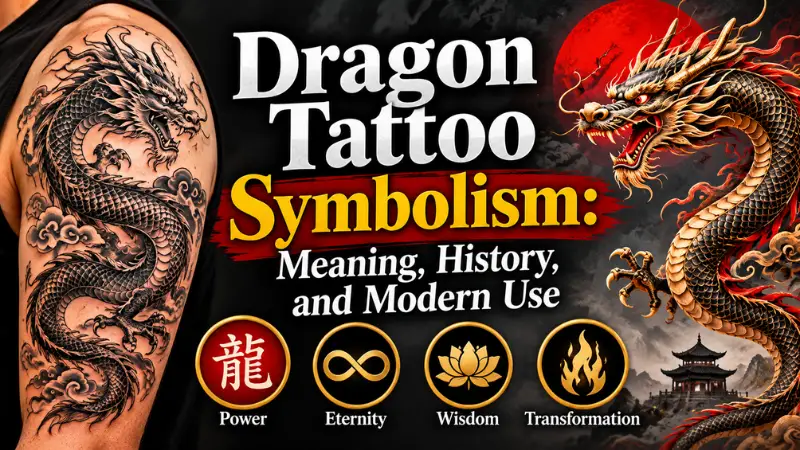
A dragon tattoo can represent strength, wisdom, protection, independence, and the ability to overcome difficult challenges. However, dragon tattoo symbolism depends heavily on the cultural tradition, artistic style, and personal story behind the design. A Chinese dragon, for example, traditionally represents prosperity and auspicious power, while a European dragon may suggest danger, courage, or an untamed force.
In the United States, dragon tattoos appeal to people for several reasons. Some appreciate their association with ancient mythology and cultural heritage. Others choose them to express resilience, personal transformation, confidence, or a determination to live independently.
The design itself also matters. A dragon surrounded by clouds and water communicates something different from a winged creature breathing fire or guarding a treasure. Understanding these differences makes it easier to interpret the tattoo without assuming that every dragon carries the same message.
Quick Answer: What Does a Dragon Tattoo Symbolize?
Dragon tattoos commonly symbolize strength, wisdom, protection, courage, and independence in modern American tattoo culture. Historically, East Asian dragons were associated with water, prosperity, good fortune, and benevolent authority, while many European traditions portrayed dragons as dangerous creatures representing chaos, temptation, or challenges overcome.
TL;DR: Key Meanings of Dragon Tattoos
- Strength: Represents physical power, determination, and personal confidence.
- Protection: Reflects guardianship and the desire to overcome danger.
- Wisdom: Connects with knowledge, experience, and thoughtful leadership.
- Good fortune: Draws on traditional Chinese dragon symbolism.
- Transformation: Represents personal growth and overcoming difficult experiences.
- Independence: Expresses freedom, individuality, and resistance to control.
1. What Does a Dragon Tattoo Represent?
A dragon tattoo is a visual statement that can communicate several ideas simultaneously. Its meaning usually comes from the creature’s appearance, cultural background, and relationship with other elements in the design.
For many Americans, the dragon represents strength that comes with responsibility. It is not simply a creature that can overpower others. In several Asian traditions, its authority is connected with wisdom, balance, and control over natural forces.
The most common interpretations include:
Strength and authority: A large dragon with an imposing posture can represent confidence, leadership, and the ability to face difficult situations.
Protection and guardianship: A dragon wrapped around a person’s arm or positioned over the back can suggest a guardian watching over the wearer.
Wisdom and experience: Traditional East Asian dragons are often associated with intelligence and an understanding of the natural world.
Freedom and independence: A dragon flying through an open sky can represent an individual who values personal freedom and refuses to be restricted by expectations.
Personal transformation: A dragon rising through clouds or emerging from flames may represent a new beginning after a difficult period.
These meanings are not universal rules. Someone might choose a dragon simply because they admire its appearance, mythology, or artistic detail.
2. Ancient Origins of Dragon Symbolism
Dragons appear in the mythology and folklore of many societies, but their origins are not connected to one universally accepted historical creature.
In ancient China, dragon imagery developed over thousands of years. Archaeological objects and early artistic representations show that dragon-like creatures were already important in Chinese culture long before modern tattooing became popular.
Chinese dragons were associated with rain, rivers, clouds, and other natural forces. Because agriculture depended heavily on rainfall, the dragon became connected with fertility, prosperity, and the well-being of communities.
The creature also acquired political importance. Chinese rulers used dragon imagery to communicate authority and legitimacy. During imperial periods, particular dragon designs became closely associated with the emperor and the royal court.
European dragon traditions developed differently. Stories from ancient Near Eastern and Mediterranean cultures often connected dragon-like creatures with danger, disorder, or forces that threatened human communities.
These contrasting histories explain why a dragon tattoo can communicate either benevolent protection or formidable danger, depending on its artistic tradition.
3. Chinese Dragon Tattoo Symbolism
The Chinese dragon, commonly called lóng, is traditionally a symbol of prosperity, wisdom, good fortune, and authority.
Unlike the frightening, fire-breathing creature familiar from many Western movies, the traditional Chinese dragon is generally a benevolent supernatural being. It is associated with rivers, lakes, rain, and clouds, making it an important figure in agricultural and spiritual traditions.
Several features give Chinese dragon tattoos their distinctive meanings:
- The dragon and pearl: A dragon pursuing a flaming pearl can represent wisdom, enlightenment, and the pursuit of knowledge.
- The five-clawed dragon: Historically associated with imperial authority and the highest levels of the Chinese court.
- The dragon and clouds: Suggest control over weather, rain, and natural forces.
- The dragon and water: Represent prosperity, life, fertility, and protection.
In Chinese culture, dragon imagery also became an expression of cultural identity. The association between dragons and imperial authority explains why these creatures appear on historical clothing, palace decorations, and ceremonial objects.
For someone choosing this style of tattoo, the design may communicate respect for Chinese heritage, ambition, good fortune, or an appreciation of traditional mythology. However, the five-clawed imperial dragon has a particularly specific historical association and should not be confused with a generic decorative dragon. National Museum of Asian Art+1
4. Japanese Dragon Tattoo Symbolism
Japanese dragon tattoos have a distinct visual identity and cultural background. The Japanese dragon is called ryū or tatsu and is closely connected with water, rain, the sea, and protection.
In Japanese mythology, dragons can be associated with water deities and supernatural guardians. Their ability to influence rain and storms made them important in communities that depended on agriculture and fishing.
Traditional Japanese tattoo art, known as irezumi, frequently features dragons surrounded by waves, clouds, wind, and other natural elements.
50+ Meaningful Traditional Japanese Dragon Tattoos Ideas
Ukiyo-e & Kabuki: Origins of the Irezumi Japanese Tattoo Style
Irezumi Tattoo: Ideas, Meaning and Design
12
Common interpretations include:
- Wisdom: The dragon represents knowledge and understanding.
- Protection: It can serve as a symbolic guardian against danger.
- Water and nature: Its connection with rain and rivers represents the forces that sustain life.
- Courage: Its imposing appearance communicates confidence and determination.
- Balance: Its relationship with natural elements can suggest harmony rather than domination.
An interesting historical connection comes from Edo-period Japan. Firefighters, known as hikeshi, sometimes wore dragon tattoos associated with water deities. Because water was essential in fighting fires, the imagery carried protective significance.
Japanese dragon tattoos became especially recognizable through the development of traditional tattoo art and illustrated stories. The dragon remains one of the best-known subjects in Japanese-inspired tattooing today. vmfa.museum+1
5. Western Dragon Tattoo Symbolism
Western dragon tattoos often communicate a different message from Chinese and Japanese designs.
In European mythology and medieval storytelling, dragons frequently appeared as dangerous creatures that threatened communities, guarded treasures, or challenged heroic figures.
In Christian imagery, the dragon could represent evil, temptation, or the forces opposing goodness. The biblical Book of Revelation, for example, uses a dragon as an image of Satan and opposition to divine authority.
However, European dragon symbolism is not entirely negative. Some stories portray dragons as guardians of valuable possessions, while modern fantasy literature and entertainment frequently depict them as intelligent, independent, and honorable creatures.
209+ European Dragon Tattoo Ideas in 2026 – BlackInk AI
10
A Western-style dragon tattoo may therefore represent:
- Fearlessness in the face of danger.
- The ability to confront personal challenges.
- Independence and resistance to control.
- Protection of family, personal values, or possessions.
- Acceptance of one’s complicated or rebellious nature.
A dragon shown fighting a knight or being defeated can suggest overcoming an obstacle. A dragon standing proudly with open wings may communicate personal strength rather than evil.
The surrounding imagery is important because it helps establish whether the dragon represents a threat, a guardian, or a challenge that has already been conquered.
6. What Dragon Tattoos Mean in American Culture
In the United States, dragon tattoos bring together several cultural influences, including Asian mythology, European folklore, military traditions, fantasy entertainment, and contemporary tattoo artistry.
There is no single American interpretation. The meaning often depends on the wearer’s background and the design they choose.
One particularly interesting American connection comes from naval history.
During the period before World War II, Chinese-style dragon tattoos became associated with American sailors serving in the U.S. Navy’s Asiatic Fleet. These tattoos could represent service in China and were connected with luck and strength. Later, the motif also became associated with service in the western Pacific.
This gives dragon tattoos a specific place in American military and maritime tattoo history, beyond their general association with strength and courage. Naval History and Heritage Command
Today, Americans may choose dragon tattoos to express:
- Personal independence and individuality.
- Pride in family or cultural heritage.
- Strength after difficult experiences.
- Interest in Asian art and mythology.
- Appreciation for fantasy, gaming, and popular culture.
- A connection with military or maritime history.
Dragon tattoos are also common in American tattoo conventions, custom tattoo studios, and large-scale sleeve designs.
For some people, the tattoo is an expression of identity. For others, it is simply an artistic choice that combines detailed scales, flowing movement, dramatic color, and recognizable mythology.
7. Different Dragon Tattoo Designs and Their Meanings
The dragon’s appearance can change the impression a tattoo creates. Its posture, movement, facial expression, and surrounding elements all contribute to its interpretation.
Traditional red Chinese Dragon
ปักพินโดย StreetPix ใน Tattoo Ideas 2026 | รอยสักมังกร, ภาพมังกร, รอยสัก
8
Here are some popular designs and their common interpretations:
| Dragon tattoo design | Common symbolic meaning | Visual message |
|---|---|---|
| Flying dragon | Freedom, ambition, transformation | Rising above limitations |
| Coiled dragon | Protection, readiness, control | Strength held in reserve |
| Fire-breathing dragon | Courage, intensity, power | Confronting challenges |
| Water dragon | Wisdom, adaptability, balance | Working with natural forces |
| Dragon and phoenix | Harmony, renewal, complementary forces | Balance between opposites |
| Dragon and tiger | Strength, opposing forces, balance | Two forms of power |
These interpretations are common artistic associations rather than fixed cultural definitions. A particular composition may have a more specific meaning depending on its historical source.
8. Dragon Tattoo Colors and Their Symbolic Meanings
Color can influence the emotional character of a dragon tattoo. Traditional cultural associations and modern color preferences both play a role.
Traditional red Chinese Dragon
Exploring Black and Grey Japanese Tattoos: Irezumi Tradition | Burned Hearts Tattoo
12
Red dragon: Red is associated with celebration, vitality, and good fortune in many Chinese cultural contexts. In contemporary tattoo art, it can also communicate passion, confidence, and intensity.
Black dragon: Black and gray designs often emphasize authority, seriousness, mystery, and visual strength. Their meaning depends heavily on the artwork rather than color alone.
Blue dragon: Blue is frequently used to suggest water, calmness, depth, and adaptability. It works particularly well in designs featuring waves and clouds.
Green dragon: Green can communicate growth, nature, renewal, and harmony. It is a natural choice for a dragon surrounded by forests or vegetation.
Gold dragon: Gold is associated with wealth, prosperity, prestige, and success. In Chinese-inspired designs, it can reinforce the dragon’s traditional association with authority and good fortune.
These are interpretive associations, not universal color codes. A tattoo’s cultural tradition should take priority over assumptions based on color psychology.
9. Emotional and Psychological Meaning of a Dragon Tattoo
People often select tattoos because they want a permanent visual reminder of an experience, belief, or personal goal.
A dragon can represent a person who has learned to manage difficult circumstances without allowing those experiences to define their entire identity.
For example, someone who has recovered from a major setback might choose a dragon rising through clouds to represent progress and renewed confidence.
Another person might select a dragon protecting a pearl as a reminder that knowledge, patience, and personal values are worth defending.
Several emotional interpretations are especially common:
Resilience: The dragon becomes a reminder to continue despite difficulties.
Self-confidence: Its commanding appearance can express confidence in one’s abilities.
Personal freedom: A dragon in flight can represent the desire to make independent decisions.
Self-control: A calm dragon can suggest that real strength involves discipline rather than aggression.
Personal identity: A culturally meaningful dragon design can reflect family history, heritage, or an important personal connection.
The tattoo does not automatically reveal someone’s personality. It communicates a possible message, while the wearer’s own explanation provides the most reliable interpretation.
10. Dragon Tattoos and Personal Transformation
Transformation is another common modern interpretation of dragon imagery.
Dragons frequently appear in stories involving dramatic change, difficult journeys, and the acquisition of wisdom. This makes them suitable symbols for people who associate their lives with overcoming obstacles.
A rising dragon can represent moving forward after a difficult period. A dragon emerging from flames might suggest rebuilding one’s life after loss or disappointment.
Some people also choose dragon tattoos to commemorate:
- Completing a difficult personal journey.
- Recovering from a major life setback.
- Starting a new career or chapter.
- Becoming more confident and independent.
- Learning to manage anger, fear, or uncertainty.
The transformation meaning is particularly personal. It does not belong exclusively to one ancient culture; it is a modern interpretation shaped by storytelling, individual experience, and contemporary tattoo culture.
11. Religious and Spiritual Interpretations
Dragons appear in several religious and spiritual traditions, but their meanings vary considerably.
In Chinese religious and philosophical traditions, dragons can be associated with water, weather, prosperity, and cosmic order. They also appear in Buddhist, Taoist, and other forms of religious art.
In Japanese Buddhism, dragons are connected with protective deities and water-related traditions. Some are associated with safeguarding Buddhist teachings.
In European Christian imagery, the dragon can represent evil or opposition to divine authority. The image of Saint Michael defeating a dragon is one example of this interpretation.
In Hindu and Buddhist traditions, nāgas are serpent-like supernatural beings associated with water, protection, and sacred places. They are related to broader serpent mythology but should not automatically be treated as interchangeable with Chinese or Japanese dragons.
For Americans considering a spiritually inspired dragon tattoo, it is worth understanding the particular religious tradition before choosing its imagery. A design connected with a sacred figure or religious narrative may communicate something more specific than a general symbol of strength.
12. Dragon Tattoos in Modern Fashion and Popular Culture
Dragon tattoos have become recognizable across several forms of American entertainment and personal style.
Fantasy films, television series, video games, comic books, and novels have introduced audiences to dragons with different personalities and abilities.
Some modern fictional dragons are frightening creatures. Others are intelligent companions, protectors, teachers, or symbols of freedom.
This variety has influenced contemporary tattoo choices.
Fine line dragon tattoo on the forearm.
Pin by Ethan Scott on Epic viral | Dragon tattoo designs, Dragon tattoo, Dragon tattoo realistic
12 Awesomely Iconic American Traditional Tattoos For Men
9
Popular modern approaches include:
- Traditional tattoos: Bold outlines and strong colors inspired by classic tattoo flash.
- Japanese-inspired tattoos: Flowing dragons combined with waves, flowers, and clouds.
- Realistic tattoos: Detailed scales, claws, eyes, and dramatic lighting.
- Minimalist tattoos: Simple outlines or small dragon silhouettes.
- Geometric tattoos: Dragons constructed from shapes, patterns, and symmetrical forms.
- Blackwork tattoos: Dark, high-contrast designs emphasizing the creature’s structure.
Social media has also made it easier for tattoo enthusiasts to discover different dragon styles and compare artistic approaches.
The modern dragon tattoo is therefore both a cultural symbol and a form of visual self-expression.
13. Dragon Tattoo Placement and Its Meaning
The location of a dragon tattoo can influence how people interpret its design, although placement does not have one universally accepted symbolic meaning.
Some people choose a visible location because they want the tattoo to express their identity openly. Others prefer a private location because the design represents a personal experience.
Tattoo uploaded by Joe • Tattoodo
Tattoo uploaded by Rebecca • Tattoodo
Ý nghĩa độc đáo của hình xăm rồng đẹp nhất
9
Common placements include:
- Back: A large dragon across the back can communicate protection, strength, and ambition. It also provides enough space for traditional Japanese compositions.
- Arm: A dragon sleeve can represent confidence, individuality, and personal identity.
- Chest: A dragon across the chest may symbolize courage, loyalty, or protection of personal values.
- Shoulder: This placement often emphasizes strength and readiness.
- Leg: A dragon extending along the leg can suggest movement, endurance, and progress.
- Wrist: A small dragon can serve as a personal reminder of resilience or independence.
In Japanese-inspired tattooing, placement also affects how the entire composition works with the body’s shape. An experienced artist considers the movement of the dragon, its surrounding elements, and how the design follows the muscles.
Ultimately, the most meaningful placement is one that suits the wearer’s intention and preferred artistic style.
14. Cultural Sensitivity and Common Misunderstandings
Dragon tattoos are popular internationally, but their cultural backgrounds deserve attention.
One common misunderstanding is that all Asian dragons represent exactly the same things. Chinese, Japanese, Korean, and other East Asian traditions have related imagery, but their stories, artistic conventions, and religious associations are not identical.
Another misconception is that every dragon represents evil. This interpretation comes largely from particular Western religious and literary traditions. It does not accurately describe the traditional Chinese dragon, which is frequently benevolent and associated with prosperity.
Cultural appropriation is another subject worth considering.
Getting a dragon tattoo inspired by another culture is not automatically disrespectful. However, problems can arise when someone uses sacred imagery without understanding it, combines unrelated religious symbols carelessly, or presents a culture’s traditions as meaningless decoration.
Before choosing a culturally specific design, consider the following:
- Identify whether the design is Chinese, Japanese, European, or inspired by another tradition.
- Learn the meaning of accompanying symbols, characters, and religious elements.
- Work with an artist who understands the style being requested.
- Avoid using unfamiliar writing simply because it looks attractive.
- Respect sacred imagery and its cultural significance.
The goal is not to discourage people from appreciating art from other cultures. It is to encourage informed choices that recognize the history behind the imagery.
15. How Dragon Tattoo Symbolism Has Evolved
The meaning of dragon tattoos has changed as dragon imagery has moved between cultures, artistic traditions, and generations.
In ancient Chinese society, dragons were associated with natural forces, prosperity, and political authority. In Japan, they became prominent in religious imagery, folklore, and traditional body art.
In medieval Europe, dragons frequently appeared as adversaries in religious and heroic stories. Their association with danger and destruction influenced Western fantasy art for generations.
American tattoo culture introduced another layer of meaning. Sailors adopted Chinese and Japanese dragon imagery, sometimes connecting it with overseas service, luck, and strength. During the twentieth century, Asian-inspired designs became increasingly recognizable within Western tattoo artistry.
Today, the dragon can represent many things at once:
- Cultural appreciation and heritage.
- Strength and personal independence.
- Spiritual beliefs and traditional mythology.
- Creativity and fantasy interests.
- Protection and personal transformation.
This evolution demonstrates why a modern tattoo should not be interpreted using only one historical definition. The wearer, the artistic tradition, and the surrounding imagery all contribute to its meaning.
FAQs
1. Is a dragon tattoo a good or bad symbol?
A dragon tattoo is generally considered a positive symbol when it represents strength, protection, wisdom, or good fortune. However, some European traditions associate dragons with evil, danger, and destructive forces, so the interpretation depends on the design’s cultural background.
2. What does a dragon tattoo mean for a woman?
For a woman, a dragon tattoo can represent independence, confidence, courage, wisdom, and personal freedom. These meanings are not gender-specific, and anyone can choose a dragon to express the qualities that matter to them.
3. What does a Japanese dragon tattoo symbolize?
A Japanese dragon tattoo commonly symbolizes wisdom, protection, strength, and a connection with water and natural forces. Traditional designs often include waves and clouds to emphasize the dragon’s relationship with rain, rivers, and the sea.
4. What does a Chinese dragon tattoo represent?
A Chinese dragon tattoo traditionally represents prosperity, good fortune, wisdom, authority, and control over natural forces. It may also express cultural pride or appreciation for Chinese mythology and history.
5. What does a black dragon tattoo mean?
A black dragon tattoo can suggest authority, resilience, mystery, discipline, and inner strength. These are modern artistic interpretations rather than fixed meanings established across every dragon tradition.
6. What does a dragon tattoo symbolize in Christianity?
In Christian symbolism, the dragon can represent Satan, evil, temptation, and opposition to divine authority, particularly in the imagery of Revelation. A dragon tattoo inspired by this tradition may communicate the struggle against evil or the triumph of faith over destructive forces.
7. Does a dragon tattoo represent protection?
Yes, protection is a common interpretation, particularly in Chinese and Japanese dragon traditions. Some historical Japanese firefighters also associated dragon imagery with water deities and protection from fire.
Conclusion
Dragon tattoos carry a wide range of meanings, including strength, eagle-tattoo-symbolismhttps://en.wikipedia.org/wiki/Double-headed_eagle, protection, courage, independence, and personal transformation. Their historical interpretations differ across cultures: Chinese and Japanese dragons are often associated with prosperity, natural balance, and guardianship, while European dragons frequently represent danger, conflict, and challenges overcome.
In modern American tattoo culture, dragon tattoo symbolism brings these traditions together with personal identity, artistic expression, and individual experiences. A person might choose a traditional Asian dragon to appreciate its cultural history, a Western fire-breathing dragon to express courage, or a minimalist design as a reminder of personal growth.
Ultimately, a dragon tattoo means most when its design reflects something the wearer genuinely values. Understanding its cultural background makes that choice more informed and gives the artwork meaning beyond its appearance.


