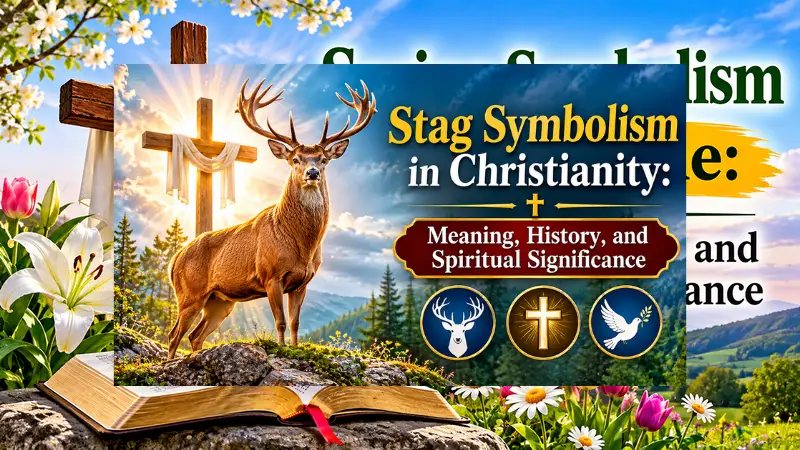
The stag has an important place in Christian symbolism, where it is commonly associated with spiritual longing, faith, purity, renewal, and the soul’s relationship with God. Often depicted as a graceful deer with large branching antlers, the animal appears in biblical imagery, early Christian art, medieval religious stories, and traditional representations of saints. Stag symbolism in Christianity is especially meaningful because it connects the natural behavior of deer with the spiritual journey of believers.
One of the most recognizable Christian images is a stag standing near water, recalling the opening words of Psalm 42, which compare the soul’s desire for God to a deer’s thirst for flowing water. Another familiar image shows a stag carrying a cross between its antlers, a motif associated with the conversion stories of Saint Eustace and Saint Hubert.
These images developed across different periods of Christian history. Understanding their origins helps explain why the stag continues to appear in church decorations, religious paintings, Christian jewelry, and personal artwork.
Quick Answer: What Does the Stag Symbolize in Christianity?
Stag symbolism in Christianity commonly represents spiritual longing, devotion to God, purity, and the desire for spiritual renewal. Historically, the stag also became associated with Christ, conversion, victory over sin, and divine guidance through biblical imagery and medieval legends involving saints.
TL;DR
- Spiritual longing: The thirsty stag represents the soul searching for God.
- Purity: Its graceful appearance became associated with innocence and spiritual devotion.
- Renewal: Traditional Christian interpretations connect deer with restoration and new spiritual life.
- Divine guidance: The stag carrying a cross represents conversion and an encounter with Christ.
- Victory over sin: Medieval Christian writers associated deer with overcoming spiritual temptation.
- Modern meaning: Christian stag imagery communicates faith, hope, transformation, and devotion.
1. What Is a Stag in Christian Symbolism?
A stag is an adult male deer, recognized by its branching antlers, strong body, and distinctive appearance. In Christian artwork, it is frequently represented standing in a forest, drinking from a stream, looking toward a cross, or appearing in a peaceful landscape.
The stag is not simply an attractive natural subject in religious art. Its physical characteristics helped artists communicate spiritual ideas.
For example, its antlers grow again after being shed. This natural process made the animal a useful image of renewal and the continuation of life. Its thirst for water also provided an understandable comparison for the human desire to find spiritual nourishment.
Christian imagery sometimes distinguishes between a stag, a hart, and a hind. A hart traditionally refers to a male deer, while a hind refers to a female deer. Although these terms can describe different animals, their symbolic interpretations sometimes overlap.
The stag’s meaning depends heavily on its surroundings. A deer drinking from a stream may represent spiritual devotion, while one carrying a crucifix points toward a particular Christian legend.
2. The Biblical Meaning of the Stag
One of the strongest biblical connections between deer and Christian spirituality appears in Psalm 42:1.
The verse compares a thirsty deer searching for water with the human soul longing for God.
This comparison gives the stag an important spiritual meaning: sincere believers desire a relationship with God just as a thirsty animal needs water to survive.
The image is effective because water is essential to physical life. In the same way, Christian teaching presents a relationship with God as essential to spiritual life.
The biblical image can communicate several related ideas:
- Faith: A believer actively seeks God’s presence.
- Devotion: Spiritual longing involves a continuing relationship with God.
- Dependence: Human beings need spiritual nourishment.
- Hope: The search for water suggests that fulfillment is possible.
Other biblical passages mention deer in connection with strength, movement, and stability. Psalm 18:33, for example, compares the speaker’s feet to those of a deer, emphasizing the ability to stand securely in difficult places.
Habakkuk 3:19 uses similar imagery to describe strength and confidence during hardship.
These passages do not establish a universal Christian meaning for every depiction of a stag. Instead, they provide several biblical associations that later Christian artists and writers developed.
3. Psalm 42 and the Stag’s Thirst for God
Psalm 42 is particularly important when understanding the stag’s religious significance.
Its opening image describes a deer longing for flowing water. The comparison communicates a spiritual desire that is both urgent and necessary.
The psalm itself expresses longing for God’s presence during a period of emotional difficulty. Its speaker remembers worship and struggles with feelings of distance and sorrow.
The deer therefore represents more than ordinary religious enthusiasm. It can symbolize a person who continues seeking God even when life feels uncertain.
In Christian interpretation, the flowing water can also suggest spiritual nourishment, divine grace, and the life-giving character of God’s presence.
This imagery became especially relevant in early Christian worship.
Deer appeared in early Christian decorative programs, including baptistery imagery, where water and spiritual renewal were closely connected. Their presence near fountains or streams helped communicate the relationship between faith, baptism, and new life.
For this reason, a stag drinking from water remains one of the clearest visual representations of spiritual longing in Christian art.
4. The Stag as a Symbol of Purity and Holiness
The stag is frequently associated with purity, innocence, and spiritual discipline in Christian-inspired artwork.
Its calm posture and graceful appearance make it suitable for representing qualities that Christians traditionally connect with holiness.
However, this association should be understood as an artistic and devotional interpretation rather than a direct biblical statement that all deer represent purity.
In religious paintings, a stag standing peacefully in a natural setting may communicate a life oriented toward goodness rather than temptation.
The animal can also represent the desire to live with a clear conscience and maintain spiritual discipline.
White stags became especially recognizable in medieval European imagery. Their unusual color helped artists communicate ideas of purity, exceptional virtue, and spiritual distinction.
In some medieval traditions, the white hart also carried royal and heraldic associations. Its meaning was therefore not exclusively religious.
For modern Christian audiences, a white stag can suggest innocence, peace, and a desire to live according to Christian values.
5. The Stag and the Story of Saint Eustace
One of the most recognizable appearances of the stag in Christian tradition comes from the legend of Saint Eustace.
According to the traditional account, Eustace was originally a Roman military officer named Placidus. Although he had not yet become a Christian, he was known for his generosity and good character.
One day, while hunting, he encountered an unusually impressive stag. When he looked toward the animal, he saw a miraculous vision of Christ appearing between its antlers.
The vision changed his life.
The encounter led Placidus to embrace Christianity and take the name Eustace. His story became an important example of unexpected conversion and divine intervention.
The stag consequently became associated with:
- Conversion to Christianity.
- Recognition of Christ.
- Divine revelation.
- Spiritual transformation.
- The unexpected arrival of faith.
The image of a crucifix between the stag’s antlers became a distinctive artistic representation of this story.
Renaissance artists, including Albrecht Dürer, depicted the encounter in celebrated works of religious art.
For Christians, this particular stag image communicates an important idea: God can reach people in unexpected circumstances, even when they are not actively searching for a religious experience.
6. Saint Hubert and the Stag Carrying a Cross
Another famous Christian tradition connects the stag with Saint Hubert, who is remembered as the patron saint of hunters.
According to his traditional legend, Hubert was a nobleman who enjoyed hunting. On a Good Friday, while pursuing a stag, he encountered an extraordinary vision.
A crucifix appeared between the animal’s antlers.
The encounter encouraged Hubert to reconsider his priorities and dedicate his life to Christianity. He eventually became a religious leader and bishop.
The story resembles the earlier legend of Saint Eustace. Indeed, the two traditions became closely connected in medieval Christian art and storytelling.
The stag carrying a cross is now particularly recognizable in images associated with Saint Hubert.
Its symbolism includes:
Spiritual awakening: The vision encourages a person to recognize a higher purpose.
Repentance: Hubert’s experience represents a change in priorities and behavior.
Divine guidance: The animal becomes the means through which Christ communicates.
Christian commitment: The encounter leads to a more devoted religious life.
An important distinction is that the cross-bearing stag is an element of traditional saint legends, not an ordinary biblical description of deer.
7. The Stag as a Symbol of Christ and Victory Over Sin
Some medieval Christian writers interpreted the stag as an image connected with Christ.
One reason came from ancient natural-history beliefs that deer could defeat or drive away snakes.
These beliefs were incorporated into medieval Christian animal symbolism. The snake was frequently used as an image of temptation, evil, and sin, making the stag’s supposed ability to overcome it spiritually meaningful.
In this interpretive tradition, the stag could represent Christ’s victory over evil.
It could also represent Christians attempting to overcome temptation through faith.
The symbolism developed in several ways:
- The stag overcoming a snake suggested victory over sin.
- Its association with renewal suggested spiritual restoration.
- Its graceful movement suggested the soul’s progress toward God.
- Its appearance in religious stories suggested divine protection.
These interpretations should be distinguished from modern zoological knowledge. They developed through historical beliefs about animals rather than scientific observations.
Nevertheless, they became part of the visual language used in medieval Christian writing and religious art.
8. Historical Origins of Stag Symbolism in Christianity
The Christian use of deer imagery developed over many centuries.
Early Christians drew on biblical language, especially the image of the thirsty deer in Psalm 42. The comparison between physical thirst and spiritual longing was particularly suitable for religious teaching.
Early Christian communities also used deer imagery in connection with baptism and sacred water.
By the medieval period, animal symbolism had become an established part of Christian visual culture. Religious writers interpreted the physical characteristics of animals as illustrations of spiritual lessons.
The stag gained additional meanings through the stories of Saint Eustace and Saint Hubert.
These legends became popular subjects in medieval manuscripts, church decorations, paintings, and later printed artworks.
During the Renaissance, artists explored the subject with greater attention to natural landscapes and animal anatomy.
Albrecht Dürer’s famous engraving of Saint Eustace, produced around 1501, demonstrates how the miraculous encounter could be presented within an elaborate natural setting.
The stag was therefore not limited to one religious meaning. Its symbolism expanded as biblical interpretation, saint legends, and artistic traditions developed.
9. What the Stag Represents in American Christianity
In the United States, Christian stag symbolism is generally encountered through biblical references, traditional religious artwork, church decoration, and personal expressions of faith.
Unlike the cross, dove, or fish, the stag is not a universally recognized Christian emblem among American believers.
Its meaning is usually understood through the particular image or biblical passage in which it appears.
For example, a deer drinking from a stream may remind a Christian of Psalm 42 and the importance of seeking God.
A stag with a crucifix between its antlers may be recognized as an image connected with Saint Eustace or Saint Hubert, particularly among Christians familiar with historic European religious art.
American churches and Christian households may also use deer imagery in nature-inspired decorations.
In these settings, the animal can communicate peacefulness, gratitude for creation, and spiritual reflection.
The symbol also fits naturally into American outdoor culture, where deer are familiar wildlife across many regions.
For some believers, this connection makes the stag an accessible reminder of God’s creation and the importance of maintaining faith during everyday life.
10. Christian Meanings of Different Stag Images
The stag’s meaning becomes easier to understand when its visual presentation is considered.
| Stag Image | Christian Symbolism | Common Interpretation |
|---|---|---|
| Stag drinking water | Spiritual longing | Seeking God’s presence |
| Stag carrying a cross | Conversion and revelation | Recognizing Christ |
| White stag | Purity and holiness | Spiritual innocence |
| Stag overcoming a snake | Victory over sin | Resisting temptation |
| Stag in a peaceful forest | Creation and reflection | Living in harmony with God’s creation |
| Stag with antlers | Renewal and restoration | New spiritual beginnings |
These interpretations are drawn from different Christian traditions and artistic contexts. They should not be treated as fixed meanings that apply to every depiction.
11. The Stag in Christian Art and Church Decoration
Christian artists have used deer imagery for centuries because it communicates religious ideas without requiring complicated visual explanations.
One traditional composition shows two deer standing beside a fountain. This arrangement is closely connected with Psalm 42 and the desire for spiritual nourishment.
Another composition places a stag in a forest with a cross between its antlers. This image generally refers to the conversion stories of Saint Eustace or Saint Hubert.
Deer may also appear in religious mosaics, illuminated manuscripts, carved decorations, stained glass, and paintings.
Early Christian baptisteries provide an especially interesting historical connection. Water, baptism, and the longing for spiritual life made deer suitable decorative subjects.
In medieval artwork, the natural environment often adds meaning to the scene. A stream can suggest spiritual nourishment, a forest can create a setting for revelation, and a crucifix can establish the specifically Christian message.
Today, these historical images continue to influence religious artwork, particularly in traditions that preserve older European Christian imagery.
12. Emotional and Psychological Meaning of the Stag
The stag can communicate several emotions that complement Christian spiritual teaching.
Its image of searching for water suggests longing, hope, and dependence. It reflects the experience of wanting something essential that cannot be replaced by material possessions.
The cross-bearing stag introduces another emotional dimension: the experience of being interrupted by a realization that changes one’s direction in life.
For people who have experienced religious conversion, this image may represent a personal turning point.
The animal’s natural appearance can also encourage feelings of calmness and appreciation for creation.
Its antlers, which are shed and regrown, offer a visual comparison for people who understand spiritual development as a continuing process of change.
These associations are not universal psychological responses. Personal experiences, religious backgrounds, and cultural influences all affect how someone interprets the animal.
Nevertheless, the stag provides a meaningful way to express faith, hope, humility, and personal renewal.
13. Stag Symbolism in Christian Tattoos and Jewelry
Stag imagery is sometimes used in Christian-inspired tattoos and jewelry.
People may choose it because it combines recognizable natural imagery with religious themes.
A stag carrying a cross is particularly suitable for someone who wants to represent conversion, devotion, or a personal commitment to Christ.
A deer drinking from a stream may represent the desire to remain spiritually connected with God.
A white stag can suggest purity, while an antler design may communicate renewal and personal growth.
Common design choices include:
- Cross between antlers: Faith, divine revelation, and conversion.
- Stag beside water: Spiritual thirst and devotion.
- White stag: Purity and innocence.
- Antler cross: A combination of Christian faith and nature-inspired imagery.
- Stag in a forest: Reflection, creation, and spiritual searching.
Before choosing a design, it is worth understanding its historical background.
For example, a crucifix between antlers is not simply a general symbol of Christianity. It has a specific connection to traditional stories about Saint Eustace and Saint Hubert.
Knowing this distinction can help someone select artwork that communicates the intended message.
14. Cross-Cultural Connections and Other Deer Traditions
Although this article focuses on Christianity, deer have symbolic meanings in several other cultural and religious traditions.
In Celtic traditions, deer appear in mythology and folklore, sometimes associated with wilderness, sovereignty, and the supernatural. The antlered figure commonly known as Cernunnos is one example of an important pre-Christian European motif.
In some East Asian traditions, deer are associated with longevity, good fortune, and prosperity. These meanings differ from the biblical emphasis on spiritual longing.
In Hindu traditions, deer appear in religious stories and artistic representations, sometimes connected with the natural world and particular deities.
These traditions should not be confused with Christian interpretations.
The similarities are interesting because different societies have used the same animal to communicate ideas about nature, renewal, and spiritual life.
However, the Christian association between the thirsty stag and the soul seeking God comes specifically from biblical interpretation.
15. Common Misunderstandings About Christian Stag Symbolism
Several misconceptions can arise when people encounter deer imagery in religious artwork.
Misunderstanding 1: Every stag represents Jesus Christ.
Not necessarily. Some medieval traditions associate the stag with Christ, but other depictions represent the Christian soul, spiritual longing, or a particular saint.
Misunderstanding 2: The cross-bearing stag appears in the Bible.
The familiar image comes from traditional accounts of Saint Eustace and Saint Hubert. It is not a direct biblical event.
Misunderstanding 3: Antlers always represent resurrection.
Antler regeneration can provide an illustration of renewal, but this is a symbolic interpretation rather than a universal Christian teaching.
Misunderstanding 4: All deer imagery has Christian origins.
Deer symbolism existed in many cultures before and outside Christianity. Their appearance in Christian artwork reflects the adaptation of natural imagery to biblical and religious ideas.
Misunderstanding 5: A white stag is exclusively a Christian symbol.
White deer have appeared in European folklore, heraldry, and royal traditions as well as Christian art.
Recognizing these distinctions helps readers appreciate the stag without assigning a religious meaning to every appearance of the animal.
16. How the Meaning of the Stag Has Evolved
The stag’s Christian significance has changed as religious art and cultural traditions have developed.
In early Christianity, its strongest associations came from biblical imagery involving thirst, water, and the soul’s desire for God.
During the medieval period, Christian writers expanded these meanings through animal symbolism. Stories about Saint Eustace and Saint Hubert introduced the memorable image of a stag carrying a crucifix.
Renaissance artists helped preserve these traditions by producing detailed paintings and engravings of the saints’ encounters.
In modern American culture, the stag is less commonly used as a formal Christian emblem. Nevertheless, its traditional associations remain recognizable in religious artwork, devotional objects, and Christian-inspired personal designs.
Today, people may interpret it through several overlapping ideas: spiritual searching, conversion, purity, renewal, and appreciation for God’s creation.
Its meaning has expanded, but the biblical image of a thirsty deer seeking water remains one of its most enduring Christian associations.
FAQs
1. What does a stag symbolize in Christianity?
A stag commonly represents spiritual longing, devotion to God, purity, and renewal. Its association with Psalm 42 makes it an especially recognizable image of the soul seeking spiritual nourishment.
2. What does a stag with a cross between its antlers mean?
A stag carrying a cross represents a miraculous encounter with Christ and spiritual conversion. The image is traditionally associated with Saint Eustace and Saint Hubert.
3. Is the stag mentioned in the Bible?
Deer are mentioned in several biblical passages, including Psalm 42:1, Psalm 18:33, and Habakkuk 3:19. These passages connect deer with spiritual longing, strength, and stability.
4. Does a stag represent Jesus in Christian symbolism?
In some medieval Christian interpretations, the stag represents Christ, particularly through traditional beliefs about deer overcoming serpents. In other contexts, it represents the Christian soul seeking God.
5. What does a white stag mean in Christianity?
A white stag can represent purity, innocence, holiness, and spiritual distinction. However, its symbolism also comes from European folklore and royal traditions, so it is not exclusively Christian.
6. What does a stag tattoo mean spiritually?
A Christian-inspired stag tattoo may represent faith, personal transformation, spiritual searching, or devotion to Christ. Its specific meaning depends on the design, especially whether it includes a cross, water, or other religious imagery.
7. Is stag symbolism positive in Christianity?
Yes, stag imagery is generally positive in Christian traditions. It is associated with spiritual devotion, divine guidance, renewal, and victory over sin, although the meaning depends on the historical and artistic context
Conclusion
The stag holds an important place in Christian symbolism because it connects the natural world with the spiritual experiences of believers. Its association with Psalm 42 represents the soul’s desire for God, while its appearance in the stories of Saint Eustace and Saint Hubert communicates conversion, divine revelation, and renewed faith.
Understanding stag symbolism in Christianity requires looking beyond the animal’s graceful appearance. Its meaning developed through biblical passages, early Christian worship, medieval religious traditions, and centuries of artistic interpretation.
Whether depicted drinking from a stream or carrying a crucifix between its antlers, the stag offers a recognizable reminder of spiritual longing, personal transformation, and the continuing search for a closer relationship with God.