The Fool tarot symbolism is closely associated with new beginnings, personal freedom, curiosity, and the willingness to enter unfamiliar territory. In modern tarot readings, The Fool represents the moment before a journey begins, when possibilities are open but the outcome remains uncertain. Rather than suggesting a lack of intelligence, the card often represents someone willing to learn through experience.
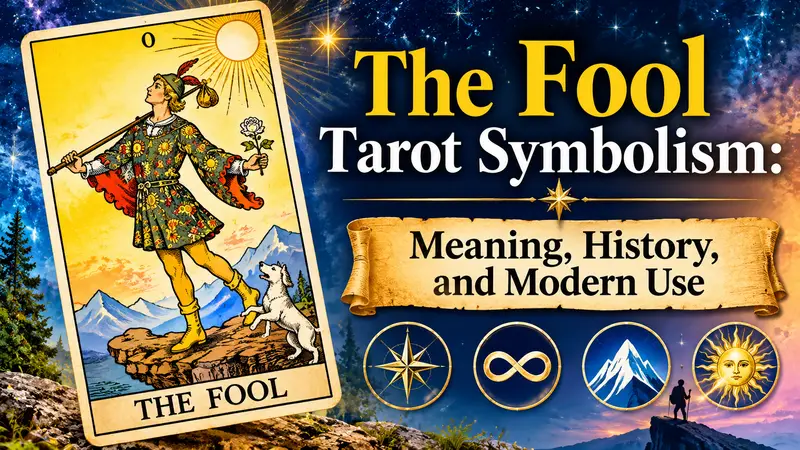
The Fool is one of the 22 cards in the Major Arcana, the section of a traditional tarot deck that explores major life experiences, personal challenges, and stages of development. Its familiar Rider-Waite-Smith illustration shows a young traveler approaching the edge of a cliff, carrying a small bundle and accompanied by a white dog.
For American readers, the card often represents starting over, taking a meaningful risk, pursuing an opportunity, or trusting oneself during a period of change. It appears in spiritual readings, personal reflection, artwork, tattoos, and popular culture. Its interpretation can be encouraging, cautionary, or somewhere between the two, depending on the surrounding cards and the question being considered.
Understanding this card requires looking beyond its cheerful appearance. Its history as a playing card, its later association with divination, and its modern interpretations all contribute to what it represents today.
Quick Answer
The Fool tarot symbolism commonly represents new beginnings, freedom, spontaneity, innocence, and taking a leap of faith in modern American tarot readings. Historically, the card developed from a Renaissance playing-card tradition and later became associated with spiritual exploration, personal transformation, and the uncertainty of life’s journey.
TL;DR
- Core meaning: New beginnings, possibility, freedom, and openness to experience.
- Historical origin: Developed within 15th-century Italian tarot card games.
- Number: Commonly numbered zero, representing unlimited potential.
- Upright interpretation: Courage, adventure, optimism, and fresh opportunities.
- Reversed interpretation: Recklessness, poor judgment, hesitation, or unrealistic expectations.
- Modern American use: Personal reflection, tattoos, spiritual readings, and creative expression.
1. What Does The Fool Tarot Card Represent?
The Fool represents the beginning of an experience before its direction becomes clear. It describes a person standing at a threshold, ready to explore something unfamiliar without knowing exactly what will happen.
In everyday terms, the card can reflect situations such as:
- Starting a new career without knowing where it will lead.
- Moving to another city for an opportunity.
- Beginning a relationship after a difficult period.
- Traveling somewhere for the first time.
- Exploring a creative project without a guaranteed outcome.
- Making a personal decision that requires courage.
Its central message is not that every risk is worthwhile. Instead, it highlights the importance of remaining open to possibilities while recognizing that growth often involves uncertainty.
The Fool can also represent innocence and curiosity. Someone who approaches life with an open mind may discover opportunities that a more cautious person overlooks.
However, innocence has two sides. It can encourage genuine discovery, but it can also lead to mistakes when someone ignores practical concerns.
This balance between freedom and responsibility is essential to understanding the card.
2. The Historical Origins of The Fool in Tarot
The Fool has a history that predates modern fortune-telling.
Tarot cards appeared in northern Italy during the 15th century. Early decks were created primarily for a trick-taking card game rather than spiritual readings. Wealthy Italian families commissioned elaborate hand-painted decks featuring rulers, religious figures, virtues, and familiar social archetypes.
The early tarot structure included four suits, 21 numbered trump cards, and a special Fool card. Unlike the other cards, the Fool occupied an unusual position within the game.
It could function as a special card that did not follow the ordinary hierarchy of trumps. Its distinctive role helped establish its association with independence and separation from conventional rules.
The surviving Visconti-Sforza tarot cards provide important evidence of this early tradition. These Renaissance decks demonstrate that the Fool was already part of tarot long before the modern occult interpretations developed. The Metropolitan Museum of Art+2
During later centuries, tarot imagery gradually acquired additional interpretations.
In the 18th and 19th centuries, European occult writers connected tarot with spiritual systems, symbolic correspondences, and divination. These developments changed how people understood the cards.
By the early 20th century, tarot had become increasingly recognizable as a tool for personal and spiritual interpretation.
The Fool consequently developed from a distinctive playing-card figure into a symbol of beginnings, uncertainty, and the human experience of entering the unknown.
3. Why The Fool Is Numbered Zero
One of the most recognizable features of The Fool is its association with the number zero.
In many modern tarot decks, particularly the Rider-Waite-Smith tradition, the card carries the number 0. This number gives it a special position among the Major Arcana.
Zero represents possibility without a fixed destination. It does not indicate that nothing exists. Instead, it suggests that something has not yet taken a defined form.
This interpretation creates several symbolic connections:
Unlimited potential: The Fool has not committed to one direction, so many possibilities remain available.
Beginning without certainty: The card represents the stage before experience provides answers.
Freedom from established expectations: Zero can suggest a position outside an established sequence or hierarchy.
Openness to learning: The Fool begins without complete knowledge and develops through experience.
Some tarot traditions place The Fool outside the numbered sequence, while others understand it as the beginning or an important transitional point in the journey through the Major Arcana.
Its number therefore reinforces the idea that a person’s next chapter does not have to follow a predetermined path.
4. Understanding The Fool’s Traditional Imagery
Smith-Waite Centennial Tarot Deck – The Homebody Collective
The familiar Rider-Waite-Smith version of The Fool was illustrated by Pamela Colman Smith and published in 1909 under the direction of Arthur Edward Waite.
The illustration contains several visual details that contribute to its modern interpretation. V&A+1
Each detail offers a different way to understand the card.
The traveler
The young traveler represents someone beginning an unfamiliar experience. His clothing and posture suggest movement, freedom, and an identity that has not yet been shaped by the journey.
He is not presented as an established authority or experienced traveler. He is someone at the beginning of an adventure.
The cliff
The cliff represents uncertainty and the possibility of danger.
Standing near its edge, the traveler faces a decision that requires awareness. The image can suggest courage, but it can also warn against moving forward without considering the consequences.
The white dog
The small white dog accompanying the traveler is commonly interpreted as a symbol of companionship, instinct, loyalty, or protection.
It can also represent a warning. The animal’s presence reminds viewers that the traveler is not entirely separated from the practical world, even when his attention is directed toward the horizon.
The small bundle
The traveler carries a modest bundle attached to a stick.
This detail can represent the experiences, abilities, and resources a person brings into a new chapter. The bundle is small, suggesting that the journey does not require carrying every possession or expectation from the past.
The white rose
The white flower represents innocence, purity, and openness.
It reinforces the idea of approaching an experience without excessive suspicion or preconceived assumptions.
The bright yellow background
The yellow sky creates an atmosphere of sunlight, optimism, and possibility.
Its brightness contrasts with the uncertainty of the cliff. The image therefore combines an encouraging outlook with a reminder that an unknown journey still carries risks.
5. The Fool’s Meaning in Modern American Culture
In the United States, The Fool is commonly understood through ideas of independence, self-discovery, personal choice, and taking chances.
These associations fit several familiar American cultural themes.
The idea of starting over is particularly relevant. Americans often celebrate stories about people leaving familiar surroundings to pursue education, build businesses, change careers, or create different lives.
The Fool can represent the emotional moment behind these decisions.
For example, someone leaving a secure job to establish a small business might identify with the card. The decision involves uncertainty, but it also reflects a willingness to pursue an opportunity.
The card can also connect with American ideas about individuality. Its traveler does not follow an established group or wait for someone else to determine the next step.
However, its symbolism should not be reduced to celebrating every form of risk-taking.
American culture also values preparation, responsibility, and practical judgment. A person who quits a job without considering financial responsibilities may be acting impulsively rather than courageously.
The Fool captures this tension between independence and responsibility.
In contemporary American spiritual communities, the card is also used as a reminder that personal growth sometimes begins before someone feels completely prepared.
6. Upright Meaning: New Beginnings and Personal Freedom
When The Fool appears upright in a tarot reading, it is generally interpreted as an encouraging sign of possibility, exploration, and fresh experiences.
Its appearance may suggest that a person is entering a stage where familiar routines are changing.
Common upright interpretations include:
- New beginnings and fresh opportunities.
- Optimism about the future.
- Independence and personal freedom.
- Curiosity and willingness to experiment.
- Trust in one’s ability to adapt.
- Adventure and exploration.
- Learning through direct experience.
In a career reading, the card might suggest exploring a different professional direction or considering an opportunity that feels unfamiliar.
In a relationship reading, it can represent emotional openness, meeting someone new, or approaching an existing relationship with a fresh perspective.
For personal development, it may encourage someone to stop allowing past disappointments to determine every future decision.
Nevertheless, the upright Fool does not guarantee success. Its message is about approaching an opportunity with openness while remaining willing to learn.
7. Reversed Meaning: Recklessness and Poor Judgment
When The Fool appears reversed, its traditional positive qualities may become exaggerated, blocked, or poorly directed.
Instead of healthy curiosity, the card may suggest carelessness. Instead of independence, it may indicate an unwillingness to accept responsibility.
Common reversed interpretations include:
- Acting without considering consequences.
- Ignoring reasonable warnings.
- Taking unnecessary financial or personal risks.
- Feeling afraid of starting something new.
- Avoiding responsibility.
- Making decisions based on unrealistic expectations.
- Refusing to learn from previous mistakes.
The reversed meaning can also represent hesitation.
For instance, someone may have an opportunity to study, relocate, or change careers but remain unable to move forward because uncertainty feels overwhelming.
In this situation, the card does not necessarily suggest taking a reckless leap. It may encourage the person to identify what is holding them back and make a realistic plan.
The exact interpretation depends on the question, the reader’s tarot tradition, and the other cards in the spread.
8. The Fool in Love and Relationships
In relationship readings, The Fool often represents emotional openness, new romantic experiences, and the willingness to approach love without allowing previous disappointments to control the future.
Its meaning changes depending on the relationship situation.
For single people: The card can represent meeting someone new, exploring romantic possibilities, or becoming comfortable with dating again. It encourages openness without assuming that every new connection will become a lasting relationship.
For couples: The Fool may suggest beginning a new chapter together, introducing spontaneity into a relationship, or exploring experiences that bring partners closer.
After a breakup: The card can symbolize emotional renewal. It may reflect the decision to rebuild one’s identity and discover what life looks like outside a previous relationship.
There is also a cautionary interpretation. In certain readings, The Fool may suggest emotional immaturity, unrealistic expectations, or entering a relationship without understanding the other person’s intentions.
Its message in love is best understood as an invitation to remain emotionally open while maintaining healthy judgment.
9. The Fool in Career, Money, and Life Decisions
The Fool frequently appears in readings about professional changes, financial choices, education, and major personal decisions.
Its connection with new beginnings makes it particularly relevant when someone is considering leaving a familiar situation.
| Context | Common Interpretation | Possible Caution |
|---|---|---|
| Career | Starting a business or exploring a new profession | Ignoring professional risks |
| Money | Exploring financial opportunities | Spending without planning |
| Education | Beginning a course or learning a skill | Underestimating the commitment |
| Travel | Exploring unfamiliar places | Overlooking practical arrangements |
| Personal growth | Developing independence | Confusing freedom with avoidance |
In career readings, The Fool may represent the beginning of an entrepreneurial project or a willingness to enter a different industry.
For financial questions, its appearance should not be treated as a guarantee of profit. It can instead highlight the need to understand the risks associated with unfamiliar opportunities.
When making important decisions, the card can serve as a reminder that confidence and preparation should work together.
A new beginning does not require knowing everything in advance, but it does require paying attention to the choices being made.
10. Spiritual and Psychological Meaning
The Fool has an important place in modern spiritual interpretations because it represents the willingness to experience life without having every answer.
Spiritually, the card is often associated with openness, discovery, and the beginning of an individual’s search for meaning.
It can represent someone questioning established beliefs, exploring different spiritual practices, or becoming more aware of personal values.
However, the card does not belong exclusively to one religion or spiritual tradition. Its modern interpretations are influenced by several European occult systems and contemporary approaches to tarot.
From a psychological perspective, The Fool can be understood as a representation of curiosity and the willingness to tolerate uncertainty.
It may reflect several human experiences:
- Curiosity: Wanting to discover something beyond familiar surroundings.
- Adaptability: Accepting that new experiences may require changes in perspective.
- Vulnerability: Recognizing that beginning something new involves the possibility of failure.
- Self-trust: Believing that mistakes can become opportunities for learning.
- Independence: Making personal decisions instead of automatically following expectations.
These are interpretive connections rather than scientifically established psychological diagnoses.
The card can also encourage useful self-reflection. Someone who repeatedly avoids new experiences might ask whether fear is protecting them from genuine danger or preventing worthwhile growth.
Likewise, someone who constantly takes risks might consider whether spontaneity has become a way of avoiding responsibility.
11. The Fool’s Journey Through the Major Arcana
One popular modern interpretation describes the Major Arcana as a symbolic journey through different stages of human experience.
This approach is commonly called the Fool’s Journey.
In this framework, The Fool begins without a fixed identity or complete understanding of the world. As the journey progresses, the other Major Arcana cards represent encounters with different experiences, challenges, relationships, and forms of knowledge.
For example:
- The Magician: Learning to use personal abilities and available resources.
- The High Priestess: Developing intuition and recognizing what is not immediately visible.
- The Empress: Experiencing creativity, care, and growth.
- The Emperor: Understanding structure, responsibility, and authority.
- The Lovers: Exploring relationships, values, and important choices.
- The Chariot: Developing determination and direction.
- Death: Experiencing endings and transformation.
- The Star: Rediscovering hope and inspiration.
- The World: Reaching a sense of completion and integration.
The sequence offers a way to understand how the Fool’s original openness develops through experience.
It is important to recognize that the Fool’s Journey is a modern interpretive framework, not a proven explanation of why Renaissance tarot cards were originally arranged as they were.
Its popularity comes from its usefulness as a storytelling and self-reflection model.
12. Cross-Cultural Connections and the Symbol of the Fool
The Fool has connections with several broader cultural ideas, although these should not be treated as identical traditions.
European medieval and Renaissance traditions
In medieval and Renaissance European culture, fools and jesters occupied unusual social positions.
Court jesters were sometimes permitted to criticize powerful people through humor, performance, and exaggerated behavior. Their position could challenge conventional expectations while also exposing social contradictions.
The tarot Fool draws on a broader visual culture in which unconventional figures represented marginality, unpredictability, and freedom from ordinary social roles. The Morgan Library & Museum+1
The wandering trickster
Various folklore traditions contain trickster figures who challenge established rules, create confusion, and reveal unexpected truths.
These figures are not necessarily innocent or harmless. Their actions can produce both opportunities and problems.
The comparison with The Fool is useful because both represent movement outside predictable social expectations. However, the tarot card and individual trickster traditions have different cultural histories.
The spiritual seeker
In several religious and philosophical traditions, the image of a beginner or wandering seeker represents humility and the willingness to learn.
This offers a useful comparison with The Fool’s modern spiritual meaning, particularly its association with openness and personal discovery.
It would be inaccurate, however, to claim that the tarot Fool originated directly from a particular ancient religious tradition.
Its documented history belongs to European tarot culture.
13. Why The Fool Appears in Tattoos, Jewelry, and Modern Art
Fool tarot pendant – Etsy Schweiz
The Fool – Tarot Card Meaning – Grace Duong
13
The Fool has become a recognizable visual symbol in modern personal style.
People who choose the card for tattoos, jewelry, or artwork often connect with its associations with independence, exploration, and personal transformation.
Tattoos
A Fool tarot tattoo can represent:
- Starting a new chapter after a difficult experience.
- Choosing an independent path.
- Traveling and discovering new places.
- Accepting uncertainty.
- Maintaining curiosity and optimism.
- Learning from mistakes rather than avoiding experiences.
Some people choose the complete Rider-Waite-Smith illustration, while others use individual elements such as the white rose, traveling bundle, cliff, or number zero.
Jewelry
The card appears in necklaces, pendants, rings, and decorative accessories.
A small Fool pendant may serve as a personal reminder to remain open to new opportunities. Its meaning can also be connected to a particular life event, such as graduation, relocation, or a career change.
Home decor and artwork
Tarot-inspired prints and framed illustrations are popular in contemporary alternative art and interior design.
The Fool’s bright colors, distinctive traveler, and unusual composition make it visually recognizable even to people who do not regularly read tarot.
Social media
On platforms such as Instagram, Pinterest, and TikTok, the card frequently appears in discussions about self-discovery, fresh starts, spirituality, and personal identity.
Its imagery is especially suitable for content about beginning a new chapter because the traveler visually communicates movement toward an unknown future.
14. Common Misunderstandings About The Fool
Although the card is commonly interpreted positively, several misunderstandings can make its symbolism confusing.
Misunderstanding 1: The Fool represents stupidity.
The word fool can suggest someone lacking intelligence. However, modern tarot interpretations generally focus on innocence, openness, inexperience, and the willingness to explore.
The card can warn about poor judgment, but foolishness is not its only or primary meaning.
Misunderstanding 2: The card guarantees a successful new beginning.
The Fool represents possibility rather than a guaranteed result. A new opportunity can lead to success, disappointment, or an experience that provides valuable lessons.
Misunderstanding 3: Taking a leap of faith means ignoring danger.
The card can encourage courage, but it should not be interpreted as advice to abandon common sense. Its cliff imagery itself introduces the possibility of consequences.
Misunderstanding 4: The Fool is inherently negative.
The card is not automatically a warning. Its upright interpretation is often optimistic, particularly when a reading concerns personal growth or fresh opportunities.
Misunderstanding 5: Tarot was originally invented for fortune-telling.
Historical evidence shows that tarot developed as a European card game during the 15th century. Its association with occult practices and divination became prominent much later. The Metropolitan Museum of Art+2
Understanding these distinctions helps separate the card’s documented history from its later spiritual interpretations.
15. How The Fool’s Symbolism Has Changed Over Time
The Fool has not maintained one fixed meaning throughout its history.
Its interpretation has developed alongside changes in tarot’s purpose and cultural position.
| Historical Period | Main Context | Interpretation |
|---|---|---|
| 15th-century Italy | Playing-card games | A special card outside the ordinary trump structure |
| 18th century | Emerging occult interest | Increasing symbolic and divinatory interpretations |
| 19th century | European esoteric movements | Connections with spiritual and philosophical systems |
| 1909 onward | Rider-Waite-Smith tarot | A recognizable image associated with beginnings and spiritual exploration |
| 21st century | Modern popular culture | Independence, self-discovery, personal freedom, and fresh starts |
The publication of the Rider-Waite-Smith deck was particularly influential.
Pamela Colman Smith’s illustrations gave the cards a visual language that readers could interpret through recognizable scenes and objects. The Fool’s traveler, cliff, dog, and flower became familiar features of modern tarot imagery. V&A+1
In the United States, the card’s popularity has expanded beyond traditional tarot readings.
It now appears in personal development discussions, contemporary spiritual communities, fashion, illustration, and online creative culture.
This evolution demonstrates how an image originally associated with a card game can acquire additional meanings as different generations use it to explore their experiences.
FAQs
1. Is The Fool a positive or negative tarot card?
The Fool is generally considered a positive card when upright because it represents new opportunities, independence, and personal growth. However, it can become a warning about recklessness, inexperience, or poor judgment when reversed or surrounded by challenging cards.
2. What does The Fool tarot card mean in a love reading?
In love readings, The Fool often represents new romantic experiences, emotional openness, and approaching relationships with curiosity. It can also suggest that someone should avoid rushing into commitments without understanding the situation.
3. What does a Fool tarot tattoo symbolize?
A Fool tarot tattoo commonly represents freedom, independence, adventure, and the courage to begin again. Some people choose it to commemorate a major life transition or remind themselves not to let uncertainty prevent personal growth.
4. Why is The Fool numbered zero?
The number zero represents unlimited potential and a position outside an established sequence. In modern tarot interpretation, it reflects the idea that The Fool has not yet committed to a particular direction or completed the experiences that will shape the journey.
5. What does The Fool mean spiritually?
Spiritually, The Fool represents openness to discovery, willingness to question familiar beliefs, and the beginning of personal exploration. It can symbolize approaching life with humility rather than assuming that every answer is already known.
6. What does The Fool reversed mean in a tarot reading?
The reversed Fool commonly represents impulsiveness, unrealistic expectations, hesitation, or a refusal to accept responsibility. Depending on the reading, it may suggest either slowing down before making a decision or finding the confidence to move forward.
7. Is The Fool the first card in the Major Arcana?
The Fool is commonly treated as the beginning of the Major Arcana and numbered zero in many modern decks. However, its position is unusual because some traditions consider it separate from the numbered sequence rather than an ordinary first card.
Conclusion
The Fool tarot symbolism represents the willingness to begin something unfamiliar, explore new possibilities, and accept that personal growth often involves uncertainty. Its familiar imagery of a traveler approaching a cliff captures the balance between optimism and caution, reminding readers that every new experience involves both opportunity and responsibility.
From its origins in 15th-century Italian card games to its modern place in American tarot readings, tattoos, artwork, and spiritual communities, The Fool has developed into a recognizable symbol of independence and self-discovery.
Ultimately, The Fool is not simply about taking chances without thinking. It represents having the curiosity to move forward, the courage to experience something new, and the judgment to learn along the way.