Introduction
Water lilies and lotus flowers are often associated with peace, purity, renewal, and spiritual growth. Their graceful blooms rise above ponds and lakes, making them natural symbols of beauty that can emerge from difficult surroundings. Although the flowers look similar at first glance, their cultural histories and symbolic meanings are not identical.
Understanding water lily vs. lotus symbolism means looking beyond their appearance. Water lilies are closely associated with renewal, tranquility, and ancient Egyptian ideas about the cycle of life, while the sacred lotus holds a particularly important place in Hinduism and Buddhism, where it can represent purity, spiritual development, and enlightenment.
In the United States, both flowers appear in tattoos, home decor, botanical gardens, fine art, and wellness-inspired design. Their meanings often overlap, but knowing the difference helps people choose a flower that expresses a more specific personal, artistic, or spiritual message.
Quick Answer
Water lily vs. lotus symbolism commonly contrasts renewal, tranquility, and the cycles of life with purity, resilience, and spiritual awakening in modern American culture. Historically, water lilies were important in ancient Egyptian art and beliefs about rebirth, while the sacred lotus became a central symbol of divine creation and enlightenment in Hindu and Buddhist traditions.
TL;DR
- Water lilies commonly symbolize renewal, serenity, and the natural cycles of life.
- Lotus flowers often represent purity, resilience, spiritual growth, and enlightenment.
- Ancient Egyptian water lilies were associated with the sun and rebirth.
- Hinduism and Buddhism give the sacred lotus important religious meanings.
- American tattoos and decor use both flowers to express personal growth and peace.
- Botanical differences matter because the two plants are not interchangeable.
1. What Is the Difference Between a Water Lily and a Lotus?
Water lilies and lotus flowers are aquatic plants that grow in ponds, lakes, and other freshwater environments. Both produce attractive blooms and broad leaves, but they belong to different botanical groups.
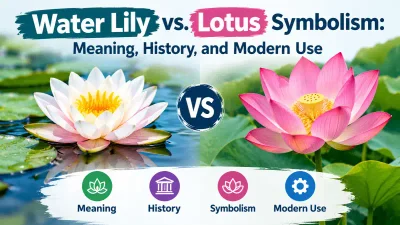
True water lilies belong to the genus Nymphaea. Their rounded leaves typically float on the water’s surface and have a distinctive notch. Their flowers often appear close to the water, with pointed petals that create a star-like shape.
Lotuses belong to the genus Nelumbo. Their leaves are generally round without a notch, and many rise above the water on tall stems. Lotus flowers often have rounded petals and a prominent central seed pod that remains visible after the petals fall.
These differences help explain why the plants developed distinct cultural associations. A floating water lily may suggest calm, rest, and the meeting of water and sunlight. A lotus rising above the pond can more readily suggest growth, emergence, and the ability to remain above surrounding difficulties.
The distinction is especially useful when interpreting paintings, religious sculptures, jewelry, or tattoos. A flower that looks like a lotus in a modern design may actually resemble a water lily, even if the artist intended to communicate a particular spiritual meaning.
2. Water Lily Symbolism: Renewal, Peace, and the Cycle of Life
Water lilies commonly symbolize renewal, tranquility, natural beauty, and the recurring cycles of life. Their daily and seasonal rhythms provide a visible reason for these associations.
Depending on the species, water lily flowers open and close in response to light or other environmental conditions. Many return to bloom during the growing season, creating a familiar image of life renewing itself. Their floating leaves and flowers can also make a pond feel sheltered and peaceful.
In modern American culture, water lilies often communicate a quieter kind of growth than the lotus. They can suggest slowing down, appreciating the present moment, or finding emotional balance after a stressful period.
The flower also has a strong connection to art. Claude Monet’s water lily paintings helped establish the plant as an enduring image of reflection, color, and changing light in American museum culture. His work does not give the flower one universal meaning, but it encourages viewers to associate water lilies with observation, stillness, and the beauty of ordinary natural surroundings.
For someone choosing a water lily as a personal symbol, the message may be simple: peace does not require dramatic transformation. Sometimes it means learning to live more comfortably with change.
3. Lotus Symbolism: Purity, Resilience, and Enlightenment
The lotus is widely associated with purity, spiritual awakening, resilience, and the ability to rise above difficult conditions. Its growth pattern provides an accessible explanation for these meanings.
Lotus plants grow from submerged roots and rhizomes in muddy environments. Their stems extend upward, carrying leaves and flowers toward the light. The resulting image can suggest progress without requiring a person to deny the challenges that came before it.
The lotus also has an important physical characteristic: its leaves repel water effectively, causing droplets to bead and roll away. This feature has inspired the modern expression “lotus effect” in materials science. Although this botanical property is not itself a religious teaching, it offers a useful visual analogy for remaining steady amid outside pressures.
In American wellness culture, the lotus frequently represents recovery, personal development, mindfulness, and a fresh start. It appears in yoga studios, meditation spaces, jewelry, and tattoos for people who want a visible reminder of their values.
Its meaning, however, is not limited to a general message about overcoming hardship. In Hinduism and Buddhism, the lotus has specific sacred associations that deserve to be understood within their religious contexts rather than reduced to a generic emblem of positivity.
4. Ancient Egyptian Water Lily Symbolism and Rebirth
Water lilies played an important role in ancient Egyptian art, religious imagery, and funerary traditions. The blue Egyptian water lily, Nymphaea caerulea, is particularly associated with imagery of the sun, creation, and renewal.
The flower’s opening and closing behavior helped make it a suitable image for recurring cycles. In Egyptian visual culture, the emergence of a flower from water could evoke the appearance of new life from primordial waters and the return of the sun after darkness.
Water lily imagery also appeared in tomb decoration and funerary settings. Flowers could be placed among offerings and represented in scenes connected with the deceased and expectations about life beyond death. Their presence linked the beauty of the living world with hopes for continued existence and renewal.
A historical naming problem is worth recognizing: ancient Egyptian flowers commonly called “lotuses” in translations were often water lilies botanically. The Indian sacred lotus, Nelumbo nucifera, is a different plant and was introduced to Egypt later than the native water lily species.
This distinction matters because the flower’s ancient symbolism cannot always be assigned accurately by relying on a modern common name. In Egyptian art, the image may refer to a water lily even when a contemporary description calls it a lotus.
5. Lotus Symbolism in Hinduism
In Hindu traditions, the lotus is a sacred and recurring image associated with divine presence, creation, beauty, and spiritual purity. It appears in religious art, sculpture, stories, and depictions of deities.
The flower can serve as a seat or pedestal for a deity, presenting the figure as distinct from ordinary worldly conditions. The lotus is also associated with Lakshmi, a goddess connected with prosperity and good fortune, and with other divine figures in different Hindu traditions.
Its symbolism is not simply that the world is impure and should be rejected. Rather, the lotus can express the possibility of living in the world without being wholly defined by its distractions and attachments. This interpretation helps explain why the flower is relevant to discussions of spiritual discipline and inner steadiness.
The lotus also carries associations with fertility, abundance, and creation in South Asian cultural traditions. Its many seeds and its recurring growth make it a natural image for continuity and flourishing.
For American readers, recognizing this religious background is important when choosing lotus imagery for jewelry, artwork, or body art. A lotus may be a personal emblem of growth, but it can also carry sacred meaning for people who practice Hinduism.
6. Lotus Symbolism in Buddhism
In Buddhism, the lotus is strongly associated with enlightenment, wisdom, compassion, and the possibility of awakening. It appears frequently in Buddhist art, including images of Buddhas and bodhisattvas seated on lotus thrones.
The plant’s growth offers a clear visual analogy: its roots remain in the mud, but the flower opens above the water. In Buddhist interpretation, this can represent the possibility of awakening within the conditions of ordinary life rather than outside them.
Lotus imagery also appears in Buddhist texts, rituals, architecture, and devotional art. Different colors may receive different interpretations in particular traditions, although color meanings are not universal across every Buddhist school or culture.
In the United States, the lotus is widely used in meditation spaces and wellness settings. Yet its meaning in Buddhism extends beyond relaxation or positive thinking. It belongs to a religious tradition concerned with suffering, ethical conduct, wisdom, and liberation.
People who use Buddhist lotus imagery in personal designs can approach it with greater understanding by learning about the tradition behind the symbol. This does not require adopting a religion, but it does help distinguish respectful appreciation from treating sacred imagery as a decorative trend alone.
7. What the Two Flowers Mean in Modern American Culture
In the United States, water lilies and lotus flowers are interpreted through several overlapping influences: gardening, art, religion, personal identity, wellness, and popular design.
Water lilies are particularly familiar as ornamental pond flowers. They evoke peaceful gardens, summer landscapes, and the pleasure of spending time near water. Their association with Monet’s paintings also makes them recognizable symbols of artistic observation and natural beauty.
Lotus flowers are especially common in yoga, meditation, and mindfulness settings. Their established role in Asian religious traditions gives them spiritual associations that are often carried into modern American wellness culture.
Neither interpretation is universal. A gardener may appreciate a lotus mainly for its large flowers and distinctive seed pod, while someone choosing a lotus tattoo may be thinking about a personal recovery or a religious commitment. Likewise, a water lily may be a favorite flower without carrying any deliberate symbolic message.
The American context therefore adds layers rather than replacing older meanings. A symbol can have religious significance in one setting, artistic associations in another, and a purely personal meaning in a third.
8. Water Lily vs. Lotus Symbolism: A Quick Comparison
| Context | Water Lily | Lotus |
|---|---|---|
| Common modern meaning | Peace, renewal, tranquility | Resilience, purity, awakening |
| Historical associations | Ancient Egyptian rebirth and solar cycles | Divine creation and spiritual development in Asian traditions |
| Religious significance | Important in ancient Egyptian imagery; meanings vary by tradition | Especially significant in Hinduism and Buddhism |
| Art and design | Reflection, stillness, natural beauty | Growth, spiritual intention, transformation |
| Personal symbolism | Emotional calm and appreciation of change | Recovery, perseverance, and a new perspective |
These are common associations, not fixed definitions. A flower’s meaning depends on the culture, the specific image, and the intention of the person using it.
9. How Flower Color Changes the Interpretation
Color can influence how Americans interpret both flowers, especially in tattoos, bouquets, illustrations, and home decor. These associations are cultural conventions rather than strict rules.
White flowers often suggest peace, simplicity, purity, or remembrance. In religious settings, white lotus imagery may have more specific associations depending on the tradition.
Pink lotus flowers are commonly used in Buddhist art and can be associated with sacred or devotional meanings. Outside religious contexts, pink often conveys gentleness, affection, or compassion.
Blue flowers may suggest calm, contemplation, wisdom, or serenity in modern decorative settings. Blue water lily imagery also has a distinctive place in ancient Egyptian art, where it was connected with renewal and the solar cycle.
Yellow flowers often communicate warmth, optimism, and vitality in American color conventions. The American lotus, Nelumbo lutea, naturally produces yellow flowers and has its own place in North American botanical history.
Purple flowers are frequently associated with creativity, individuality, or spiritual reflection in modern design, although these meanings depend heavily on the artist and audience.
Color should be interpreted alongside the flower itself. A white lotus in a religious sculpture may carry a different meaning from a white lotus printed on a spa towel, even when the basic visual association is similar.
10. Emotional and Psychological Meaning
People often choose flowers as symbols because plants make abstract experiences easier to picture. A bloom emerging above water can stand for a difficult period that has passed, while a flower floating quietly on a pond can suggest the wish for a calmer life.
The water lily may appeal to someone who values rest, reflection, or emotional balance. It can represent a desire to protect a peaceful part of life amid work, family obligations, or uncertainty.
The lotus may appeal to someone who wants to acknowledge a process of change. It can mark the end of a difficult chapter, a commitment to personal growth, or the decision to keep moving toward a goal despite setbacks.
These associations can be useful in personal reflection, but they are not psychological diagnoses. Choosing a lotus does not prove that someone has overcome trauma, and choosing a water lily does not automatically mean that the person is peaceful.
The most meaningful interpretation is usually the one connected to a real experience, value, or intention. The flower becomes a reminder because of what the person associates with it, not because the plant determines the person’s character.
11. Why Water Lilies and Lotuses Appear in Tattoos and Jewelry
Water lily and lotus designs are popular in American body art and jewelry because they combine recognizable shapes with flexible meanings. Both can be represented as simple outlines, detailed botanical illustrations, geometric patterns, or colorful flowers.
A water lily tattoo may express a love of nature, a connection to a meaningful place, a desire for peace, or an appreciation for art. It can be particularly appropriate for someone whose memories are tied to a pond, lake, garden, or a favorite painting.
A lotus tattoo is often chosen to represent resilience, transformation, spiritual practice, or personal growth. Some people also choose it because of a direct connection to Hinduism or Buddhism.
In jewelry, either flower can function as a personal reminder or a gift that communicates care, hope, or encouragement. Lotus pendants are particularly common in wellness-oriented designs, while water lily motifs may suit botanical or nature-inspired collections.
Before selecting a design, consider both its appearance and its cultural context. If the image draws directly on a sacred religious tradition, learning what the motif means in that tradition can make the choice more informed and respectful.
12. Water Lilies and Lotuses in Home Decor and Garden Design
In American homes, both flowers are used to create a sense of calm, but they suit different decorative intentions. Water lily imagery often complements natural landscapes, traditional botanical prints, and interiors inspired by lakes, ponds, or gardens. Lotus imagery is frequently found in meditation rooms, yoga spaces, and contemporary interiors that emphasize simplicity and intentional living.
The difference is partly visual. Water lilies are commonly depicted floating among broad leaves, creating a horizontal composition that feels connected to the water’s surface. Lotus designs often emphasize an upright flower, making them suitable for artwork that draws the eye upward.
Living plants offer another dimension. A water lily in a garden pond can support the atmosphere of a natural retreat, while a lotus can become a striking focal point because its leaves and flowers often rise above the water.
Neither flower automatically creates a particular emotional effect. Lighting, placement, color, and personal associations all influence how a design feels. Someone decorating a quiet reading corner might choose a water lily for its connection to stillness, while another person might choose a lotus to mark a period of personal change.
13. Native American Connections and the American Lotus
The lotus has a botanical history in North America that is separate from its better-known associations with South Asian religions. The American lotus, Nelumbo lutea, is native to parts of the United States and produces large yellow flowers and distinctive circular leaves.
Indigenous peoples of North America have used the American lotus as a food source. Its seeds and underground structures have been eaten, although practices differ among communities and regions. Historical accounts also describe particular cultural and ceremonial associations, but these should not be generalized to all Native American nations.
This history matters because American lotus symbolism is not exclusively imported from Asian religious traditions. The plant existed in North American ecosystems long before modern wellness culture adopted lotus imagery.
At the same time, it would be misleading to assign one universal spiritual meaning to the American lotus across Indigenous cultures. Each community has its own history, knowledge, and traditions. Specific cultural claims should be grounded in the relevant nation or community rather than assumed from the plant’s appearance.
For contemporary Americans, the native lotus can symbolize a connection to local landscapes, ecological heritage, and the natural history of freshwater wetlands. Its presence also offers a reminder that similar-looking plants can carry different cultural histories depending on where they grow and how people relate to them.
14. Common Misunderstandings About Water Lily and Lotus Symbolism
One frequent misconception is that water lilies and lotuses are simply two names for the same flower. Their similarities have contributed to centuries of confusion in translation, art history, and everyday conversation. Botanically, however, true water lilies and lotuses belong to different genera and plant families.
Another misunderstanding is that the lotus always symbolizes overcoming suffering. This interpretation is common in modern American self-development culture, but the flower’s religious meanings are more specific and varied. In Hinduism and Buddhism, it can communicate ideas about divine presence, wisdom, spiritual practice, and awakening that go beyond a general message of perseverance.
Water lilies are sometimes described as symbols of peace without any historical qualification. Although tranquility is a reasonable modern association, their meanings have varied across cultures. Ancient Egyptian water lily imagery, for example, was connected with the sun, creation, and the continuation of life.
Color meanings can also be oversimplified. There is no single universal rule that a blue, pink, or white flower must communicate one particular emotion or spiritual idea. The same color can function differently in religious art, a botanical illustration, or a contemporary tattoo.
Finally, neither plant has an inherent moral meaning. Growing in muddy water does not make a flower a literal representation of human suffering, nor does a clean-looking bloom prove purity of character. These are human interpretations built from visual experience, religious traditions, and personal associations.
Understanding these distinctions makes the symbols more useful. Instead of treating every flower as a universal sign, consider the plant’s identity, the context in which it appears, and the meaning its creator intended.
15. How Their Symbolism Has Evolved Into the Present Day
The meanings of water lilies and lotuses have developed through centuries of religious practice, artistic representation, translation, and everyday use. Their modern interpretations reflect this history, but they do not simply repeat it.
In ancient Egypt, water lilies were incorporated into imagery associated with creation, solar cycles, funerary practices, and renewal. In South Asia, the sacred lotus became a central image in Hindu and Buddhist traditions, with associations extending to divine figures, spiritual understanding, and enlightenment.
As religious images moved across regions and artistic traditions, the flowers were sometimes renamed, stylized, or interpreted through unfamiliar cultural frameworks. Translation contributed to confusion between the Egyptian water lily and the Indian lotus, while artists often simplified botanical details to suit decorative or religious purposes.
In the United States, the nineteenth- and twentieth-century popularity of botanical illustration, public gardens, and Impressionist art helped establish water lilies as familiar images of nature and reflection. Meanwhile, the lotus became increasingly visible in religious art, meditation practices, yoga environments, and modern personal design.
Today, digital culture adds another layer. A lotus emoji, a minimalist flower drawing, or a tattoo image may communicate personal growth without explaining the symbol’s origins. The image can be meaningful to its user while carrying a different significance for someone familiar with its religious history.
The important change is not that older meanings have disappeared. Rather, the same flower now moves between settings in which it can function as a sacred image, a botanical subject, an artistic motif, or a private reminder of a person’s experiences.
FAQs
1. Is a lotus flower more spiritual than a water lily?
The lotus has a particularly prominent spiritual role in Hinduism and Buddhism, where it is associated with divine presence, awakening, and enlightenment. Water lilies also have religious and historical significance, especially in ancient Egyptian traditions, so the difference is not that one flower is inherently more spiritual than the other.
2. What does a water lily tattoo symbolize?
A water lily tattoo can represent tranquility, renewal, an appreciation of nature, or a personal connection to a meaningful place. Its significance ultimately depends on the wearer’s experience and the design’s cultural or artistic context.
3. What does a lotus tattoo mean in American culture?
In contemporary American tattoo culture, a lotus often represents resilience, personal transformation, spiritual growth, or a new chapter in life. For some wearers, it also expresses a connection to Hinduism or Buddhism rather than a general self-improvement message.
4. Are water lilies and lotuses symbols of rebirth?
Both flowers can symbolize renewal, although their historical associations differ. Ancient Egyptian water lily imagery was connected with solar cycles and the continuation of life, while the lotus is associated with spiritual awakening and transformation in several Asian traditions.
5. What does a white lotus symbolize?
A white lotus can suggest purity, clarity, and spiritual development, particularly in some Buddhist traditions. Its precise meaning depends on the religious school, artwork, or cultural setting in which it appears.
6. Can I use a lotus design if I am not Buddhist or Hindu?
A lotus can be appreciated as a botanical image or a personal symbol by people from many backgrounds. If you choose a design taken directly from religious imagery, understanding its original context and treating it respectfully helps avoid reducing a sacred symbol to decoration alone.
7. Which flower should I choose to represent personal growth?
A lotus is a natural choice if you want to express perseverance, transformation, or spiritual development. A water lily may be a better fit if your emphasis is on tranquility, renewal, and learning to appreciate life’s changing rhythms.
Conclusion
Water lily vs. lotus symbolism reveals two related but distinct ways of expressing renewal and growth. Water lilies are commonly associated with tranquility, the cycles of life, and ancient Egyptian imagery, while the sacred lotus has especially strong connections to purity, divine creation, and enlightenment in Hindu and Buddhist traditions.
In modern America, both flowers appear in art, gardens, jewelry, tattoos, and personal spaces. Their meanings can overlap, but their botanical differences and cultural histories make them more than interchangeable decorative motifs.
The best choice depends on the message you want the flower to carry. Whether you prefer the quiet beauty of a water lily or the upward-reaching bloom of a lotus, understanding its origins gives your choice a more considered and personal meaning.