Introduction
The ace of hearts symbolism combines two familiar images: the ace, which can represent a beginning or a position of distinction, and the red heart, which is widely associated with love, affection, and emotional connection. Together, these elements make the card a recognizable symbol of romance, opportunity, and meaningful relationships in American culture.
People encounter the ace of hearts in playing cards, romantic artwork, tattoos, jewelry, greeting cards, and popular entertainment. Some choose it to express devotion to a partner, while others associate it with a fresh emotional start, self-love, or the courage to open their hearts again.
Its meaning is not limited to romance, however. Older playing-card fortune-telling traditions also connected the ace of hearts with home and personal life. Understanding these different interpretations helps explain why a single playing card can communicate love, hope, luck, and the promise of a new chapter.
Quick Answer
Ace of hearts symbolism commonly represents love, romance, emotional fulfillment, and new beginnings in modern American culture, especially in relationships, tattoos, and personal artwork. Historically, the card has also been associated with home, family happiness, favorable personal news, and romantic possibilities in playing-card traditions.
TL;DR
- Core meaning: Love, affection, emotional connection, and opportunity.
- Card symbolism: The heart represents feeling, while the ace suggests a beginning or distinction.
- Historical associations: Traditional card readings linked it with home and personal relationships.
- American culture: It appears in romance, entertainment, card games, and Valentine’s Day imagery.
- Tattoo meaning: It can express devotion, self-love, or a willingness to take emotional risks.
- Modern interpretation: Personal context determines whether it represents romance, hope, luck, or renewal.
What Does the Ace of Hearts Look Like?
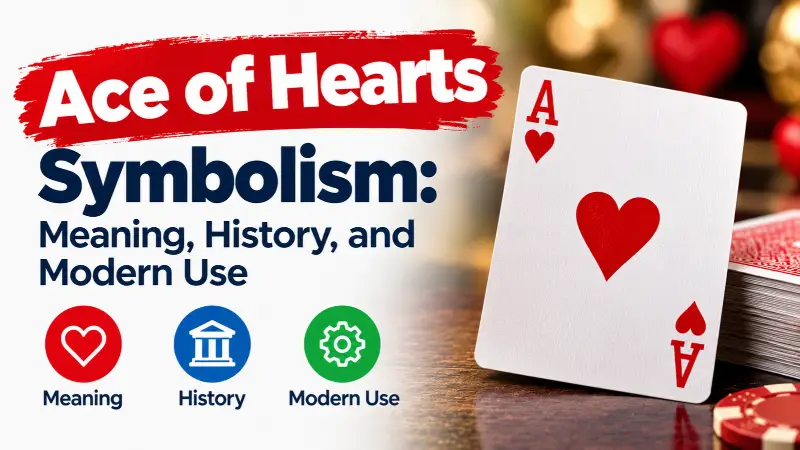
The ace of hearts is one of the 52 cards in a standard playing-card deck. It typically has a white background, a large red heart in the center, and an “A” alongside a small heart symbol in opposite corners. This corner indexing allows players to identify the card even when several cards overlap in a hand.
Although its design is simple, each element contributes to its familiar associations. The heart is commonly understood as a sign of affection and emotional attachment, while the red color often suggests warmth, passion, and vitality.
The letter A identifies the card’s rank. Depending on the game, an ace can be the highest card, the lowest card, or part of a sequence that uses both ends of the ranking system. This flexibility helps explain why the ace can suggest either a starting point or an exceptional position.
Americans see the card in poker and other card games, magic performances, casino imagery, romantic illustrations, clothing, posters, and digital graphics. Its recognizable appearance allows it to communicate an idea even when no words accompany it.
The Core Meaning of the Ace of Hearts
The ace of hearts is most commonly interpreted as a sign of love, emotional opportunity, and a positive development in personal relationships. These meanings come from combining the cultural associations of the heart suit with the varied significance of the ace.
Love and affection are its most immediate associations. The card may represent romantic attraction, devotion between partners, or the importance of a close emotional bond.
New beginnings form another common interpretation. An ace can suggest the first stage of something, so the ace of hearts may symbolize a new relationship, renewed commitment, reconciliation, or a decision to become emotionally open again.
Emotional fulfillment refers to the satisfaction people find in connection, trust, and belonging. The card can represent the hope of finding a relationship that feels meaningful rather than merely exciting.
Opportunity and good fortune arise from the ace’s status as a potentially high-value card. In symbolic use, it may suggest that a promising opportunity has appeared, although success still depends on what someone does with it.
These meanings are interpretations, not guarantees. Drawing or displaying the card cannot establish that a particular relationship will succeed or that good news is certain to arrive.
Why the Heart Became a Symbol of Love
The familiar heart shape is a stylized symbol rather than an accurate drawing of the human organ. Its association with love developed through medieval European art, literature, and cultural conventions, eventually becoming one of the world’s most recognizable signs of affection.
During the late Middle Ages, images of lovers exchanging or presenting hearts appeared in European manuscripts and artistic works. Over time, the heart became associated with romantic devotion, compassion, courage, and a person’s innermost feelings. The red heart later became a familiar feature of European playing cards.
By the time the French-suited deck became established, hearts were one of four standard suits alongside diamonds, clubs, and spades. The suit carried a recognizable shape that people could easily associate with emotion, even outside the context of a card game.
This history helps explain the ace of hearts’ modern meaning. The card combines a playing-card rank with a symbol that already had strong emotional associations. Its romantic interpretation grew from that combination rather than from a single documented event.
What the Ace Represents in Playing-Card Symbolism
The ace has a flexible meaning because its value changes across games and traditions. In some games, it is the highest card; in others, it can function as the lowest card or occupy different positions in a sequence.
Beyond gameplay, the ace has become associated with excellence, distinction, opportunity, and having an advantage. Expressions such as “ace player” and “ace up your sleeve” reflect its broader place in English-speaking culture.
When paired with hearts, these associations can suggest an important emotional opportunity or the beginning of a significant relationship. A person might interpret the card as representing the chance to build a meaningful connection or to approach love with renewed confidence.
The combination does not have a fixed historical definition that applies to every situation. Rather, its symbolic meaning develops from the ace’s flexible rank and the heart suit’s established emotional associations.
Historical Origins of the Ace of Hearts
Playing cards spread through Europe during the late medieval period, with surviving examples dating to the fourteenth and fifteenth centuries. Early decks varied considerably in their designs, suits, and rankings.
The French suit system, which established hearts, diamonds, clubs, and spades in familiar forms, became standardized during the fifteenth century. Its simplified designs were easier to reproduce and helped make playing cards more accessible.
The ace also experienced changes in status. In early card traditions, it could function as a low card representing one, while later games and conventions elevated it to the highest position. Modern decks preserve this flexibility because different games assign values differently.
The ace of hearts therefore developed within a changing history of card games and symbolic imagery. Its modern associations with romance and new beginnings are understandable interpretations of its visual elements, but they should not be presented as the only meanings the card has ever held.
Ace of Hearts in Traditional Fortune-Telling
In cartomancy, the practice of interpreting ordinary playing cards for divination, the ace of hearts has often been connected with home, love, family, and favorable personal developments.
Some historical fortune-telling manuals treated it primarily as a house or household card. Others emphasized affection, happiness, love letters, or pleasant news. These interpretations varied according to the author, the surrounding cards, and the particular reading system.
In contemporary readings, the ace of hearts may be interpreted as a new romantic connection, emotional renewal, a welcoming home environment, or an opportunity to strengthen a relationship. A reader might also associate it with reconciliation or greater harmony among family members.
These interpretations belong to a divinatory tradition rather than an established method of predicting events. A card reading can be used as a prompt for reflection, but there is no reliable evidence that the ace of hearts can forecast someone’s romantic future.
What the Ace of Hearts Means in American Culture
In the United States, the ace of hearts most readily suggests romance, affection, and the possibility of a favorable emotional outcome. The card’s familiar red heart makes it easy to recognize, even among people who do not play cards regularly.
Its use around Valentine’s Day is a natural extension of the heart’s association with romantic love. The card can appear on greeting cards, themed decorations, gifts, and playful messages between partners.
American popular culture also connects playing cards with luck, risk, competition, and strategy. As a result, the ace of hearts can suggest taking a chance on love or treating a relationship as something worth investing in.
Unlike symbols tied to one specific religion or historical event, the ace of hearts has no single official cultural meaning in the United States. Its interpretation depends on the setting. In a card game, it is a playing card; on a romantic gift, it may represent devotion; and in a tattoo, it may communicate a personal story.
Ace of Hearts Meaning in Love and Relationships
The card’s most familiar modern interpretation concerns romantic relationships. It can represent the excitement of meeting someone new, the decision to commit to a partner, or the desire to rebuild emotional closeness after a difficult experience.
For an established couple, the ace of hearts might symbolize choosing one another again. Rather than representing the beginning of a relationship alone, it can serve as a reminder that affection and trust require continued attention.
For someone who is single, the card may represent openness to love or hope for a meaningful connection. It can also stand for self-love, especially when someone is learning to set healthy boundaries or recover confidence after disappointment.
However, the card does not guarantee a soulmate, marriage, reconciliation, or a particular person’s feelings. Its value as a personal symbol comes from the meaning someone gives it, not from certainty about future events.
Ace of Hearts Tattoos and Personal Identity
An ace of hearts tattoo can communicate romantic devotion, emotional courage, or a willingness to take a chance on a relationship. The design is recognizable and compact, making it suitable for people who prefer a small symbol rather than a large illustrative tattoo.
Some people choose the card to commemorate a partner or a significant relationship. Others use it to mark a period of personal change, such as learning to trust again or choosing to prioritize their own emotional well-being.
The surrounding design can alter its interpretation. A name or date may connect the card to a specific person or memory, while a pair of cards can represent a relationship or partnership. Hearts combined with dice may emphasize risk and chance, whereas a simple ace can keep the focus on affection.
There is no universal code that determines what an ace of hearts tattoo means. The wearer’s intention, the accompanying imagery, and the circumstances behind the design all matter.
Jewelry, Fashion, and Decorative Uses
The ace of hearts appears in pendants, rings, earrings, clothing, accessories, and decorative artwork. Its compact shape and recognizable red heart make it suitable for designs that communicate an idea without relying on written language.
In jewelry, the card can serve as a romantic gift or a private reminder of a relationship. Someone may wear it to honor a partner, celebrate a new chapter, or express an appreciation for classic playing-card imagery.
Fashion designs may use the ace of hearts to create a playful, rebellious, or vintage-inspired look. In some settings, it references gambling culture; in others, it simply adds a recognizable heart motif.
The meaning also depends on the other symbols present. Paired hearts can emphasize romance, while cards displayed alongside dice or casino imagery may point toward chance, competition, or a gambling theme.
Ace of Hearts in Movies, Music, and Digital Culture
Playing cards are common visual elements in entertainment because they can suggest risk, strategy, luck, and unexpected outcomes. The ace of hearts adds an emotional dimension to those familiar themes.
In a romantic story, the card might represent a declaration of love or an important relationship. In a gambling scene, it may simply be a valuable card in the hand. In artwork or a music-related design, it can function as a visual shorthand for passion, attraction, or emotional vulnerability.
On social media, the card may appear in relationship posts, personalized graphics, digital stickers, and tattoo inspiration. Its interpretation often comes from the accompanying caption rather than from the image alone.
The card can also be used ironically. Someone might post an ace of hearts to joke about being unlucky in love or to present themselves as a romantic who is willing to take risks. This flexibility is one reason the symbol remains useful in contemporary visual communication.
How the Ace of Hearts Differs From Other Aces
Each ace combines the general associations of its rank with the character of its suit. Although the meaning changes between games and cultural settings, the four cards often carry different symbolic impressions in modern American imagery.
| Card | Common Symbolic Association | Typical Interpretation |
|---|---|---|
| Ace of Hearts | Love and emotional opportunity | Romance, affection, or a fresh start |
| Ace of Spades | Risk, intensity, or mortality | High stakes, defiance, or a darker aesthetic |
| Ace of Diamonds | Value and material opportunity | Wealth, success, or ambition |
| Ace of Clubs | Initiative and action | Enterprise, effort, or new possibilities |
These are broad cultural associations, not universal definitions. The ace of spades, for example, has a stronger documented presence in death-related folklore and military imagery than the ace of hearts, while the other suits may have different meanings in particular games or fortune-telling systems.
The ace of hearts is generally the most immediately romantic of the four because the heart symbol already has a well-established connection with affection. That makes it especially suitable for relationship-themed designs and personal gifts.
Common Misunderstandings About Ace of Hearts Symbolism
One common misconception is that the ace of hearts always predicts a new romance. Although that interpretation appears in some card-reading traditions, the card may also symbolize home, family, affection, or an existing relationship.
Another misunderstanding is that the ace must always be the strongest card. Its ranking depends on the game, and some games treat it as low or allow it to occupy more than one position in a sequence.
The card is also sometimes described as an ancient universal symbol of love. Its recognizable form and modern associations developed through European playing-card and heart-symbol traditions, rather than from one universal symbolic system shared by every culture.
Finally, a person who wears or displays the ace of hearts is not necessarily communicating a romantic commitment. They may appreciate playing cards, enjoy the design, identify with gambling imagery, or simply like the visual contrast of red and white.
FAQs
What does the ace of hearts mean spiritually?
Some people interpret the ace of hearts as a reminder to lead with compassion, remain open to connection, and approach relationships thoughtfully. These are personal or contemporary spiritual interpretations rather than a single established religious teaching.
Does the ace of hearts mean someone is in love with you?
No, the card cannot establish another person’s feelings. In a symbolic reading, it may prompt reflection on affection or romantic possibilities, but real feelings are better understood through communication and behavior.
Is the ace of hearts a lucky card?
It can be considered favorable in some games and fortune-telling traditions, particularly those that associate it with love, happiness, or good news. Whether it is a winning card in an actual game depends on the rules and the hand being played.
What does the ace of hearts mean in a dream?
A person might interpret the card in a dream as representing romance, emotional opportunity, or an important personal connection. Dream symbols are subjective, however, and the card does not have a scientifically established universal meaning.
What does the ace of hearts mean when paired with another heart card?
In some playing-card readings, two heart cards together emphasize relationships, affection, or family matters. The precise interpretation depends on the reading system and the second card, so there is no single meaning for every combination.
Does the ace of hearts symbolize marriage?
It can be used to represent commitment or the hope of a lasting relationship, but it is not an established universal symbol of marriage. Its meaning in a wedding gift, tattoo, or personal reading depends on the intention behind its use.
What is the difference between the ace of hearts and the heart emoji?
The heart emoji usually communicates affection, love, support, or appreciation directly. The ace of hearts can communicate those feelings too, but it adds the associations of playing cards, chance, rank, and opportunity.
Conclusion
Ace of hearts symbolism centers on love, affection, emotional opportunity, and the possibility of a new beginning. Its familiar red heart connects it with romantic feeling, while the ace adds associations with potential, distinction, and favorable opportunities. Historical card-reading traditions also gave it meanings connected with home, family, and personal happiness.
Whether it appears in a tattoo, a gift, a card game, or a piece of artwork, the ace of hearts does not have to mean the same thing to everyone. Its most useful interpretation comes from the context in which it appears and the feelings or experiences the person associates with it. Ultimately, the card can serve as a reminder that meaningful relationships are shaped not just by opportunity, but by the choices people make.