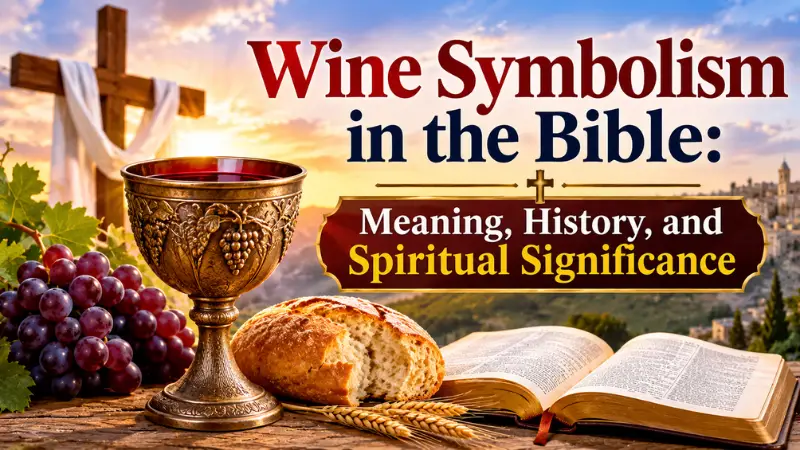
Wine symbolism in the Bible carries several meanings, including joy, celebration, abundance, fellowship, spiritual blessing, and God’s relationship with humanity. It appears in stories about family gatherings, religious ceremonies, prophetic messages, and the life and teachings of Jesus Christ. Unlike symbols with only one interpretation, wine can represent both blessing and warning depending on the passage.
For Christians and readers of biblical literature in the United States, wine is especially recognizable because of its connection to the Last Supper and Communion. It represents the blood of Jesus, the new covenant, forgiveness, and remembrance of his sacrifice. Wine also appears in wedding celebrations, agricultural imagery, and teachings about self-control.
Understanding these different meanings requires looking at the historical world of the Bible. Wine was an ordinary agricultural product in ancient Mediterranean societies, but its importance in daily life also made it a natural image for spiritual truths. Its biblical meaning developed through stories, poetry, prophecy, and Christian worship.
Quick Answer
Wine symbolism in the Bible commonly represents joy, celebration, God’s blessings, fellowship, and spiritual abundance. Historically, it also symbolizes covenant, the blood of Christ, sacrifice, judgment, and the consequences of excessive drinking, depending on the biblical passage.
TL;DR
- Wine represents joy, celebration, and God’s provision.
- The vineyard symbolizes fruitfulness, care, and spiritual responsibility.
- Jesus connects wine with his blood and the new covenant.
- Communion uses wine or grape juice to remember Christ’s sacrifice.
- Biblical warnings distinguish moderate use from drunkenness.
- Wine can also symbolize judgment, suffering, and divine wrath.
1. What Wine Represents in Biblical Symbolism
Wine has several related meanings in Scripture, and its interpretation depends on the situation in which it appears. In some passages, it represents God’s generosity and the enjoyment of life. In others, it becomes an image of spiritual responsibility, sacrifice, or punishment.
The most common symbolic meanings include:
- Joy and happiness: Wine accompanies celebrations and expresses the enjoyment of life’s blessings.
- Abundance and prosperity: A productive vineyard represents fruitful land and material provision.
- Fellowship: Sharing a cup reflects hospitality, unity, and participation in a common meal.
- Covenant and sacrifice: Wine represents Christ’s blood in the New Testament.
- Spiritual renewal: New wine can illustrate transformation and the arrival of something new.
- Judgment: A cup of wine can represent God’s anger and the consequences of wrongdoing.
These meanings are connected rather than entirely separate. A drink associated with celebration can also become an image of suffering when the biblical writer changes the setting.
For example, Psalm 104:14–15 describes wine as something that gladdens the human heart. By contrast, Jeremiah 25:15 uses a cup of wine as an image of divine judgment. The difference comes from the passage’s message, not from wine having an inherently good or bad meaning.
2. Ancient Roots of Wine in Biblical Culture
Wine was an important part of agricultural and social life in the ancient Near East. People cultivated grapevines, harvested grapes, pressed their juice, and stored fermented wine in containers. Viticulture required land, labor, seasonal attention, and knowledge passed between generations.
In ancient Israel, wine was commonly consumed alongside bread and other basic foods. It was served at meals, offered to guests, and associated with festivals. It also had economic importance because vineyards could provide a valuable agricultural product for households and communities.
This everyday role explains why biblical writers used wine in so many different ways. Their original audiences understood the work involved in producing it and recognized what a successful harvest meant for a family.
The image of wine therefore communicated more than pleasure. It could suggest security, successful farming, hospitality, and the ability to enjoy the results of one’s labor.
Wine also appeared in religious offerings. In Numbers 15:5, for example, wine is included in instructions concerning drink offerings. Its presence in worship connected agricultural production with gratitude toward God.
3. Wine as a Symbol of Joy and Celebration
One of the clearest positive meanings of wine in the Bible is happiness.
Psalm 104:14–15 describes God’s provision through plants, food, and wine. The passage places wine within a wider picture of creation supplying what human beings need to live and flourish.
This is an important distinction: the positive symbolism is not simply about drinking. It concerns receiving ordinary gifts with gratitude and recognizing the goodness of creation.
Wine also appears in celebrations involving families, communities, and important occasions. Ecclesiastes 9:7 connects eating bread and drinking wine with enjoying life. The passage encourages readers to appreciate everyday experiences rather than treating life as something to endure without gratitude.
In modern American Christianity, this interpretation often appears in discussions about:
- Family celebrations and shared meals.
- Wedding receptions and hospitality.
- Gratitude for food and agricultural abundance.
- Fellowship within religious communities.
- Appreciating ordinary blessings.
The symbolism presents celebration as a legitimate part of human life when it is accompanied by gratitude and moderation.
4. Wine and God’s Blessings of Abundance
In biblical agricultural imagery, a healthy vineyard often represents prosperity and security.
Deuteronomy 7:13 connects God’s blessings with agricultural production, including grain, wine, and oil. These products were essential signs of a successful harvest in a society that depended heavily on farming.
Similarly, 1 Kings 4:25 describes people living securely under their own vines and fig trees during Solomon’s reign. The image suggests peace, stability, and the ability to enjoy the fruits of one’s land.
Isaiah 25:6 uses a banquet with rich food and well-aged wine to portray a future celebration associated with God’s saving work.
Wine in these passages is therefore connected with more than personal wealth. It represents a community having enough to eat, a productive environment, and freedom from constant insecurity.
This meaning remains recognizable in American culture, where vineyard imagery often appears in discussions of harvest, family heritage, rural life, and agricultural abundance.
5. The Vineyard as a Symbol of God’s Relationship With His People
The Bible frequently uses vineyards to describe God’s relationship with Israel.
One important example appears in Isaiah 5:1–7, where the prophet presents Israel as a vineyard carefully planted and maintained by its owner. Despite receiving attention and care, the vineyard produces undesirable fruit.
The image communicates a moral expectation: receiving God’s care should lead to justice and righteousness.
The vineyard represents the people, while its fruit represents the results of their collective behavior. The disappointment of the owner illustrates the difference between what God expects and what the community actually produces.
Jesus later uses vineyard imagery in Matthew 21:33–46. In this parable, a landowner prepares a vineyard, rents it to tenants, and sends servants to collect its produce. The tenants reject and mistreat those sent to them.
The story addresses responsibility, rejection of God’s messengers, and accountability.
These passages show that vineyards do not always symbolize prosperity. Sometimes they represent spiritual responsibility and the consequences of failing to meet it.
6. Wine as a Symbol of Covenant and the Blood of Jesus
The connection between wine and the blood of Jesus is among the most important meanings in Christian biblical symbolism.
During the Last Supper, Jesus shared bread and a cup with his disciples. In Matthew 26:27–28, he connected the cup with his blood and the covenant made for many.
Luke 22:20 describes the cup as the new covenant in his blood. Paul repeats this tradition in 1 Corinthians 11:25.
To understand the importance of this language, it helps to consider the Old Testament.
In Exodus 24:8, Moses uses sacrificial blood when describing the covenant between God and Israel. Blood represents the solemn establishment of a relationship involving commitment and responsibility.
When Jesus connects the cup with his blood, the language recalls this earlier covenant tradition while introducing the Christian understanding of his approaching death.
For Christians, wine consequently represents:
- Christ’s sacrifice.
- Forgiveness of sins.
- The establishment of the new covenant.
- Reconciliation between God and humanity.
- Participation in the Christian community.
This interpretation is central to Communion and the Eucharist. Christian traditions differ in how they explain the relationship between the consecrated wine and Christ’s blood, but they share the importance of remembering Jesus’ words and sacrifice.
7. Wine at the Last Supper and the Meaning of Communion
The Last Supper gives wine a special place in Christian worship.
According to Matthew, Mark, and Luke, Jesus shared a final meal with his disciples before his arrest and crucifixion. During that meal, he gave new significance to the cup.
The event connects an ordinary shared meal with the central Christian message of sacrifice and redemption.
In the United States, Christians encounter this symbolism through different forms of worship.
Catholic churches celebrate the Eucharist, in which consecrated wine is understood as the Blood of Christ. Many Protestant churches observe Communion or the Lord’s Supper, with differing theological explanations of Christ’s presence.
Some Protestant congregations use grape juice rather than fermented wine. This practice is particularly familiar in American churches influenced by temperance movements and traditions of alcohol abstinence.
The choice of beverage does not erase the central meaning of the ceremony for these congregations. The emphasis remains on Christ’s sacrifice, remembrance, and the unity of believers.
8. Wine at the Wedding in Cana: Celebration and Transformation
One of the most recognizable stories involving wine appears in John 2:1–11.
Jesus attends a wedding in Cana with his mother and disciples. During the celebration, the hosts run out of wine, creating an embarrassing problem for the wedding party.
Jesus then turns water into wine. The event becomes the first sign described in John’s Gospel and reveals something about his identity and ministry.
Several symbolic interpretations emerge from the story.
Hospitality: The miracle prevents a wedding celebration from ending in embarrassment. It demonstrates concern for an ordinary human occasion.
Abundance: The quantity and quality of the wine suggest generosity rather than bare necessity.
Transformation: Water becoming wine provides an image of change and points toward the new possibilities associated with Jesus’ ministry.
Revelation: John presents the event as a sign through which Jesus’ glory becomes visible to his disciples.
For American readers, this passage is especially relevant because wine remains associated with weddings and communal celebrations. However, its biblical significance goes beyond wedding customs: the story connects celebration with the revealing of Jesus’ identity.
9. New Wine as a Symbol of Spiritual Renewal
The expression “new wine” has a special place in the New Testament.
In Matthew 9:16–17, Jesus explains that new wine should be placed in new wineskins. Otherwise, the expanding wine can cause old wineskins to burst.
The immediate teaching concerns the incompatibility of old and new wineskins, but the image also communicates a broader point about change.
Jesus uses the familiar process of storing wine to explain why his ministry cannot simply be fitted into every existing religious expectation.
New wine can therefore symbolize:
- New beginnings.
- Spiritual renewal.
- Change in religious understanding.
- The arrival of a new stage in God’s work.
- The need for openness to transformation.
The metaphor is not an instruction to reject everything old. Rather, it highlights the importance of recognizing when a new reality requires a different response.
In modern Christian language, people sometimes use “new wine” to describe spiritual growth, renewed faith, or a fresh movement within a church community. Such uses are interpretations of the biblical image rather than a single fixed definition.
10. Wine as a Symbol of Judgment and Divine Wrath
Wine does not always have a positive meaning in Scripture.
Some biblical passages describe a cup filled with wine as an image of judgment. Instead of representing celebration, the cup represents the consequences of wrongdoing and the experience of divine punishment.
Psalm 75:8 presents a cup in God’s hand containing a strong mixture that the wicked are made to drink. Jeremiah 25:15 uses similar imagery when describing judgment upon nations.
The Book of Revelation also uses wine imagery in its descriptions of divine wrath and the consequences of allegiance to evil.
This symbolism works through a contrast. A cup normally associated with hospitality and shared enjoyment becomes an image of something unwanted and unavoidable.
The reader is confronted with a different kind of drinking: not a celebration freely chosen, but an experience of judgment.
Understanding this distinction prevents a common mistake in biblical interpretation. Wine does not automatically symbolize blessing simply because it appears in Scripture. Its meaning must be determined by the surrounding story or teaching.
11. Biblical Warnings About Drunkenness and Excess
The Bible distinguishes between wine as a gift and drunkenness as a harmful behavior.
Proverbs 20:1 warns that wine can become deceptive and lead people away from wise judgment. Proverbs 23:29–35 describes the physical, emotional, and behavioral consequences of excessive drinking.
Other passages reinforce this concern:
- Ephesians 5:18 warns believers against drunkenness.
- Proverbs 31:4–5 cautions rulers about drinking when responsible decisions must be made.
- 1 Peter 4:3 refers to excessive drinking among behaviors Christians should leave behind.
These teachings do not all make the same argument about alcohol. Their common concern is the loss of self-control, impaired judgment, irresponsible conduct, and the damage that excess can cause.
This distinction matters in American Christian communities, where attitudes toward alcohol vary considerably. Some churches permit moderate consumption, while others encourage complete abstinence.
The broader biblical lesson is that a good thing can become harmful when it controls a person’s behavior.
12. The Cup of Suffering: Another Meaning of Wine
Wine and the cup sometimes represent suffering rather than celebration.
In Matthew 20:22, Jesus asks James and John whether they can drink the cup he is about to drink. The question refers to the suffering and sacrifice associated with his mission.
Later, in the Garden of Gethsemane, Jesus prays about the cup of suffering before his arrest (Matthew 26:39).
The image is significant because it reverses the familiar meaning of a shared cup. Instead of inviting someone to enjoy a celebration, Jesus uses the cup to describe the cost of remaining faithful to his purpose.
In Christian interpretation, this imagery can communicate:
- Sacrifice for others.
- Accepting difficult responsibilities.
- Enduring hardship.
- Faithfulness during suffering.
- Obedience to God’s will.
The cup of suffering should not be confused with the wine of Communion, although the two images are connected through the events leading to the crucifixion.
Communion remembers Christ’s sacrifice, while the cup of suffering emphasizes the ordeal he willingly faced.
13. How Different Christian Traditions Interpret Wine
Christians generally recognize wine as an important biblical image, but they do not always agree about its sacramental meaning or appropriate use.
| Christian tradition | Understanding of wine | Common practice |
|---|---|---|
| Roman Catholic | Consecrated wine becomes the Blood of Christ. | Fermented grape wine is used in the Eucharist. |
| Eastern Orthodox | Wine participates in the sacramental mystery of Christ’s Blood. | Fermented wine is used during the Divine Liturgy. |
| Lutheran | Communion involves Christ’s real presence, understood through Lutheran theology. | Wine is commonly used in the Lord’s Supper. |
| Baptist | Communion is generally observed as a remembrance of Christ’s sacrifice. | Many congregations use grape juice. |
| Methodist | Wine or grape juice may be used, depending on the congregation and tradition. | Practices emphasize remembrance and participation in Christ’s grace. |
These differences reflect broader disagreements about sacraments, biblical interpretation, and the role of religious tradition.
For example, Catholic teaching describes the Eucharistic change through the doctrine of transubstantiation. Many Protestant communities understand Communion differently, although they also regard it as an important expression of Christian faith.
In the United States, the use of grape juice is particularly associated with some Protestant churches and the historical influence of temperance movements.
It is important not to assume that every Christian community interprets Communion in precisely the same way.
14. Wine Symbolism in Modern American Christian Culture
Wine remains visible in American religious life, even among Christians who avoid alcoholic beverages.
Its most recognizable appearance is in Communion services. The cup represents remembrance of Jesus, the new covenant, and the shared identity of believers.
Wine-related imagery also appears in Christian artwork, church decorations, Bible illustrations, and religious education.
Common examples include:
- Communion chalices: Represent the cup shared by Jesus and his disciples.
- Grape clusters: Represent fruitfulness, provision, and the vine.
- Vine illustrations: Refer to Jesus’ teaching in John 15.
- Wedding imagery: Connect wine with celebration and the wedding at Cana.
- Church artwork: Uses grapes, leaves, and cups to communicate sacramental themes.
The grapevine has another important Christian association in John 15:1–5. Jesus describes himself as the true vine and his followers as branches.
This teaching emphasizes the relationship between spiritual life and continued connection with Christ. Branches cannot produce fruit independently of the vine, just as believers need to remain connected to their spiritual source.
For many American Christians, this image is more immediately recognizable than the symbolism of wine itself.
15. Emotional and Psychological Meaning of Biblical Wine
Wine symbolism also communicates recognizable human experiences.
Its positive meanings are closely associated with belonging, gratitude, hospitality, and celebration. Sharing a drink at a meal can represent trust and acceptance because it involves participating in a common experience.
In biblical narratives, a shared cup can also establish a sense of community. The Last Supper illustrates this particularly well: Jesus gathers his disciples around a meal before his death, giving an ordinary act of fellowship a lasting religious meaning.
The negative imagery communicates a different emotional experience.
A cup of judgment can suggest fear, accountability, and the consequences of wrongdoing. The image of drunkenness can communicate vulnerability, poor decisions, and the loss of personal control.
These meanings explain why wine works so effectively as a biblical metaphor. It belongs to ordinary human life, so readers can understand its symbolic implications without needing an unfamiliar object or abstract concept.
For contemporary readers, the central emotional contrast is between gratitude and excess, fellowship and isolation, or celebration and suffering.
16. Common Misunderstandings About Wine in the Bible
Several popular interpretations simplify biblical wine symbolism too much.
Misunderstanding 1: Wine always represents God’s blessing.
Wine can represent prosperity and joy, but it also appears in passages about judgment, suffering, and moral failure. Its meaning depends on the context.
Misunderstanding 2: The Bible teaches that drinking alcohol is always sinful.
The biblical discussion is more complicated. Wine appears in positive settings, but drunkenness and irresponsible consumption receive strong warnings. Christian denominations also differ in their practical teachings about alcohol.
Misunderstanding 3: Wine in Communion has exactly the same meaning in every church.
Christian traditions share the connection with Jesus’ sacrifice but differ in their explanations of Christ’s presence in the sacrament.
Misunderstanding 4: New wine always predicts a specific modern religious event.
The wineskins metaphor in Matthew 9 primarily illustrates the relationship between Jesus’ ministry and existing religious expectations. Modern applications should not replace the passage’s original context.
Misunderstanding 5: Biblical wine was identical to modern commercial wine.
Ancient wine production, storage, and drinking practices differed from contemporary commercial production. It is therefore unwise to assume that every modern beverage comparison accurately reflects biblical conditions.
The safest approach is to interpret each passage according to its literary, historical, and religious setting rather than assigning one universal meaning to every appearance of wine.
17. Wine Symbolism Compared Across Biblical Contexts
The following comparison shows how the same object can communicate very different ideas depending on the passage.
| Biblical context | Symbolic meaning | Key Bible reference | Main message |
|---|---|---|---|
| Daily life | Joy and provision | Psalm 104:14–15 | Enjoying God’s gifts |
| Agricultural harvest | Abundance and prosperity | Deuteronomy 7:13 | Fruitfulness and blessing |
| Wedding at Cana | Celebration and transformation | John 2:1–11 | Jesus reveals his glory |
| Last Supper | Covenant and sacrifice | Matthew 26:27–28 | Christ’s blood and forgiveness |
| New wineskins | Renewal and change | Matthew 9:16–17 | Making room for something new |
| Cup of judgment | Divine punishment | Jeremiah 25:15 | Accountability for wrongdoing |
The comparison highlights an important principle: wine is not a symbol with one permanent meaning. Its significance changes according to the message, characters, and circumstances surrounding it.
FAQs
1. What does wine symbolize spiritually in the Bible?
Wine spiritually represents joy, God’s blessings, fellowship, spiritual abundance, and covenant. In the New Testament, it also represents the blood of Jesus and his sacrifice for humanity.
2. Does wine symbolize the Holy Spirit in the Bible?
Wine is sometimes associated with spiritual celebration and renewal, but the Bible does not establish wine as a universal symbol of the Holy Spirit. Interpretations connecting new wine with the Spirit are generally theological applications of particular passages.
3. What does red wine symbolize in Christianity?
Red wine is especially associated with the blood of Jesus during Communion. Its color helps communicate the connection between the Last Supper, Christ’s sacrifice, forgiveness, and the new covenant.
4. What does dreaming about wine mean biblically?
The Bible does not provide a universal interpretation for dreaming about wine. Depending on the biblical imagery someone associates with it, wine might suggest celebration, abundance, temptation, or judgment, but a modern dream should not automatically be treated as a divine message.
5. Is wine a positive or negative symbol in the Bible?
Wine can have both positive and negative meanings. It represents joy, hospitality, and prosperity in some passages, while other passages use it to illustrate drunkenness, suffering, and divine judgment.
6. Why did Jesus use wine during the Last Supper?
Jesus connected the cup of wine with his blood and the new covenant. This established the foundation for Christian Communion, through which believers remember his sacrifice and its significance.
7. What does new wine symbolize in Matthew 9:17?
New wine represents something that cannot simply be contained within old structures. Jesus uses the comparison with wineskins to explain why his ministry brings a new reality that requires an appropriate response
Conclusion
Wine symbolism in the Bible connects ordinary human experiences with important spiritual teachings. It represents joy, agricultural abundance, hospitality, fellowship, and gratitude, while also communicating sacrifice, covenant, suffering, and judgment. Its meaning depends on how biblical writers use it in individual passages.
For modern American Christians, the most recognizable association remains the wine of Communion, which connects the Last Supper with the blood of Jesus and the new covenant. Other biblical images, including the wedding at Cana, the vineyard, and the new wineskins, add further meanings involving celebration, responsibility, and renewal.
Ultimately, understanding biblical wine symbolism means looking beyond the drink itself. It reveals how Scripture uses familiar elements of everyday life to explain faith, human responsibility, and the relationship between God and humanity.