Introduction
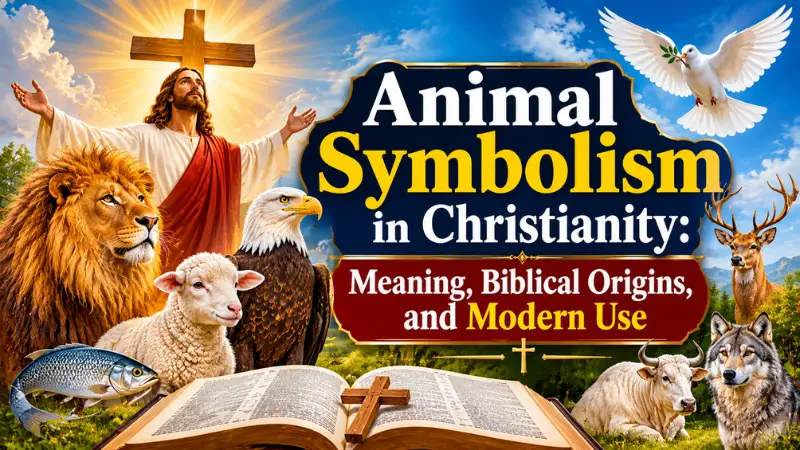
Animals play an important role in Christian symbolism. From the lamb associated with Jesus Christ to the dove representing the Holy Spirit, different creatures communicate religious ideas that might otherwise require lengthy explanations. Their meanings come from biblical stories, teachings, parables, early Christian artwork, and centuries of religious tradition.
Animal symbolism in Christianity helps believers understand spiritual themes such as innocence, sacrifice, resurrection, wisdom, protection, and redemption. Some animals represent positive qualities, while others serve as warnings about temptation, pride, danger, or spiritual deception.
In the United States, Christian animal imagery appears in churches, stained-glass windows, religious paintings, Christmas decorations, Easter celebrations, jewelry, tattoos, and personal expressions of faith. Understanding these symbols requires looking beyond their appearance and considering the biblical stories and theological ideas behind them.
Quick Answer
Animal symbolism in Christianity commonly represents faith, purity, sacrifice, protection, and the relationship between God and humanity. Historically, animals gained their religious meanings through biblical narratives, teachings of Jesus, early Christian art, and traditions that used creatures such as the lamb, dove, lion, fish, and eagle to communicate spiritual truths.
TL;DR
- The lamb represents Jesus, innocence, sacrifice, and redemption.
- The dove symbolizes the Holy Spirit, peace, and divine presence.
- The lion communicates Christ’s authority, courage, and kingship.
- The fish became an early symbol of Christian identity.
- The serpent can represent temptation, evil, or spiritual wisdom.
- Eagles symbolize renewal, strength, and trust in God.
Why Animals Are Important in Christian Symbolism
Christianity uses animals to make spiritual teachings easier to recognize and remember. Biblical writers frequently drew on familiar creatures because their characteristics were understandable to people living in agricultural societies.
A lamb, for example, was familiar to communities that raised sheep for food, clothing, and religious sacrifice. Its vulnerability made it an effective image of innocence and sacrifice. A lion, by contrast, suggested authority and strength because of its position as a formidable predator.
Animals also appear in biblical parables, prophetic visions, historical accounts, and descriptions of worship. Their meanings depend on the passage in which they appear.
Three important distinctions help explain Christian animal imagery:
- Biblical symbolism: An animal represents an idea within a particular Scripture passage.
- Traditional Christian symbolism: Religious communities develop additional meanings through worship, teaching, and artwork.
- Personal symbolism: Individuals use animal images to express their own understanding of faith.
These categories sometimes overlap, but they are not interchangeable. An animal appearing in the Bible does not automatically have one fixed religious meaning.
Historical Origins of Animal Symbols in Christianity
Animal symbolism in Christianity developed from Jewish Scripture, the teachings of Jesus, early Christian worship, and the artistic traditions of the ancient Mediterranean world.
The Old Testament already used animals to communicate religious lessons. Sheep represented God’s people, the serpent appeared in the story of Eden, and the eagle illustrated divine protection and renewal. Sacrificial animals also played an important role in Israelite religious life.
The New Testament expanded these associations. Jesus described Himself as the Good Shepherd, referred to His followers as sheep, and was identified as the Lamb of God. The Gospels also describe the Holy Spirit descending upon Jesus in the form of a dove during His baptism.
During the first centuries of Christianity, believers used recognizable animal images in religious art, including paintings in Roman catacombs. The fish, lamb, dove, peacock, and other creatures appeared in visual expressions of Christian hope and belief.
As Christian churches developed, animal imagery became increasingly elaborate. Medieval artists incorporated creatures into stained glass, manuscripts, church decorations, sculptures, and religious paintings. Some represented biblical events, while others illustrated moral lessons about virtues and sins. New Advent+2
The Lamb: Innocence, Jesus Christ, and Sacrifice
The Lamb of God | Stained Glass Art
8
The lamb is one of the most recognizable animals in Christian religious imagery. It commonly represents Jesus Christ, innocence, humility, sacrifice, and redemption.
Its meaning comes from several connected biblical traditions.
In the Old Testament, lambs were used in sacrificial worship. The Passover story also describes the use of a lamb’s blood as a sign of protection for the Israelites in Egypt. These traditions helped establish the lamb as an image associated with sacrifice and deliverance.
In the New Testament, John the Baptist calls Jesus the Lamb of God (John 1:29). This description connects Jesus with the idea of an innocent sacrifice offered for the forgiveness of sin.
The Book of Revelation develops the imagery further by presenting the Lamb as victorious and worthy of worship. Here, the lamb is not simply a picture of weakness. It represents Christ’s victory through self-giving sacrifice.
In American churches, lamb imagery frequently appears around Easter, particularly in artwork depicting the crucifixion and resurrection. It is also used in Christian children’s books, baptismal decorations, religious jewelry, and church stained glass.
Main symbolic meanings:
- Innocence and purity
- Jesus Christ and divine sacrifice
- Forgiveness and redemption
- Humility and gentleness
- Victory over sin and death
The Dove: The Holy Spirit and Peace
Der heilige Severin: Bischof und Schutzpatron von Köln
Matthew 3:16 Devotional: When the Heavens Open: Seeing the Spirit in the Ordinary Waters | Bible Art
Missions — St. Andrew United Methodist Church ~ Titusville, Florida – Worship 10:00am
8
The dove represents the Holy Spirit, peace, purity, and divine presence in Christian tradition.
Its most important biblical connection appears in the accounts of Jesus’ baptism. According to Matthew 3:16, the Spirit of God descends like a dove and comes upon Jesus. This event established the dove as a recognizable visual representation of the Holy Spirit.
The dove also appears in the Old Testament story of Noah’s Ark. After the flood, Noah sends out a dove, which eventually returns with a freshly picked olive leaf. The bird indicates that the waters are receding and that the earth is becoming habitable again (Genesis 8:11).
This story connects the dove with peace, restoration, and the possibility of a new beginning.
In American Christian communities, white doves commonly appear in baptism ceremonies, church artwork, wedding decorations, and religious greeting cards. Some churches also use dove imagery during Pentecost, which celebrates the coming of the Holy Spirit.
A dove carrying an olive branch can communicate reconciliation and peace, while a dove surrounded by rays of light more directly suggests divine presence.
The Lion: Courage, Authority, and Christ’s Kingship
What does Revelation 5:5 mean? | Bible Art
Ces animaux qui symbolisent le Christ
This item is unavailable – Etsy
7
The lion represents strength, courage, authority, protection, and kingship in Christian symbolism.
One of its most important biblical associations is the Lion of Judah. In Genesis 49:9, Judah is compared to a young lion. The imagery becomes especially significant in Revelation 5:5, where Jesus is identified as the Lion of the tribe of Judah.
This title emphasizes Christ’s royal authority and victory.
The lion also appears in the story of Daniel in the lions’ den (Daniel 6). Daniel’s survival demonstrates God’s protection and his faithfulness under pressure.
However, lions do not always represent goodness. First Peter 5:8 compares the devil to a roaring lion searching for someone to devour. In this passage, the animal illustrates danger, aggression, and spiritual opposition.
For American Christians, lion imagery frequently appears in church logos, men’s ministry designs, Christian clothing, wall decorations, and tattoos. The Lion of Judah is particularly popular among people who want to express courage and confidence in Christ.
The meaning depends on the surrounding imagery. A crowned lion may communicate kingship, while a lion standing beside a lamb can express the relationship between Christ’s authority and sacrificial nature.
The Fish: Christian Identity and Faith
Si vous voyez ce symbole de poisson sur une voiture, vous devriez savoir ce qu’il signifie
The fish, commonly called the Ichthys or Ichthus, is among the oldest recognizable symbols associated with Christianity.
Its importance comes partly from the Greek word for fish, whose letters form an acrostic expressing the phrase “Jesus Christ, Son of God, Savior.”
The fish also connects with several Gospel stories. Jesus calls fishermen to become His disciples (Matthew 4:19), multiplies fish to feed a crowd, and appears to His disciples in a resurrection account involving fish (John 21).
These connections helped make the fish a natural representation of Christian faith and discipleship.
Early Christians used the fish in visual art and religious settings. It could identify a Christian community or communicate belief without requiring a lengthy written statement. New Advent+1
Today, Americans often recognize the fish as a Christian symbol when it appears on vehicle bumpers, business signs, church materials, clothing, and jewelry.
Its meaning is generally straightforward: the person displaying it wants to communicate an association with Jesus Christ and Christian belief.
The Eagle: Renewal, Strength, and Trust in God
Bird Symbolism in Christianity: Doves, Eagles, and What They Represent | Funeral.com, Inc.
The eagle represents strength, renewal, spiritual perspective, and confidence in God’s sustaining power.
Its biblical significance is especially clear in Isaiah 40:31, which describes those who trust in the Lord as renewing their strength and rising on wings like eagles.
The eagle’s ability to soar high above the ground makes it a fitting image of endurance and hope. It suggests the ability to continue through difficulty rather than surrender to exhaustion.
Another important passage appears in Exodus 19:4, where God reminds Israel that He carried them on eagles’ wings and brought them to Himself. The imagery communicates divine care and protection.
In Christian art, the eagle is also associated with John the Evangelist. This connection comes from the traditional identification of the four living creatures in Revelation 4 with the four Gospel writers.
In the United States, eagle imagery has an additional cultural association with national identity because the bald eagle is the country’s national bird. However, a Christian eagle image and an American patriotic eagle image do not necessarily communicate the same message.
When the eagle appears alongside a Bible verse or religious artwork, it generally emphasizes faith, spiritual endurance, and renewal.
The Serpent: Temptation, Evil, and Wisdom
EDENSKI VRT I NJEGOVA SIMBOLIKA (2.DIO) – Transpersonalna psihologija
The serpent has one of the most complicated meanings in Christian symbolism. It can represent temptation, deception, sin, evil, and, in a different biblical context, healing and caution.
Its negative association begins in Genesis 3, where the serpent tempts Eve in the Garden of Eden. The episode introduces disobedience and humanity’s separation from God into the biblical narrative.
In Revelation 12:9, the ancient serpent is identified with the devil and Satan. This connection reinforces the serpent’s association with spiritual deception.
However, Scripture also gives the serpent a more complicated role.
In Numbers 21:8–9, Moses raises a bronze serpent so that Israelites bitten by snakes can look at it and live. Jesus later refers to this event in John 3:14 when explaining His own coming crucifixion.
Matthew 10:16 offers another distinction: Jesus tells His followers to be wise as serpents and innocent as doves. Here, serpent-like wisdom means practical awareness rather than wickedness.
For modern American Christians, a serpent surrounding a tree usually suggests the temptation in Eden. A bronze serpent may instead refer to healing, salvation, and the connection Jesus makes in the Gospel of John.
The Sheep: Guidance, Belonging, and God’s Care
The Voice of the Shepherd – Catholic Daily Reflections
catholic-daily-reflections.com
Sheep represent believers, dependence on God, spiritual guidance, and belonging to a faith community.
One of the best-known biblical passages is Psalm 23, which describes God as a shepherd who provides guidance, protection, and rest.
Jesus develops this image in John 10 by describing Himself as the Good Shepherd who knows His sheep and lays down His life for them.
This relationship communicates more than obedience. It expresses trust, care, and the belief that God does not abandon those who belong to Him.
Sheep also appear in Jesus’ parables. In Luke 15:3–7, a shepherd leaves the other ninety-nine sheep to search for one that has become lost. The story illustrates God’s concern for people who have wandered away.
American churches frequently use sheep imagery in children’s ministries, Sunday school illustrations, Christian books, and educational materials. It is especially effective when teaching children about God’s guidance and the importance of community.
The Lamb and the Lion: Two Images of Christ
The combination of the lamb and lion offers an interesting way to understand Christian ideas about Jesus.
The lamb represents sacrifice, humility, and innocence. The lion communicates authority, kingship, courage, and victory.
Although the images appear to suggest opposite qualities, Christian theology brings them together in the person of Christ.
Jesus is presented as the Lamb who gives Himself for humanity and the victorious King who defeats evil. Revelation 5 is particularly important because it introduces the Lion of Judah and then describes a Lamb standing as though it had been slain.
This contrast helps explain why the two animals sometimes appear together in Christian paintings, jewelry, tattoos, and church decorations.
The combined image communicates a particular understanding of Christian leadership: genuine authority is not simply about force or domination. It is also expressed through sacrifice, love, and service.
The Deer: Spiritual Longing and the Desire for God
Psalms 42:1 – Sanctuary Expressions
The deer, particularly the stag, symbolizes spiritual longing, devotion, and the desire to experience God’s presence.
Its most recognizable biblical connection appears in Psalm 42:1:
“As the deer pants for streams of water, so my soul pants for you, my God.”
The comparison describes a person’s longing for God as a thirsty animal’s need for water. It communicates spiritual hunger, dependence, and the search for fulfillment through faith.
In traditional Christian artwork, a deer drinking from a stream can represent the soul seeking spiritual nourishment. The image is also associated with baptism and the waters of salvation in some Christian artistic traditions.
In the United States, deer imagery is less common than the dove or lamb in mainstream church decorations. However, it appears in Christian nature artwork, devotional prints, Bible illustrations, and personal jewelry.
Its central message is that faith involves an ongoing desire to know God rather than simply following religious practices.
The Pelican: Self-Sacrifice and Christ’s Love
The Pelican & the Alchemy of the Self
The pelican has a distinctive place in traditional Christian art because it represents self-sacrifice, charity, and Christ’s willingness to give His life for humanity.
The symbolism developed from an old natural-history legend claiming that a mother pelican wounded her own breast to feed her young with her blood during a time of hunger.
This account was not an accurate description of pelican behavior. Nevertheless, medieval Christians adopted the story as a religious illustration of sacrificial love.
The image became known as the Pelican in Her Piety. It often shows a parent pelican bending toward its chicks in a nest.
Christian artists used the image to communicate Christ’s sacrifice and, particularly in later medieval traditions, the Eucharist.
In modern American churches, pelicans are relatively uncommon compared with lambs and doves. They can still be found in historic church decorations, religious architecture, stained glass, and traditional Christian artwork.
The pelican is a useful reminder that some Christian symbols developed through religious interpretation of folklore rather than direct biblical descriptions. New Advent+1
The Peacock and Phoenix: Resurrection and Eternal Life
Bible | Messiah | Resurrection — The Anástasis Center
7
The peacock and phoenix are two birds associated with immortality, resurrection, and life beyond death in historical Christian art.
Their meanings developed through ancient beliefs and visual traditions rather than direct biblical descriptions.
The peacock became associated with eternal life because people in the ancient world believed its flesh did not decay after death. Early Christians adopted this existing association and used peacocks in religious artwork to express the hope of immortality and resurrection.
However, the peacock could also represent vanity and pride. Its colorful display and elaborate feathers made it an appropriate image for excessive self-importance in some moral interpretations.
The phoenix comes from ancient mythology. According to the traditional legend, the bird eventually dies and rises again through a process associated with fire and rebirth.
Early Christians found a useful comparison between this legendary renewal and the resurrection of Jesus Christ. The phoenix consequently appeared in some early Christian artwork as an image of life overcoming death.
Neither bird is a central animal symbol in everyday American Christian worship today. Nevertheless, both remain important when studying historic churches, ancient mosaics, Christian funerary artwork, and the development of resurrection imagery. New Advent+1
Animal Symbolism in Different Christian Traditions
Christian traditions share many biblical animal associations, but their use in religious artwork and worship can differ.
Catholic and Eastern Orthodox communities have particularly extensive histories of religious iconography. Their churches may display lambs, doves, eagles, lions, peacocks, and other creatures in mosaics, paintings, vestments, and architectural decoration.
Many Protestant traditions also use biblical animal imagery, although some denominations favor simpler church interiors and fewer decorative religious images.
The following table summarizes commonly recognized meanings.
| Animal | Christian symbolic meaning | Important biblical connection | Common modern use |
|---|---|---|---|
| Lamb | Sacrifice, innocence, redemption | John 1:29 | Easter and church artwork |
| Dove | Holy Spirit and peace | Matthew 3:16 | Baptisms and weddings |
| Lion | Courage, kingship, authority | Revelation 5:5 | Tattoos and church designs |
| Fish | Jesus Christ and Christian identity | Matthew 4:19 | Jewelry and vehicle emblems |
| Eagle | Renewal and divine strength | Isaiah 40:31 | Inspirational artwork |
| Serpent | Temptation, deception, wisdom | Genesis 3; Matthew 10:16 | Biblical illustrations |
| Sheep | Believers and God’s guidance | John 10 | Children’s ministry |
| Deer | Spiritual longing | Psalm 42:1 | Devotional artwork |
| Pelican | Self-sacrifice and charity | Traditional Christian art | Historic church decoration |
| Peacock | Immortality and, sometimes, pride | Early Christian art | Religious mosaics |
These meanings are common associations, not a universal dictionary. A particular animal can communicate different ideas depending on the biblical passage, denomination, artistic period, and surrounding imagery.
Animal Symbolism in American Christian Culture
In the United States, Christian animal imagery is part of everyday religious and cultural life.
People encounter these symbols in churches, religious holidays, family celebrations, Christian businesses, clothing, and personal expressions of belief.
Several settings are especially important.
Churches and religious architecture: Lambs, doves, lions, and eagles appear in stained-glass windows, altar decorations, wall paintings, and church logos. Older churches may also preserve traditional images such as the pelican or peacock.
Easter celebrations: Lamb imagery is particularly common during Easter because it connects Jesus’ sacrifice with resurrection and redemption. Doves and other birds may also appear in seasonal decorations.
Baptisms and weddings: White doves are popular in religious designs because of their association with the Holy Spirit, purity, and peace.
Christian education: Sheep, fish, lions, and doves are used in children’s Bibles, Sunday school materials, classroom decorations, and religious illustrations.
Personal identity: Some Americans display the Christian fish on vehicles or wear crosses and animal-themed jewelry to communicate their beliefs.
There is also an important distinction between Christian and national symbolism. The bald eagle, for example, is primarily an American national emblem. Although its qualities can be connected with biblical ideas of strength and renewal, an American eagle does not automatically represent Christianity.
What Animal Colors Mean in Christian Artwork
Colors can add another layer of meaning to Christian animal imagery. Their interpretation depends on the artwork, religious tradition, and biblical context.
- White: Commonly associated with purity, innocence, holiness, and victory. White doves and lambs often communicate these ideas.
- Red: Can represent blood, sacrifice, martyrdom, and the Passion of Christ. A red lamb or red accents in religious artwork may emphasize Christ’s suffering.
- Gold: Often communicates heavenly glory, divine majesty, and holiness. Golden backgrounds are particularly familiar in traditional religious iconography.
- Blue: Frequently associated with heaven, faithfulness, and the divine. A blue background surrounding a dove can reinforce its spiritual significance.
- Green: Can suggest renewal, growth, hope, and new life.
These associations should not be treated as rigid rules. For example, a white animal may simply be depicted in its natural appearance rather than as a deliberate statement about purity.
Emotional and Psychological Meaning of Christian Animal Symbols
Christian animal symbols communicate emotions and spiritual attitudes through recognizable images.
A lamb can make viewers think about gentleness, vulnerability, forgiveness, and compassion. It can also remind Christians of the cost of sacrifice and the importance of humility.
A lion often communicates confidence, bravery, and protection. Someone choosing a Lion of Judah tattoo may want to express courage while acknowledging Christ as the source of their strength.
The dove creates a different emotional impression. Its gentle appearance and association with the Holy Spirit make it suitable for expressing comfort, reconciliation, and hope during difficult periods.
Sheep and shepherd imagery can communicate safety and belonging. It suggests that believers are not expected to navigate every difficulty alone.
These interpretations also explain why animal symbols are frequently used in memorial artwork, Christian gifts, and personal devotional spaces.
However, psychological responses are individual. A person may associate an eagle with freedom because of American culture, while another may immediately think of Isaiah 40:31.
Modern Uses of Christian Animal Symbolism
The Lamb of God Pendant Necklace in Solid Gold (Yellow/Rose/White) | eBay
DUSTIN COLLINS | Classic City Tattoo
Aufkleber Christenfisch Jesusfisch ICHTHYS Scheibenaufkleber | plot4u
8
Christian animal imagery continues to appear in modern American life, although people use it in different ways.
Tattoos: The Lion of Judah, lamb, dove, and Christian fish are popular choices for people expressing faith through body art. A lion may represent courage, while a lamb may communicate devotion to Christ.
Jewelry: Cross necklaces featuring doves, lamb pendants, fish-shaped accessories, and religious rings combine visual design with personal belief.
Home decorations: Families display framed pictures of the Good Shepherd, decorative doves, biblical animal illustrations, and inspirational artwork featuring eagles.
Fashion: Christian clothing brands use lion imagery, fish symbols, and lamb designs on shirts, sweatshirts, hats, and accessories.
Social media: Animal images appear in Christian profile pictures, inspirational posts, Bible verse graphics, and church promotional materials.
Church branding: Congregations sometimes use lions to represent courage, eagles to communicate spiritual growth, or fish to identify their Christian mission.
The important difference between historical and modern use is that today’s designs often combine traditional biblical meanings with personal expression and contemporary visual style.
Misunderstandings and Misuse of Christian Animal Symbols
Animal imagery can be misunderstood when people assume that every creature has one permanent Christian meaning.
For example, the lion is often associated with Jesus as the Lion of Judah, but 1 Peter 5:8 uses a roaring lion to describe spiritual danger. The surrounding passage determines the intended message.
The serpent presents another common misunderstanding. Although it is frequently associated with Satan and temptation, the bronze serpent in Numbers 21 serves as an instrument of healing, and Jesus refers to it when discussing His crucifixion.
The eagle is sometimes interpreted as a Christian symbol simply because it appears in American patriotic designs. Its religious meaning should be distinguished from its national significance.
The phoenix and pelican also require historical context. Neither is a literal biblical animal symbol with a clearly defined role in Scripture. Their Christian meanings developed through ancient legends and later religious interpretation.
Another problem occurs when animal symbols are used to suggest that a particular person, political movement, or organization has God’s special approval. A biblical image does not automatically validate every modern use of it.
Understanding the original context helps prevent these symbols from being used inaccurately or misleadingly.
How Christian Animal Symbolism Has Changed Over Time
Christian animal symbolism has evolved as religious practices, artistic styles, and cultural traditions have changed.
In early Christianity, animals helped communicate essential beliefs about Jesus, salvation, resurrection, and eternal life. Fish, lambs, and doves were especially useful because their meanings could be understood without elaborate explanations.
During the Middle Ages, religious artists expanded this visual language. Churches incorporated lions, eagles, pelicans, peacocks, stags, and other creatures into paintings, manuscripts, sculptures, and stained glass.
Some meanings became more elaborate through medieval bestiaries, which were collections of animal descriptions and moral interpretations. These works sometimes included inaccurate claims about animal behavior, but their stories helped artists communicate religious lessons.
The Reformation brought different approaches to religious imagery. Some Protestant communities reduced the use of elaborate church decorations, while Catholic and Orthodox traditions continued developing their established visual languages.
In contemporary America, animal symbols serve both traditional and personal purposes. A person might choose a dove to express peace, a lion to represent courage, or a lamb to demonstrate devotion to Jesus.
The underlying biblical associations remain recognizable, but modern designs increasingly combine religious heritage with individual identity.
FAQs
1. What is the most important animal symbol in Christianity?
The lamb is among the most important Christian animal symbols because it represents Jesus Christ, sacrifice, innocence, and redemption. Its connection with the Lamb of God makes it especially significant during Easter and other celebrations of Christ’s sacrifice.
2. What animal represents the Holy Spirit?
The dove represents the Holy Spirit in Christianity. This association comes from Jesus’ baptism, when the Spirit descended upon Him in the form of a dove, as described in Matthew 3:16.
3. What does the lion symbolize in Christianity?
The lion commonly represents Jesus Christ’s kingship, authority, courage, and victory. The title Lion of Judah appears in Revelation 5:5, although lions can also represent spiritual danger in other biblical passages.
4. What does a fish symbolize in Christianity?
The fish, also called the Ichthys, represents Jesus Christ and Christian identity. Its Greek name forms an acrostic meaning Jesus Christ, Son of God, Savior, and it became an important identifying symbol among early Christians.
5. What does a serpent represent in the Bible?
The serpent most commonly represents temptation, deception, and Satan because of its role in Genesis 3. However, the bronze serpent in Numbers 21 also becomes an image associated with healing and, through Jesus’ reference in John 3:14, His crucifixion.
6. Are all animals positive symbols in Christianity?
No. Some animals represent negative qualities such as temptation, greed, pride, deception, and spiritual danger. The serpent, wolf, and certain birds can carry negative associations, although their meanings depend on the biblical passage and artistic context.
7. What animal represents resurrection in Christian symbolism?
The lamb is strongly associated with Christ’s victory over death, while the peacock and phoenix historically represented immortality and resurrection in Christian art. The phoenix is particularly interesting because its symbolism developed from an ancient legend rather than a direct biblical account.
Conclusion
Animal symbolism in Christianity provides a visual way to understand biblical teachings, religious traditions, and the relationship between God and humanity. The lamb communicates sacrifice and redemption, the dove represents the Holy Spirit and peace, the lion expresses Christ’s authority, and the fish identifies the Christian faith.
These meanings developed through Scripture, early Christian communities, medieval artwork, and centuries of religious interpretation. Some symbols, such as the peacock and phoenix, also demonstrate how older cultural stories became part of Christian artistic tradition.
Today, animal symbolism in Christianity remains visible in American churches, Easter celebrations, tattoos, jewelry, religious decorations, and personal expressions of faith. Understanding the biblical background makes these images more meaningful and helps distinguish traditional Christian teachings from modern interpretations.