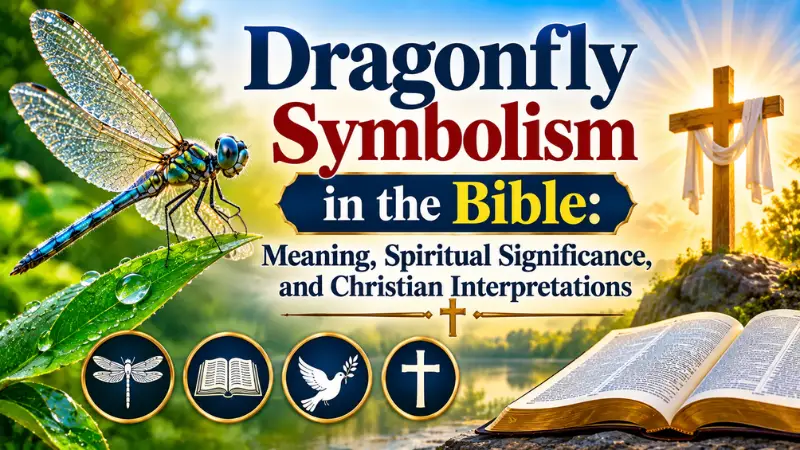
Dragonfly symbolism in the Bible is often associated with spiritual transformation, renewal, personal growth, and the beauty of God’s creation. Although dragonflies are not specifically mentioned in Scripture, many Christians find meaningful connections between the insect’s remarkable life cycle and biblical teachings about becoming a new person, embracing change, and growing in faith.
A dragonfly is a delicate insect with a long, slender body, transparent wings, and remarkable flying abilities. It begins its life underwater before emerging as a winged adult. This change from an aquatic nymph to a flying insect provides a natural illustration of transformation, making the dragonfly an interesting subject for spiritual reflection.
For Christians in the United States, seeing a dragonfly may bring thoughts of hope, fresh beginnings, God’s creativity, or a period of personal change. However, understanding its religious significance requires distinguishing between what the Bible actually teaches and the meanings people have developed through personal beliefs and cultural traditions.
Quick Answer
Dragonfly symbolism in the Bible is commonly interpreted by modern Christians as a reminder of transformation, spiritual renewal, personal growth, and God’s creative work. However, dragonflies are not directly mentioned in Scripture, so these meanings come from connecting their natural life cycle with biblical themes rather than from an established biblical teaching.
TL;DR
- Dragonflies are not specifically mentioned in the Bible.
- Their life cycle can represent spiritual transformation and new beginnings.
- Christians connect their development with becoming a new creation in Christ.
- Their appearance may remind believers of God’s creativity and creation.
- Modern American interpretations often associate dragonflies with hope and personal growth.
- Claims about angels or deceased loved ones are personal spiritual beliefs, not biblical promises.
1. Does the Bible Mention Dragonflies?
The Bible does not specifically identify dragonflies or assign them a particular spiritual meaning. Unlike doves, lambs, serpents, and eagles, which have recognizable roles in biblical imagery, dragonflies do not appear as named symbols in the biblical text.
Scripture does, however, mention several kinds of insects. Locusts appear in accounts of judgment and agricultural destruction, ants illustrate diligence in Proverbs 6:6, and bees appear in descriptions of honey and military imagery.
These examples demonstrate that insects can carry different meanings depending on their biblical context. Their symbolic significance comes from how they are used in a particular passage, not simply from their existence in nature.
The absence of dragonflies does not prevent Christians from appreciating them as part of God’s creation. It simply means that any spiritual interpretation should be presented as a personal reflection rather than a direct biblical command or promise.
This distinction is important because some modern spiritual articles describe dragonflies as if Scripture specifically identifies them as signs of angels, resurrection, or divine messages. Those claims go beyond what the Bible actually says.
2. Spiritual Meaning of Dragonflies in Christianity
Although dragonflies do not have an established biblical meaning, Christians often associate them with several spiritual ideas.
These interpretations develop from observing the insect’s physical characteristics and connecting them with familiar Christian teachings.
Common Christian interpretations include:
- Transformation: Leaving an earlier stage of life behind and embracing change.
- Renewal: Beginning a new chapter with hope and faith.
- Spiritual growth: Developing greater patience, wisdom, and understanding.
- Freedom: Moving beyond limitations and experiencing personal growth.
- God’s creation: Appreciating the beauty, variety, and complexity of the natural world.
For example, someone experiencing a major life transition might see a dragonfly near a garden or pond and consider it a reminder to remain hopeful.
A Christian might use that moment to reflect on God’s guidance without assuming that the insect was deliberately sent as a supernatural message.
The important idea is that nature can inspire reflection, while the foundation of Christian belief remains Scripture.
3. Dragonfly Symbolism and 2 Corinthians 5:17
One of the most relevant biblical passages for understanding the spiritual interpretation of a dragonfly is 2 Corinthians 5:17.
The verse teaches that anyone who is in Christ becomes a new creation. The old has passed away, and a new life has begun.
This passage describes spiritual transformation through faith in Jesus Christ.
The dragonfly’s development offers a useful visual comparison. It begins life as an aquatic nymph, living underwater and gradually developing before emerging into its adult form.
Although this biological process is not the same as Christian spiritual rebirth, it provides an illustration of leaving one stage behind and entering another.
For believers, this comparison can represent:
- Leaving destructive habits behind.
- Developing a stronger relationship with God.
- Choosing forgiveness instead of resentment.
- Moving forward after difficult experiences.
- Living according to renewed Christian values.
Consider someone who has struggled with past mistakes but has decided to rebuild their life through faith. A dragonfly may remind that person of the possibility of meaningful change.
The verse itself teaches about transformation in Christ. The dragonfly is simply a natural image that can help someone reflect on that teaching.
4. Dragonflies as Symbols of Spiritual Renewal
Renewal is another biblical theme that people commonly connect with dragonflies.
In Christianity, renewal involves more than changing circumstances. It includes a renewed attitude, restored hope, and a willingness to follow God’s direction.
Romans 12:2 encourages believers to be transformed through the renewing of their minds.
This teaching focuses on changing how people think and live rather than simply changing their outward appearance.
A dragonfly can serve as a reminder of this process because its life develops through distinct stages. Its emergence from the water offers a visual connection to leaving an earlier condition behind.
In everyday Christian life, renewal may involve:
- Rebuilding faith after disappointment.
- Finding hope after a difficult season.
- Reconsidering personal priorities.
- Developing healthier relationships.
- Returning to prayer and spiritual practices.
For example, someone recovering from a painful personal experience may find comfort in watching dragonflies near a lake.
The insect does not guarantee that difficulties will disappear. Instead, it can provide a moment to reflect on the biblical promise that spiritual renewal is possible.
5. What a Dragonfly Can Teach About God’s Creation
Another way Christians interpret dragonflies is through the biblical understanding of creation.
Psalm 19:1 describes the heavens as declaring the glory of God and the skies as displaying the work of His hands.
This passage reflects the belief that the natural world provides opportunities to appreciate God’s creativity.
Dragonflies offer several reasons for admiration. Their wings allow them to move in different directions, their large compound eyes provide an extensive field of vision, and their development connects aquatic and terrestrial environments.
These characteristics make them interesting examples of biological diversity.
For a Christian observer, noticing a dragonfly may encourage appreciation for:
- The complexity of living creatures.
- The balance of natural ecosystems.
- The variety of life on Earth.
- The relationship between living things and their environments.
- The responsibility to care for creation.
The spiritual lesson does not depend on assigning a secret meaning to the insect.
Rather, the dragonfly can remind believers to notice the natural world and appreciate the creativity reflected in its many forms.
6. Dragonfly Symbolism in the United States
In the United States, dragonflies commonly appear in garden decorations, jewelry, artwork, clothing, and personal accessories.
Their association with water, gardens, and warm weather makes them familiar sights in many American communities.
Their symbolic meanings are generally positive, although interpretations vary according to individual beliefs.
For many Americans, dragonflies represent:
Personal transformation: Their unusual life cycle makes them appealing symbols for people beginning a new chapter.
Hope and encouragement: Their presence around ponds and gardens may remind people of peaceful surroundings and better days.
Freedom and independence: Their quick, agile flight can suggest movement, flexibility, and the ability to move beyond limitations.
Connection with nature: Their delicate appearance makes them popular in garden designs and nature-inspired artwork.
In Christian communities, these interpretations may overlap with reflections on renewal, faith, and God’s creation.
However, dragonflies do not have a universal religious meaning in American culture. A Christian might interpret one through biblical teachings, while another person might simply appreciate its appearance.
7. Historical Meanings of Dragonflies in Religious and Cultural Traditions
Dragonflies have appeared in human art and decorative objects for thousands of years, although their meanings have not always been consistent.
Ancient Egyptian objects include dragonfly-shaped amulets dating to approximately 1981–1640 BCE. Their presence in decorative and personal objects suggests that people valued the insect’s recognizable form, although the exact meaning of every example cannot be established with certainty.
European interpretations were sometimes less positive.
In a Northern European Christian artistic context around 1500, the dragonfly could be associated with the devil. A painting known as Virgin and Child with a Dragonfly, created by the Master of Saint Giles, presents the insect as a creature caught by the Christ child. Its historical interpretation connects the scene with Christ’s victory over evil.
This example demonstrates why it is inaccurate to claim that dragonflies have always represented positive spiritual transformation.
Their meanings have depended on the culture, historical period, and artistic context.
In other traditions, dragonflies have been associated with speed, strength, seasonal change, and victory. These interpretations developed independently of biblical teaching.
Understanding this history helps readers separate Christian reflection from broader cultural symbolism.
8. Dragonfly Symbolism and Spiritual Growth
Spiritual growth is a gradual process that involves learning, patience, reflection, and developing a stronger relationship with God.
The dragonfly’s life cycle provides an interesting comparison.
Unlike butterflies, which undergo complete metamorphosis through a pupal stage, dragonflies develop through incomplete metamorphosis. Their young, called nymphs, live in water and gradually grow through several stages before emerging as winged adults.
Much of this development happens out of public view.
For Christians, this can serve as a reminder that personal growth is not always immediately visible.
Someone may spend months or years developing patience, rebuilding confidence, strengthening faith, or changing harmful habits before others notice the difference.
The comparison offers several practical lessons:
- Growth takes time and cannot always be rushed.
- Difficult periods can become opportunities for learning.
- Faith requires consistent effort.
- Personal change often begins internally.
- Progress does not always follow a predictable schedule.
Philippians 1:6 expresses confidence that God continues the good work He begins in believers.
A dragonfly can serve as a visual reminder of that idea, although its biological development should not be confused with the spiritual process described in the verse.
9. What Does Seeing a Dragonfly Mean Spiritually?
People sometimes wonder whether seeing a dragonfly has a special spiritual meaning.
The answer depends largely on personal belief and the circumstances in which the insect appears.
For some Christians, an unexpected dragonfly sighting may encourage thoughts about God’s creation, personal change, or the importance of remaining hopeful.
Others may simply view it as an ordinary encounter with nature.
Here are several common interpretations:
| Situation | Possible Spiritual Interpretation | Biblical Connection |
|---|---|---|
| Seeing a dragonfly near water | Reflection and personal growth | Romans 12:2 |
| Seeing one during a difficult period | Hope and encouragement | Isaiah 43:18–19 |
| Seeing one after a major life change | New beginnings | 2 Corinthians 5:17 |
| Seeing one in a garden | Appreciation of creation | Psalm 19:1 |
| Watching one emerge as an adult | Development and patience | Philippians 1:6 |
These are reflective associations rather than biblical predictions.
A dragonfly appearing at a particular time does not establish that God is sending a coded message or promising a specific future event.
Christians can appreciate meaningful moments while keeping their beliefs grounded in Scripture.
10. Do Dragonflies Represent Angels or Deceased Loved Ones?
One popular modern interpretation associates dragonflies with angels or deceased family members.
This belief is particularly common in personal spirituality, memorial jewelry, and online discussions about signs from loved ones.
For someone grieving a parent, spouse, friend, or family member, seeing a dragonfly may bring back comforting memories.
The insect may become personally associated with someone who has passed away, especially if that person enjoyed spending time outdoors or had a particular interest in nature.
However, there is an important distinction between emotional meaning and biblical teaching.
The Bible does not identify dragonflies as angels, nor does it teach that deceased people communicate with the living through dragonfly sightings.
Christians may find comfort in remembering loved ones when they encounter one, but they should not treat the sighting as proof of supernatural communication.
A healthy interpretation can recognize the emotional importance of the experience without making claims that Scripture does not support.
11. Different Dragonfly Colors and Their Symbolic Interpretations
Dragonflies come in several colors, including blue, green, red, yellow, black, and metallic shades.
People sometimes assign spiritual meanings to these colors, especially when discussing personal experiences, artwork, and jewelry.
However, the Bible does not establish specific spiritual meanings for dragonfly colors.
The following interpretations reflect modern symbolic associations rather than official Christian teachings.
| Dragonfly Color | Common Symbolic Association | Possible Personal Reflection |
|---|---|---|
| Blue | Peace, calm, and understanding | Seeking patience and clarity |
| Green | Growth and renewal | Developing faith and healthier habits |
| Red | Courage and strength | Facing difficult circumstances |
| Yellow | Joy and optimism | Appreciating hope and happiness |
| Black | Mystery and reflection | Considering personal changes |
| Purple | Wisdom and dignity | Developing spiritual understanding |
For example, a blue dragonfly might remind someone of peaceful moments spent near water.
A green dragonfly could represent growth or a fresh start in someone’s personal life.
These interpretations can make color symbolism meaningful in personal expression, but they should not be presented as biblical definitions.
12. Dragonflies in Christian Tattoos, Jewelry, and Home Decor
Dragonfly designs are popular in American personal style because they combine recognizable natural beauty with flexible symbolic meanings.
For Christians, these designs can communicate ideas about faith, growth, and appreciation for creation.
Christian dragonfly tattoos
Some people choose dragonfly tattoos to mark a period of personal change, recovery, or renewed commitment to their faith.
A dragonfly combined with a cross may communicate the person’s connection between transformation and Christian belief.
Others choose a dragonfly with a Bible verse, particularly 2 Corinthians 5:17, to represent becoming a new creation in Christ.
Dragonfly jewelry
Necklaces, bracelets, earrings, and pendants featuring dragonflies are often selected as reminders of important life experiences.
A person may wear one to remember a loved one, celebrate a fresh beginning, or express an appreciation for nature.
Home decorations
Dragonfly motifs also appear in stained-glass designs, garden ornaments, wall art, and decorative lamps.
American Arts and Crafts and Art Nouveau-inspired designs have helped maintain the insect’s popularity as an artistic motif. The dragonfly designs associated with Louis Comfort Tiffany are particularly recognizable.
For Christian households, these decorations may simply reflect an appreciation of God’s creation rather than a specific religious doctrine.
13. Emotional and Psychological Meaning of Dragonflies
Dragonflies can carry emotional significance because people often connect natural objects with personal experiences.
Their association with water, gardens, sunlight, and movement makes them suitable reminders of peaceful or meaningful moments.
Several emotional interpretations are common.
Hope after difficult experiences
Someone who has experienced disappointment may associate a dragonfly with the possibility of moving forward.
Acceptance of change
The insect’s development can remind people that life involves different stages and that change is a normal part of growth.
Freedom from the past
Its agile flight can represent a desire to move beyond unhealthy patterns, regrets, or limiting circumstances.
Peace and reflection
Watching a dragonfly near a pond may encourage someone to slow down and appreciate the present moment.
In Christian life, these emotional associations can become opportunities for prayer, gratitude, and reflection.
The important point is that the insect does not automatically produce a particular psychological response. Its meaning depends on the person’s memories, experiences, and beliefs.
14. Common Misunderstandings About Biblical Dragonfly Symbolism
Online discussions sometimes present dragonfly interpretations as established biblical facts. This can create confusion for readers who want an accurate Christian understanding.
Several misunderstandings deserve clarification.
Misunderstanding 1: Dragonflies are mentioned in the Bible.
They are not specifically identified in Scripture. Their spiritual significance comes from later interpretation and personal reflection.
Misunderstanding 2: A dragonfly always represents an angel.
There is no biblical teaching establishing dragonflies as signs of angels. This is a modern spiritual belief.
Misunderstanding 3: A dragonfly sighting predicts a major life change.
The insect’s appearance does not provide a reliable prediction about someone’s future.
Misunderstanding 4: Every dragonfly color has a biblical meaning.
Color interpretations are generally drawn from modern symbolism and personal associations, not specific biblical passages.
Misunderstanding 5: Dragonflies represent resurrection in Christian doctrine.
Christians may use the insect’s development as an illustration of change, but its life cycle is not an established biblical representation of Christ’s resurrection.
These distinctions do not make dragonflies spiritually meaningless. They simply encourage a thoughtful approach that respects the difference between Scripture, tradition, and individual interpretation.
15. How Dragonfly Symbolism Has Evolved Over Time
Dragonfly symbolism has changed as different societies have developed their own interpretations of the insect.
In ancient decorative traditions, dragonflies appeared in objects and artwork, including Egyptian amulets.
In some European Christian art, they received negative associations, including connections with evil.
In other cultural traditions, their speed, agility, and distinctive flight inspired associations with strength and victory.
Modern American culture generally presents dragonflies more positively. They frequently appear in nature-inspired artwork, jewelry, garden decorations, and designs associated with personal growth.
Christian interpretations have also developed through modern reflection on biblical themes.
Today, people may connect the insect with:
- Becoming a new creation in Christ.
- Renewing one’s thoughts and attitudes.
- Appreciating God’s creation.
- Finding encouragement during difficult periods.
- Accepting the different stages of life.
The central difference is that modern Christian interpretations usually draw on broader biblical ideas rather than on a specific passage about dragonflies.
This makes the symbol flexible while preserving the distinction between personal meaning and established religious teaching.
FAQs
1. What is the biblical meaning of a dragonfly?
The Bible does not assign a specific meaning to dragonflies because they are not directly mentioned in Scripture. Christians commonly connect them with transformation, renewal, spiritual growth, and appreciation of God’s creation.
2. Does seeing a dragonfly mean God is sending you a message?
A dragonfly sighting is not identified in the Bible as a specific message from God. However, Christians may use the experience as an opportunity to reflect on faith, hope, and the natural world.
3. What Bible verse relates most closely to dragonfly symbolism?
Second Corinthians 5:17 is particularly relevant because it describes becoming a new creation through Christ. Its message of spiritual transformation can be compared symbolically with the dragonfly’s transition from an aquatic nymph to a flying adult.
4. Do dragonflies symbolize death or a deceased loved one?
Some modern spiritual traditions associate dragonflies with remembrance and the presence of deceased loved ones. Christianity does not establish dragonflies as signs from the dead, although seeing one may provide personal comfort during grief.
5. Are dragonflies a good sign in Christianity?
Dragonflies are not officially classified as good or bad signs in Christian teaching. Many believers interpret them positively as reminders of God’s creativity, personal growth, and the possibility of renewal.
6. What does a blue dragonfly mean spiritually?
A blue dragonfly is commonly associated with peace, calmness, communication, and clarity in modern color symbolism. These associations are personal and cultural interpretations rather than meanings specifically established by the Bible.
7. Why do Christians associate dragonflies with transformation?
Christians often make this connection because dragonflies undergo significant physical development before becoming flying adults. Their life cycle provides a useful illustration of the biblical teaching about spiritual transformation, particularly the message in 2 Corinthians 5:17.
Conclusion
Dragonfly symbolism in the Bible is best understood through the distinction between Scripture and personal spiritual interpretation. The Bible does not directly mention dragonflies, but Christians can connect their natural development with biblical themes of transformation, renewal, spiritual growth, and appreciation for God’s creation.
For modern American Christians, a dragonfly may serve as a reminder to embrace positive changes, remain hopeful during difficult seasons, and recognize the beauty of the natural world. Its appearance can also bring comfort through personal memories and reflection without necessarily representing a supernatural message.
Ultimately, the dragonfly offers an interesting natural illustration of change and development. Its symbolic value comes from the meaning people draw from its life cycle, while Christian faith remains grounded in the teachings of Scripture.