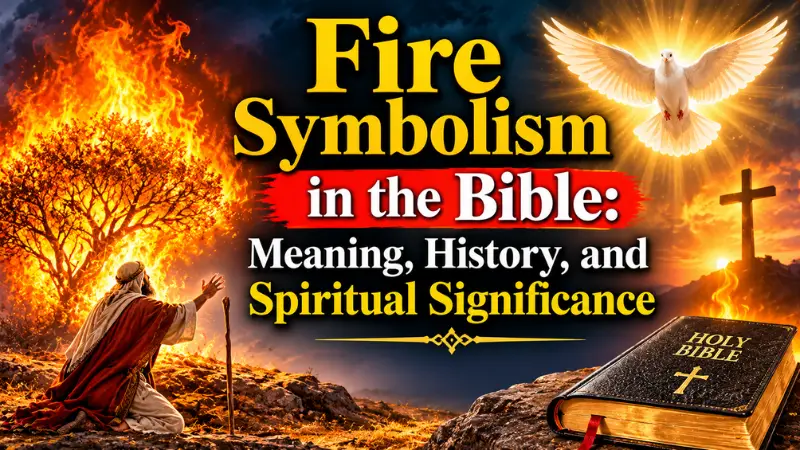
Fire is one of the most recognizable and frequently used images in Scripture. From the burning bush that spoke to Moses to the flames appearing at Pentecost, fire symbolism in the Bible communicates several important spiritual ideas, including God’s presence, holiness, judgment, purification, and the work of the Holy Spirit. Its meaning depends on the passage and the situation in which it appears.
For biblical writers, fire was more than a natural source of heat and light. It could protect people, consume offerings, refine precious metals, destroy evil, and represent the presence of God. These familiar qualities made it an effective way to communicate ideas about divine power and humanity’s relationship with the sacred.
Today, American Christians encounter biblical fire imagery in church services, sermons, worship music, religious artwork, tattoos, and personal expressions of faith. Understanding its original context helps explain why the same image can represent comfort and spiritual renewal in one passage but warning and judgment in another.
Quick Answer: What Does Fire Symbolize in the Bible?
Fire symbolism in the Bible commonly represents God’s presence, holiness, judgment, purification, and the Holy Spirit. Historically, it also represented divine protection, sacrificial worship, spiritual testing, and the destruction of evil, with its meaning changing according to the biblical passage.
TL;DR
- God’s presence: Fire reveals God’s holiness and nearness to humanity.
- Divine judgment: Flames represent God’s response to wickedness and injustice.
- Purification: Refining fire illustrates spiritual growth and the removal of impurities.
- Holy Spirit: Fiery tongues at Pentecost represent the Spirit’s arrival and activity.
- Protection: The pillar of fire guides and protects the Israelites.
- Sacrifice: Altar flames represent offerings and worship directed toward God.
1. What Fire Represents in Biblical Symbolism
Fire has several connected meanings throughout the Bible, but its symbolism is not limited to one spiritual message.
In the Old Testament, fire frequently appears when God reveals His presence, communicates with people, guides His followers, or demonstrates His authority. In other passages, it represents punishment, destruction, and the consequences of disobedience.
The New Testament continues these themes while introducing important connections with the Holy Spirit, spiritual transformation, and final judgment.
Five major meanings stand out:
- Divine presence: God reveals Himself through fire.
- Holiness: Fire illustrates God’s purity and separation from sin.
- Judgment: Fire represents the consequences of wrongdoing.
- Purification: Fire removes impurities and tests spiritual character.
- Spiritual empowerment: Fire is associated with the Holy Spirit and Christian devotion.
These meanings are related, but they are not interchangeable. A flame in a passage about Pentecost should not automatically be interpreted in the same way as a destructive fire in a passage about judgment.
The surrounding biblical story determines the most appropriate interpretation.
2. Fire as a Symbol of God’s Presence
One of the clearest biblical associations with fire is the presence of God.
The burning bush in Exodus 3:1–6 provides an important example. Moses encounters a bush that burns without being consumed. From the flames, God calls Moses and gives him the responsibility of leading the Israelites out of Egyptian slavery.
The unusual fire attracts Moses’ attention, but the encounter becomes a revelation of God’s identity and authority.
Another example appears in Exodus 19:16–18, when God descends upon Mount Sinai. The mountain is covered with smoke, and its appearance is compared to a blazing furnace.
These events communicate that God’s presence is holy, extraordinary, and not something people should approach carelessly.
For modern Christians, the burning bush is often understood as a reminder that God can make Himself known in unexpected circumstances. It also illustrates how an ordinary object can become part of a significant spiritual encounter.
3. The Burning Bush and the Meaning of Spiritual Calling
The burning bush deserves special attention because it combines several ideas within one biblical event.
In Exodus 3, the bush continues burning without being destroyed. This unusual feature distinguishes it from an ordinary fire.
The scene is commonly interpreted through three related ideas:
God’s enduring presence: The bush remains intact despite the flames, emphasizing that the encounter is not an ordinary natural event.
Divine calling: God uses the moment to call Moses into a particular responsibility.
Holiness: God instructs Moses to remove his sandals because the ground where he stands is holy.
The story also introduces an important connection between spiritual experiences and responsibility. Moses does not simply witness something extraordinary; he receives a mission that will change the future of the Israelites.
In American Christian culture, the burning bush is frequently used in religious art, Bible illustrations, educational materials, and discussions about recognizing God’s calling.
It can represent the idea that a person’s purpose may begin with an unexpected encounter or a moment of spiritual awareness.
4. Fire as a Symbol of Divine Judgment
Fire also represents God’s judgment against wickedness, injustice, and rebellion.
This meaning appears in several Old Testament stories. Genesis 19:24–25 describes the destruction of Sodom and Gomorrah, where fire and sulfur become instruments of divine judgment.
Another example appears in Leviticus 10:1–2. Nadab and Abihu offer unauthorized fire before God, and a fire from the Lord consumes them.
These passages use fire to communicate the seriousness of violating divine commands and treating holiness without proper respect.
The theme continues in the New Testament.
In Matthew 13:40–42, Jesus uses the image of a fiery furnace when explaining the separation of the wicked from the righteous at the end of the age.
Revelation 20:11–15 also uses the lake of fire as an image associated with final judgment.
For American Christian readers, these passages often appear in discussions about accountability, repentance, salvation, and the consequences of evil.
However, biblical judgment imagery should be interpreted carefully. Not every mention of fire describes punishment, and not every fiery passage is intended as a literal description of a future event.
5. Fire as a Symbol of Purification and Spiritual Refinement
Fire does not always destroy something in biblical symbolism. Sometimes it makes something more valuable by removing unwanted material.
The process of refining metal provides an important biblical comparison.
When gold or silver is heated, impurities can be separated from the precious material. Biblical writers use this familiar process to describe spiritual testing, purification, and the development of faith.
Malachi 3:2–3 describes God as a refiner’s fire, emphasizing the purification of His people.
Similarly, Zechariah 13:9 compares the testing of God’s people to refining silver and testing gold.
The New Testament develops this idea in 1 Peter 1:6–7. Peter compares tested faith to gold refined by fire, explaining that genuine faith becomes evident through difficulties.
This symbolism suggests several spiritual lessons:
- Difficult experiences can reveal the strength of a person’s faith.
- Personal growth may involve confronting harmful attitudes and behavior.
- Spiritual maturity requires patience and perseverance.
- Testing can expose weaknesses that need attention.
For many American Christians, refining fire is a familiar image in sermons, devotional writing, worship songs, and discussions about overcoming hardship.
Importantly, the image does not mean that every painful experience is necessarily sent by God as punishment. Its central lesson is that faith can be tested and strengthened through difficult circumstances.
6. The Pillar of Fire: Guidance and Divine Protection
One of the most comforting examples of fire symbolism appears in Exodus 13:21–22.
After the Israelites leave Egypt, God guides them through the wilderness using a pillar of cloud during the day and a pillar of fire at night.
The fire provides light in the darkness and serves as a visible sign of divine guidance.
The pillar also appears in Exodus 14:19–20, where it takes a position between the Israelites and the Egyptian forces pursuing them.
This makes the image particularly meaningful because fire represents both direction and protection.
Its symbolism can be understood in three ways:
Guidance: The Israelites are not left to navigate the wilderness without direction.
Protection: The pillar separates them from the approaching Egyptian army.
Faithfulness: The continuing presence of the pillar demonstrates God’s commitment to guiding His people.
In modern Christian interpretation, the pillar of fire often represents trusting God when the future is uncertain.
It is especially relevant in devotional discussions about major life decisions, personal challenges, and maintaining faith during periods of uncertainty.
7. Fire and the Holy Spirit at Pentecost
One of the most recognizable New Testament images involving fire appears in Acts 2:1–4.
During the Jewish festival of Pentecost, the disciples are gathered together when a sound like a strong wind fills the house. They then see what appear to be divided tongues of fire resting on each of them.
They are filled with the Holy Spirit and begin speaking in other languages.
This event marks an important moment in the early Christian movement.
The flames are described as resembling fire rather than as ordinary burning flames. Their appearance communicates the extraordinary nature of the event and the Spirit’s presence among the disciples.
Pentecost is therefore associated with:
- The arrival of the Holy Spirit.
- Spiritual empowerment.
- The beginning of public Christian witness.
- Communication across language barriers.
- The spread of the Christian message.
In the United States, this imagery is especially recognizable in Pentecostal and charismatic Christian traditions, where fire frequently appears in worship artwork, preaching, and discussions about spiritual renewal.
It is also used more broadly across Christian communities to represent the Spirit’s work in believers’ lives.
8. Fire as a Symbol of Sacrifice and Worship
Fire played an important practical and religious role in ancient Israelite worship.
In the Old Testament, offerings were frequently burned on altars as part of religious ceremonies. These sacrifices appear throughout Leviticus 1–7, which describes different types of offerings and the procedures associated with them.
Fire was not simply a decorative feature of worship. It was part of the sacrificial process through which offerings were presented to God.
Leviticus 6:12–13 also gives instructions for maintaining the altar fire. The fire was to remain burning rather than be allowed to go out.
Other biblical passages describe moments when fire from God consumes an offering.
For example:
- Leviticus 9:24 describes fire coming from the Lord and consuming the burnt offering.
- 1 Kings 18:38 describes fire consuming Elijah’s offering during his confrontation with the prophets of Baal.
- 2 Chronicles 7:1 describes fire descending from heaven and consuming the offerings at the dedication of Solomon’s temple.
These events connect fire with worship, divine acceptance, and the recognition of God’s authority.
In modern Christian churches, altar fire is generally understood symbolically rather than as a requirement for worship. Its historical importance remains visible in religious paintings, Bible teaching, and discussions about sacrifice and devotion.
9. Fire as a Symbol of Spiritual Passion and Zeal
Fire can also describe intense spiritual commitment.
This meaning is particularly interesting because it does not necessarily involve a visible flame.
In Luke 24:32, two disciples recall how their hearts were burning within them while Jesus explained the Scriptures during their journey.
The burning sensation expresses an intense emotional and spiritual response to understanding God’s message.
Jeremiah 20:9 provides another example. Jeremiah describes God’s message as something like a burning fire within his heart, making it impossible for him to remain silent.
In these passages, fire represents:
- Strong spiritual conviction.
- Enthusiasm for God’s truth.
- The desire to communicate a message.
- Inner motivation and commitment.
American Christian communities often use similar imagery when discussing passionate worship, religious dedication, and sharing one’s faith.
However, biblical zeal should not be confused with uncontrolled anger or hostility. Genuine spiritual commitment is better understood through the broader biblical emphasis on love, patience, humility, and righteousness.
10. Fire as a Symbol of Testing and Difficult Experiences
The Bible sometimes compares life’s difficulties to passing through fire.
Psalm 66:10–12 describes God’s people being tested and experiencing hardship before reaching a place of relief.
Isaiah 43:2 offers another important example. God promises to remain with His people when they pass through waters and walk through fire.
The passage does not promise a life without trouble. Instead, it emphasizes God’s presence during difficult experiences.
First Peter 4:12 also tells believers not to be surprised by painful trials, describing them as a test.
This symbolism is particularly relevant to people experiencing:
- Grief and personal loss.
- Financial uncertainty.
- Family difficulties.
- Social rejection.
- Challenges to religious beliefs.
- Periods of personal transformation.
In contemporary American Christian life, the phrase “going through the fire” is commonly used to describe a difficult period that tests someone’s faith.
Its message is not that suffering is automatically beneficial. Rather, it encourages believers to remain faithful and seek strength during circumstances they cannot fully control.
11. What Does Fire Mean in Different Biblical Contexts?
The following table shows how the meaning of fire changes depending on the passage.
| Biblical context | Symbolic meaning | Scripture |
|---|---|---|
| Burning bush | God’s presence and holiness | Exodus 3:2–6 |
| Pillar of fire | Guidance and protection | Exodus 13:21–22 |
| Mount Sinai | Divine authority and holiness | Exodus 19:18 |
| Refining precious metals | Purification and testing | Malachi 3:2–3 |
| Pentecost | Holy Spirit and spiritual empowerment | Acts 2:1–4 |
| Final judgment | Accountability and destruction of evil | Revelation 20:14–15 |
The comparison demonstrates why interpreting fire requires attention to its biblical setting.
A fire that guides people through a wilderness communicates something very different from a fire associated with divine judgment.
12. Fire Symbolism in the Old Testament and New Testament
Fire appears in both parts of the Christian Bible, although different passages emphasize different aspects of its meaning.
In the Old Testament, fire frequently accompanies divine appearances, religious ceremonies, national deliverance, and warnings of judgment.
Important examples include the burning bush, Mount Sinai, the pillar of fire, Elijah’s confrontation with the prophets of Baal, and the altar offerings.
The New Testament continues the association between fire and God’s holiness but gives additional attention to the Holy Spirit, spiritual testing, and final judgment.
The following comparison highlights these developments.
| Theme | Old Testament | New Testament |
|---|---|---|
| God’s presence | Burning bush and Mount Sinai | Fiery imagery associated with Christ |
| Guidance | Pillar of fire | Spiritual guidance and faith |
| Purification | Refining silver and gold | Tested faith |
| Divine judgment | Sodom and Gomorrah | Final judgment imagery |
| Spiritual activity | Prophetic fire imagery | Tongues of fire at Pentecost |
The two testaments should not be treated as presenting completely unrelated meanings. Instead, they develop connected themes through different stories and religious contexts.
13. What Does Fire Symbolize in Modern American Christian Culture?
In the United States, biblical fire imagery remains common in Christian communication and religious expression.
Its appearance varies among denominations, churches, and individual believers.
Church services and worship
Fire frequently appears in worship presentations, sermon illustrations, and religious artwork. It can represent the Holy Spirit, spiritual enthusiasm, or a desire for renewal.
Pentecostal and charismatic traditions
These communities often place particular emphasis on the imagery of Acts 2. Fire may represent spiritual empowerment, the presence of the Holy Spirit, and religious experience.
Christian music
Songs about spiritual fire commonly use flames as metaphors for devotion, renewed faith, and a desire to follow God.
Religious education
The burning bush, pillar of fire, and Pentecost are frequently used in children’s Bible lessons because their visual imagery helps explain important biblical events.
Personal faith and identity
Some Christians use fire imagery to communicate commitment, perseverance, or a personal connection to a particular Bible passage.
Although the symbol is widespread, its interpretation is not identical across American Christianity. Some communities emphasize the Holy Spirit, while others focus more heavily on purification, holiness, or judgment.
14. Fire in Christian Tattoos, Jewelry, and Religious Artwork
Fire has become a recognizable visual element in contemporary Christian design.
People sometimes choose flames because they connect with a particular biblical story or express something meaningful about their faith.
Common examples include:
Christian tattoos: A flame surrounding a cross may represent spiritual devotion, while a burning bush design may symbolize God’s calling and presence.
Religious jewelry: Flame-shaped pendants and cross designs can represent faith, spiritual passion, or the Holy Spirit.
Wall art and home decor: Biblical illustrations of the burning bush and Pentecost are used in religious artwork and inspirational displays.
Church graphics: Flames frequently appear in logos and promotional materials for churches, particularly those emphasizing renewal or Pentecostal beliefs.
The intended meaning depends on the design. A flame surrounding a Bible might communicate enthusiasm for Scripture, while a pillar of fire may specifically reference the Israelites’ journey through the wilderness.
For anyone choosing a religious fire design, understanding the associated passage can make the image more personal and meaningful.
15. Positive and Negative Meanings of Fire in the Bible
One reason biblical fire is interesting is that it can communicate opposite ideas.
It can represent divine protection, but it can also represent destruction. It can illustrate spiritual purification, but it can also describe punishment.
These contrasting meanings reflect the different ways fire operates in the natural world.
| Positive symbolism | Negative symbolism |
|---|---|
| God’s presence | Divine judgment |
| Spiritual guidance | Destruction |
| Purification | Punishment |
| Holy Spirit | Final condemnation |
| Spiritual passion | Uncontrolled anger |
| Protection | Consequences of rebellion |
This distinction is important when interpreting religious artwork or biblical references.
For example, flames surrounding a dove may communicate the Holy Spirit, while flames surrounding a scene of destruction may represent judgment.
The image itself does not provide the complete meaning. The surrounding details and biblical context matter.
16. Common Misunderstandings About Biblical Fire Symbolism
Several misunderstandings can develop when biblical fire passages are interpreted without considering their context.
Misunderstanding 1: Fire always represents hell.
Fire appears in many biblical passages that have nothing to do with hell. It can represent God’s presence, guidance, worship, purification, or spiritual empowerment.
Misunderstanding 2: Every mention of fire describes a literal event.
Some biblical passages describe physical flames, while others use fire as a metaphor or vision. The literary form of the passage matters.
Misunderstanding 3: Spiritual testing always means punishment.
The refining-fire image frequently describes the testing and strengthening of faith. It should not automatically be interpreted as evidence that someone has done something wrong.
Misunderstanding 4: Pentecost means Christians should expect physical flames.
Acts 2 describes tongues that appeared like fire. The comparison communicates the nature of the event; it does not establish physical flames as a universal requirement of Christian experience.
Misunderstanding 5: All Christian denominations interpret fire identically.
Christian communities share many biblical references but sometimes emphasize different theological aspects. Pentecostal churches, for example, often give particular attention to the fire imagery associated with the Holy Spirit.
Understanding these distinctions prevents a single interpretation from being applied to every biblical passage.
FAQs
1. What is the main meaning of fire in the Bible?
Fire primarily represents God’s presence, holiness, judgment, and purification. In the New Testament, it is also associated with the Holy Spirit, particularly through the events described in Acts 2.
2. Is fire a positive or negative symbol in the Bible?
Fire can have both positive and negative meanings depending on the passage. It represents guidance and spiritual renewal in some stories, while other passages associate it with destruction and divine judgment.
3. What does a spiritual fire symbolize in Christianity?
Spiritual fire commonly represents strong faith, devotion, spiritual passion, and the work of the Holy Spirit. Christians may also use the expression to describe renewed commitment to prayer, worship, and religious practice.
4. What does the burning bush symbolize in the Bible?
The burning bush represents God’s holy presence and His calling of Moses. Its unusual appearance, burning without being consumed, introduces the encounter in which Moses receives his mission to lead the Israelites out of Egypt.
5. What does fire symbolize at Pentecost?
At Pentecost, the tongues that appeared like fire represented the arrival and activity of the Holy Spirit among Jesus’ followers. The event also marked their empowerment to communicate the Christian message to people from different nations.
6. What does passing through fire mean in the Bible?
Passing through fire can represent experiencing hardship, testing, and difficult circumstances while remaining under God’s care. Isaiah 43:2 is an important example because it emphasizes God’s presence during periods of trouble.
7. Why does God use fire as a symbol in the Bible?
Fire was a familiar part of ancient daily life, used for cooking, warmth, lighting, metalworking, and religious offerings. Its ability to illuminate, consume, and refine made it a useful image for communicating divine holiness, judgment, purification, and power.
Conclusion
Fire is one of the Bible’s most versatile religious symbols. It represents God’s presence and holiness, the protection of His people, the purification of faith, the work of the Holy Spirit, and the consequences of wrongdoing. Its meaning changes according to the biblical story rather than following one fixed interpretation.
For modern American Christians, these images remain relevant in worship, religious artwork, personal devotion, and discussions about faith. The burning bush reminds believers of God’s calling, the pillar of fire illustrates divine guidance, and Pentecost connects flames with spiritual empowerment.
Ultimately, fire symbolism in the Bible teaches that the same image can communicate different aspects of God’s relationship with humanity. Understanding the passage behind the flame reveals whether it represents guidance, transformation, holiness, or judgment.