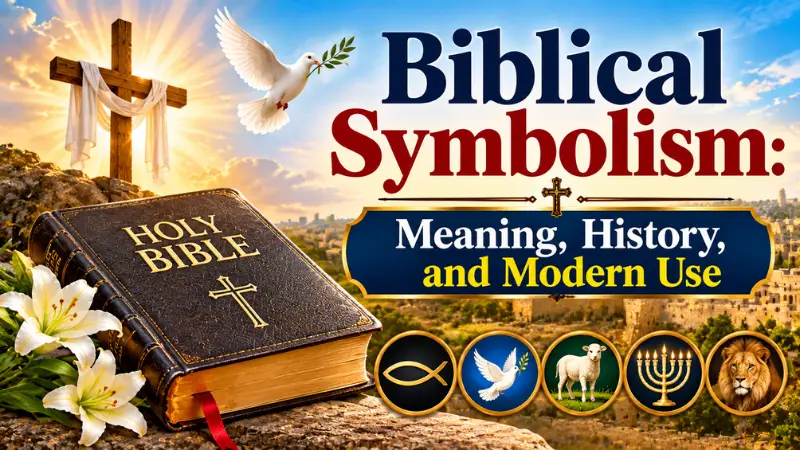
Biblical symbolism refers to the use of objects, colors, animals, numbers, places, and natural elements to communicate spiritual ideas in the Bible. From the rainbow associated with God’s covenant to the lamb representing sacrifice and redemption, biblical symbolism gives familiar images meanings that extend beyond their physical appearance.
These symbols matter because they help readers understand how biblical writers communicated ideas about faith, morality, human relationships, judgment, hope, and God’s relationship with humanity. Rather than expressing every teaching through direct explanation, biblical authors often used recognizable images, stories, poetry, and metaphors.
In the United States, biblical imagery appears in churches, religious artwork, wedding ceremonies, funeral traditions, jewelry, tattoos, literature, and popular culture. Even people who do not regularly read Scripture may recognize symbols such as the cross, the dove, the olive branch, or the rainbow.
Understanding their original biblical contexts makes it easier to distinguish traditional religious meanings from modern interpretations.
Quick Answer
Biblical symbolism commonly represents spiritual ideas such as faith, hope, love, sacrifice, forgiveness, purity, and redemption through recognizable images and objects. Historically, these symbols developed through ancient Hebrew traditions, biblical narratives, poetry, prophetic writing, and early Christian interpretation, and they continue to influence American religious art, traditions, and everyday culture.
TL;DR
- Biblical symbols communicate spiritual teachings through familiar images and stories.
- Ancient Hebrew traditions shaped many symbols found in Scripture.
- The cross, dove, lamb, and rainbow remain recognizable American religious symbols.
- Colors and numbers carry meanings that depend on biblical context.
- Christian artwork, tattoos, ceremonies, and architecture preserve biblical imagery.
- Modern interpretations sometimes differ from the original scriptural meanings.
What Biblical Symbols Represent
A biblical symbol is an image, object, action, or natural feature that communicates an idea beyond its ordinary physical function. Its meaning comes from the way it is used in a particular passage and the wider biblical story.
For example, bread is ordinary food, but in biblical narratives it can also represent God’s provision, hospitality, dependence, and spiritual nourishment. Light can describe physical brightness while also representing truth, guidance, goodness, or divine presence.
Biblical symbolism generally serves several purposes:
- Spiritual teaching: Makes religious ideas easier to understand through familiar images.
- Moral instruction: Connects objects and stories with virtues, mistakes, and consequences.
- Covenant and identity: Reminds communities of promises, responsibilities, and relationships with God.
- Prophetic communication: Uses visions and symbolic actions to communicate warnings or hopes.
- Worship and remembrance: Gives religious practices recognizable forms and shared meanings.
A useful distinction is that a symbol does not always have one universal meaning. Water, for instance, can represent cleansing and renewal, but it can also appear as a destructive force in stories about floods and judgment.
Ancient Roots and Historical Development
Biblical symbolism developed within the cultures of the ancient Near East, particularly the traditions of ancient Israel and its neighboring societies. The Hebrew Bible emerged over many centuries, preserving historical narratives, laws, poetry, wisdom literature, prophetic messages, and visions.
These different forms of writing used imagery in different ways. Agricultural communities understood references to vineyards, sheep, seeds, harvests, and drought because those things shaped everyday life. A vineyard could therefore communicate ideas about cultivation, responsibility, faithfulness, and judgment.
Ancient Hebrew writers also used symbolic actions. Prophets sometimes performed unusual physical acts to communicate messages that ordinary speeches could not convey as vividly. Ezekiel’s vision of dry bones, for example, presents a picture of national restoration and renewed life in Ezekiel 37.
The New Testament continued this tradition while giving many familiar images new significance through the life, teachings, death, and resurrection of Jesus.
Early Christians gradually developed a recognizable visual vocabulary. Fish, anchors, shepherds, doves, and other images appeared in early Christian art and personal objects. The cross eventually became the most widely recognized Christian emblem, although its prominence as a physical image developed over time rather than appearing fully formed in the earliest Christian communities. Bible Gateway+1
The Cross: Sacrifice, Redemption, and Christian Identity
Contact – First Presbyterian Church of Taos
A place of worship, a historic treasure, an iconic landmark | Norwich Cathedral
7
The cross is the most recognizable symbol of Christianity in the United States. It represents the crucifixion of Jesus Christ and, for Christians, the relationship between suffering, sacrifice, forgiveness, and redemption.
Its meaning comes from the New Testament accounts of Jesus’ execution. What was originally an instrument of Roman punishment became central to Christian understanding of salvation because believers connect Jesus’ death with God’s reconciliation with humanity.
Different Christian traditions display the cross differently:
- Plain cross: Often emphasizes Christ’s death and resurrection without depicting his body.
- Crucifix: Shows Jesus on the cross and emphasizes the suffering and sacrifice of the crucifixion.
- Empty cross: Commonly highlights the belief that Jesus rose from the dead.
- Celtic cross: Combines a cross with a surrounding ring and is associated with historic Celtic Christian art.
In American culture, the cross appears in church buildings, cemeteries, necklaces, memorials, wedding ceremonies, and personal tattoos. For many Christians, wearing one expresses religious commitment or remembrance. For others, it represents family heritage or a connection to a particular Christian community.
The cross can also communicate grief, endurance, and hope. Its meaning is not simply that suffering exists, but that Christian faith understands suffering and death in relation to resurrection.
The Dove: Peace, Purity, and the Holy Spirit
Em như chim câu trắng – Thảo Trinh | BCĐCNT
White dove with olive green branch. Flying pigeon bird, symbol of peace, religious sign. Watercolor
Pfingsten: Wie der Heilige Geist die Jünger Jesu erfüllt und die Kirche begründet
7
The dove carries several related meanings in biblical tradition, especially peace, new beginnings, and the presence of the Holy Spirit.
One important appearance occurs in Genesis 8. After the flood, Noah sends out a dove, which eventually returns carrying a freshly picked olive leaf. The image signals that the floodwaters are receding and that life is becoming possible again.
Another important appearance occurs during Jesus’ baptism. The Gospels describe the Spirit of God descending like a dove, connecting the bird with divine presence and the beginning of Jesus’ public ministry.
These passages explain why the dove became a familiar image in Christian churches and religious artwork.
In the United States, a white dove frequently appears in:
- Baptism and confirmation artwork.
- Church windows and religious decorations.
- Memorial services and funeral imagery.
- Wedding invitations and Christian greeting cards.
- Jewelry and tattoos representing peace or spiritual renewal.
The dove is also widely understood as a secular symbol of peace. That modern meaning overlaps with biblical imagery, although not every dove illustration has a specifically religious intention.
The Lamb: Innocence, Sacrifice, and Jesus Christ
The lamb is one of the Bible’s most significant animal images. It can represent innocence, vulnerability, sacrifice, and dependence on a shepherd.
Its connection with sacrifice is particularly important in the Old Testament. Lambs appear in Israelite sacrificial practices and in the Passover narrative in Exodus 12. These traditions provide essential background for later Christian interpretations of Jesus.
In the New Testament, John the Baptist identifies Jesus as the Lamb of God in John 1:29. The Book of Revelation develops the image further by portraying a slain lamb as a central figure in its visions.
For Christians, the Lamb of God represents Jesus’ sacrificial death and victory over evil. The image combines apparent vulnerability with authority and triumph.
American churches frequently use lamb imagery in Easter decorations, children’s religious education, stained-glass windows, and Christian artwork. It is also common in religious paintings that depict Jesus as a shepherd or protector.
The lamb should not be understood as representing weakness alone. In Christian interpretation, its significance comes from the relationship between sacrifice, innocence, and redemption.
The Rainbow: God’s Covenant and the Promise of Hope
The rainbow is associated with God’s promise to Noah after the flood in Genesis 9:8–17. In the biblical narrative, God establishes a covenant promising that a flood will never again destroy all life on Earth.
The rainbow serves as the sign of that covenant. Its appearance in the sky becomes a reminder of divine commitment and the preservation of creation.
This makes the rainbow especially important because it represents a promise rather than merely a positive emotion. Its biblical meaning connects hope with faithfulness, protection, and the continuation of life.
In the United States, the rainbow appears in Christian children’s books, church nurseries, nursery decorations, religious school materials, and artwork based on Noah’s story.
However, the rainbow also has several modern cultural meanings unrelated to Noah’s covenant, including LGBTQ+ pride, diversity, inclusion, and broader expressions of hope. These meanings should not automatically be treated as interchangeable with its biblical interpretation.
Biblical Colors and Their Symbolic Associations
Color symbolism is especially visible in biblical descriptions of clothing, sacred objects, temples, visions, and ceremonial settings. Colors can help establish atmosphere, communicate status, or reinforce a spiritual theme.
However, the Bible does not provide one universal dictionary assigning a fixed meaning to every color. Interpretations depend on the passage, historical setting, and religious tradition.
Incumbent of the Church of St. Michael and All Angels, Pierrefonds. — Anglican Diocese
| Color | Common biblical association | Biblical context |
|---|---|---|
| White | Purity, holiness, victory | Revelation 7:9–14 |
| Purple | Royalty, wealth, status | Mark 15:17 |
| Red or scarlet | Blood, sacrifice, sin | Isaiah 1:18; Leviticus 17:11 |
| Blue | Sacred garments and heavenly associations | Exodus 28:31 |
| Gold | Preciousness, glory, sacred honor | Exodus 25:10–11 |
| Black | Mourning, darkness, hardship | Revelation 6:5–6 |
White garments, for example, are associated with purity and victory in several passages in Revelation. Purple clothing, meanwhile, communicates social status and royal authority in ancient settings.
Red requires particular attention because its associations vary. Blood can represent life in Leviticus 17:11, while scarlet imagery in Isaiah 1:18 appears in a discussion of sin and cleansing.
Modern Christian artwork often uses these traditional associations, especially during Christmas, Easter, Lent, and other church seasons. Nevertheless, a color should not be assigned a biblical meaning without examining its context.
Numbers in Biblical Symbolism
Numbers frequently appear in biblical narratives, genealogies, visions, and religious instructions. Some numbers acquire recurring associations because of how often they appear in particular theological or literary settings.
The most familiar examples include:
Number 3 — Completeness and significant spiritual events
The number three appears in important biblical patterns. Jesus’ resurrection on the third day is central to Christian belief, as described in 1 Corinthians 15:3–4. Three also appears in accounts of prayer, testimony, and divine revelation.
Number 7 — Completion and fulfillment
Seven is especially prominent in the creation account. Genesis 2:2–3 describes God completing creation and resting on the seventh day. Revelation also uses groups of seven, including churches, seals, trumpets, and bowls.
Number 12 — God’s people and community
Twelve is associated with the twelve tribes of Israel and the twelve apostles. In Revelation 21, the number appears repeatedly in the description of the New Jerusalem, connecting it with the identity and completeness of God’s people.
Number 40 — Testing, preparation, and transition
Forty appears in accounts of testing and preparation. Rain falls for forty days and nights in Genesis 7, Moses spends forty days on Mount Sinai in Exodus 24:18, and Jesus fasts for forty days in Matthew 4:2.
These associations are useful for understanding biblical patterns, but they should not become a system for predicting the future or assigning supernatural messages to every number encountered in daily life. Biblical numbers have literary and theological functions, not necessarily hidden meanings in every occurrence.
Animals, Plants, and Natural Elements
The natural world provides much of the Bible’s symbolic vocabulary. Its writers frequently drew on the environment familiar to ancient agricultural and pastoral communities.
How Many Trees Grow in Israel? Fascinating Facts About the Trees of the Land – Hidabroot
Como Israel construiu sua tradição milenar no vinho
4
Some especially recognizable examples include:
- Olive tree: Associated with peace, fruitfulness, and continuity. Olive branches appear in the account of Noah’s dove in Genesis 8.
- Vine and vineyard: Often represent a community’s relationship with God, responsibility, and spiritual fruitfulness. Isaiah 5 uses a vineyard to describe Israel.
- Mustard seed: Represents the surprising growth of God’s kingdom in Jesus’ teaching in Matthew 13:31–32.
- Eagle: Can represent strength, protection, and renewal. Isaiah 40:31 uses eagle imagery to describe renewed strength.
- Sheep: Represent vulnerability, dependence, and the relationship between a shepherd and those under their care. Psalm 23 is a familiar example.
- Bread: Represents physical provision and spiritual nourishment. Jesus develops the image in John 6:35.
- Water: Can communicate cleansing, life, renewal, danger, or judgment, depending on the passage.
These examples demonstrate why biblical symbolism requires attention to context. A vineyard in one passage may communicate abundance, while another vineyard may illustrate neglect and judgment.
Water, Light, and Fire: Three Important Biblical Images
Water, light, and fire appear throughout Scripture because they connect everyday human experiences with spiritual questions.
Water and cleansing
Water is essential for life, making it a natural image for renewal and cleansing. In the New Testament, baptism uses water as an outward expression of repentance, spiritual commitment, and new life.
In John 4, Jesus speaks to a Samaritan woman about living water, using the image to explain the spiritual life he offers.
Water can also represent destruction. The flood in Genesis demonstrates how the same natural element can communicate judgment rather than comfort.
Light and truth
Light frequently represents goodness, guidance, understanding, and divine presence. Psalm 119:105 describes God’s word as a lamp for the feet and a light for the path.
In John 8:12, Jesus describes himself as the light of the world. The image suggests guidance away from spiritual darkness and toward truth.
Fire and purification
Fire has several biblical associations, including God’s presence, judgment, testing, and purification.
In Exodus 3, Moses encounters God through the burning bush. In Acts 2, tongues resembling fire appear during the coming of the Holy Spirit at Pentecost.
Fire therefore does not always indicate destruction. Its meaning depends on whether the passage emphasizes divine presence, purification, judgment, or another function.
Biblical Symbolism in Parables and Stories
Jesus frequently used everyday experiences to explain spiritual teachings. These short teaching stories, known as parables, are an important part of biblical symbolic communication.
The Parable of the Sower in Matthew 13:1–23 provides a clear example. A farmer scatters seed across different types of ground. The seed represents the message of God’s kingdom, while the different soils illustrate different responses to that message.
Other familiar examples include:
- The Good Samaritan (Luke 10:25–37): Challenges narrow definitions of neighborly responsibility through a story about compassion.
- The Prodigal Son (Luke 15:11–32): Explores repentance, forgiveness, family relationships, and the father’s welcoming response.
- The Lost Sheep (Luke 15:3–7): Illustrates the value of recovering someone who has become separated from the community.
- The Wise and Foolish Builders (Matthew 7:24–27): Uses the difference between building on rock and sand to explain the importance of acting on Jesus’ teachings.
Not every detail in a parable needs to represent a separate spiritual concept. The central lesson, the characters’ actions, and the surrounding conversation usually provide the strongest clues to its meaning.
Prophetic Visions and Symbolic Imagery in Revelation
jenikirbyhistory.getarchive.net
Some of the Bible’s most elaborate symbolic imagery appears in prophetic and apocalyptic literature. These writings use visions, unusual creatures, numbers, colors, and dramatic scenes to communicate messages about political power, faithfulness, suffering, judgment, and hope.
The books of Daniel and Revelation are particularly important examples.
Daniel 7 describes four beasts emerging from the sea. These creatures represent kingdoms or political powers within the vision. Their unusual appearance communicates the destructive character of earthly authority.
Revelation contains images such as:
- Seven lampstands representing seven churches.
- A lamb representing Jesus Christ.
- A dragon representing the adversary.
- Crowns representing authority and dominion.
- White garments associated with purity and victory.
- The New Jerusalem representing the promised future of God’s people.
These images draw on earlier biblical traditions, Jewish apocalyptic literature, and the political and social world familiar to the original readers. Bible Gateway+2
For modern readers, one important consideration is that apocalyptic imagery should not automatically be treated as a literal prediction of contemporary events. Revelation belongs to a particular literary and historical tradition. Its images communicate theological and moral claims as well as visions of the future.
How Americans Understand Biblical Symbolism Today
Biblical imagery has a visible place in American culture because Christianity has influenced the country’s religious institutions, artistic traditions, literature, architecture, and public ceremonies.
The United States includes many Christian denominations, Jewish communities, people of other religions, and people who identify with no religion. Consequently, biblical symbols do not carry exactly the same meaning for every American.
Some familiar examples illustrate the differences.
In churches: Crosses, doves, candles, fish, and images of shepherds communicate religious teachings and help establish the visual identity of congregations.
At weddings: Biblical imagery often appears in wedding ceremonies, particularly through references to love, commitment, faithfulness, and the relationship between spouses. Rings are also sometimes accompanied by Scripture readings, although the ring itself is not a uniquely biblical symbol.
At funerals and memorials: Crosses, white flowers, doves, and images of light frequently express remembrance, resurrection, comfort, and hope.
During Easter: Lamb imagery, crosses, empty tomb illustrations, and sunrise scenes reinforce Christian themes of sacrifice and resurrection.
During Christmas: Stars, angels, shepherds, and nativity scenes recall the Gospel accounts of Jesus’ birth.
In public art and architecture: Biblical images appear in historic buildings, religious monuments, stained glass, paintings, and memorial spaces.
These uses show that biblical symbolism functions both as a religious language and as part of America’s wider cultural heritage.
Biblical Symbolism Across Different Religious Traditions
The Bible is a foundational text for Judaism and Christianity, and it is also recognized within Islam as containing accounts of figures who are important in Islamic tradition.
However, the same biblical image can be understood differently across these religions.
Judaism: The Hebrew Bible, or Tanakh, includes symbolic imagery connected with creation, covenant, law, wisdom, and the relationship between God and Israel. The olive tree, for example, appears in biblical descriptions of Israel and its people. Jewish interpretation also places particular importance on the historical, literary, and theological context of Scripture.
Christianity: Christian traditions interpret many Hebrew Bible symbols in relation to Jesus, the New Testament, salvation, and the church. The lamb, Passover, shepherd imagery, and covenant language are examples.
Islam: The Quran recognizes several figures also known from biblical traditions, including Noah, Abraham, Moses, and Jesus. However, Islamic interpretations follow the Quran and Islamic theological traditions rather than simply adopting Christian interpretations of biblical symbols.
There are also differences among Christian communities themselves. Catholic, Orthodox, Protestant, and other traditions may emphasize different aspects of religious imagery, worship, and sacred art.
Recognizing these distinctions prevents the mistaken assumption that every religious community interprets a shared image in exactly the same way.
Emotional and Psychological Meaning of Biblical Symbols
Biblical symbols often communicate emotions because they connect spiritual ideas with familiar human experiences.
A cross can remind someone of grief, sacrifice, forgiveness, or the hope of resurrection. A dove can communicate peace after a difficult period. A shepherd can represent safety, care, and the desire for guidance.
These images are particularly meaningful because they connect abstract beliefs with things people can see and recognize.
Several emotional associations are especially common:
- Hope: Rainbows, sunrise, new growth, and resurrection imagery.
- Comfort: Shepherds, green pastures, still waters, and protective imagery.
- Forgiveness: The prodigal son, cleansing water, and restoration.
- Belonging: The church, the family of God, and the twelve tribes.
- Sacrifice: The lamb, the cross, and Passover imagery.
- Renewal: Baptism, living water, and the resurrection.
Personal experiences also shape interpretation. Someone who grew up attending church may associate a particular symbol with family gatherings or childhood memories. Another person may understand the same image primarily through art, literature, or cultural exposure.
A symbol’s emotional meaning can therefore be personal without being entirely separate from its biblical background.
Why Biblical Symbols Appear in Tattoos, Jewelry, and Home Decor
Tatuajes de cruz: 35 diseños en HD para los más religiosos
6
Biblical imagery remains popular in personal style because it allows people to express beliefs, values, memories, and connections through recognizable designs.
Tattoos: Crosses, doves, praying hands, olive branches, lambs, and Bible verses are common choices. A cross tattoo may express Christian identity, while an olive branch can represent reconciliation or peace.
Jewelry: Cross necklaces, fish pendants, dove earrings, and engraved Bible references allow people to carry religious reminders in everyday life.
Home decor: Scripture prints, crosses, framed religious artwork, and nativity scenes are frequently used to establish a Christian atmosphere in homes.
Fashion: Christian clothing sometimes features short Bible passages, fish symbols, crosses, or other recognizable imagery.
Social media: Users incorporate biblical images into profile pictures, inspirational posts, digital artwork, and messages about faith.
The meaning of a personal design depends on the person using it. Two people may choose the same symbol for different reasons: one may be expressing religious devotion, while another may be remembering a loved one.
Common Misunderstandings and Misuse of Biblical Symbols
Biblical symbolism is sometimes misunderstood when people separate an image from its original passage or assign meanings that Scripture does not establish.
Several misunderstandings are particularly common.
Assuming every number has a secret meaning
Numbers such as 3, 7, 12, and 40 have recognizable biblical associations. However, this does not mean every appearance of these numbers contains a hidden spiritual message.
Treating every color as a fixed spiritual code
White is frequently associated with purity, but biblical color references do not always carry the same meaning. The surrounding passage matters more than a modern color chart.
Confusing biblical meaning with later Christian tradition
Some familiar Christian images developed after the biblical period. The fish, anchor, halo, and many traditional artistic representations became part of Christian visual culture through later historical developments.
Using Revelation to make unsupported predictions
Revelation contains dramatic visions, but identifying every modern political event, disaster, or technological development with a particular biblical image is speculative. Historical context and literary interpretation are essential.
Claiming that a modern symbol has only one religious meaning
The rainbow is a good example. Its biblical association with Noah’s covenant remains important to Christians, but contemporary Americans also use it to represent inclusion, diversity, and LGBTQ+ identity.
Understanding these distinctions does not diminish the religious importance of biblical imagery. It helps readers approach Scripture and modern culture more accurately.
How Biblical Symbolism Has Evolved Over Time
Biblical symbolism has not remained limited to the original settings in which its images appeared. As Scripture was interpreted, translated, illustrated, and incorporated into religious practices, its symbols acquired additional cultural associations.
Several historical developments help explain this evolution.
Ancient Israelite traditions: Natural elements, agricultural images, sacrifices, clothing, and sacred objects communicated ideas about worship, covenant, community, and moral responsibility.
Early Christianity: Christians connected familiar biblical images with the life and teachings of Jesus. Fish, shepherds, anchors, and other visual motifs appeared in early Christian communities.
Medieval Christianity: Churches, illuminated manuscripts, mosaics, sculptures, and stained glass developed elaborate visual systems for communicating biblical stories and theological ideas.
The Protestant Reformation: Different Christian communities developed distinct approaches to religious images. Some maintained elaborate visual traditions, while others preferred simpler church interiors and greater emphasis on Scripture.
Modern American culture: Biblical imagery became visible in church architecture, popular religious artwork, jewelry, memorials, clothing, literature, and digital communication.
Today, biblical symbols can function simultaneously as religious expressions, historical references, personal reminders, and cultural images. Their original meanings remain important, but their modern interpretations reflect changing communities and social experiences.
How to Interpret Biblical Symbols Correctly
Understanding biblical imagery does not require guessing at hidden messages. A careful reading of the passage usually provides the most reliable starting point.
These five principles help readers avoid common interpretive mistakes.
1. Read the surrounding passage. Examine what happens before and after the symbol appears. A dove in Noah’s story has a different narrative function from the dove at Jesus’ baptism.
2. Identify the literary form. Poetry, parables, historical narratives, prophetic messages, and apocalyptic visions communicate in different ways.
3. Consider the original audience. Ask what the image would have meant to people living in the ancient world. Agricultural references, royal garments, and sacrificial practices had recognizable historical associations.
4. Compare related passages. An image appearing in several biblical books may develop additional meaning over time. The lamb, for example, connects sacrificial traditions with New Testament descriptions of Jesus.
5. Distinguish Scripture from later interpretation. Christian artwork, church traditions, and modern spiritual practices may add associations that are not explicitly stated in the original biblical passage.
The most reliable interpretation considers the original text before applying a symbol to contemporary life.
FAQs
1. What is the main purpose of biblical symbolism?
Its main purpose is to communicate spiritual, moral, and theological ideas through recognizable images, stories, and objects. It helps readers understand abstract teachings by connecting them with familiar experiences.
2. What are the most important biblical symbols?
Some of the most recognizable are the cross, lamb, dove, rainbow, olive branch, light, water, and shepherd. Each communicates different ideas, including sacrifice, peace, covenant, renewal, guidance, and spiritual protection.
3. What does biblical symbolism mean in a dream?
Some Christians interpret dream imagery through biblical themes, but Scripture does not provide a universal dictionary for interpreting every modern dream. The meaning of a dream should not be treated as a guaranteed divine message simply because it contains a familiar biblical image.
4. What does a biblical symbol tattoo represent?
A biblical tattoo often represents faith, religious identity, remembrance, forgiveness, or personal commitment. A cross may represent devotion to Jesus, while a dove may communicate peace or the Holy Spirit.
5. Are biblical symbols always positive?
No. Some communicate hope, love, and renewal, while others represent judgment, suffering, temptation, or destruction. The serpent, for example, is associated with temptation in Genesis 3, while fire can represent either divine presence or judgment.
6. Why are numbers imporNumbers help establish patt th
Numbers help establish patterns and reinforce theological themes in biblical writing. Seven is associated with completion, twelve with Israel and the apostles, and forty with periods of testing or preparation, although context determines how each number functions.
7. Is biblical symbolism the same as Christian symbolism?
They overlap, but they are not identical. Biblical symbolism refers to imagery and meanings found in Scripture, while Christian symbolism also includes images, traditions, and artistic conventions that developed in the centuries after the New Testament was written.
Conclusion
Biblical symbolism provides a way to understand how Scripture communicates ideas about faith, sacrifice, forgiveness, hope, judgment, and the relationship between God and humanity. Images such as the cross, dove, lamb, rainbow, light, and water carry meanings shaped by their original biblical contexts and subsequent religious traditions.
In modern American culture, these symbols remain visible in churches, family traditions, personal artwork, tattoos, jewelry, holidays, and memorials. Their meanings sometimes overlap with broader cultural interpretations, making historical understanding especially valuable.
Ultimately, understanding biblical symbolism means looking beyond an image’s appearance and asking what it communicates within the biblical story. The original context gives each symbol its foundation, while its continuing use shows how religious ideas remain part of everyday cultural expression.