
Introduction
An international color symbolism chart helps explain how people around the world associate colors with emotions, beliefs, traditions, and cultural identities. Red may represent love and celebration in one setting, while white can symbolize weddings in one culture and mourning in another. These differences make color an important part of communication across countries.
Colors influence how people interpret clothing, flags, religious artwork, holidays, business branding, and everyday design. In the United States, for example, red, white, and blue are strongly connected with national identity, while black is commonly associated with mourning, formality, and elegance. In other countries, the same colors may communicate entirely different ideas.
Understanding international color symbolism is useful for travelers, designers, writers, educators, businesses, and anyone interested in cultural traditions. Although some color associations appear across many societies, no single meaning applies everywhere. History, religion, geography, social customs, and personal experiences all influence how a color is understood.
Quick Answer
An international color symbolism chart explains the common meanings of colors across different cultures, including associations with love, peace, prosperity, mourning, spirituality, and national identity. While some meanings are widely shared, historical traditions and cultural practices can give the same color very different meanings in different countries.
TL;DR
- Red: Often represents love, passion, danger, celebration, and prosperity.
- Blue: Commonly symbolizes peace, trust, stability, and spirituality.
- White: Represents purity and weddings in some cultures, but mourning in others.
- Green: Frequently connects with nature, renewal, health, and religious identity.
- Black: Can communicate elegance, authority, grief, or mystery.
- Yellow and gold: Often represent happiness, wealth, sunlight, and royalty.
What Is International Color Symbolism?
International color symbolism refers to the meanings and associations that different societies attach to colors. These meanings develop through historical events, religious teachings, natural environments, traditional clothing, political movements, and everyday customs.
A color does not communicate the same message in every situation. For example, red may represent romance when used on Valentine’s Day cards in the United States, but it can also indicate danger on warning signs. In Chinese celebrations, red is strongly associated with happiness, good fortune, and prosperity.
Color symbolism is therefore more than a collection of simple definitions. It is a cultural language that helps people communicate ideas without using words.
An international chart provides a starting point for understanding these associations. It should be treated as a flexible reference rather than a universal rulebook.
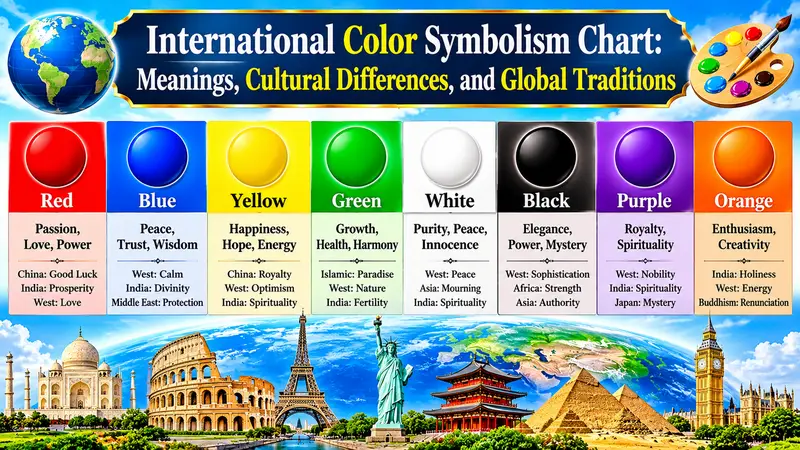
International Color Symbolism Chart: Meanings Around the World
The following chart compares common interpretations of major colors in different cultural settings. Individual meanings can vary by region, religion, historical period, and occasion.
| Color | Common Symbolic Meaning | Cultural Associations | Modern Uses |
|---|---|---|---|
| Red | Love, passion, courage, prosperity | Chinese celebrations, Western romance, political movements | Weddings, holidays, branding |
| Blue | Peace, trust, stability, spirituality | Western business culture, religious art, national identity | Corporate design, uniforms |
| Yellow | Happiness, sunlight, caution, wealth | Asian imperial traditions, Western warning signs | Festivals, advertising |
| Green | Nature, growth, renewal, prosperity | Islamic traditions, environmental movements, Irish identity | Sustainability, gardens |
| White | Purity, peace, innocence, mourning | Western weddings, East Asian funeral traditions | Weddings, religious ceremonies |
| Black | Elegance, authority, grief, mystery | Western mourning, formal fashion, ceremonial clothing | Fashion, memorials |
| Purple | Royalty, wisdom, spirituality, dignity | European royal traditions, religious observances | Luxury branding, ceremonies |
| Orange | Energy, enthusiasm, creativity, spirituality | Hindu traditions, autumn celebrations, national identity | Festivals, sports, design |
| Pink | Affection, tenderness, romance, femininity | Modern Western fashion and popular culture | Gifts, clothing, campaigns |
| Brown | Earth, stability, simplicity, tradition | Rural life, natural materials, traditional design | Interior design, packaging |
| Gold | Wealth, achievement, divinity, prestige | Royal traditions, religious objects, awards | Medals, luxury products |
| Silver | Modernity, technology, elegance, prestige | Ceremonial objects, jewelry, contemporary design | Electronics, accessories |
These meanings are common associations, not fixed definitions. The same color may communicate different ideas depending on the object, occasion, and people involved.
Red Symbolism Across Different Countries
<text>Red is one of the most recognizable colors in international symbolism. It is frequently connected with strong emotions, physical energy, celebration, love, and danger.</text>
In the United States, red commonly represents romance, especially during Valentine’s Day. It also appears in national imagery, sports uniforms, warning signs, and political branding. Its meaning can shift from affection to urgency depending on the setting.
In China, red has an important connection with happiness, good fortune, prosperity, and celebration. It is especially visible during Lunar New Year festivities and traditional wedding celebrations. Red envelopes containing money are commonly given as gifts during important occasions.
In India, red is associated with marriage, auspiciousness, celebration, and religious traditions. Red clothing and decorative elements often appear in Hindu wedding ceremonies, although regional practices differ.
In many Western European traditions, red has also been associated with love, courage, sacrifice, and religious imagery.
The color’s international importance comes partly from its visibility. Blood, fire, ripe fruit, and warning signals have helped create associations with life, danger, energy, and urgency.
Blue Symbolism in Western and Eastern Cultures
Blue is frequently associated with calmness, trust, stability, wisdom, and spirituality. Its connection with the sky and water helps explain why many people associate it with openness and tranquility.
In the United States, blue is widely used in corporate branding because it can communicate reliability and professionalism. Banks, technology companies, educational institutions, and public organizations often use different shades of blue in their visual identities.
In many Western traditions, blue has also been connected with religious imagery, especially representations of the Virgin Mary in Christian art. It can communicate devotion, protection, and heavenly qualities.
In parts of the Middle East and Mediterranean region, blue objects are traditionally associated with protection against the evil eye. Blue beads, glass ornaments, and decorative designs are used in various communities as protective symbols.
In modern Japan and other East Asian settings, blue can communicate freshness, technology, cleanliness, and reliability, depending on its application.
Although blue is often described as a peaceful color, it can also suggest sadness. Expressions such as feeling blue demonstrate how a color can acquire emotional meanings through language and popular culture.
White Symbolism: Purity, Peace, and Mourning
White has several contrasting meanings around the world. It is commonly associated with purity, innocence, simplicity, peace, and cleanliness, but its connection with mourning is equally important in certain cultural traditions.
In the United States, white is strongly connected with weddings. Traditional white wedding dresses became especially influential in Western fashion after Queen Victoria wore a white dress for her 1840 wedding. The style gradually became an established bridal convention.
In many East Asian traditions, including Chinese and Japanese funeral customs, white is associated with death, mourning, and remembrance. White garments may be worn during funerals or other mourning practices.
In Hindu traditions, white can be associated with simplicity, spiritual discipline, and mourning. Its use depends on the ceremony and community.
White also appears in international peace symbolism. White flags are widely recognized as signals of surrender or a request to stop fighting.
The important lesson is that white does not have one universal emotional meaning. A white dress may communicate celebration at an American wedding, while white funeral clothing can express respect and mourning elsewhere.
Green Symbolism in Religion, Nature, and National Identity
Green is commonly associated with plants, growth, renewal, fertility, and environmental awareness. Its connection with vegetation makes it one of the most recognizable colors for representing nature.
In the United States, green is strongly connected with environmental movements, conservation, organic products, and sustainability. It also appears during St. Patrick’s Day celebrations, reflecting Irish cultural identity and the holiday’s traditional imagery.
Green has a significant place in Islamic symbolism. It is associated with paradise in Islamic tradition and appears in religious art, architecture, and the flags of several Muslim-majority countries. However, its meaning and use differ among communities.
In Ireland, green has historical connections with national identity and cultural independence. It is prominently displayed during national celebrations and St. Patrick’s Day events.
Green can also carry less positive associations. In English, expressions such as green with envy connect the color with jealousy. This demonstrates how language can influence symbolic interpretation.
Yellow Symbolism: Happiness, Wealth, and Caution
Yellow is closely associated with sunlight, warmth, happiness, optimism, and energy. Because it is highly visible, it is also frequently used to attract attention.
In the United States, yellow appears in traffic signs, road markings, safety equipment, and caution signals. It can communicate both friendliness and a need to pay attention.
In China, yellow historically held associations with imperial authority and prestige. Its use in clothing and decorative objects could communicate high status in particular historical periods.
In Hindu traditions, yellow and saffron shades are associated with religious observances, knowledge, auspiciousness, and spiritual life. Yellow clothing and flowers may appear during festivals and ceremonies.
In many contemporary societies, yellow is used in advertising and product design to communicate energy and friendliness.
Its meaning depends on context. A yellow flower may represent happiness or friendship, while a yellow warning sign communicates caution rather than celebration.
Purple Symbolism: Royalty, Wisdom, and Spirituality
Purple has historically been associated with royalty, wealth, authority, and dignity. One reason is the historical expense of producing certain purple dyes.
In the ancient Mediterranean world, Tyrian purple was produced from sea snails and required considerable labor. Its high cost made purple garments a visible sign of wealth and political status.
In European history, purple became associated with monarchs, religious officials, and ceremonial clothing. These traditions helped establish its modern connection with luxury and prestige.
In the United States, purple appears in graduation ceremonies, educational branding, artistic design, and products intended to communicate creativity or sophistication. It is also connected with certain social and political movements.
In some Christian traditions, purple is used during Advent and Lent as a color of preparation, reflection, and penitence.
The color can communicate either luxury or contemplation, depending on the shade and setting.
Orange Symbolism in Global Traditions
Orange combines the visual warmth of red with some of the brightness associated with yellow. It is commonly connected with enthusiasm, creativity, celebration, and energy.
In the United States, orange is associated with autumn, pumpkins, Halloween decorations, and fall festivals. It also appears in sports uniforms, safety clothing, and branding designed to attract attention.
In Hindu traditions, saffron and orange shades are significant in religious clothing and spiritual practices. Saffron-colored garments are associated with renunciation and spiritual commitment among certain religious communities.
Orange is also an important national color in several countries. In Ireland, orange is part of the national flag and has historical connections with Protestant and unionist traditions.
In Buddhist communities, orange and saffron-colored robes are associated with monastic life, although robe colors vary across Buddhist traditions and regions.
Orange therefore represents more than enthusiasm. Its religious, political, and historical associations can be equally important.
Pink Symbolism: Love, Compassion, and Identity
Pink is commonly associated with affection, tenderness, romance, kindness, and emotional warmth. Its modern meaning has been strongly influenced by fashion, advertising, popular culture, and changing ideas about gender.
In the United States, pink is frequently connected with Valentine’s Day, romantic gifts, flowers, and expressions of affection. Pink ribbons are also widely recognized as symbols of breast cancer awareness and support.
In Japan, pink is closely associated with cherry blossoms, particularly during the springtime viewing season known as hanami. These blossoms represent beauty, renewal, and the temporary nature of life.
In Western societies, pink became increasingly associated with femininity during the twentieth century. However, this association is cultural rather than biological, and historical clothing traditions did not always assign pink to girls and blue to boys.
Today, pink can represent confidence, individuality, compassion, and social identity as well as romance.
Black Symbolism: Mourning, Power, and Elegance
Black has a wide range of meanings, including grief, authority, sophistication, mystery, rebellion, and formality.
In the United States, black is commonly worn at funerals and memorial services. It is also a standard color for formal clothing, business attire, and evening fashion. The same color can therefore communicate sadness in one situation and elegance in another.
In many Western societies, black became associated with mourning through historical clothing customs. Its use in funeral attire helped establish a recognizable visual expression of respect for the deceased.
Black also has political and cultural significance. It appears in movements connected with racial identity, resistance, solidarity, and social justice. Its meaning in these contexts depends on the movement and historical circumstances.
In some Asian traditions, black can represent authority, formality, or other philosophical associations. In certain African cultural traditions, it may communicate maturity, ancestry, or spiritual significance.
Black should not automatically be interpreted as negative. Its meaning is strongly influenced by the occasion and cultural setting.
Brown Symbolism: Earth, Stability, and Simplicity
Brown is associated with soil, wood, natural materials, agriculture, and the physical environment. These connections make it a common symbol of stability, reliability, warmth, and simplicity.
In the United States, brown appears frequently in rustic interior design, outdoor branding, natural product packaging, and autumn decorations. It can suggest craftsmanship, tradition, and an appreciation for uncomplicated materials.
In many cultures, brown connects with the land and agricultural life. Its association with soil can represent fertility, nourishment, and the practical foundations of everyday living.
Brown is also used in contemporary branding to communicate authenticity and natural ingredients. Coffee companies, outdoor businesses, and handmade product manufacturers frequently use earthy shades.
However, brown can sometimes be associated with dullness or aging in fashion and design. Its interpretation depends on the shade, surrounding colors, and intended message.
Gold and Silver Symbolism Around the World
Gold and silver are metallic colors with associations that often extend beyond ordinary color symbolism.
Gold commonly represents wealth, achievement, success, royalty, and prestige. Its connection with precious metal has made it an important visual sign of status across many historical societies.
In the United States, gold appears on medals, trophies, graduation decorations, luxury products, and award ceremonies. A gold medal, for example, communicates achievement and distinction.
In many religious traditions, gold is used in sacred objects, ceremonial clothing, temple decorations, and artistic representations of divine authority.
Silver is frequently associated with elegance, modernity, technology, reflection, and refinement. It is widely used in jewelry, ceremonial objects, electronics, and contemporary architecture.
The two colors can communicate different kinds of prestige. Gold often suggests traditional wealth and achievement, while silver may suggest precision, modern design, and understated sophistication.
How Religion and Spiritual Traditions Influence Color Meanings
Religion has played an important role in shaping color symbolism. Sacred clothing, religious buildings, ceremonial objects, and artwork often use particular colors to communicate spiritual ideas.
In Christianity, white can represent resurrection, purity, and celebration. Purple is used in some traditions during periods of preparation and penitence, while red appears in ceremonies associated with the Holy Spirit, martyrdom, or sacrifice.
In Hinduism, saffron and yellow have associations with spiritual discipline, knowledge, and auspicious occasions. Red also has an important place in wedding ceremonies and religious celebrations.
In Buddhism, saffron, orange, and other robe colors are connected with monastic traditions. Their use varies across Buddhist communities.
In Islam, green is an important color in religious and cultural imagery and is associated with paradise in Islamic tradition.
These examples demonstrate why an international chart should distinguish religious symbolism from everyday color preferences. A color used in a sacred ceremony may carry meanings that are not apparent from its appearance alone.
How Color Symbolism Differs Between Countries
Cultural differences are especially noticeable when the same color appears in weddings, funerals, festivals, and national ceremonies.
In the United States, white is a traditional bridal color. In several East Asian funeral traditions, white clothing may instead communicate mourning and respect for the deceased.
Red provides another example. American Valentine’s Day celebrations commonly use red to express romance, whereas Chinese New Year celebrations use it to communicate good fortune and happiness.
Green can represent environmental awareness in American advertising, while its religious associations are particularly important in many Muslim communities.
These differences are not always strict national rules. Large countries contain different ethnic, religious, and regional communities, each with its own traditions.
| Occasion | United States | Other Cultural Traditions |
|---|---|---|
| Weddings | White commonly represents bridal purity | Red is prominent in many Chinese and Indian wedding traditions |
| Funerals | Black is widely used for mourning | White is traditional in several East Asian mourning practices |
| New Year celebrations | Gold, silver, and bright colors suggest celebration | Red is particularly important during Chinese Lunar New Year |
| Religious ceremonies | White, purple, and red have Christian associations | Saffron, orange, green, and white have significance in other religious traditions |
| National identity | Red, white, and blue represent the American flag | National colors vary according to each country’s history |
The Psychology Behind Color Symbolism
Color symbolism is connected with human perception, emotion, memory, and learned associations. People often respond to colors before consciously thinking about what those colors represent.
Research examining color and emotion has found recurring patterns across different countries. Yellow and orange are frequently associated with energetic positive emotions, while blue, green, and white are often linked with calmer positive feelings. Red can communicate both positive and negative high-energy emotions.
However, these associations do not mean that a particular color automatically produces a specific emotional response.
Several factors influence interpretation:
- Brightness: Lighter colors are often associated with openness and positive feelings.
- Saturation: Highly saturated colors can appear more energetic and attention-grabbing.
- Temperature: Warm colors often suggest activity, while cool colors can suggest calmness.
- Personal experience: Memories and individual preferences influence emotional reactions.
- Cultural learning: Religious traditions, language, and social customs shape expectations.
For example, someone may associate blue with a childhood home, while another person connects it with a national flag or professional uniform.
Color psychology is useful for understanding general patterns, but it should not be treated as a method for predicting every person’s feelings or behavior.
How Businesses and Designers Use International Color Symbolism
Businesses use color to communicate identity, establish recognition, and influence how customers interpret products.
In the United States, blue is frequently used by financial institutions and technology companies to suggest reliability. Green is common in environmental branding, while black and gold can communicate luxury.
International companies must consider whether their color choices have different meanings in the markets they serve.
For example, a company introducing a wedding-related product in China may find red more culturally appropriate than white for certain celebratory designs. A business operating in several countries should also consider how packaging colors appear in religious, ceremonial, and everyday settings.
Designers can use an international color reference when developing:
- Brand identities and logos.
- Product packaging and advertising.
- Websites and mobile applications.
- International marketing campaigns.
- Clothing and fashion collections.
- Educational materials and cultural displays.
The best color choice depends on the intended audience, product, and message. A successful design should communicate clearly without relying on assumptions about an entire population.
Common Misunderstandings About International Color Symbolism
One common misunderstanding is that every color has a universal meaning. Although certain emotional associations appear across different countries, the same color can communicate contrasting ideas depending on the situation.
Another mistake is assuming that an entire country follows one color tradition. The United States, India, China, Japan, and other large nations contain diverse communities with different religious and regional practices.
People also sometimes confuse modern marketing associations with historical symbolism. For example, pink’s association with femininity in contemporary American culture developed through changing fashion and commercial conventions. It is not an unchanging historical rule.
A further misunderstanding is treating color psychology as an exact science that predicts behavior. Research identifies recurring associations, but it does not establish that everyone reacts to colors in the same way.
Finally, translating a color’s name does not necessarily translate its cultural meaning. Understanding the occasion and tradition behind a color is just as important as recognizing the color itself.
How International Color Meanings Have Changed Over Time
Color symbolism has evolved through trade, religion, migration, political movements, technological developments, and popular culture.
In ancient societies, certain colors were expensive because their dyes required rare natural materials and extensive labor. Purple, for example, became associated with wealth and political authority partly because of the difficulty of producing prestigious purple dyes.
Religious institutions later developed recognizable color traditions through ceremonial clothing, architecture, and artwork. These traditions influenced how communities interpreted colors in everyday life.
During the modern period, mass production and international trade made a wider range of colors available to ordinary consumers. Advertising, fashion, television, and eventually social media helped spread color associations across national boundaries.
Today, a color can have traditional religious meaning in one context and a modern commercial meaning in another. International communication has created shared visual references, but it has not eliminated cultural differences.
FAQs
1. What is the most universally recognized color symbolism?
Red, blue, green, white, and black have widely recognized associations across many societies. However, their meanings are influenced by cultural traditions, religious practices, and the situations in which they appear.
2. Which color represents good luck in different countries?
Red is strongly associated with good fortune and prosperity in Chinese culture. Green, gold, and other colors also represent luck or prosperity in particular cultural traditions.
3. Why does white represent weddings in some countries and mourning in others?
White became associated with bridal purity and celebration in many Western wedding traditions. In several East Asian cultures, it is traditionally used in funeral clothing and represents mourning and respect for the deceased.
4. What color represents peace around the world?
White is widely recognized as a symbol of peace, particularly through the use of white flags. Blue is also commonly associated with calmness, harmony, and peaceful environments.
5. Which colors represent wealth and success?
Gold and purple have longstanding associations with wealth, royalty, and prestige. Green can also represent financial prosperity, particularly in modern American culture.
6. Do color meanings change between cultures?
Yes. The same color can communicate different emotions and traditions depending on the country, religion, historical background, and occasion. Red, for example, can represent romance in the United States and good fortune during Chinese celebrations.
7. Is color symbolism scientifically proven?
Research supports recurring associations between colors and emotions across different populations. However, these findings do not establish that colors produce identical emotional reactions in everyone or have universally fixed meanings.
Conclusion
An international color symbolism chart provides a useful way to understand how colors communicate emotions, traditions, religious beliefs, and cultural identities around the world. Red can represent love or prosperity, blue can suggest trust and peace, green can communicate renewal, and white can symbolize either celebration or mourning depending on the culture.
For Americans, understanding these differences is particularly useful in travel, education, fashion, business, design, and international communication. Recognizing the historical background behind a color helps prevent misunderstandings and encourages greater cultural awareness.
Ultimately, colors do not speak a single universal language. Their meanings develop through the people, traditions, and experiences that give them significance.


