Introduction
The Jack of Clubs is a playing card often associated with intelligence, curiosity, ambition, resourcefulness, and youthful energy. In Jack of Clubs symbolism, the combination of the Jack’s court-card identity and the Clubs suit creates an image commonly interpreted as a clever, active, and opportunity-seeking personality. Its meaning becomes especially interesting in cartomancy, where individual playing cards are used for symbolic readings.
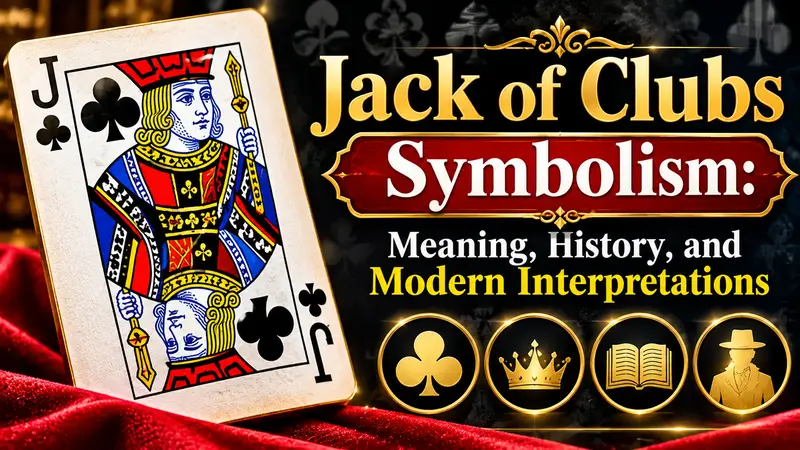
In an ordinary American deck, the Jack of Clubs features a male court figure alongside three black club-shaped symbols. Although most people recognize it as one of the 52 standard playing cards, its imagery also connects to centuries of European card-making, social customs, and fortune-telling traditions.
Today, people encounter this card in poker games, card tricks, historical artwork, tattoos, and spiritual readings. Its interpretation depends on context: a card player may see it simply as a useful rank, while someone interested in cartomancy may associate it with intelligence, communication, determination, or a young person entering an important stage of life.
Quick Answer
The Jack of Clubs commonly symbolizes intelligence, ambition, curiosity, resourcefulness, and youthful initiative in modern American card symbolism. In traditional playing-card readings, it can represent a clever young person, useful information, practical opportunities, or the ability to turn ideas into action.
TL;DR
- Core meaning: Intelligence, ambition, curiosity, and initiative.
- Jack symbolism: Youth, movement, communication, and developing potential.
- Clubs symbolism: Action, work, practical growth, and social connections.
- Cartomancy: Often represents a clever or resourceful young person.
- American context: Appears in card games, magic, tattoos, and fortune-telling.
- Modern interpretation: Encourages strategic thinking and taking practical opportunities.
What Does the Jack Represent in a Playing-Card Deck?
The Jack is one of three traditional court cards in a standard playing-card suit, positioned between the 10 and the Queen. Historically, the figure was called a knave, a term referring to a male attendant, servant, or person serving someone of higher rank.
The modern Jack developed from this earlier courtly figure. Over time, the character became a familiar part of European and American card decks, representing a younger male figure rather than a king or queen.
Symbolically, the Jack is often interpreted as representing:
- Youth: A person who is still learning and developing.
- Initiative: The willingness to take action rather than wait.
- Curiosity: An interest in discovering new information.
- Communication: Messages, conversations, and social interaction.
- Potential: Abilities that have not yet reached their full expression.
In symbolic readings, the Jack can represent someone who brings movement into an otherwise settled situation. It may suggest a newcomer, a messenger, a student, or a person whose ideas influence what happens next.
These are interpretive associations, not meanings established by the historical designers of the cards.
What the Clubs Suit Represents
The Clubs suit is traditionally represented by a black, three-lobed figure resembling a clover leaf. Its French name, trèfle, literally refers to a clover. The familiar four-suit system developed from French playing cards during the fifteenth century.
In modern cartomancy, Clubs are frequently associated with practical matters, communication, work, learning, ambition, and social activity. These associations are especially common in popular English-language interpretations of playing cards.
The suit can also be connected with action and the development of ideas. Unlike Hearts, which are commonly interpreted through emotional relationships, or Diamonds, which often concern money and material matters, Clubs are frequently read through activity, effort, and intellectual engagement.
When the Jack appears in this suit, its youthful and active character combines with the practical associations of Clubs. This helps explain why the card is often interpreted as a sign of someone who uses intelligence and initiative to pursue opportunities.
Historical Origins of the Jack of Clubs
Playing cards have a long history of cultural exchange. They existed in China before their widespread appearance in Europe, and related card traditions were present in the Islamic world before European decks became established.
By the fourteenth century, playing cards had reached parts of Europe. Early decks differed considerably in their illustrations, suit symbols, and court figures. Some featured attendants, officials, and other people associated with royal households rather than the standardized characters found in modern decks.
French cardmakers helped establish the familiar suits of Hearts, Diamonds, Clubs, and Spades during the fifteenth century. The simplified designs were easier to reproduce, making printed decks more affordable and widely available.
The Jack of Clubs emerged from this evolving European card tradition. Its original significance was connected to the structure of the deck and the courtly rank it represented, not to a universal system of personality traits or predictions.
As card reading and fortune-telling developed, individual cards acquired additional symbolic interpretations. The Jack gradually became associated with younger people, attendants, messengers, and other figures whose roles involved movement or service.
Jack of Clubs Meaning in Cartomancy
Cartomancy is the practice of interpreting ordinary playing cards for symbolic guidance or fortune-telling. It developed in Europe as playing cards became more widely available, with different readers creating their own interpretive systems.
Within cartomancy, the Jack of Clubs is commonly interpreted as a card of intelligence, useful communication, practical ambition, and opportunity.
It may represent a person who is clever, energetic, sociable, or interested in learning. Depending on the reading, it can also suggest a helpful message, a new connection, or an opportunity that requires initiative.
Some interpretations associate the card with a young man or an individual who displays youthful characteristics. This does not necessarily indicate someone’s actual age or gender. In modern readings, it can describe a personality or role rather than a specific person.
It is important to recognize that playing-card divination has no single universally accepted interpretation system. Different readers may assign different meanings depending on surrounding cards, traditional methods, and personal practice.
What the Jack of Clubs Means in Love and Relationships
In relationship readings, the Jack of Clubs is often associated with communication, curiosity, and an active social life. It may represent someone who enjoys conversation, likes meeting new people, and approaches relationships with enthusiasm.
For someone who is single, the card can be interpreted as a possible new connection or an opportunity to meet someone through shared interests, education, or social activities.
For people already in relationships, it may encourage more open communication and intellectual connection. It can suggest that spending time learning together, sharing ideas, or exploring new experiences may improve the relationship.
However, the card is not traditionally a guaranteed prediction of marriage, romance, or a particular person’s arrival. Its interpretation is more useful as a symbolic prompt to consider communication and personal initiative.
Jack of Clubs Meaning in Career, Work, and Money
The career interpretation of the Jack of Clubs focuses on ideas, practical intelligence, and the willingness to develop new skills. It can represent a person who learns quickly, communicates effectively, and recognizes opportunities that others may overlook.
In a career reading, the card may suggest:
- Learning a new professional skill.
- Taking responsibility for a project.
- Building useful professional relationships.
- Sharing an innovative idea.
- Exploring a new business opportunity.
- Improving communication with colleagues.
For students and professionals beginning their careers, the card can represent ambition and the value of remaining curious.
Financially, its interpretation is generally more connected with practical decision-making than sudden wealth. It may encourage someone to research an opportunity, develop a useful skill, or approach financial matters with greater awareness.
The card should not be treated as a reliable prediction of financial success. Its value in a reading comes from the questions it encourages people to consider.
Jack of Clubs in Dreams and Spiritual Interpretations
Some people interpret playing cards in dreams as symbols connected to choices, relationships, uncertainty, or everyday decisions. Seeing the Jack of Clubs may therefore be understood as an image of communication, intellectual activity, or an opportunity that deserves attention.
A dream involving the card could reflect a situation in which someone is learning something new, considering a decision, or waiting for important information.
The surrounding details matter. A card appearing during a friendly game may carry a different personal association from one appearing in a stressful or confusing dream.
There is no established scientific evidence that dreaming about a particular playing card predicts future events. Dream interpretations are subjective, and the most useful meaning often comes from connecting the image with current experiences and emotions.
In spiritual interpretations, the Jack of Clubs may be used as a reminder to combine curiosity with responsible action. It can represent the importance of developing knowledge rather than relying entirely on assumptions.
Jack of Clubs Meaning in American Culture
In the United States, the Jack of Clubs is first and foremost a familiar playing card. Americans encounter it in poker, blackjack, bridge, family card games, magic performances, and collectible playing-card designs.
Its cultural meaning is influenced by both entertainment and symbolic traditions. In a poker game, the Jack has a defined numerical rank and strategic value. In a fortune-telling setting, the same card may be interpreted as a person, message, or opportunity.
American card culture also gives playing cards a connection with competition, probability, skill, and chance. This makes the Jack of Clubs an interesting image for artists and designers interested in combining traditional card imagery with ideas about intelligence and risk-taking.
Unlike certain national emblems or religious symbols, the Jack of Clubs does not have one official American cultural meaning. Its interpretation depends on whether it appears in a game, artwork, personal design, or divination practice.
Jack of Clubs Symbolism in Tattoos, Jewelry, and Art
The Jack of Clubs can make an interesting design because it combines a recognizable playing-card format with a court figure and a distinctive suit symbol.
In tattoo culture, playing-card designs are sometimes chosen to represent personality, luck, confidence, strategy, or a meaningful personal experience. Someone might choose the Jack of Clubs to express intelligence, independence, ambition, or an interest in card games.
Common design approaches include:
- Traditional playing-card design: A recognizable representation of the original card.
- Minimalist outline: A simple black illustration emphasizing the suit and rank.
- Vintage card artwork: An older-looking design that references historical decks.
- Personalized artwork: Additional numbers, dates, initials, or decorative details.
- Black-and-gray designs: A restrained style that emphasizes the card’s traditional appearance.
In jewelry, the card may appear on pendants, bracelets, or decorative accessories. Some people select it because of its personal meaning, while others simply appreciate its graphic appearance.
There is no universal rule that a Jack of Clubs tattoo represents a particular lifestyle, personality, or belief. Its meaning belongs largely to the person choosing the design.
Jack of Clubs Compared With Other Jacks
Each Jack belongs to a different suit, so cartomancy traditions often distinguish their interpretations by combining the character of the court card with the associations of the suit.
| Playing Card | Common Symbolic Interpretation | Main Associations |
|---|---|---|
| Jack of Clubs | Intelligence and practical ambition | Learning, work, communication |
| Jack of Hearts | Affection and emotional expression | Romance, friendship, kindness |
| Jack of Diamonds | Opportunity and practical interests | Money, business, information |
| Jack of Spades | Caution and intellectual seriousness | Challenges, strategy, difficult news |
These descriptions represent common modern cartomancy interpretations rather than universally established meanings. Different reading traditions may interpret the same cards differently.
The comparison helps explain why the Jack of Clubs is generally associated with practical thinking and activity rather than primarily with romantic or emotional concerns.
Positive and Challenging Interpretations of the Jack of Clubs
The Jack of Clubs is generally interpreted positively, especially when a reading focuses on learning, communication, and personal initiative.
Its positive associations include intelligence, adaptability, curiosity, useful connections, and the ability to recognize opportunities. It may encourage someone to take an active role in solving a problem instead of waiting for circumstances to change.
However, some interpretations also recognize less helpful qualities associated with the card’s youthful or restless character.
These can include:
- Acting before considering the consequences.
- Becoming distracted by too many interests.
- Overestimating one’s abilities.
- Using cleverness without sufficient honesty.
- Starting projects without completing them.
These challenging meanings should not be treated as fixed warnings. They provide alternative ways of examining the card, particularly when it appears alongside other cards that suggest conflict or uncertainty.
Common Misunderstandings About the Jack of Clubs
One common misconception is that the Jack of Clubs always represents a young man. Although traditional interpretations sometimes associate Jacks with younger male figures, contemporary readers may interpret the card as a personality, situation, or developing opportunity.
Another misunderstanding is that the card guarantees good luck or financial success. The Jack of Clubs is often interpreted positively, but its symbolic associations do not establish what will happen in someone’s life.
It is also easy to confuse ordinary playing-card symbolism with tarot meanings. Standard playing cards and tarot decks share historical connections, but they are not identical systems. The Jack of Clubs should not automatically be assigned the same meaning as a particular tarot court card.
Finally, the Clubs suit should not be assumed to have one universally accepted spiritual meaning. Its interpretation in cartomancy developed through different reading traditions and should be distinguished from the historical reason the suit appears in playing cards.
FAQs
What does the Jack of Clubs mean spiritually?
The Jack of Clubs is commonly interpreted as a symbol of intellectual development, curiosity, communication, and purposeful action. In spiritual readings, it may encourage someone to use knowledge and practical abilities to move forward.
Is the Jack of Clubs a good or bad card?
The card is generally considered positive in popular cartomancy interpretations because of its associations with intelligence, ambition, and opportunity. However, it can also suggest impatience, distraction, or unfinished plans depending on the reading.
Does the Jack of Clubs represent a person?
Yes, traditional card readings sometimes associate it with a clever, energetic young man or a helpful individual. Modern interpretations may also use it to describe someone who is curious, communicative, and ambitious, regardless of age or gender.
What does the Jack of Clubs mean in love?
In love readings, it commonly represents communication, new social connections, and intellectual attraction. It may suggest an opportunity to develop a relationship through conversation and shared interests.
What does the Jack of Clubs mean in a career reading?
It often represents learning, professional development, useful contacts, and creative problem-solving. The card may encourage someone to pursue opportunities that require initiative and clear communication.
What is the difference between the Jack of Clubs and the Jack of Hearts?
The Jack of Clubs is commonly associated with intelligence, practical ambition, and communication, while the Jack of Hearts focuses more on affection, friendship, and emotional expression. Both can represent people or developing situations in cartomancy.
Does the Jack of Clubs represent good luck?
Some modern interpretations connect the card with favorable opportunities and helpful information. However, it is not universally recognized as a luck card, and its appearance should not be treated as a guarantee of future success.
Conclusion
The Jack of Clubs combines the traditional symbolism of the Jack with the practical and active associations of the Clubs suit. It is commonly interpreted as representing intelligence, curiosity, ambition, communication, and the ability to recognize opportunities.
In modern American culture, the card exists in several settings, from everyday games and artistic designs to tattoos and cartomancy. Its meaning changes according to how people use and interpret it, rather than following one universally accepted definition.
Ultimately, Jack of Clubs symbolism offers a useful reminder of the value of curiosity, thoughtful decisions, and taking action when opportunities arise. It represents the idea that intelligence becomes most valuable when it is put to practical use.