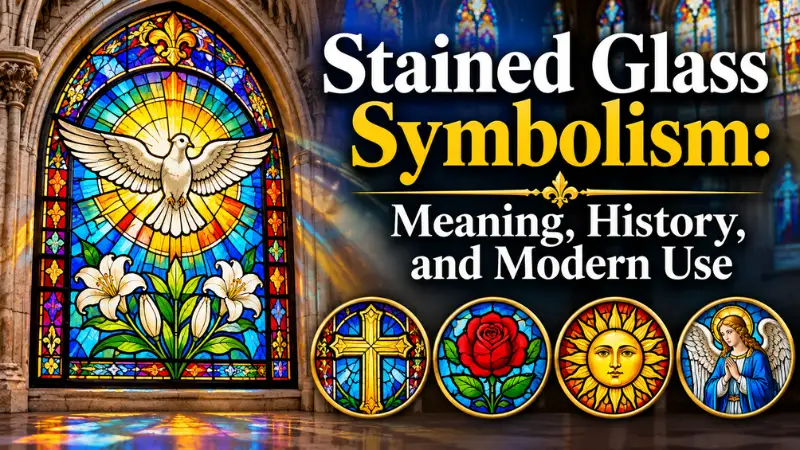
Stained glass symbolism is closely connected to spirituality, faith, beauty, transformation, and the relationship between light and darkness. Recognized for its colorful patterns and illuminated designs, stained glass has appeared in churches, cathedrals, historic buildings, private homes, and modern artwork for centuries. Its ability to transform ordinary sunlight into shifting colors has made it an enduring artistic and symbolic tradition.
Although many people associate stained glass with Christian churches, its meaning extends beyond religion. In contemporary American culture, it can represent hope, individuality, remembrance, creativity, and the beauty of seeing the world from different perspectives.
Understanding its symbolism requires looking at how the material developed, why religious communities embraced it, and how artists and homeowners continue to use it today.
Quick Answer
Stained glass symbolism commonly represents spirituality, divine light, hope, beauty, and transformation in modern American culture. Historically, it was especially associated with Christian teachings, sacred stories, and the idea of bringing spiritual meaning into physical spaces through illuminated color.
TL;DR
- Spirituality: Represents divine light, faith, and the presence of something sacred.
- Transformation: Shows how ordinary light becomes something visually extraordinary.
- History: Developed into a major storytelling art in medieval European churches.
- American culture: Appears in religious buildings, historic homes, memorials, and contemporary design.
- Personal expression: Communicates individuality, creativity, hope, and emotional remembrance.
- Modern design: Combines traditional craftsmanship with contemporary artistic expression.
1. What Is Stained Glass and Why Is It Symbolic?
Reflections for Lent: 2026 What we love | ResourceUMC
Masjid-e-Thaqwa – Hadith | ஹதீஸ் |Dua | துஆ
10
Stained glass is an artistic form made by arranging colored or decorated glass pieces into a larger image, pattern, or design. Traditionally, individual pieces are connected with narrow strips of lead, although modern artists also use copper foil, fused glass, and other construction methods.
The glass receives its color through metallic compounds added during manufacturing or through decorative treatments applied to its surface. When sunlight passes through it, the colors become visible in ways that change with the weather, time of day, and surrounding environment.
This relationship between light and color gives stained glass much of its symbolic significance.
Unlike an ordinary painting, which reflects light from its surface, stained glass allows light to pass through the artwork. This physical quality has encouraged associations with:
- Spiritual enlightenment and divine presence.
- Hope emerging from difficult circumstances.
- Beauty created through different elements.
- The connection between the physical and spiritual worlds.
- Individuality and creative expression.
The material itself becomes part of the message. Light is not simply represented in the design; it actively participates in creating the image.
2. The Core Symbolic Meanings of Stained Glass
Although interpretations depend on the design and setting, several meanings appear consistently in stained glass traditions.
Spirituality and divine presence
In religious settings, illuminated glass often suggests the presence of God, sacred knowledge, or spiritual guidance. The light entering a church through colored windows can create an atmosphere associated with prayer and contemplation.
Hope and renewal
Light passing through dark or cloudy surroundings can represent optimism, reassurance, and the possibility of a new beginning. This interpretation is especially common in contemporary decorative art.
Transformation and change
Stained glass transforms sunlight into a colorful visual experience. Symbolically, this can represent personal growth, changing perspectives, and the ability to find beauty in different circumstances.
Unity and diversity
A stained-glass window may contain hundreds of individual pieces, each contributing to one complete image. This arrangement can symbolize cooperation, community, and the importance of different individuals within a shared whole.
Memory and remembrance
Memorial windows frequently preserve the names, stories, or images of people who have died. Their lasting presence makes stained glass a meaningful expression of remembrance and family heritage.
These meanings are related, but they are not interchangeable. A church window depicting a biblical event communicates something different from an abstract stained-glass panel created for a modern living room.
3. Historical Origins: From Ancient Glass to Medieval Churches
Église Saint-Pierre à Chartres
Notre Dame de Chartres – Les Vitraux
Catalog – ANTIQUITIES, PRE COLUMBIAN, Islamic Art SALE
9
The history of stained glass began long before the great European cathedrals.
Ancient civilizations, including the Egyptians and Romans, developed sophisticated glassmaking techniques. Colored glass appeared in decorative objects, mosaics, architectural features, and other forms of craftsmanship.
Romans also used glass in windows, although the widespread development of elaborate pictorial stained-glass windows came later.
Early Christian communities adopted decorative glass and mosaics as part of their religious environments. As church architecture developed, colored glass became an increasingly important way to introduce sacred imagery into buildings.
Between approximately 1150 and 1500, stained glass reached a particularly influential period in medieval Europe.
Gothic architecture encouraged the construction of larger windows, allowing churches to incorporate extensive biblical scenes, saints, religious figures, and symbolic patterns.
These windows served practical and educational purposes. At a time when many worshippers could not read religious texts, visual narratives helped communicate important stories and teachings.
The symbolism gradually expanded from decorative beauty into a visual language connecting light, faith, education, and sacred space.
4. Christian Symbolism and the Meaning of Sacred Light
Explore the Beauty of Mobile’s Oldest Stained-Glass Windows
Christianity has played a major role in shaping the traditional interpretation of stained glass.
In Christian buildings, light frequently represents God’s presence, spiritual truth, goodness, and guidance. Stained-glass windows make these ideas visible through illuminated religious scenes and carefully arranged colors.
Common Christian subjects include:
- Jesus Christ and biblical events.
- The Virgin Mary and scenes from her life.
- Angels representing divine messengers.
- Saints associated with particular virtues or traditions.
- Doves representing the Holy Spirit.
- Crosses symbolizing sacrifice, redemption, and salvation.
A window depicting the resurrection of Jesus, for example, may communicate renewal, victory over death, and the promise of eternal life.
Similarly, an image of a dove surrounded by light may represent peace and the Holy Spirit.
The symbolism is not limited to individual religious figures. The entire window can contribute to the sacred character of a building by changing the appearance of natural light.
For many Christian communities, stained glass helps create an environment in which worshippers can reflect on spiritual teachings through both images and atmosphere.
5. What Different Colors Represent in Stained Glass
Stained glass windows in the dining room
Color is one of the most recognizable features of stained glass. Artists use different shades to establish mood, emphasize important figures, and communicate ideas.
However, color symbolism is not universal. Its interpretation depends on religious traditions, historical periods, artistic choices, and cultural settings.
The following table explains some common associations in American decorative and religious contexts.
| Color | Common Symbolic Meaning | Typical Associations |
|---|---|---|
| Red | Love, sacrifice, courage | Passion, religious devotion, remembrance |
| Blue | Peace, faith, wisdom | Spiritual reflection, calmness, trust |
| Green | Growth, renewal, life | Nature, healing, new beginnings |
| Yellow and Gold | Light, joy, hope | Celebration, divine glory, warmth |
| Purple | Dignity, reflection, devotion | Royalty, spirituality, contemplation |
| White | Purity, peace, innocence | New beginnings, simplicity, sacredness |
In Christian stained glass, blue is frequently associated with the Virgin Mary, while red may communicate sacrifice or the presence of the Holy Spirit, depending on the subject.
Green often suggests renewal and life, making it suitable for floral designs and scenes involving nature.
Gold and yellow can create associations with sunlight, glory, and celebration. Purple may communicate dignity, penitence, or spiritual reflection.
In modern American interiors, these colors are often selected for their visual and emotional effects rather than strict religious meanings.
A blue-and-green window in a living room, for instance, might simply create a peaceful atmosphere without communicating a specific religious message.
6. Stained Glass Symbolism in American Culture
Little Rock | Historic Little Rock Baptist Church | United States
1303 W Main St, Waxahachie, TX 75165 | Realtor.com®
Greenwood Cemetery – Independence Chapel (2001) — Don Young Glass Studio
13
Stained glass has an important place in American architectural and artistic history.
During the nineteenth century, Gothic Revival architecture became increasingly popular in the United States. Churches influenced by European Gothic buildings incorporated pointed arches, decorative details, and colorful windows.
Episcopal and other Christian congregations helped establish demand for professionally designed stained glass. As the practice developed, American artists began experimenting with different materials, colors, and artistic approaches.
By the late nineteenth and early twentieth centuries, stained glass had become prominent beyond traditional church architecture.
Its American cultural meanings include several distinct ideas.
Religious identity: Churches use stained glass to communicate faith, preserve religious traditions, and create recognizable sacred environments.
Community heritage: Historic windows often reflect the families, congregations, and communities that contributed to a building’s development.
Artistic independence: American designers adapted traditional European techniques to create more naturalistic and experimental artwork.
Historical preservation: Original stained-glass windows can become important features of historic churches, public buildings, and residential properties.
Personal remembrance: Families and organizations sometimes commission windows to honor individuals or preserve significant events.
In the United States, stained glass is therefore both a religious art form and a recognizable part of architectural heritage.
7. Louis Comfort Tiffany and the American Artistic Transformation
“Louis Comfort Tiffany: Treasures From The Driehaus Collection” At MWPAI | WAMC
One of the most important figures in American stained-glass history was Louis Comfort Tiffany (1848–1933).
Tiffany helped transform the appearance of American decorative glass through his experimentation with opalescent glass and innovative color combinations.
Working alongside other influential artists, including John La Farge, he helped develop an approach that moved beyond the conventional appearance of medieval-style windows.
Opalescent glass could contain variations in color, texture, and transparency. These qualities allowed artists to produce more naturalistic effects, especially in floral, landscape, and nature-inspired designs.
Tiffany’s windows frequently incorporated:
- Flowers and botanical arrangements.
- Trees, leaves, and natural landscapes.
- Birds and other wildlife.
- Decorative geometric patterns.
- Subtle combinations of transparent and opaque glass.
His work helped establish stained glass as a form of fine art and luxury interior decoration in the United States.
Symbolically, this development broadened the material’s associations. Instead of communicating only religious narratives, stained glass could express a love of nature, craftsmanship, beauty, and artistic individuality.
Tiffany-style glass remains recognizable in American homes, museums, historic buildings, and decorative objects.
8. Stained Glass in Other Cultures and Religious Traditions
Although medieval Christianity played a major role in the development of pictorial stained glass, the use of colored glass in architecture is not exclusive to Christian communities.
Different cultures have incorporated decorative glass, colored architectural elements, and illuminated patterns into their artistic environments.
Islamic architecture
Islamic architectural traditions have used colored glass, patterned screens, and decorative geometric designs in various regions and historical periods.
These designs may emphasize order, symmetry, craftsmanship, and the relationship between natural light and architectural space.
It is important to distinguish traditional Islamic geometric decoration from the figurative imagery commonly found in Christian stained-glass windows. Many Islamic religious settings avoid depicting sacred figures.
European secular traditions
In European homes, civic buildings, and public institutions, stained glass has also represented family identity, civic pride, heraldry, and historical events.
Family coats of arms and decorative emblems were particularly useful for communicating ancestry and social identity.
Modern international art
Contemporary artists across different countries use colored glass to explore nature, cultural heritage, memory, identity, and abstraction.
The symbolism therefore depends on the artwork rather than belonging to one universal religious interpretation.
For American readers, this distinction is useful because stained glass can be appreciated as a shared artistic tradition without assuming that every window has Christian meaning.
9. Emotional and Psychological Meaning of Stained Glass
Colorful Cathedral Light | Stained glass light, Light images, Stained glass
Stained glass can create an emotional experience even when viewers do not recognize the images or understand their historical background.
One reason is its relationship with natural light.
Sunlight changes throughout the day, causing colors to appear brighter, softer, warmer, or darker. A window that looks relatively ordinary in the morning may produce a completely different atmosphere in the afternoon.
This changing appearance can encourage several emotional associations.
Comfort and reassurance: Warm colors and illuminated spaces can make an interior feel welcoming and peaceful.
Reflection: Complex patterns encourage viewers to slow down and examine individual details.
Personal transformation: The combination of different pieces into a complete image can suggest growth, healing, and the development of identity.
Emotional connection: A window associated with a family member, religious community, or historic event can become a lasting reminder of personal experiences.
Acceptance of differences: Individual pieces may vary in shape and color while contributing to one design. This can provide a meaningful metaphor for cooperation and belonging.
These interpretations are not scientifically fixed psychological effects. People respond differently according to their memories, cultural backgrounds, personal beliefs, and experiences.
Nevertheless, the visual qualities of stained glass help explain why it remains emotionally meaningful in both religious and secular environments.
10. What Broken or Repaired Stained Glass Symbolizes
A damaged stained-glass window can carry a different meaning from an intact one.
Historically, windows have been damaged by weather, building deterioration, accidents, conflict, and deliberate destruction. Their restoration often requires specialized craftsmanship because individual pieces must be repaired or replaced without losing the original design.
In contemporary art and personal interpretation, broken glass can represent:
- Loss and the experience of hardship.
- Fragility and the temporary nature of life.
- The effects of conflict or historical change.
- Recovery after a difficult experience.
- The preservation of something valuable despite damage.
A restored window can become a particularly meaningful image of continuity.
Its appearance may contain evidence of earlier damage, yet the artwork remains part of the building’s history.
This does not mean that every repaired window was intentionally designed to represent healing. The symbolic interpretation comes from how people understand the object and its history.
11. Stained Glass in American Homes and Interior Design
Farrow & Ball Skylight No. 205 | Paint Colour Edmonton – Carbon Boutique
Colored Mosaic Design Suncatcher-Glass Suncatchers | Myphotostation – MyPhotoStation
14
Stained glass has moved well beyond churches and historic public buildings.
In American residential design, it is used to introduce color, privacy, craftsmanship, and decorative interest into everyday spaces.
Common applications include:
- Front-door panels and decorative transoms.
- Kitchen and bathroom windows.
- Living-room accent windows.
- Decorative lamps and lighting fixtures.
- Hanging window ornaments and sun catchers.
- Cabinet inserts and room dividers.
In older American homes, stained-glass panels can reflect Victorian, Arts and Crafts, or other historical design influences.
In contemporary homes, abstract patterns and simplified geometric compositions are often preferred.
The symbolism also changes with the setting.
A floral window may communicate an appreciation for nature, while a geometric panel may suggest balance and order. A custom family design might represent heritage and belonging.
For some homeowners, stained glass is simply an attractive decorative feature. It does not always need to communicate a specific symbolic message to be meaningful.
12. Modern Uses in Tattoos, Jewelry, and Personal Expression
Shattering the Mold: The Timeless Beauty of Stained Glass Window Tattoos: 60 Designs – inktat2.com
STYLE Art by 1991 – Free | Tensor.Art | Tensor.Art
11
Stained-glass designs have become a source of inspiration for contemporary personal style.
Their distinctive combination of outlines, colors, and separate visual elements makes them adaptable to tattoos, jewelry, accessories, and fashion.
Stained-glass tattoos
A stained-glass tattoo often uses dark outlines and brightly colored sections to recreate the appearance of a traditional window.
Common designs include:
- Roses and other flowers.
- Butterflies and birds.
- Religious crosses and angels.
- Sunlight and celestial imagery.
- Abstract geometric compositions.
A person might choose this style to represent faith, personal transformation, family memories, or appreciation for artistic craftsmanship.
The meaning depends on the image itself and the individual’s reasons for choosing it.
Jewelry
Stained-glass-inspired pendants, earrings, and decorative pieces can communicate creativity, individuality, and appreciation for handmade art.
Fashion and accessories
Color-blocked patterns and glass-inspired designs appear in clothing, scarves, handbags, and artistic accessories.
Social media and digital artwork
Artists use stained-glass aesthetics in digital illustrations, photography, wallpapers, and graphic designs. The visual style is recognizable because of its strong outlines, vivid colors, and illuminated appearance.
These modern uses show how a traditional architectural art form can become an expression of personal identity.
13. Stained Glass in Memorials, Weddings, and Important Life Events
Wade Memorial Chapel in Cleveland
Stained glass is sometimes chosen for occasions that carry personal, family, or community significance.
Its durability and ability to preserve images make it suitable for commemorating important people and events.
Memorials and remembrance
Memorial windows are often installed in churches, chapels, and other meaningful locations. They may include names, dates, religious imagery, or personalized designs honoring someone who has died.
For families, these windows can represent lasting memories, gratitude, faith, and the continuation of a person’s legacy.
Weddings
Stained glass can appear in wedding venues, decorative backdrops, and custom artwork. Floral patterns, doves, hearts, and illuminated designs may communicate love, commitment, unity, and the beginning of a shared life.
Family heritage
Some families preserve or commission stained-glass panels featuring family names, historical symbols, or meaningful decorative elements.
Community celebrations
Schools, religious organizations, and cultural institutions may use stained glass to recognize important milestones or celebrate their collective history.
These applications demonstrate that stained glass is not simply an architectural decoration. It can become a permanent record of relationships, shared experiences, and important moments.
14. Common Misunderstandings and Misuse of Stained Glass Symbolism
Stained glass has a recognizable historical association with religion, but several misunderstandings can arise when its symbolism is interpreted too narrowly.
Misunderstanding 1: All stained glass is Christian.
Christian churches have played a major role in its development, but stained glass has also appeared in homes, civic buildings, museums, and secular artwork.
Misunderstanding 2: Every color has one universal meaning.
Red, blue, green, and other colors can carry different associations depending on their historical, religious, and artistic contexts.
A red section in one window might represent sacrifice, while another might use red simply to create visual contrast.
Misunderstanding 3: Stained glass always represents spirituality.
Some windows are primarily decorative. Others communicate family identity, artistic experimentation, nature, or historical events.
Misunderstanding 4: Broken glass automatically symbolizes personal suffering.
Damage can encourage interpretations involving loss or recovery, but an ordinary damaged window does not necessarily carry an intentional symbolic message.
Misunderstanding 5: Traditional religious imagery has the same meaning in every culture.
Symbols such as doves, angels, crosses, and sacred figures have specific meanings within particular traditions. Their interpretations should not be separated from their cultural and religious backgrounds.
A careful interpretation considers the artwork’s original purpose, location, imagery, and intended audience rather than assigning a universal meaning to every window.
15. How Stained Glass Symbolism Has Evolved Over Time
The meaning of stained glass has changed as its artistic techniques, architectural uses, and cultural settings have developed.
Its earliest architectural applications were largely decorative. During the medieval period, religious institutions helped transform it into an important storytelling medium.
Later, religious and political changes in Europe contributed to a decline in elaborate church windows in some regions. The Reformation, changing artistic preferences, and damage to religious buildings all affected the tradition.
During the nineteenth century, the Gothic Revival renewed interest in medieval architecture and stained-glass craftsmanship.
In the United States, artists such as Louis Comfort Tiffany helped expand its artistic possibilities through new materials and decorative techniques.
The twentieth century introduced additional changes. Modern architects and artists experimented with abstract patterns, unconventional shapes, and new methods of assembling colored glass.
Today, stained glass serves several purposes simultaneously:
- A traditional expression of religious faith.
- An important element of architectural heritage.
- A medium for contemporary fine art.
- A decorative feature in residential interiors.
- A personal expression of identity and remembrance.
Its historical religious associations remain recognizable, but its modern meaning is considerably broader.
FAQs
1. What does stained glass symbolize spiritually?
Stained glass spiritually symbolizes divine light, faith, hope, spiritual understanding, and the presence of something sacred. In Christian churches, illuminated windows often communicate biblical teachings and represent the relationship between earthly life and the divine.
2. Is stained glass a symbol of hope?
Yes. Stained glass is commonly interpreted as a symbol of hope because sunlight passes through colored sections to create an illuminated image. This visual transformation can represent optimism, renewal, and the possibility of finding beauty after difficult experiences.
3. What does a stained-glass tattoo mean?
A stained-glass tattoo can represent individuality, faith, creativity, personal growth, or the idea that different experiences contribute to a complete identity. Its meaning depends on the chosen imagery, colors, and personal associations of the wearer.
4. What does stained glass symbolize in Christianity?
In Christianity, stained glass commonly represents divine light, spiritual truth, faith, and biblical teachings. Windows depicting Jesus, Mary, saints, angels, or biblical events help communicate religious stories and establish a reflective atmosphere for worship.
5. What does blue stained glass represent?
Blue stained glass is commonly associated with peace, faith, wisdom, and spiritual reflection. In Christian artwork, it is frequently used in representations of the Virgin Mary, although its meaning depends on the particular image and tradition.
6. Why is stained glass used in churches?
Stained glass is used in churches because it combines visual storytelling with natural light. Historically, windows helped communicate biblical narratives to worshippers, while their illuminated colors contributed to an atmosphere suitable for prayer and religious reflection.
7. Does stained glass have a meaning outside religion?
Yes. Outside religious settings, stained glass can represent artistic creativity, family heritage, individuality, community identity, and remembrance. Modern artists also use it to explore nature, abstract design, and personal experiences.
Conclusion
Stained glass represents spirituality, hope, transformation, beauty, and the connection between light and human experience. Its historical association with Christian churches established many of its traditional meanings, but its role in American culture has expanded through architecture, decorative arts, memorials, and contemporary personal expression.
Understanding stained glass symbolism means looking beyond its colorful appearance and considering its history, imagery, materials, and setting. A traditional church window, a Tiffany-inspired lamp, and a modern stained-glass tattoo may all use similar visual techniques while communicating very different ideas.
Ultimately, stained glass reminds us that individual pieces can contribute to a meaningful whole, and that light can change the way we see familiar things.