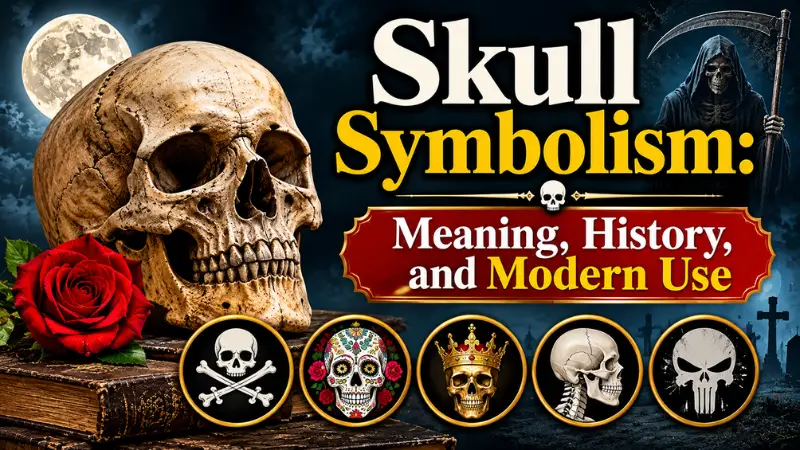
A human skull is one of the most recognizable symbols in the world. Its hollow eye sockets, exposed teeth, and unmistakable shape make it an immediate reminder of human mortality. Skull symbolism carries several meanings in modern American culture, including death, danger, strength, rebellion, remembrance, and the temporary nature of life.
People encounter skull imagery in many different settings. It appears on Halloween decorations, motorcycle clothing, jewelry, tattoos, warning labels, military insignia, artwork, and even luxury fashion. Although the image often looks threatening, its meaning depends heavily on the setting and the person using it.
Understanding this symbol requires looking beyond its association with death. Across different historical periods and cultural traditions, skulls have represented religious reflection, respect for ancestors, political satire, personal identity, and the idea that everyone shares the same human fate.
Quick Answer
Skull symbolism commonly represents death, mortality, danger, and rebellion in modern American culture, particularly in Halloween decorations, tattoos, fashion, and warning signs. Historically, skulls also represented remembrance, spiritual reflection, equality in death, and the importance of appreciating life’s limited time.
TL;DR
- Death and mortality: Skulls remind people that human life is temporary.
- Historical meaning: European traditions used skulls as reminders of death and moral responsibility.
- American culture: Halloween, pirate imagery, and popular fashion give skulls different meanings.
- Personal identity: Tattoos and jewelry often express courage, independence, or remembrance.
- Cultural traditions: Mexican Día de los Muertos uses skull imagery to honor departed loved ones.
- Modern interpretation: Skulls can communicate danger, strength, humor, or artistic expression.
What Does a Skull Symbolize?
The most familiar meaning of a skull is death. Because it is the recognizable structure remaining after the body’s soft tissues have disappeared, it naturally represents the physical end of human life.
However, the skull communicates more than the idea of dying. It can represent the following concepts:
Mortality: A skull reminds people that life has an ending, regardless of wealth, age, or social position.
Danger: Skull-and-crossbones imagery warns people about poisonous substances, hazardous materials, and potentially fatal risks.
Rebellion: In fashion, music, and tattoo culture, skulls often communicate independence and resistance to conventional expectations.
Strength and courage: Some people use skull designs to express fearlessness, resilience, or a willingness to confront difficult experiences.
Remembrance: In memorial art and religious traditions, skulls can encourage reflection on people who have passed away.
Equality: A skull represents a shared human structure, making it a reminder that death eventually removes distinctions between social classes and personal achievements.
These interpretations are not interchangeable. A skull on a household cleaning product communicates a safety warning, while a skull surrounded by flowers on a memorial altar may represent love and remembrance.
Ancient Origins and the Historical Meaning of Skulls
Human societies have encountered and interpreted skulls since prehistoric times. Archaeological evidence from different parts of the world shows that human remains, including skulls, sometimes received special treatment in burial practices and ceremonial settings.
However, there was no single universal meaning. Some communities treated skulls as important ancestral remains, while others associated them with death, spiritual protection, or ritual practices.
In ancient Greece and Rome, artistic references to mortality eventually contributed to a tradition of reflecting on life’s temporary nature. Later European art developed this idea more visibly through objects associated with death and the passage of time.
By the late medieval and early modern periods, skull imagery had become an established visual reminder of mortality in European religious and artistic settings.
During the 16th and 17th centuries, skulls appeared frequently in paintings, religious objects, and personal jewelry. Artists used them to communicate that physical beauty, wealth, and worldly success could not prevent death.
This historical development helped establish the skull as a symbol of mortality and reflection rather than simply a frightening object.
Memento Mori: The Skull as a Reminder to Live
One of the most important historical interpretations of the skull comes from the Latin expression memento mori, meaning remember that you must die.
This philosophy encouraged people to recognize the temporary nature of human existence. Instead of treating death only as something frightening, it presented mortality as a reason to examine personal priorities and behavior.
European artists frequently included skulls in paintings alongside other symbolic objects:
- Hourglasses: Represented the passage of time.
- Extinguished candles: Suggested the end of life.
- Wilting flowers: Represented fading beauty and physical decline.
- Books: Could represent the limitations of human knowledge and achievement.
- Fruit: Suggested abundance, pleasure, and eventual decay.
These objects frequently appeared in vanitas paintings, particularly in 17th-century Dutch art.
A skull in this setting was not necessarily intended to create fear. It encouraged viewers to consider what mattered beyond possessions, reputation, and temporary pleasures.
Today, this interpretation remains relevant to people who wear skull jewelry or display skull artwork as a reminder to value their time and relationships.
What Skull Symbolism Means in American Culture
In the United States, skull imagery has developed several recognizable cultural meanings. Its interpretation often depends on the environment in which it appears.
Halloween is one of the strongest influences on the American understanding of skulls. During October, skulls and skeletons become common decorations associated with haunted houses, horror stories, costumes, and supernatural entertainment.
Outside Halloween, skulls appear in motorcycle culture, rock music, military designs, sports branding, and alternative fashion.
American consumers also encounter skull-and-crossbones imagery in safety communication. On certain chemical containers, the symbol communicates acute toxicity and warns people against dangerous exposure.
The symbol can also communicate personal identity. Someone wearing a skull necklace may appreciate its appearance, identify with a particular music scene, or associate it with independence.
Importantly, Americans do not always interpret skulls negatively. A colorful skull can appear playful, artistic, or celebratory, while a realistic human skull may create a more serious impression.
The surrounding colors, objects, and cultural references often determine the message.
Skull Symbolism in Halloween and American Traditions
Halloween has played a major role in making skull and skeleton imagery familiar throughout the United States.
The holiday takes place on October 31 and is associated with costumes, haunted attractions, ghost stories, trick-or-treating, and decorations representing death and supernatural themes.
Skulls are especially popular because they provide an instantly recognizable image of mortality without requiring complicated explanations.
Common Halloween interpretations include:
- Fear: Skulls represent the frightening aspects of death and the unknown.
- Mystery: Their association with graveyards and supernatural stories creates an eerie atmosphere.
- Humor: Cartoon skulls and skeleton decorations make death-related imagery less serious.
- Transformation: Skeleton costumes temporarily change a person’s appearance and identity.
- Entertainment: Horror films, games, and haunted attractions use skulls to create suspense.
American Halloween culture also includes plastic skeletons, skull-shaped candy, decorative tombstones, and skull masks.
However, it is important to distinguish Halloween from Día de los Muertos, or Day of the Dead. Although both can feature skulls and skeletons, they have different cultural purposes and traditions.
Skull Symbolism in Mexican Día de los Muertos
One of the most recognizable cultural uses of skull imagery appears in Mexico’s Día de los Muertos celebrations.
Observed primarily on November 1 and 2, this tradition honors deceased family members and welcomes their memory into the lives of the living.
The skull, known as a calavera in Spanish, is an important visual element of the celebration. Unlike the threatening skull often found in horror movies, a decorated calavera can communicate affection, remembrance, humor, and acceptance of mortality.
Sugar skulls are particularly recognizable. They may feature colorful icing, flowers, decorative patterns, and names written across their foreheads.
Their meaning is connected to remembering the deceased rather than celebrating death as something frightening.
Another important figure is La Catrina, an elegantly dressed skeleton popularized by Mexican printmaker José Guadalupe Posada in the early 20th century. Her image became a recognizable expression of satire, social commentary, and the idea that wealth and social status cannot protect anyone from death.
In the United States, Día de los Muertos celebrations are especially visible in Mexican American communities, cultural festivals, museums, and community art programs.
It is important not to treat these traditions as interchangeable with Halloween. Their imagery may look similar, but Día de los Muertos centers on family remembrance, cultural continuity, and honoring those who have died.
Skull Symbolism in Religion and Spiritual Traditions
Religious interpretations of skulls vary significantly across cultures and traditions.
In Christianity, skulls sometimes appear in religious artwork as reminders of human mortality, repentance, and the temporary nature of earthly life.
Some traditional images of Christian saints include skulls to communicate contemplation, spiritual discipline, or detachment from worldly possessions.
In particular, the skull associated with Saint Jerome became a familiar element in European religious paintings. It represented his reflection on mortality and spiritual priorities.
In certain Hindu and Buddhist traditions, skull imagery appears in specific religious and ritual contexts. For example, skull cups and garlands of skulls can be associated with particular deities, ritual symbolism, and teachings about impermanence.
These images should not be interpreted as representing the same beliefs as European Christian memento mori traditions.
In Mexican folk religion, Santa Muerte is another important example. Often represented as a female skeletal figure, Santa Muerte is venerated by some followers who seek protection, assistance, or support during difficult circumstances.
Her symbolism is distinct from ordinary skull decorations and Día de los Muertos imagery.
These examples demonstrate that a skull does not automatically represent evil or disrespect. Its religious meaning depends on the beliefs and practices surrounding it.
The Meaning of Skull and Crossbones
The skull and crossbones is a particular variation of skull imagery. It consists of a human skull positioned above two crossed bones.
In popular culture, it is strongly associated with pirates, poison, and danger.
The pirate connection comes from the Jolly Roger, the name commonly used for pirate flags. Some historical pirate crews used skull-and-crossbones designs to frighten ships into surrendering without a fight.
The symbol became especially recognizable through books, illustrations, films, and popular depictions of maritime piracy.
In modern American life, skull and crossbones imagery has a more practical meaning on certain hazardous chemical labels. It warns that a substance may cause serious poisoning or death through exposure.
The symbol also appears in military-inspired clothing, motorcycle designs, and entertainment branding.
Its meaning can therefore change considerably:
| Context | Common Meaning in the USA | Main Association |
|---|---|---|
| Pirate imagery | Threat and intimidation | Historical piracy |
| Chemical labels | Acute toxicity | Safety warnings |
| Halloween | Death and fear | Horror entertainment |
| Tattoos | Courage and independence | Personal identity |
| Historical artwork | Human mortality | Memento mori |
Emotional and Psychological Meaning of Skulls
Skulls often create strong emotional reactions because they make an abstract subject—death—visually recognizable.
A person does not need to understand anatomy to recognize a human skull. Its shape immediately connects with ideas about the human body, mortality, and the absence of life.
For some people, skull imagery creates discomfort because it reminds them of loss, aging, or the uncertainty of life.
For others, it encourages acceptance. Seeing a skull may help someone acknowledge that life is limited and that personal experiences should not be taken for granted.
There are several emotional associations worth considering.
Acceptance of mortality: A skull can represent a willingness to acknowledge death instead of avoiding the subject.
Resilience: Someone who has survived a difficult experience may use a skull as a reminder of personal endurance.
Grief and remembrance: Memorial artwork can connect skull imagery with thoughts about loved ones who have passed away.
Independence: In alternative fashion, skulls can communicate an identity that does not follow mainstream expectations.
Curiosity: Anatomical skull artwork may reflect an interest in biology, medicine, science, or human history.
Psychological responses are individual. There is no reliable rule that someone who likes skull designs is fascinated by death or has a particular personality.
The meaning comes from the person’s experience and the context of the image.
Why People Choose Skull Tattoos
Skull tattoos remain popular because the design can communicate several different ideas without relying on words.
Some people choose realistic anatomical skulls, while others prefer minimalist outlines, colorful illustrations, floral compositions, or traditional tattoo designs.
The personal meaning often depends on the details surrounding the skull.
Common interpretations include:
- Life and death: A reminder that human life is temporary.
- Personal transformation: Leaving an earlier version of oneself behind.
- Courage: Facing fear, uncertainty, or difficult experiences.
- Remembrance: Honoring a person who has passed away.
- Rebellion: Expressing independence and individuality.
- Strength: Representing endurance through challenging circumstances.
A skull tattoo combined with a rose can communicate the relationship between beauty and mortality. The flower represents life, affection, or beauty, while the skull introduces the reality of physical decline.
A skull with a clock may represent the passage of time, while a skull with a snake can suggest danger, transformation, or traditional tattoo aesthetics.
Some people also choose skull tattoos simply because they appreciate the artwork.
There is no universal interpretation that applies to every tattoo.
Skull Symbolism in Fashion, Jewelry, and Art
Skulls have become familiar design elements in American fashion and contemporary art.
Their popularity increased significantly in modern popular culture, particularly through rock music, motorcycle communities, alternative fashion, and graphic design.
In the 1960s, skull imagery became more visible in countercultural art and popular visual culture. Artists such as Andy Warhol explored skulls as subjects in their artwork, while rock bands used skeleton and skull graphics to create recognizable visual identities.
Today, skull designs appear in:
Jewelry: Rings, necklaces, bracelets, and earrings use skull shapes to express individuality or a particular aesthetic.
Clothing: Graphic T-shirts, jackets, shoes, and accessories incorporate skull designs as fashion statements.
Home decoration: Skull sculptures, wall art, and decorative objects can create gothic, industrial, or alternative interiors.
Fine art: Artists use anatomical imagery to explore mortality, identity, the human body, and social commentary.
Digital culture: Emojis, gaming graphics, memes, and online illustrations use skulls to communicate different emotions.
The skull emoji, 💀, has also developed a particularly recognizable meaning in digital communication. In American internet slang, it frequently communicates that something is extremely funny, surprising, or overwhelming.
For example, someone might write, “That joke absolutely killed me 💀.”
In this context, the skull is humorous rather than threatening.
Controversies and Misunderstandings About Skull Imagery
Although skulls appear in many cultural settings, their meanings can sometimes be misunderstood.
One common mistake is assuming that every skull represents violence, evil, or disrespect for the dead.
Historical evidence shows that skulls have also represented remembrance, religious reflection, and the importance of recognizing mortality.
Another misunderstanding involves Día de los Muertos.
Decorated sugar skulls and La Catrina are sometimes treated as ordinary Halloween decorations without consideration of their Mexican cultural background. Although artistic inspiration can cross cultural boundaries, these images have specific meanings connected to remembrance and cultural heritage.
The distinction matters when using such imagery in commercial designs, public events, or personal artwork.
Skull-and-crossbones imagery also requires context. A pirate-themed skull is not necessarily a safety warning, while the same general design on a hazardous chemical label has a specific protective purpose.
Political and extremist groups have occasionally adopted skull imagery for threatening or ideological purposes. Certain military and paramilitary designs have also used skulls to communicate intimidation.
However, a skull design alone does not establish that someone supports a particular movement or ideology.
The surrounding symbols, historical context, and intended message must be considered before drawing conclusions.
How Skull Symbolism Has Changed Over Time
The meaning of skull imagery has developed considerably across different historical periods.
In earlier societies, human skulls could have ceremonial, ancestral, or religious importance. In medieval and early modern European traditions, they increasingly became recognizable reminders of death and spiritual responsibility.
Later, the skull appeared in mourning jewelry, paintings, literature, and theatrical representations of death.
The rise of modern entertainment introduced additional interpretations. Pirate stories, horror films, rock music, and countercultural movements helped associate skulls with rebellion, danger, and alternative identity.
In contemporary America, the symbol has become more flexible.
A skull can appear on a Halloween decoration, a luxury bracelet, a motorcycle jacket, a chemical warning, or a colorful memorial artwork.
These objects may share the same basic shape, but their messages are different.
The most significant change is that skull imagery is no longer limited to serious discussions of death. It has become a familiar part of fashion, humor, commercial design, and everyday communication.
Different Types of Skull Designs and Their Meanings
The design surrounding a skull can change how people interpret it.
Here are several recognizable variations and their common associations:
| Skull Design | Common Symbolic Meaning | Where It Appears |
|---|---|---|
| Human skull | Mortality and the human condition | Art and tattoos |
| Skull and crossbones | Danger, death, and piracy | Warning labels and graphics |
| Sugar skull | Remembrance and celebration of life | Día de los Muertos |
| Skull with roses | Life, beauty, love, and mortality | Tattoos and artwork |
| Flaming skull | Intensity, rebellion, and danger | Gaming and fashion |
| Skull with a clock | Time and the temporary nature of life | Tattoos and decorative art |
These interpretations are common associations rather than fixed rules. Artists and individuals often create their own meanings through color, composition, and personal experiences.
The Meaning of Skull Colors and Artistic Details
Color can influence how a skull design is understood.
A black skull often creates associations with mourning, mystery, gothic aesthetics, or death. In some designs, black also gives the image a traditional or minimalist appearance.
A white skull may emphasize anatomy, remembrance, simplicity, or the visual contrast between the human body and its skeletal structure.
Colorful skulls are particularly recognizable in Mexican-inspired decorative artwork. Bright colors, flowers, and elaborate patterns can transform a traditionally frightening image into one associated with honoring the deceased.
Red skull designs may communicate passion, intensity, danger, or aggression, depending on their surrounding elements.
Gold skulls may suggest wealth, status, luxury, or artistic decoration.
Flowers, butterflies, clocks, snakes, and flames also influence interpretation.
For example, a skull surrounded by butterflies can suggest transformation and the relationship between life and death. A skull accompanied by a clock emphasizes the passage of time.
These combinations show why the meaning of a skull cannot be determined by its shape alone.
FAQs
1. Is a skull a symbol of good luck or bad luck?
A skull does not have one universal connection to luck. In some settings, it represents danger or death, while in others it communicates protection, remembrance, or personal strength. Its interpretation depends on the cultural tradition and the intention behind the design.
2. What does a skull tattoo mean spiritually?
A skull tattoo may represent acceptance of mortality, spiritual reflection, personal transformation, or remembrance. Some people choose it to express their understanding of life’s temporary nature rather than to communicate anything negative.
3. What does a skull with roses symbolize?
A skull with roses commonly represents the relationship between beauty and mortality. The roses can symbolize love, affection, and life, while the skull represents the inevitability of death. Together, they create an image that contrasts beauty with impermanence.
4. Why is the skull and crossbones associated with pirates?
Some historical pirate crews used skull-and-crossbones flags to intimidate other ships and encourage surrender. Over time, pirate stories, illustrations, and films made the design a recognizable symbol of piracy and danger.
5. What do sugar skulls represent?
Sugar skulls are associated with Día de los Muertos, a Mexican tradition honoring deceased loved ones. Their colors and decorations help express remembrance, affection, and the continuing connection between families and their ancestors.
6. Does wearing a skull necklace mean someone is interested in death?
No. People wear skull jewelry for many reasons, including fashion, artistic appreciation, personal identity, remembrance, and cultural expression. The design alone does not reveal someone’s beliefs or personality.
7. What does the skull emoji mean in text messages?
The skull emoji 💀 commonly means that something is extremely funny or surprising in modern online communication. It often represents the expression “I’m dead” or “I’m dying laughing,” rather than an actual reference to death.
Conclusion
Skulls have represented much more than physical death across different societies and historical periods. They have served as reminders of mortality, expressions of religious reflection, symbols of danger, and images of personal independence.
In the United States, skull imagery has become part of everyday culture through Halloween, tattoos, fashion, music, entertainment, and digital communication. Mexican Día de los Muertos traditions also demonstrate how a skull can honor departed loved ones rather than create fear.
Ultimately, skull symbolism depends on the cultural setting, artistic details, and personal intention behind the image. Whether it appears in a historical painting, a tattoo, a safety warning, or a colorful decorative design, its meaning reflects the way people understand life, death, identity, and remembrance.