Introduction
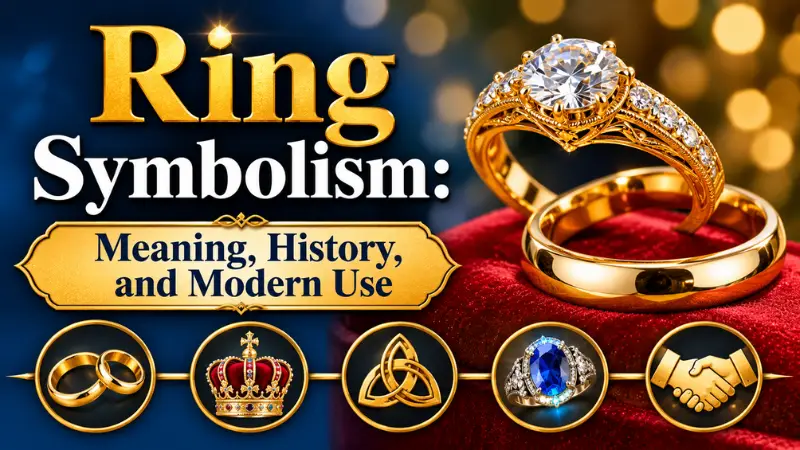
Rings are among the most recognizable objects in human culture. Worn on fingers for thousands of years, they can represent love, marriage, loyalty, authority, personal identity, and even social status. Ring symbolism is especially important in the United States, where wedding bands, engagement rings, class rings, and family heirlooms often carry personal stories.
A ring may look like a simple circle of metal, but its shape and placement give it meaning. Its unbroken circular form is commonly associated with continuity, while wearing it on a particular finger can communicate a relationship, achievement, or personal belief.
Today, rings serve both practical and symbolic purposes. Some people wear them to mark a marriage, others use them to remember a loved one, and many choose jewelry simply because it reflects their style. Understanding these different meanings reveals why such a small object can carry so much personal and cultural significance.
Quick Answer
Ring symbolism commonly represents love, commitment, unity, and lasting connection in modern American culture, especially through engagement and wedding rings. Historically, rings have also symbolized authority, wealth, loyalty, religious devotion, and social identity.
TL;DR
- Love and commitment: Engagement and wedding rings represent romantic promises.
- Unity: The circular shape suggests continuity and an unbroken bond.
- Authority: Historical rings identified rulers, officials, and influential individuals.
- Identity: Class rings and signet rings communicate personal or group affiliation.
- Remembrance: Heirloom and memorial rings preserve family connections.
- Modern fashion: Decorative rings express personality, taste, and individuality.
What Is a Ring and Why Does Its Shape Matter?
A ring is a circular band, usually made from metal, designed to be worn around a finger. It may contain gemstones, engraved words, family crests, religious symbols, or decorative patterns. Although rings are most commonly associated with jewelry, their uses have included identification, official authentication, and ceremonial purposes.
The circle is central to many interpretations. Because it has no visible beginning or end, people often associate it with eternity, continuity, and completeness. In relationships, this makes the ring a natural representation of a promise intended to last.
The symbolism also comes from how a ring is worn. Unlike a necklace or decorative object kept at home, a finger ring is visible during everyday activities. It can quietly communicate something important about the wearer without requiring an explanation.
The Core Meaning of Ring Symbolism
The most common meanings associated with rings include love, commitment, unity, loyalty, and identity. However, not every ring communicates the same message.
Love and commitment are especially familiar in American culture. Engagement and wedding rings make romantic promises visible and provide a recognizable sign of a relationship.
Unity and eternity come from the circular design. The continuous band offers a visual representation of a connection without an obvious endpoint.
Loyalty and belonging are expressed through rings exchanged between friends, family members, organizations, or partners. A shared design can represent membership in a group or commitment to a common purpose.
Power and authority have historical roots. Certain rings were worn by rulers, religious officials, and other influential figures as signs of office or status.
Personal identity is another modern meaning. A ring may reflect an individual’s taste, heritage, beliefs, accomplishments, or memories.
The context matters more than the object alone. A diamond engagement ring and a graduation class ring may both be circular bands, but they communicate different things.
Ancient Origins of Rings and Their Symbolic Importance
Rings have been used since ancient times, although their materials and purposes varied across civilizations. Early examples were made from materials such as bone, shell, stone, and metal. Some served as ornaments, while others indicated social position, personal affiliation, or authority.
In ancient Egypt, rings were associated with personal adornment, status, and religious ideas. Circular forms could be connected with continuity and eternity, while particular designs and materials reflected the wearer’s position or beliefs.
In ancient Rome, rings became important markers of social standing and official identity. Signet rings, which carried engraved symbols or family marks, could be pressed into wax to authenticate documents. This practical use helped establish the ring as a sign of authority and personal recognition.
Over time, rings became associated with marriage, religious service, inheritance, and political power. Their meanings developed differently across cultures, but their ability to serve as both personal objects and public signals remained significant.
What Rings Symbolize in Modern American Culture
In the United States, rings are especially associated with relationships and personal milestones. Engagement rings and wedding bands are familiar parts of American marriage customs, while graduation rings, championship rings, and family jewelry mark achievements and shared histories.
An engagement ring generally signals a promise to marry. A wedding band represents the marriage itself and the continuing relationship between spouses. Although traditions vary, these rings are widely understood as visible signs of romantic commitment.
Rings also appear in American education and sports culture. High school and college class rings commemorate graduation and institutional belonging. Championship rings recognize athletic achievement and membership in a winning team.
Beyond ceremonies, Americans wear rings for personal expression. Some choose understated bands, while others prefer large gemstones, vintage designs, or custom jewelry. The meaning may be entirely personal rather than connected to a formal tradition.
Ring Meaning by Finger
The finger on which a ring is worn can influence how people interpret it. However, these customs are not universal, and fashion choices or family traditions may differ.
| Finger | Common Symbolic Meaning | Modern American Association | Important Note |
|---|---|---|---|
| Left ring finger | Romantic commitment | Engagement and marriage | Widely used in U.S. wedding traditions |
| Right ring finger | Personal commitment or status | Fashion, cultural, or relationship rings | Meaning varies considerably |
| Index finger | Authority and confidence | Statement jewelry and signet rings | Historically associated with status |
| Middle finger | Balance and individuality | Personal style and bold designs | No single established meaning |
| Pinky finger | Heritage and affiliation | Family crests and signet rings | Can represent professional or family identity |
| Thumb | Independence and individuality | Fashion and self-expression | Often chosen for its distinctive appearance |
Why Wedding and Engagement Rings Represent Eternal Love
Wedding and engagement rings are among the clearest examples of symbolic jewelry in the United States. Their meaning comes from the combination of the circular shape, the act of exchanging rings, and the public recognition of a relationship.
The engagement ring traditionally represents an intention to marry. It marks a transition from dating or courtship toward a planned marriage. The wedding band is exchanged during the marriage ceremony and represents the commitment established between spouses.
The use of the left ring finger is often connected to an ancient belief about a vein running from that finger directly to the heart. This idea became known as the vena amoris, or vein of love. Modern anatomy does not support the belief, but the tradition remains part of popular explanations for wedding-ring customs.
Not every couple follows the same practice. Some wear rings on the right hand, choose matching bands, exchange nontraditional jewelry, or decide not to wear rings at all. The relationship, rather than the jewelry, gives the commitment its meaning.
Rings as Symbols of Power, Wealth, and Authority
Long before diamond engagement rings became a familiar cultural image, rings could communicate a person’s rank, wealth, or official responsibilities.
Signet rings are a notable historical example. Their engraved surfaces could be used to create an identifying seal on documents. Because the seal represented the authority of its owner, the ring became associated with legal recognition, family identity, and political influence.
Religious institutions also developed traditions involving ceremonial rings. Certain bishops and other religious officials wear rings as signs of office, responsibility, or spiritual authority.
In modern America, this symbolism remains visible in some professional, institutional, and ceremonial settings. A distinctive ring may suggest family heritage, military service, achievement, or membership in a particular organization.
Religious and Spiritual Meanings of Rings
Rings have different meanings across religious traditions. In some settings, they represent a promise, covenant, spiritual responsibility, or connection to a community.
In Christianity, wedding rings are commonly used in marriage ceremonies as visible reminders of marital commitment. Certain clergy also wear rings associated with their religious office. Their meaning depends on denomination and institutional custom.
In Judaism, a ring may play an important role in traditional Jewish marriage ceremonies. The groom traditionally gives the bride a ring as part of the marriage process, with the act carrying legal and ceremonial significance.
In other religious and spiritual communities, rings may contain sacred inscriptions, protective designs, or symbols of devotion. These meanings should not be generalized across entire religions because practices differ between communities.
For many Americans, a religious ring is both jewelry and a personal statement of faith. It may serve as a reminder of religious commitments during ordinary daily activities.
The Emotional and Psychological Meaning of Wearing a Ring
Rings can become emotionally important because they are worn close to the body and often remain part of someone’s daily routine. A person may associate a ring with a relationship, a family member, a major achievement, or a period of personal change.
A wedding band, for example, can provide a daily reminder of a shared commitment. A ring inherited from a grandparent may preserve a connection to family history, even when the original owner is no longer alive.
Rings can also function as objects of comfort. Some people touch or turn their rings when thinking, feeling nervous, or remembering someone important. This behavior does not have one universal psychological explanation, but it shows how ordinary objects can become connected to personal memories and habits.
For others, a ring communicates confidence or individuality. A distinctive design can make someone feel more comfortable expressing their personality or cultural background.
Family Heirloom and Memorial Ring Symbolism
Heirloom rings often carry meanings that extend beyond their material value. A ring passed from one generation to another can preserve family history, commemorate an important relationship, or represent a connection to ancestors.
An inherited engagement ring may remind someone of a grandparent’s marriage. A signet ring may carry a family crest or initials associated with a particular family line. In these situations, the ring becomes a physical link between past and present generations.
Memorial rings can also help people remember someone who has died. Some include engraved dates, initials, birthstones, or other personal details. Others are created from existing family jewelry and given to relatives as keepsakes.
These rings are not necessarily connected to formal mourning customs. Their importance comes from the memories and relationships that the wearer associates with them.
Why People Choose Rings for Tattoos and Personal Style
Ring tattoos have become an alternative for people who want a permanent symbol of commitment or identity. Couples sometimes choose matching designs to represent a relationship, while others use ring tattoos to commemorate family connections or personal milestones.
Unlike ordinary jewelry, a tattoo cannot be easily removed or exchanged. This permanence can make it appealing as a symbol of a lasting decision, although it also means the choice deserves careful consideration.
In everyday fashion, rings allow people to experiment with appearance and personal expression. Stacking several thin bands, wearing a bold gemstone, or choosing a vintage signet ring can communicate different styles without necessarily carrying a formal symbolic meaning.
Some people prefer minimalist designs because they are comfortable and understated. Others choose elaborate pieces because they enjoy craftsmanship, color, and visual impact.
Cultural Differences in Ring Symbolism Around the World
Ring traditions differ across countries and communities. In the United States, wedding rings are commonly worn on the left ring finger, but this practice is not universal.
In several European countries and other parts of the world, wedding rings are traditionally worn on the right hand. The choice may reflect religious customs, national traditions, or family practice rather than a different level of commitment.
In some cultures, rings also communicate family position, religious affiliation, or social identity. Traditional designs may incorporate regional patterns, gemstones, or engraved symbols that carry meanings understood within a particular community.
These differences are important when interpreting jewelry. A ring worn on the right hand should not automatically be assumed to indicate that someone is unmarried, just as a ring on the left hand does not always indicate marriage.
Common Misunderstandings About Ring Symbolism
One common misconception is that every ring has a fixed symbolic meaning. In reality, the meaning depends on its design, history, wearer, and cultural setting. A plain metal band may represent marriage to one person and simply be a fashion accessory to another.
Another misunderstanding is that a ring’s finger placement always reveals relationship status. Although certain customs are widely recognized in the United States, people frequently wear rings according to personal preference or traditions from other countries.
It is also incorrect to assume that expensive rings represent stronger love or commitment. The price of a ring reflects materials, craftsmanship, and market value, not the quality of a relationship.
Finally, not every inherited ring has a documented family history. Some are passed down with stories, while others acquire personal significance through the memories of the people who wear them. Their emotional value does not depend on their age or monetary worth.
How Ring Symbolism Has Changed Over Time
The meaning of rings has expanded as societies and personal customs have changed. In ancient communities, rings could communicate social rank, authority, identity, or religious affiliation. Later, marriage traditions made them increasingly recognizable as symbols of romantic commitment.
In modern America, rings serve several purposes at once. A person may wear a wedding band for commitment, a family heirloom for remembrance, and a decorative ring for personal style.
Changing attitudes toward marriage and relationships have also influenced ring customs. Some couples select alternative gemstones, matching bands, recycled materials, or designs that reflect their individual values. Others choose not to exchange rings.
The object remains recognizable, but its meaning is increasingly shaped by the people who wear it. This flexibility explains why rings continue to appear in ceremonies, fashion, family traditions, and everyday life.
FAQs
What does a ring symbolize spiritually?
A ring can represent eternity, unity, commitment, faith, or a spiritual promise. Its meaning depends on the religious tradition and the specific design or ceremony in which it appears.
What does wearing a ring on the left ring finger mean?
In the United States, a ring on the left ring finger is commonly associated with engagement or marriage. However, people may wear jewelry on this finger for fashion, personal reasons, or cultural traditions.
What does a ring on the right hand symbolize?
A right-hand ring can represent marriage, personal commitment, independence, or simply individual style. Its meaning varies between cultures, so it should not be used alone to determine someone’s relationship status.
Why do rings symbolize eternity?
The circular shape has no obvious beginning or end, making it a natural representation of continuity and lasting connection. This visual quality helped make rings especially suitable for marriage and commitment ceremonies.
What does an inherited ring symbolize?
An inherited ring commonly represents family heritage, remembrance, and continuity between generations. Its value may come from the person who previously wore it rather than from its materials or market price.
Are rings considered symbols of good luck?
Some rings are believed to bring good fortune because of their gemstones, religious inscriptions, or cultural associations. These beliefs vary by tradition and personal conviction rather than representing a universal meaning.
What does a ring tattoo symbolize?
A ring tattoo often represents permanent commitment, loyalty, remembrance, or a personal milestone. Couples may choose matching designs, while others use them to express individuality or preserve an important memory.
Conclusion
Ring symbolism connects everyday jewelry with ideas of love, commitment, identity, authority, and remembrance. Its circular shape makes it a familiar representation of continuity, while its historical uses show how rings have communicated social position, religious devotion, and personal relationships across different cultures.
In modern American life, a ring can be a wedding promise, a family keepsake, a religious reminder, or simply an expression of personal style. Its meaning ultimately comes from the intention, history, and relationship attached to it. A small band can carry a story that lasts far longer than the jewelry itself.