Introduction
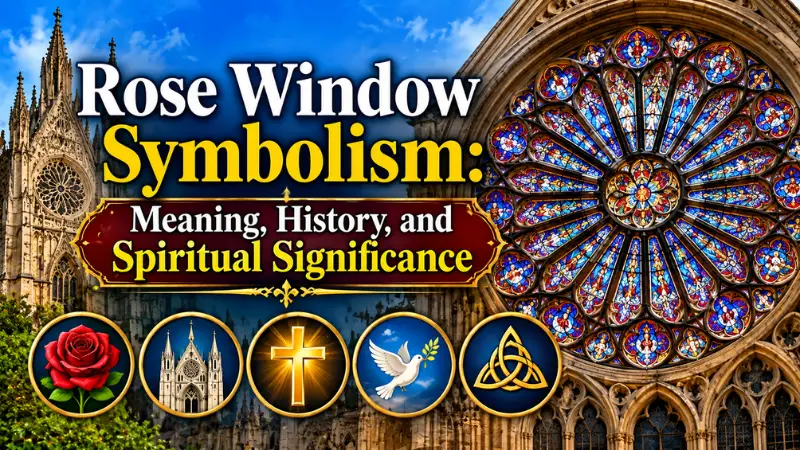
A rose window is a large, circular stained-glass window commonly found in Gothic churches and cathedrals. Its colorful glass, symmetrical patterns, and radiating shapes create an image that combines artistic beauty with religious meaning. Rose window symbolism is closely associated with faith, divine light, spiritual unity, eternity, and the relationship between heaven and earth.
The design is especially recognizable in medieval European architecture, where builders used elaborate circular windows to bring colored light into sacred spaces. Many featured biblical figures, saints, geometric patterns, or scenes from Christian teachings. Their arrangement was not simply decorative; it helped communicate religious ideas to people attending church.
Today, Americans encounter rose windows in historic churches, religious buildings, architectural photography, artwork, and contemporary interior design. Although their original meaning developed within Christianity, their circular geometry and colorful patterns have also inspired broader interpretations involving harmony, wholeness, beauty, and spiritual reflection.
Quick Answer
Rose window symbolism commonly represents faith, divine light, spiritual unity, and eternity in American religious and architectural contexts. Historically, these circular stained-glass windows became important features of Gothic churches, where their biblical imagery and radiant designs communicated Christian beliefs about God, creation, and salvation.
TL;DR
- Core meaning: Faith, eternity, divine light, and spiritual harmony.
- Historical origin: Rose windows became prominent in medieval Gothic church architecture.
- Christian symbolism: Their imagery often represents Christ, Mary, saints, and biblical teachings.
- Circular design: The shape can suggest unity, completeness, and eternity.
- American significance: Found in historic churches and contemporary religious architecture.
- Modern use: Inspires jewelry, tattoos, decorative art, and architectural design.
What Is a Rose Window?
A rose window is a circular window divided into decorative sections by stone framework, commonly called tracery, and filled with stained glass. The sections often extend outward from a central point, creating patterns that resemble flower petals, wheels, or geometric stars.
The name comes from the window’s flower-like appearance, particularly in designs that resemble a rose. However, not every circular stained-glass window contains an actual flower. Some feature elaborate geometric arrangements, religious figures, or scenes from the Bible.
Rose windows are most strongly associated with Gothic architecture, especially the great cathedrals of medieval Europe. They were frequently installed above main entrances, across the transept, or at the ends of church buildings.
Their scale and position made them architectural focal points. When sunlight passed through the colored glass, it transformed the interior with changing patterns of light. This visual experience contributed to their association with the presence of God and the spiritual character of sacred spaces.
The Religious Meaning of the Circular Shape
The circular form is one of the most important features of a rose window. Unlike a rectangular window, which has clear edges and corners, a circle has no obvious beginning or ending. This makes it a natural visual expression of eternity, completeness, and the continuity of spiritual life.
In Christian architecture, the circle can suggest God’s eternal nature and the unity of creation. The design also draws attention toward its center, where an image of Christ, the Virgin Mary, or another sacred figure may appear.
The surrounding sections often create a sense of order. Each section contributes to the overall composition, much like individual members of a religious community contribute to a shared faith.
This interpretation is especially visible in medieval windows with carefully arranged figures and repeated geometric patterns. The circular design brings separate images together into one unified religious composition.
Divine Light and the Presence of God
Light is central to understanding rose window symbolism. Medieval Christian thinkers often connected light with God’s presence, truth, goodness, and spiritual understanding. Stained glass transformed ordinary sunlight into colored patterns that filled church interiors with an unusual visual atmosphere.
The effect was both architectural and religious. Rather than entering through plain glass, sunlight passed through carefully arranged colors and images. Worshippers experienced a changing display that could make the building feel visually distinct from the outside world.
The French abbey church of Saint-Denis played an important role in developing Gothic architecture and its use of stained glass. Its influential abbot, Suger, valued the spiritual associations of light and supported the use of elaborate windows.
This does not mean every color had one fixed religious meaning. The interpretation depended on the images, inscriptions, and wider design. Nevertheless, the relationship between light and spiritual understanding became an important part of the medieval cathedral experience.
Historical Origins and the Development of Rose Windows
Circular openings existed in Roman architecture long before the Gothic period. These openings, often called oculi, allowed daylight into buildings and sometimes appeared as decorative architectural features.
During the Romanesque period, circular openings developed into more elaborate windows. As Gothic architecture advanced during the twelfth century, builders gained the ability to create larger openings supported by increasingly sophisticated stone frameworks.
The rose window became one of the recognizable features of this architectural development. The Abbey Church of Saint-Denis near Paris is particularly important in the history of early Gothic architecture, while French cathedrals helped establish the monumental designs that became widely admired.
By the thirteenth century, large rose windows were prominent in major Gothic churches. Their construction required close cooperation between architects, stoneworkers, and glassmakers. The stone tracery had to support the structure while leaving enough space for the colored glass.
Over time, the designs became increasingly elaborate. Some included dozens of individual sections, each containing a figure, decorative pattern, or biblical scene.
What Rose Windows Represent in Christianity
Christian rose windows frequently communicate religious teachings through visual storytelling. Their central images and surrounding figures are arranged to express relationships between Christ, Mary, saints, angels, and the wider Christian understanding of creation.
Christ may occupy the center of a window as a representation of divine authority and salvation. In other examples, the Virgin Mary appears prominently, reflecting her importance in Catholic devotion and medieval religious culture.
Surrounding sections may contain apostles, prophets, biblical kings, angels, or scenes from scripture. Their positions can help explain the relationship between different parts of Christian teaching.
Some windows also illustrate the Last Judgment, the life of Christ, or important events from the Old and New Testaments. These images allowed religious buildings to communicate stories visually, including to worshippers who could not read.
The rose window therefore functioned as more than an attractive architectural feature. It could serve as a carefully organized visual expression of Christian belief.
Famous Rose Windows and Their Symbolic Meanings
Several European cathedrals demonstrate how the design and meaning of rose windows can differ.
| Rose Window | Location | Symbolic Meaning |
|---|---|---|
| West Rose Window | Chartres Cathedral, France | The Last Judgment and Christ’s authority |
| North Rose Window | Chartres Cathedral, France | The Virgin Mary and her religious significance |
| South Rose Window | Chartres Cathedral, France | Christ, biblical figures, and heavenly order |
| West Rose Window | Notre-Dame de Paris, France | The Virgin and Child, biblical history, and Christian teaching |
| Rose Window | Durham Cathedral, England | Christ surrounded by apostles and heavenly figures |
Библия на цветном стекле: 36 занимательных деталей витражей собора Нотр-Дам-де-Шартр | Вокруг Света
An Exterior View of the North Rose Window by French School
South Rose Window of Notre Dame Cathedral
8
Chartres Cathedral is particularly notable because its three large rose windows have distinct religious programs. The western window focuses on the Last Judgment, while the northern window emphasizes the Virgin Mary and the southern window glorifies Christ.
At Notre-Dame de Paris, the west rose window features the Virgin and Child at its center. Its surrounding sections include religious and biblical imagery, showing how the circular design could organize an extensive visual narrative.
These examples demonstrate why it is important not to assign one universal meaning to every rose window. The central figure, surrounding scenes, and location within the building all contribute to its interpretation.
Rose Window Symbolism in the United States
In the United States, rose windows are most commonly encountered in churches, cathedrals, historic religious buildings, and institutions influenced by Gothic architecture.
American churches adopted Gothic Revival design during the nineteenth and early twentieth centuries. Architects used pointed arches, decorative stonework, stained glass, and large circular windows to create buildings that recalled the appearance of medieval European churches.
For Christian communities, these windows can represent faith, worship, divine light, and the continuity of religious tradition. Their imagery may also commemorate a congregation’s history, honor a donor, or celebrate an important biblical event.
Rose windows also appear in buildings that serve educational and cultural purposes. Historic preservation projects and architectural exhibitions help Americans appreciate them as examples of craftsmanship and religious art.
Their significance is not limited to people who attend church. Visitors may admire the geometric patterns, colored glass, and relationship between architecture and natural light without sharing the religious beliefs represented in the window.
In contemporary American design, the circular pattern has also influenced decorative glass, public artwork, and interior architecture. These newer uses often emphasize visual harmony rather than formal Christian teaching.
Cross-Cultural Influence of Rose Window Designs
Although the rose window is strongly associated with Western Christianity, circular floral patterns and radial geometric designs appear in many other cultural traditions.
Islamic architecture, for example, frequently uses geometric patterns to express mathematical order, repetition, and visual harmony. Although these designs are not the same as Christian rose windows, they demonstrate how circular arrangements can communicate ideas about unity and order.
Hindu and Buddhist artistic traditions also use circular arrangements in mandalas and other sacred designs. These compositions can represent the structure of the universe, spiritual balance, and the relationship between individual and universal existence.
It is important to distinguish these traditions rather than assume they share the same religious meaning. A Gothic rose window is rooted in Christian architecture, while a mandala belongs to different religious and philosophical contexts.
Modern designers sometimes combine elements from these artistic traditions. When doing so, understanding their original purposes helps preserve cultural meaning.
The Emotional and Psychological Meaning of Rose Windows
Rose windows can create feelings of calmness, wonder, reflection, and belonging. Their balanced patterns provide a sense of visual order, while their colors and natural lighting can make a large interior feel welcoming and contemplative.
The circular arrangement may also encourage people to think about completeness and connection. Rather than focusing on one isolated image, viewers experience a composition in which every section contributes to the whole.
For religious visitors, this experience may encourage prayer or spiritual reflection. For someone interested in architecture, it may inspire appreciation for human creativity and craftsmanship.
The changing sunlight adds another emotional dimension. A window can look different depending on the time of day, weather, and viewing position. This makes the experience temporary and personal, even when the artwork itself remains unchanged.
These responses are not universal psychological effects. People interpret architectural spaces according to their experiences, beliefs, and cultural backgrounds.
Rose Window Symbolism in Art, Tattoos, and Jewelry
Rose window designs have moved beyond church architecture and now appear in various forms of personal expression.
Tattoos: A rose window tattoo may represent faith, spiritual identity, family unity, or a connection to a particular religious tradition. Some people choose a simplified circular design because they appreciate its symmetry and artistic detail.
Jewelry: Pendants, earrings, and rings featuring rose window patterns can represent religious devotion, personal heritage, or appreciation for Gothic art. Small geometric versions are particularly suitable for jewelry because they preserve the circular structure.
Home décor: Decorative glass panels, wall art, mirrors, and window treatments sometimes borrow rose window patterns. These designs can introduce a traditional architectural appearance into contemporary interiors.
Fashion: Clothing and accessories may feature circular stained-glass illustrations or Gothic-inspired geometric patterns. In this setting, the design often communicates an appreciation for historical architecture rather than a specific religious belief.
Digital art: Illustrators and graphic designers use rose window patterns in posters, backgrounds, illustrations, and decorative graphics. Their symmetrical structure makes them suitable for both traditional and modern visual styles.
The meaning depends on the person’s intention. A religious tattoo may carry a different significance from a decorative pendant purchased simply because the pattern is attractive.
Colors and Their Symbolic Associations
Color contributes significantly to the appearance of a rose window. Medieval glassmakers used different colors to create contrast, highlight figures, and organize religious scenes.
Although colors can have traditional Christian associations, their meanings are not fixed across every historical window.
| Color | Common Symbolic Association | Possible Religious Interpretation |
|---|---|---|
| Blue | Peace, truth, and heaven | Spiritual devotion and heavenly presence |
| Red | Love, sacrifice, and courage | Christ’s sacrifice and martyrdom |
| Gold or yellow | Light, glory, and majesty | Divine glory and heavenly splendor |
| Green | Life, renewal, and hope | Creation and spiritual renewal |
| Purple | Royalty and dignity | Christ’s kingship and religious authority |
| White | Purity and holiness | Spiritual innocence and divine perfection |
These associations are useful starting points, not universal rules. A particular window may use color primarily for artistic balance or to distinguish different figures and scenes.
The combination of colors can also create an overall impression of brightness, movement, and visual harmony.
Common Misunderstandings About Rose Window Symbolism
One common misconception is that every rose window represents the Virgin Mary. Mary is central to some famous examples, particularly the northern rose window at Chartres, but other windows focus on Christ, the Last Judgment, or different biblical subjects.
Another misunderstanding is that the circular design always represents eternity. Eternity is a reasonable symbolic interpretation, especially within Christian contexts, but the circle also serves practical architectural and decorative purposes.
Some people assume that every section of a rose window has a secret meaning. While many medieval windows contain carefully planned religious imagery, not every geometric detail has a documented theological explanation.
There is also confusion between rose windows and ordinary circular stained-glass windows. The terms are sometimes used interchangeably, but a traditional rose window usually has an elaborate arrangement of radiating stone tracery and decorative glass.
Finally, the design should not automatically be interpreted as a pagan symbol or a representation of a particular mystical system. Its historical development is closely connected to medieval Christian architecture.
How Rose Window Symbolism Has Changed Over Time
The earliest circular architectural openings served practical purposes, particularly bringing daylight into buildings. As stained glass and Gothic construction techniques developed, these openings became increasingly elaborate.
During the medieval period, rose windows became important elements of Christian religious architecture. Their images communicated biblical stories, represented sacred figures, and contributed to the spiritual atmosphere of churches.
During later centuries, changing architectural preferences and religious developments influenced how churches used stained glass. Some historic windows were repaired, replaced, or redesigned to reflect new artistic tastes.
In nineteenth-century America, the Gothic Revival movement renewed interest in medieval architectural forms. Churches and other buildings adopted pointed arches, stained-glass panels, and circular window designs.
Today, rose windows occupy several different roles. They remain meaningful religious features in churches, while also serving as subjects of historical study, architectural photography, decorative art, and personal design.
Their interpretation has expanded, but the connection between the circular form, colored light, and Christian sacred architecture remains central to their historical identity.
FAQs
What does a rose window symbolize spiritually?
A rose window commonly symbolizes divine light, faith, spiritual unity, and eternity. In Christian churches, its imagery often communicates religious teachings about Christ, Mary, salvation, and the relationship between heaven and earth.
Why are rose windows circular?
The circular shape allows decorative sections to radiate from a central point, creating a balanced architectural composition. Symbolically, the circle can suggest eternity, completeness, and unity, although its structural and artistic purposes are also important.
What does a rose window symbolize in Christianity?
In Christianity, rose windows often represent God’s presence, divine light, and the unity of creation. Their stained-glass images may depict Christ, the Virgin Mary, saints, angels, and important biblical events.
What does a rose window tattoo mean?
A rose window tattoo may represent religious faith, spiritual identity, family connection, or appreciation for Gothic architecture. Its meaning depends on the wearer’s beliefs and the specific images included in the design.
Are rose windows only found in Catholic churches?
No. Although historically associated with medieval Catholic churches, rose windows also appear in other Christian architectural traditions, including Anglican, Episcopal, and some Protestant buildings. Modern architectural designs may also borrow their circular patterns for decorative purposes.
What is the difference between a rose window and a mandala?
A rose window is an architectural feature traditionally made with stained glass and stone tracery, particularly in Gothic churches. A mandala is a symbolic geometric composition used in certain Hindu and Buddhist traditions, often representing spiritual order or the universe.
Why do rose windows have so many colors?
Different colors help create visual contrast, distinguish figures, and communicate religious narratives. Sunlight passing through the glass also produces changing patterns that contribute to the atmosphere of the building.
Conclusion
Rose window symbolism represents faith, divine light, spiritual unity, and eternity, with its strongest historical associations rooted in medieval Christian architecture. Its circular structure brings separate patterns and images together, while its stained glass transforms natural sunlight into an important part of the religious experience.
In modern America, rose windows continue to appear in churches, historic buildings, artwork, jewelry, and decorative designs. Some people appreciate their Christian significance, while others are drawn to their symmetry, colors, and architectural craftsmanship.
Whether viewed as a religious image or an artistic achievement, a rose window demonstrates how architecture can communicate ideas through shape, light, and carefully arranged detail.