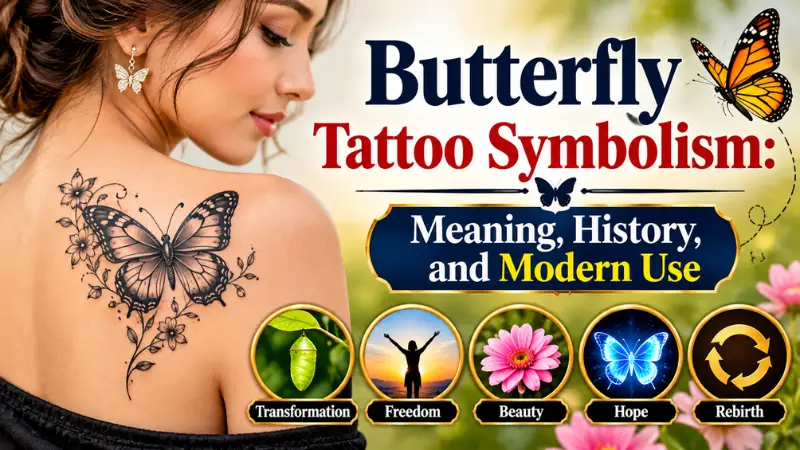
A butterfly tattoo is often chosen to represent personal transformation, freedom, new beginnings, or the strength to move beyond a difficult period. Its meaning comes partly from the butterfly’s remarkable life cycle: it begins as a caterpillar, develops inside a chrysalis, and eventually emerges with wings. For many Americans, this makes the butterfly a natural symbol of personal growth, recovery, and becoming someone new.
But the meaning of a butterfly tattoo is not limited to change. Some people choose it to honor someone who has died, celebrate independence, express love, mark a significant life experience, or represent a connection with nature. Others simply appreciate its delicate wings, movement, and variety of colors.
Understanding its symbolism means looking beyond its appearance. The butterfly has connections to ancient beliefs about the soul, cultural traditions surrounding death and remembrance, and modern ideas about identity. These associations help explain why a relatively small tattoo can communicate such a personal story.
Quick Answer: What Does Butterfly Tattoo Symbolism Mean?
Butterfly tattoo symbolism most commonly represents transformation, personal growth, freedom, and new beginnings in modern American culture. Historically, butterflies have also been associated with the soul, life after death, spiritual renewal, and the connection between life and mortality.
TL;DR
- Transformation: Leaving an old identity behind and beginning a new chapter.
- Freedom: Independence, self-expression, and personal choice.
- Healing: Recovery after grief, hardship, or emotional struggles.
- Remembrance: Honoring deceased loved ones and preserving their memory.
- Spirituality: Representing the soul, renewal, and life’s temporary nature.
- Individuality: Expressing personality through species, colors, and tattoo placement.
1. The Main Symbolic Meanings of a Butterfly Tattoo
The butterfly has several recognizable meanings, but the interpretation usually depends on the wearer’s experience and the design they choose.
Transformation and personal growth
Transformation is the most widely recognized meaning. A caterpillar does not simply grow larger; it undergoes metamorphosis and emerges in a completely different physical form.
For someone who has experienced a major life change, a butterfly tattoo can represent:
- Overcoming a painful chapter.
- Becoming more confident and independent.
- Recovering after a difficult relationship.
- Starting over after a major setback.
- Accepting personal changes with time.
For example, someone who has rebuilt their life after a divorce might choose a butterfly to mark the beginning of a more independent chapter.
Freedom and independence
A butterfly’s ability to fly makes it a natural image of freedom. In tattoo culture, this can represent escaping restrictive expectations, making independent decisions, or finally feeling comfortable with one’s identity.
Hope and new beginnings
A butterfly emerging from its chrysalis offers a recognizable image of possibility. People sometimes choose this tattoo after graduating, recovering from illness, moving to a new place, or making a significant personal decision.
Beauty and individuality
Butterflies have different wing patterns, shapes, and colors. A tattoo can celebrate individuality without necessarily representing a dramatic life experience.
The wearer might simply identify with the butterfly’s appearance, delicacy, or relationship with the natural world.
2. Why the Butterfly Represents Transformation
The butterfly’s life cycle explains much of its modern symbolism.
It passes through four stages:
- Egg: The beginning of life and potential.
- Caterpillar: Growth, development, and preparation.
- Chrysalis: A period of change and transition.
- Adult butterfly: Emergence, independence, and a new form of life.
These stages provide a natural comparison with human experiences.
A person may spend years developing their identity, encounter a difficult period that changes their priorities, and eventually emerge with a different understanding of themselves.
This is why butterfly tattoos frequently appear alongside dates, meaningful words, initials, or other personal images.
There is one important distinction: metamorphosis is a biological process, not a promise that every difficult experience produces a better outcome. The tattoo represents the wearer’s interpretation of change rather than a scientific description of human development.
3. Historical Origins of Butterfly Symbolism
Butterfly imagery has appeared in ancient art, jewelry, mythology, and funerary objects. Its association with transformation is easy to understand, but its connection with the soul and death developed through additional cultural beliefs.
Ancient Greek beliefs
In ancient Greek culture, the word psychē was associated with both the soul and the butterfly. This linguistic connection helped establish the insect as an image of the soul’s departure from the body.
The connection also appears in representations of Psyche, a figure from Greek mythology whose name means soul. Artists sometimes depicted her with butterfly wings.
Ancient Greek and Roman artwork therefore provides an important historical background for the modern association between butterflies, spiritual life, and the human soul.
Ancient funerary traditions
Butterfly designs also appeared in objects associated with burial and remembrance.
For example, a Hellenistic Greek necklace preserved in the Walters Art Museum includes a butterfly pendant. Its placement in a grave reflects the suitability of the butterfly as an image of the soul.
These historical examples show that butterfly symbolism did not begin with modern tattoo fashion. The connection between wings, the soul, and life beyond death has much older roots.
4. Butterfly Symbolism in American Culture
In the United States, butterfly tattoos are generally understood through personal experience rather than one fixed religious or cultural tradition.
Three interpretations are particularly common.
Personal reinvention: The butterfly represents someone who has changed their lifestyle, beliefs, priorities, or sense of identity.
Emotional remembrance: It can honor someone who has died or preserve the memory of a meaningful relationship.
Self-expression: It can communicate independence, creativity, femininity, or appreciation for nature.
Butterflies also appear in American art, garden design, clothing, jewelry, and environmental awareness campaigns.
The monarch butterfly has a particularly recognizable place in North American culture because of its remarkable migration between Canada, the United States, and Mexico.
Its seasonal movement makes it a natural image of travel, endurance, return, and connection across generations.
However, a butterfly tattoo does not automatically communicate any particular political, religious, or social affiliation. Its meaning is usually personal unless the wearer gives it a more specific context.
5. Butterfly Tattoos as Symbols of Healing and Recovery
For many people, getting a butterfly tattoo marks the end of a difficult experience or the beginning of emotional recovery.
It can represent surviving circumstances that once seemed overwhelming.
Some common personal associations include:
- Recovering from emotional abuse.
- Moving forward after depression or personal hardship.
- Rebuilding confidence after rejection.
- Finding strength after a major loss.
- Learning to accept one’s body or identity.
The butterfly does not necessarily mean that the person has forgotten what happened. Instead, it can represent the decision to carry the experience without allowing it to define the rest of life.
A small butterfly on the wrist, for example, might serve as a private reminder of progress. A larger design across the shoulder might represent a more visible celebration of independence.
The meaning comes from the person’s story, not the size of the tattoo.
6. Butterfly Tattoos, Death, and Remembrance
One of the more meaningful interpretations is the connection between butterflies and deceased loved ones.
This association has both historical and cultural foundations.
In ancient Greek traditions, butterflies could represent the soul. In parts of central Mexico, monarch butterflies have also been associated with the returning souls of ancestors.
For some Purépecha communities, the monarch’s arrival around the beginning of November coincides with traditions honoring the dead. The butterfly is therefore connected with remembrance and the relationship between living family members and deceased ancestors.
In modern American tattoo culture, people may choose a butterfly to remember:
- A deceased parent or grandparent.
- A child or sibling.
- A close friend.
- A partner who has passed away.
- Someone whose influence continues to shape their life.
Some memorial designs include a person’s name, birth and death dates, initials, or a short message.
Others use a butterfly alongside a flower or a small heart.
A memorial butterfly does not have to suggest that the deceased person has literally returned. For many wearers, it simply expresses love, memory, and the wish to maintain an emotional connection.
7. Different Butterfly Colors and Their Tattoo Meanings
Color can change the impression of a butterfly tattoo. However, these meanings are modern artistic associations rather than universal historical rules.
Common contemporary interpretations
| Butterfly color | Common symbolic meaning | Emotional association |
|---|---|---|
| Blue | Hope, freedom, and change | Calmness and confidence |
| Purple | Spirituality and individuality | Reflection and creativity |
| White | Peace, remembrance, and renewal | Innocence and serenity |
| Black | Endings, grief, and transformation | Strength and acceptance |
| Yellow | Happiness and optimism | Energy and warmth |
| Pink | Love, kindness, and compassion | Affection and tenderness |
| Red | Passion and courage | Intensity and determination |
| Orange | Enthusiasm and personal growth | Confidence and vitality |
A black butterfly, for example, does not automatically represent death or bad luck. Someone might choose it because they appreciate minimalist artwork or because it represents the end of an old chapter.
Likewise, a white butterfly may represent remembrance for one person and a fresh beginning for another.
The wearer’s intention matters more than a color dictionary.
8. Popular Butterfly Tattoo Designs and What They Represent
Idée tatouage Poignet Femme : 30 modèles + aperçu sur votre peau (2026) | TatouageIA
Small butterfly tattoo
Often represents personal growth, freedom, or a private reminder of change. Its simple appearance makes it suitable for people who prefer understated tattoos.
Monarch butterfly tattoo by Daniel Chashoudian: TattooNOW
Monarch butterfly tattoo
Can symbolize endurance, migration, homecoming, and remembrance. Its recognizable orange-and-black pattern also makes it a popular nature-inspired design.
Walk-Ins Welcome at Mantle Tattoo in Downtown Los Angeles
Butterfly with flowers
Combines transformation with natural beauty, growth, affection, and renewal. Different flowers can add personal or cultural meanings.
Black and Grey “Half Skull Half Butterfly With Flowers” Tattoo – BlackInk AI
Butterfly and skull
Contrasts life and mortality. It can represent accepting that life is temporary, surviving loss, or finding meaning in change.
Best Friend Tattoos: Celebrate Your Bond in Style – Chronic Ink
Two butterflies
May represent romantic partnership, friendship, family bonds, or two people sharing a meaningful experience.
40+ Chrysalis Tattoo Ideas in 2025 – BlackInk AI
Butterfly emerging from a chrysalis
Makes the transformation theme especially clear. It can symbolize the process of becoming a different, more confident version of oneself.
9. Cultural and Religious Meanings of the Butterfly
Butterfly symbolism varies across cultures. Understanding these differences helps prevent the assumption that every butterfly carries the same message.
Greek mythology
The butterfly is connected with Psyche and the soul. This is one of the strongest historical foundations for interpreting the insect as a spiritual symbol.
Mexican traditions
Among some Indigenous communities in central Mexico, particularly Purépecha and Mazahua communities, monarch butterflies are associated with ancestors and remembrance.
Their seasonal arrival overlaps with Día de los Muertos, a celebration that honors deceased family members.
This meaning is especially relevant to monarch butterfly tattoos, although not every Mexican family or community interprets the butterfly in the same way.
Chinese symbolism
In traditional Chinese art, butterflies have been associated with joy, weddings, and longevity.
The Chinese word for butterfly also creates a traditional wordplay connection with an advanced age, helping explain its appearance in artwork associated with long life.
Two butterflies can therefore suggest romantic happiness or marital harmony.
Japanese symbolism
Butterflies have appeared in Japanese decorative arts, clothing, and literature for centuries, influenced partly by earlier Chinese artistic traditions.
Their meanings can include beauty, change, and the soul, while paired butterflies may suggest romantic relationships.
Christianity
Butterflies are sometimes used in Christian artwork as images of resurrection, renewal, and life beyond death.
However, the butterfly is not a universally prescribed Christian symbol, nor is its meaning explicitly established as a fixed biblical teaching. Christians may interpret it through the broader idea of spiritual transformation.
10. Emotional and Psychological Meaning of Butterfly Tattoos
A tattoo can function as a personal reminder, especially when it marks an experience that changed someone’s outlook.
Butterfly imagery is particularly suitable for this because its visible transformation provides a straightforward way to communicate an internal experience.
A person who has struggled with self-confidence might use a butterfly to celebrate becoming comfortable with their appearance. Someone who has experienced a difficult relationship might choose one to represent independence.
There are also different emotional messages depending on the design.
- A delicate butterfly can suggest gentleness and sensitivity.
- A butterfly with open wings can communicate confidence and freedom.
- A dark butterfly can express acceptance of painful experiences.
- A colorful butterfly can reflect optimism and creativity.
- A butterfly resting on a flower can suggest peace and contentment.
These interpretations are not psychological diagnoses or reliable ways to determine someone’s personality. They are visual associations that people use to communicate feelings.
A tattoo may also carry several meanings simultaneously. Someone can associate the same butterfly with a deceased relative, personal growth, and a renewed appreciation for life.
11. Where People Commonly Place Butterfly Tattoos
Placement can influence how a butterfly tattoo looks and how personally meaningful it feels.
Minimalist butterfly tattoo on the wrist. | 작은 타투, 손 문신, 나비모양 문신
Wrist
Often chosen for a visible daily reminder of independence, recovery, or personal change.
Pin de dwiirka kartika em Bunga | Tatuagem de borboleta no ombro, Tatuagem de borboleta, Tatuagem
Shoulder and back
Provide room for larger wings, symmetrical designs, and additional floral details.
30 Beautiful Ankle Tattoos for Women
Ankle
Can suggest movement, independence, and a personal journey.
Ezra – Tatouage Papillon en mouvement, pour oser renaître à chaque bat – Nefari
Collarbone
Works well for delicate designs that are visible with certain clothing and easy to conceal when desired.
Best Butterfly Tattoo Ideas: Stunning Designs for Every Style — Certified Crown Brand
Behind the ear
A discreet location for someone who wants a small, personal design.
Placement does not have a universal symbolic meaning. The same butterfly can communicate exactly the same personal story whether it appears on the wrist, shoulder, or ankle.
12. Butterfly Tattoos in Modern Fashion and Popular Culture
Butterfly tattoos remain recognizable in American tattoo culture because they can be adapted to many artistic styles.
Some people prefer traditional colorful designs with clearly defined wings. Others choose fine-line tattoos, realistic illustrations, geometric patterns, or minimalist outlines.
Butterflies have also appeared in fashion photography, album artwork, jewelry collections, and celebrity-inspired aesthetics.
Their visual flexibility is part of their appeal. A butterfly can look delicate, dramatic, naturalistic, abstract, or contemporary without losing its recognizable form.
Social media has also encouraged people to share tattoos alongside personal stories. A photograph of a butterfly may be accompanied by an explanation of recovery, a tribute to a family member, or a celebration of a major life change.
Still, appearance alone does not reveal the wearer’s history. Two nearly identical tattoos can have completely different personal meanings.
13. Common Misunderstandings About Butterfly Tattoo Symbolism
Although butterfly tattoos generally have positive associations, several misconceptions deserve attention.
Misunderstanding 1: Every butterfly tattoo represents transformation.
Transformation is a common interpretation, but some people choose butterflies for beauty, nature, affection, or personal memories.
Misunderstanding 2: Black butterflies always symbolize death.
Black can suggest mourning or difficult experiences, but it can also be an artistic choice without a negative meaning.
Misunderstanding 3: Butterfly tattoos are exclusively feminine.
Butterflies are popular in designs traditionally marketed toward women, but their meanings are not restricted by gender. Anyone can use the symbol to express freedom, remembrance, or personal growth.
Misunderstanding 4: Butterfly tattoos always have religious significance.
Historical religious and spiritual associations exist, but a modern tattoo does not automatically communicate a religious belief.
Misunderstanding 5: A butterfly tattoo has one universal meaning.
Its interpretation depends on cultural background, design, personal experience, and the wearer’s intention.
It is also worth distinguishing authentic cultural traditions from commercialized interpretations. For example, the monarch’s association with ancestors in some Mexican Indigenous communities has a specific cultural context. It should not be presented as a universal belief shared by every Mexican person.
14. How Butterfly Tattoo Meanings Have Evolved
The butterfly’s symbolism has changed as people have used it in different artistic, spiritual, and cultural settings.
In ancient Greek and Roman traditions, it was associated with the soul and mortality. In other historical traditions, it appeared in decorative art connected with love, joy, marriage, and longevity.
During later periods, butterfly imagery became popular in jewelry, clothing, paintings, and decorative design. Its visual connection with beauty and change made it suitable for both personal adornment and artistic expression.
In contemporary American tattoo culture, the meaning has expanded further. The butterfly can represent:
- Personal independence and self-discovery.
- Recovery after difficult experiences.
- Memorials for loved ones.
- Changing relationships and identities.
- Appreciation for nature and wildlife.
- A celebration of beauty and individuality.
Environmental awareness has also added another dimension. The monarch butterfly, in particular, has become associated with migration, habitat conservation, and the importance of protecting natural ecosystems.
The modern butterfly tattoo therefore combines older spiritual associations with contemporary ideas about identity, memory, and personal development.
FAQs
1. What does a butterfly tattoo mean spiritually?
Spiritually, a butterfly tattoo can represent the soul, renewal, spiritual development, and life after death. These interpretations have historical connections with ancient Greek symbolism and other cultural traditions, although individual religious beliefs differ.
2. Does a butterfly tattoo mean someone has overcome trauma?
It can. Many people choose butterfly tattoos to represent recovery after emotional hardship, difficult relationships, illness, or other life-changing experiences. However, the tattoo alone does not establish that someone has experienced trauma.
3. What does a butterfly tattoo mean for a woman?
For some women, it represents independence, confidence, personal growth, femininity, or self-acceptance. Others choose it to honor a loved one or simply because they appreciate butterfly artwork. These meanings are not exclusive to women.
4. What does a black butterfly tattoo symbolize?
A black butterfly can represent mourning, remembrance, the end of a difficult chapter, or acceptance of change. It can also be purely an aesthetic preference without any connection to death or sadness.
5. Is a butterfly tattoo a symbol of a deceased loved one?
Yes. Some people use butterfly tattoos as memorials for deceased relatives, friends, or partners. The design may represent the soul, continued love, cherished memories, or a personal sense of spiritual connection.
6. What does a monarch butterfly tattoo symbolize?
A monarch butterfly tattoo commonly represents endurance, migration, transformation, and the idea of returning home. In connection with some Mexican Indigenous traditions, it can also represent deceased ancestors and remembrance during Día de los Muertos.
Conclusion
Butterfly tattoos carry several connected meanings, with transformation, freedom, personal growth, and new beginnings among the most recognizable in modern American culture. Their historical associations with the soul, remembrance, and spiritual renewal give the design additional significance beyond its appearance.
Ultimately, butterfly tattoo symbolism depends on the person wearing it. For one individual, it may celebrate independence after a difficult relationship; for another, it may honor a loved one or mark an important personal milestone.
The most meaningful butterfly tattoo is one that reflects the wearer’s own experience. Its wings may represent freedom, its transformation may recall personal growth, and its presence may serve as a lasting reminder of a life chapter worth remembering.