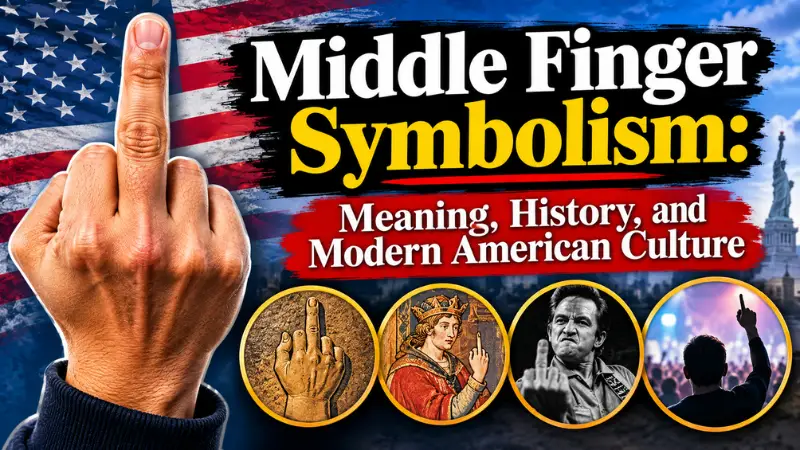
The middle finger symbolism is closely associated with anger, disrespect, defiance, and rejection in modern American culture. Recognized as one of the world’s most familiar offensive hand gestures, it communicates a message that people often understand without hearing a single word. Whether used during an argument, displayed in a photograph, or featured in popular culture, the gesture carries a clear social meaning.
The gesture involves raising the middle finger while keeping the other fingers folded toward the palm. In the United States, it is commonly called flipping the bird, giving someone the finger, or simply the one-finger salute.
Although most Americans recognize it as an insult, its history reaches back to ancient Greece and Rome. Understanding its origins helps explain why a simple movement of the hand became such a recognizable expression of contempt and rebellion.
Quick Answer: What Does the Middle Finger Symbolize?
The middle finger commonly symbolizes anger, disrespect, defiance, contempt, and an insulting rejection of someone in modern American culture. Its documented history dates to ancient Greece, where it carried obscene and sexually suggestive associations before becoming an established expression of insult in Roman society.
TL;DR
- Anger: Expresses frustration, hostility, and resentment.
- Disrespect: Communicates contempt or deliberate insult.
- Defiance: Challenges authority, rules, or social expectations.
- Historical roots: Appears in ancient Greek and Roman records.
- American culture: Became a widely recognized symbol of rebellion.
- Digital expression: Appears in emojis, memes, photographs, and entertainment.
1. What Does the Middle Finger Look Like?
The middle finger is the longest finger on the human hand, positioned between the index and ring fingers. The insulting gesture involves extending this finger upward while curling the remaining fingers into the palm, usually with the thumb holding them in place.
The physical movement is simple, but its meaning is immediately recognizable in many English-speaking communities.
People encounter this gesture in several settings:
- Road-rage incidents and disagreements between drivers.
- Arguments between friends, strangers, or family members.
- Movies, television programs, and comedy performances.
- Social media photographs, memes, and reaction images.
- Protest imagery and rebellious fashion.
- Illustrations and artwork expressing frustration.
Unlike many hand gestures that require accompanying speech, the middle finger can communicate an entire hostile message independently.
Its meaning also depends on context. A person might use it during a serious confrontation, while another might display it jokingly among close friends. The physical movement remains similar, but the relationship between the people changes how it is received.
2. The Main Symbolic Meanings of the Middle Finger
The gesture has several closely connected interpretations. Although disrespect remains its central meaning, people use it to express different emotional reactions.
Anger and Frustration
The middle finger frequently represents anger when someone feels mistreated, ignored, or provoked.
For example, a driver who believes another motorist has behaved dangerously might raise the gesture to communicate frustration. It becomes a visible response when ordinary conversation is impossible or unwanted.
Disrespect and Contempt
One of its strongest meanings is deliberate disrespect.
Unlike an accidental insult, displaying the gesture generally communicates that the person intends to offend, dismiss, or humiliate someone. It can suggest that the recipient does not deserve courtesy or consideration.
Defiance and Rebellion
The gesture can also represent resistance against authority and social expectations.
In photographs, music videos, and protest-related imagery, it sometimes communicates an unwillingness to follow rules or accept another person’s control.
Rejection and Disapproval
Another interpretation is a forceful refusal.
Someone might use the gesture to express rejection of an idea, situation, demand, or individual. Rather than explaining their disagreement, they communicate that they strongly oppose what is happening.
These meanings overlap, but their emphasis changes with the situation.
3. Ancient Greek Origins and Early Symbolism
The historical record of the middle finger reaches back more than 2,000 years.
One of its earliest documented appearances occurs in ancient Greek comedy. In Aristophanes’ play The Clouds, traditionally dated to 423 BCE, a character named Strepsiades makes an obscene gesture involving the middle finger during a discussion about poetic rhythm.
The scene uses sexual humor to mock the conversation and its participants. This provides evidence that the gesture already carried an offensive or sexually suggestive meaning in ancient Greek society.
Another historical account concerns Diogenes of Sinope, the Greek philosopher associated with the Cynic school.
According to the later biographical account of Diogenes Laërtius, Diogenes reportedly raised his middle finger when referring to the Athenian orator Demosthenes. The action expressed his contempt for the public figure.
These examples reveal two important aspects of its early symbolism:
- Sexual insult and vulgar humor.
- Public disrespect toward another person.
The gesture was not simply a modern invention or an accidental hand movement. Its offensive meaning was already recognizable in classical antiquity.
However, surviving historical references do not establish exactly when or where the gesture first originated.
4. Roman Symbolism: The Digitus Impudicus
The ancient Romans adopted the gesture and gave it a recognizable Latin name: digitus impudicus, commonly translated as the indecent or impudent finger.
Roman writers referred to it in contexts involving insult, sexual impropriety, and deliberate provocation.
Smarthistory – Colossus of Constantine
In Roman society, bodily gestures could communicate messages that were difficult or inappropriate to express directly. The middle finger was particularly offensive because of its association with sexual imagery and indecent behavior.
Historical accounts also connect the gesture with Emperor Caligula, who reportedly used his middle finger as an insulting substitute for an ordinary hand gesture of respect.
Roman literary references demonstrate that the gesture was not merely a private expression. It could be used to challenge social standing, embarrass another person, or display open contempt.
Its Roman history helped establish the long association between the raised finger and deliberate insult.
5. Why the Middle Finger Became a Symbol of Insult
One commonly discussed explanation connects the gesture’s early meaning with phallic imagery.
According to this interpretation, the extended middle finger represents a penis, while the folded fingers on either side suggest surrounding anatomy. This proposed resemblance helps explain the sexual associations found in ancient accounts.
However, it is important to distinguish historical evidence from later interpretation.
Ancient Greek comedy provides evidence of an obscene meaning, but that does not establish every detail of the gesture’s original invention. The precise circumstances of its earliest development remain uncertain.
Interestingly, a 2019 psychological study involving American English speakers examined whether seeing the gesture still automatically activated thoughts of its proposed sexual origin.
The experiments found no significant evidence of that association. Instead, the results supported the idea that modern users primarily understand the gesture as a conventional insult.
This distinction matters: a symbol can retain a historical origin without people consciously thinking about that origin whenever they encounter it.
6. Middle Finger Symbolism in the United States
In the United States, the middle finger is one of the most recognizable gestures of public disrespect. Its meaning is generally understood across different age groups, regions, and social environments.
American culture often associates it with personal freedom, emotional expression, and resistance to authority. However, its primary meaning remains offensive rather than inspirational.
Several aspects of American life have helped establish its cultural position.
Everyday communication: People sometimes use it during arguments, traffic disputes, or confrontations when they want to express anger without speaking.
Entertainment: American movies, television programs, comedy shows, and music videos frequently use the gesture to portray rebellious personalities or confrontational situations.
Youth culture: Teenagers and young adults sometimes use it in humorous photographs, social media posts, and informal interactions. Among friends, it may communicate playful annoyance rather than genuine hostility.
Public expression: Protesters and public figures occasionally use it to demonstrate dissatisfaction with institutions, political decisions, or authority figures.
The American interpretation is therefore broader than simple anger, but context remains essential. A gesture directed at a stranger during an argument is likely to be received differently from one shared between close friends as an inside joke.
7. The Middle Finger as a Symbol of Rebellion and Freedom
Although the gesture is primarily offensive, it sometimes represents resistance and personal independence.
Its rebellious meaning comes from its deliberate rejection of accepted standards of politeness. In many American social settings, people are expected to communicate disagreement respectfully. Raising the middle finger openly rejects that expectation.
This makes it useful in visual expressions of nonconformity.
For example, a musician might use the gesture in a promotional photograph to establish an aggressive public image. A protester might display it toward an institution to communicate frustration with its decisions.
The gesture can suggest:
- Resistance against unfair treatment.
- Refusal to accept unwanted authority.
- Rejection of social pressure.
- Independence from conventional expectations.
- Frustration with established institutions.
However, rebellion and freedom are interpretations that depend on context. The gesture does not automatically represent a political position, social movement, or commitment to personal liberty.
Sometimes it simply means that someone is angry.
8. Cross-Cultural Meaning of the Middle Finger
The middle finger is recognized in many countries, partly because of international entertainment, movies, music, and internet culture.
Its meaning is broadly consistent in many English-speaking societies, including the United States, the United Kingdom, Canada, and Australia.
However, gestures are culturally dependent. A movement that communicates one message in one country may have a different meaning elsewhere.
Rude hand gestures 10 offensive signs around the world – Artofit
| Cultural context | Common interpretation | Important consideration |
|---|---|---|
| United States | Anger, insult, defiance | Widely recognized as offensive |
| United Kingdom | Contempt and disrespect | The two-finger V-sign can also serve as an insult |
| Australia | Disrespect and provocation | Generally understood similarly to American usage |
| Western Europe | Offensive rejection or hostility | Recognition varies by country |
| International internet culture | Anger, sarcasm, and rebellion | American media has helped spread recognition |
It is important not to assume that every society interprets every gesture identically. Even when people recognize the middle finger, their reactions to it can differ according to local customs, social expectations, and personal relationships.
There is no widely established religious tradition in which the gesture serves as a standard positive spiritual symbol. Its historical associations are primarily secular, social, and obscene.
9. Emotional and Psychological Symbolism
The middle finger communicates emotion through a physical action rather than spoken language.
Psychologically, it can function as an expression of frustration, hostility, perceived injustice, or a desire to establish distance from another person.
Its emotional significance often depends on the circumstances surrounding its use.
Anger as an Immediate Reaction
When someone feels insulted or threatened, the gesture can become a spontaneous form of emotional expression.
It allows a person to display dissatisfaction without explaining the reasons behind it.
Control and Personal Boundaries
Some people use the gesture to communicate that they do not want further interaction.
In this situation, it becomes a hostile form of boundary-setting. The person is signaling rejection rather than inviting discussion.
Humor and Emotional Release
Among friends, the gesture may become part of informal humor.
For example, someone might raise a middle finger after losing a friendly competition or receiving an exaggerated joke. The gesture communicates mock frustration without necessarily creating conflict.
Social Identity
The gesture can also communicate a particular public image.
People who use it in fashion photography, music, or entertainment may be presenting themselves as unconventional, rebellious, or uninterested in traditional expectations.
These psychological interpretations do not mean that everyone who uses the gesture has the same personality or emotional motivation.
10. Middle Finger Symbolism in Tattoos and Personal Style
The middle finger occasionally appears in tattoos, clothing graphics, accessories, and alternative fashion.
Unlike traditional symbolic tattoos that represent love, spirituality, or remembrance, this image usually communicates a more confrontational message.
Tattoos
A middle-finger tattoo may represent:
- Personal rebellion.
- Independence and nonconformity.
- Anger toward a past experience.
- Rejection of social expectations.
- A humorous or sarcastic personality.
For some people, it represents a reminder not to let others control their decisions. For others, it is simply an intentionally provocative design.
Clothing and Accessories
The gesture appears on graphic T-shirts, hoodies, patches, phone cases, and other fashion items.
It is particularly associated with punk-inspired fashion, streetwear, and alternative artistic expression.
Jewelry
Middle-finger imagery sometimes appears in rings, pendants, and novelty accessories.
These pieces are generally designed to make a statement rather than communicate a traditional cultural or religious meaning.
The important distinction is that wearing an image of the gesture does not necessarily mean someone intends to insult another person. Fashion and personal expression can use offensive imagery without directing it toward a particular individual.
11. The Middle Finger in Social Media and Digital Culture
Digital communication has given the gesture a new way to reach audiences.
The middle-finger emoji, 🖕, is commonly used in text messages, online conversations, memes, and social media comments.
Über 270 neue Emojis für das Smartphone – COMPUTER BILD
Its digital meanings include:
Frustration: Someone might send the emoji after receiving disappointing news or experiencing an irritating situation.
Sarcasm: Friends sometimes use it as an exaggerated response to an obvious joke.
Disapproval: It can communicate strong disagreement with a comment, opinion, or public statement.
Rebellion: Social media users sometimes include it in photographs or captions to create an intentionally provocative image.
Digital communication introduces an important complication: written conversations lack many facial expressions, vocal cues, and physical signals.
As a result, the same emoji can be interpreted differently depending on the relationship between the sender and recipient.
A close friend might understand it as playful teasing, while a colleague or stranger might view it as disrespectful.
12. Middle Finger Symbolism in Movies, Music, and Popular Culture
American entertainment has helped turn the middle finger into a recognizable visual shorthand for rebellion and confrontation.
In movies, the gesture often appears when a character rejects an antagonist, challenges authority, or expresses frustration after an argument.
In music, particularly rock, punk, hip-hop, and alternative genres, it can contribute to an image of independence and resistance.
Musicians sometimes use the gesture in photographs, stage performances, and promotional artwork to communicate an aggressive or unconventional identity.
Television comedy also uses it for humorous effect. A character might raise the gesture after an embarrassing experience, an unfair decision, or an irritating exchange.
These appearances have made the gesture familiar even to people who rarely use it themselves.
However, entertainment does not remove its offensive meaning. A gesture that works as a humorous scene in a movie may still create genuine conflict when used toward someone in everyday life.
13. Controversies and Common Misunderstandings
The middle finger is widely recognized, but its use can create misunderstandings and social consequences.
Is It Always an Aggressive Gesture?
No. Although it is generally offensive, its meaning can become playful among people who share a close relationship.
Two friends might use it jokingly without intending to damage their relationship. The same gesture directed at an unfamiliar person could provoke an argument.
Does It Always Represent Rebellion?
Not necessarily. Some people use it to challenge authority, but others simply express irritation or make a joke.
It should not automatically be interpreted as a political statement or a sign of personal independence.
Is It Appropriate in Public?
Its use depends on the setting. A gesture that might be tolerated in an informal social gathering could be considered unacceptable in a workplace, classroom, professional event, or family environment.
Can It Have Legal Consequences?
In the United States, the gesture can be protected expressive conduct in certain circumstances. However, that does not mean every situation involving it is legally protected.
Threatening behavior, harassment, workplace policies, and the circumstances of an encounter can affect how an incident is handled.
The distinction between offensive expression and unlawful conduct is important.
14. How the Meaning Has Changed Over Time
The middle finger has retained its association with insult for thousands of years, but the way people use and understand it has evolved.
Its historical development can be understood through several broad periods.
| Historical period | Main association | Cultural development |
|---|---|---|
| Ancient Greece | Sexual insult and mockery | Appeared in comedy and philosophical accounts |
| Ancient Rome | Indecency and contempt | Became known as digitus impudicus |
| Later European history | Obscene or insulting expression | Continued in changing social and artistic contexts |
| 19th and 20th centuries | Public insult and provocation | Became increasingly visible in photographs and popular entertainment |
| 21st century | Anger, sarcasm, rebellion, and humor | Spread through digital communication and international media |
One notable American historical image dates to 1886, when a Boston Beaneaters baseball player was photographed displaying the gesture toward a rival team.
This early photographic example demonstrates that the gesture was already part of American public expression during the nineteenth century.
In subsequent decades, movies, television, celebrity culture, and music helped make it increasingly familiar.
Today, the gesture has a dual role. It remains an unmistakable insult, but it can also function as a humorous image, a fashion statement, or a symbol of nonconformity.
Its basic meaning has remained recognizable even as its social applications have expanded.
15. Positive and Negative Interpretations of the Middle Finger
The middle finger is not traditionally a positive symbol, but its meaning can change according to the intention behind its use.
For example, a person might associate it with overcoming an unfair situation or refusing to tolerate disrespect.
In that context, the gesture represents personal defiance rather than an intention to hurt someone.
The following comparison explains the difference:
| Interpretation | Symbolic meaning | Typical context |
|---|---|---|
| Negative | Anger and hostility | Personal arguments |
| Negative | Contempt and disrespect | Insulting another person |
| Negative | Provocation | Public confrontations |
| Context-dependent | Independence and defiance | Rebellious fashion or artwork |
| Context-dependent | Sarcasm and humor | Friendly interactions |
| Context-dependent | Rejection of authority | Protest and entertainment |
The most important distinction is between the gesture’s established cultural meaning and the intention of the individual displaying it.
A person may use it to express personal frustration without necessarily wishing harm upon anyone.
Nevertheless, its offensive associations remain strong, particularly in formal and unfamiliar social situations.
FAQs
1. What does the middle finger symbolize spiritually?
The middle finger does not have one universally accepted spiritual meaning. Its established historical and cultural associations are primarily related to insult, obscenity, and defiance rather than religious teachings.
2. Why is the middle finger considered offensive?
Its offensive history is documented in ancient Greek and Roman culture, where it carried obscene and insulting associations. Over time, it developed into a conventional gesture of contempt that remains widely recognized today.
3. What does a middle-finger tattoo mean?
A middle-finger tattoo commonly represents rebellion, independence, frustration, or rejection of social expectations. Some people choose it for humor, while others use it to express resistance against a difficult personal experience.
4. Does the middle finger represent freedom or disrespect?
Its primary cultural meaning is disrespect, but it can represent freedom or independence in certain artistic and rebellious contexts. The difference depends on the person’s intention and the situation in which the image appears.
5. What does the middle-finger emoji 🖕 mean in texting?
The emoji usually communicates anger, frustration, sarcasm, or strong disapproval. Among close friends, it can also be a humorous reaction, although its meaning may be misunderstood without additional context.
6. Did the middle finger originate in ancient Greece or Rome?
The earliest documented evidence of the gesture as an obscene expression comes from ancient Greece. The Romans subsequently adopted it and referred to it as digitus impudicus.
7. Is the middle finger considered offensive in every country?
It is widely recognized as offensive internationally, but cultural familiarity and reactions vary. Its meaning can also be influenced by local customs, relationships, and the circumstances in which someone uses it.
Conclusion
The middle finger is a recognizable symbol of anger, disrespect, contempt, and defiance. Its documented history stretches from ancient Greek comedy to Roman society and eventually into modern American entertainment, fashion, and everyday communication.
Although its central meaning remains offensive, modern interpretations sometimes include humor, rebellion, and personal independence. The middle finger symbolism therefore demonstrates how a simple physical gesture can retain its historical associations while gaining new meanings through changing social attitudes.
Ultimately, understanding this gesture requires looking beyond the movement itself. Its meaning comes from history, cultural expectations, personal relationships, and the intention behind the action.