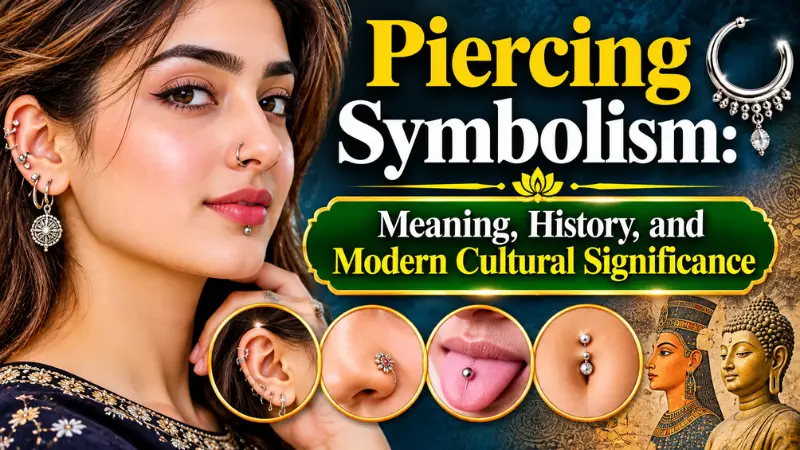
Piercing symbolism is closely connected to personal identity, self-expression, beauty, and cultural belonging. Whether someone wears simple earrings, a nose ring, a septum ring, or multiple body piercings, the choice can communicate something about their personality, values, experiences, or connection to a particular community. Although piercings are often considered fashion accessories in the United States, their meanings extend far beyond appearance.
For thousands of years, people across different societies have modified their bodies through piercing for religious ceremonies, social recognition, beauty, and rites of passage. The location, jewelry, and cultural setting often determine what a piercing represents.
Today, body piercing occupies an interesting position in American culture. It can be a mainstream fashion choice, a statement of independence, a connection to cultural heritage, or a deeply personal reminder of an important life experience. Understanding its symbolism requires looking at both its historical roots and the reasons people continue to choose it.
Quick Answer: What Does Piercing Symbolize?
Piercing symbolism commonly represents self-expression, individuality, personal identity, beauty, and independence in modern American culture. Historically, piercings have also symbolized social status, spiritual devotion, cultural belonging, maturity, and participation in important community traditions.
TL;DR: Key Meanings of Piercing
- Individuality: Expressing personal style and distinguishing oneself.
- Self-expression: Making an outward statement about identity and personality.
- Cultural heritage: Maintaining traditions and community connections.
- Spiritual meaning: Representing religious devotion or ceremonial participation.
- Independence: Exercising personal choice and control over appearance.
- Transformation: Marking maturity, personal milestones, or life changes.
1. What Is Piercing and Why Does It Have Symbolic Meaning?
Body piercing is the practice of creating an opening in a part of the body to accommodate jewelry or another decorative object. Common examples include earlobe, cartilage, nostril, septum, eyebrow, lip, tongue, navel, and other body piercings.
The jewelry may consist of gold, silver, stainless steel, titanium, or other materials. Its appearance can be simple or elaborate, depending on personal preference and cultural tradition.
Piercing becomes symbolic because it involves a deliberate decision about the body. Unlike an ordinary clothing accessory, a piercing changes the body to accommodate something that may remain part of someone’s appearance for years.
For some people, an earring is simply attractive jewelry. For others, the first piercing marks adulthood, celebrates a personal achievement, or represents a connection with family traditions.
This difference is important: a piercing does not have one universal meaning. Its symbolism depends on the person wearing it, the type of piercing, the surrounding culture, and the circumstances in which it was received.
2. The Core Symbolism of Piercing in Modern Culture
In contemporary American culture, body piercing is most commonly associated with personal expression and individual style.
However, several related meanings explain why people choose to modify their appearance.
Individuality and uniqueness
Piercings allow people to create an appearance that reflects their preferences rather than simply following conventional fashion. Someone with several ear piercings may enjoy combining different jewelry styles, while another person may choose a distinctive septum ring.
Beauty and attractiveness
Piercing has long been connected to physical decoration. Earrings, nose studs, and other jewelry can emphasize facial features or complement clothing.
Independence and freedom
Choosing a piercing can represent the freedom to make decisions about one’s own appearance. This interpretation is particularly meaningful for people who grew up with strict expectations about clothing, gender expression, or physical presentation.
Identity and belonging
Piercings can also communicate membership in a social, cultural, or artistic community. Certain styles have become associated with musicians, alternative fashion, punk culture, and other creative movements.
These meanings frequently overlap. A person might choose a piercing because it looks attractive while also appreciating its connection to independence and individuality.
3. Ancient Origins of Body Piercing
Body piercing is not a modern invention. Archaeological evidence and historical accounts demonstrate that people have practiced body modification for thousands of years.
One of the best-known examples is Ötzi the Iceman, a naturally preserved human body dating to approximately 3300 BCE. His ears showed modifications consistent with enlarged piercings, providing evidence of ancient body decoration. PubMed Central (PMC)+1
In ancient Egypt, jewelry and body adornment communicated wealth, beauty, and social position. Earrings were associated with elite appearance, and archaeological evidence has connected ear jewelry with members of Egyptian royalty.
Other societies developed their own traditions. In different African communities, ear stretching and lip plates became associated with beauty, maturity, social identity, or community customs.
In parts of ancient Central America, including Maya and Aztec societies, ritual body modification could carry religious significance. Certain ceremonial practices involving the mouth and tongue were connected to offerings and communication with spiritual forces.
The important historical lesson is that piercing developed independently in different parts of the world. Its meaning was shaped by local beliefs rather than a single shared tradition.
4. Piercing Symbolism in the United States
In the United States, piercing has gradually moved from a relatively conventional form of decoration into a broader form of personal expression.
For much of the twentieth century, ordinary ear piercing was widely accepted, particularly for women. Other forms of body piercing were less common and sometimes associated with alternative lifestyles.
During the late twentieth century, this began to change. Punk, underground music, LGBTQ+ communities, and alternative fashion movements helped introduce additional forms of body modification into American popular culture.
The modern body-piercing movement developed particularly during the 1970s and expanded through the 1980s and 1990s. OUP Academic+1
By the 2020s, nose rings, cartilage jewelry, multiple ear piercings, and other styles had become familiar parts of mainstream fashion.
American interpretations commonly include:
- Freedom: Choosing how to present oneself.
- Creativity: Developing a distinctive personal appearance.
- Confidence: Feeling comfortable with an unconventional style.
- Individual identity: Communicating personality without relying on words.
- Cultural connection: Maintaining or celebrating family traditions.
However, acceptance is not identical everywhere. Some workplaces, schools, religious communities, and families continue to have different expectations about visible body modifications.
5. Different Types of Piercings and Their Symbolic Meanings
Different piercing locations can suggest different forms of personal expression. However, these interpretations are modern associations, not universal cultural rules.
Hinged Segment Clicker Ring – Sterling Silver – piercedowl
12
Ear piercing
Ear piercings are commonly associated with beauty, tradition, maturity, and personal style. They are also among the most socially accepted forms of body modification in the United States.
Nose piercing
Nose piercings can symbolize individuality, beauty, cultural heritage, and independence. In some South Asian traditions, nose jewelry has established cultural and ceremonial associations.
Septum piercing
Septum jewelry is often associated with alternative fashion, self-confidence, and nonconformity in modern Western culture. Its meaning varies considerably between individuals and communities.
Eyebrow piercing
Eyebrow piercings are frequently connected with edgy fashion, experimentation, and personal identity. They may also represent someone’s interest in alternative or creative aesthetics.
Lip and tongue piercing
These piercings can communicate unconventional style, individuality, and willingness to experiment with appearance. Their meanings are generally personal rather than universally established.
Navel piercing
Navel piercings became particularly fashionable in Western popular culture during the 1990s. They are commonly associated with body confidence, fashion, and youthful self-expression.
6. Religious and Spiritual Symbolism of Piercing
Piercing has appeared in different religious and spiritual traditions, although its significance varies widely.
In some Hindu communities, nose piercing is connected with cultural customs, marriage traditions, and feminine adornment. Jewelry worn in the nose may be especially significant during weddings and other family ceremonies.
In certain historical and traditional South Asian settings, nose jewelry has also been associated with regional ideas about femininity and adulthood.
In some Indigenous and other traditional communities, body modification can be part of ceremonies that connect individuals with ancestors, spiritual beliefs, or community responsibilities.
The Bible also contains references to earrings and nose rings. In Genesis 24:22, for example, Abraham’s servant gives Rebekah jewelry that includes a nose ring and bracelets. In this context, jewelry functions as a gift within an important family and marriage arrangement.
Christian interpretations of body piercing differ. Some Christians view ordinary jewelry as an acceptable form of personal decoration, while others approach body modification through beliefs about modesty and respect for the body.
There is no single religious interpretation that applies to every piercing.
7. Cultural Meanings of Piercing Around the World
Piercing has different meanings across societies, and understanding those differences helps prevent cultural misunderstandings.
| Culture or context | Common symbolic associations | Important distinction |
|---|---|---|
| Ancient Egypt | Wealth, beauty, and social position | Jewelry could communicate status. |
| South Asian traditions | Marriage, femininity, and cultural identity | Meanings vary by region and community. |
| Maasai traditions | Beauty, maturity, and social identity | Ear stretching has specific cultural contexts. |
| Maya and Aztec traditions | Religious ceremonies and ritual practices | Some modifications had sacred significance. |
| Modern United States | Individuality, fashion, and independence | Personal expression is especially common. |
In some Maasai communities, ear stretching has historically formed part of traditional appearance and social identity. The practice should not be reduced to a simple fashion statement because its significance is connected to particular cultural traditions.
Similarly, the Mursi people of Ethiopia are known for traditional lip plates worn by some women. These practices have specific historical and social contexts that cannot be accurately explained through modern Western fashion categories.
The broader point is that body modification can communicate much more than attractiveness. It may express belonging, life experience, and inherited cultural identity.
8. The Emotional and Psychological Meaning of Piercing
For many people, getting a piercing is an emotional experience rather than an ordinary shopping decision.
The choice may represent a personal transition, a new beginning, or a desire to feel more comfortable in one’s appearance.
A sense of control
People sometimes choose piercings because they want to make an intentional decision about their bodies. This can be meaningful during periods when other aspects of life feel uncertain.
Confidence and self-acceptance
A piercing may help someone feel more comfortable with their appearance. Wearing jewelry that reflects personal taste can reinforce a positive sense of identity.
Remembering an important moment
Some individuals get piercings after graduating, ending a difficult relationship, beginning a new chapter, or achieving a personal goal.
Emotional independence
For someone who has spent years following other people’s expectations, choosing an unconventional piercing may represent greater personal freedom.
Psychological motivations vary, however. Having several piercings does not automatically indicate emotional distress, insecurity, rebellion, or any particular personality characteristic. Research on body modification describes a range of motivations, including aesthetics, identity, personal expression, and social belonging. ScienceDirect+1
9. Piercing as a Symbol of Rebellion and Independence
One of the most recognizable modern associations of piercing is rebellion.
This connection developed partly because visible body modifications challenged conventional ideas about professional appearance, respectability, and appropriate fashion.
During the twentieth century, punk musicians and members of alternative communities used distinctive clothing, hairstyles, tattoos, and piercings to challenge mainstream expectations.
For these individuals, modifying the body could be a deliberate statement against social conformity.
A person wearing a septum ring or several facial piercings might therefore communicate that they prefer personal freedom over traditional appearance standards.
Nevertheless, rebellion is not the meaning behind every piercing.
Someone wearing small gold nose jewelry may simply appreciate its appearance or cultural significance. A teenager getting ordinary ear piercings may be following a family tradition rather than rejecting social expectations.
The symbolic meaning depends on intention and context.
10. Piercing, Gender Identity, and Personal Expression
Body piercing has also become a way for people to explore how they present themselves.
Historically, certain forms of jewelry were strongly associated with gender expectations. Earrings, for example, were widely treated as feminine accessories in many twentieth-century American settings.
Those expectations have become more flexible.
Today, men and women wear earrings, nose rings, cartilage jewelry, and other piercings in different styles. Some people also use body jewelry as part of their gender expression or as a way to communicate a sense of identity.
For LGBTQ+ individuals, piercing has sometimes functioned as a visible form of community identification or personal expression, particularly within alternative and queer cultural spaces.
However, no particular piercing establishes someone’s gender identity or sexual orientation.
A septum ring does not automatically indicate that someone belongs to a specific community, just as an ear piercing does not determine someone’s personality.
Respecting individual interpretation is more accurate than assigning identities based on appearance.
11. Why Piercing Is Popular in Tattoos, Jewelry, and Fashion
Piercing has become an established part of modern fashion because it combines decoration with personal choice.
Luxury Jewelry Store | Crowned Jewelz Co. Elegant & Timeless – Crowned JewelZ Co.
Professional Ear Piercing in Edinburgh, Glasgow, Aberdeen – PURE Spa UK
Adult Nose Piercing Appointment – Porter Lyons
11
In contemporary American fashion, piercings are often styled according to clothing, hairstyles, makeup, and other accessories.
Some popular approaches include:
- Curated ear styling: Combining several earrings and cartilage piercings.
- Minimalist jewelry: Wearing small gold or silver studs.
- Alternative fashion: Pairing septum or eyebrow jewelry with distinctive clothing.
- Personalized jewelry: Choosing pieces with initials, meaningful shapes, or gemstones.
- Cultural jewelry: Wearing traditional designs connected to family heritage.
Piercings also appear in music videos, television, fashion photography, and social media.
Celebrities and fashion influencers have helped make certain piercing styles more visible, although their popularity is not the only reason people choose them.
For many individuals, jewelry is simply another way to create a personal appearance.
12. Piercing as a Symbol of Transformation and Life Milestones
A piercing can mark a change in someone’s life.
For example, a person might get their first ear piercing as a child, choose a nose piercing after becoming an adult, or add new jewelry following an important personal achievement.
In some cultures, body modification has historically been connected to initiation ceremonies and transitions between stages of life.
Certain traditions used piercing to recognize maturity, marriage eligibility, or membership in a particular social group.
Modern American piercings are generally less formal, but the emotional connection with life transitions remains relevant.
A piercing can serve as a personal reminder of:
- Reaching adulthood.
- Recovering from a difficult period.
- Starting a new chapter.
- Celebrating independence.
- Honoring a personal achievement.
- Developing a stronger sense of identity.
Unlike a conventional gift, a piercing becomes part of the person’s physical appearance. That can make it a lasting reminder of the decision behind it.
13. Controversies and Misunderstandings About Piercing
Despite its growing acceptance, piercing still carries certain social assumptions.
One common misunderstanding is that people with visible piercings are rebellious, irresponsible, or unprofessional. These judgments are stereotypes rather than reliable assessments of character.
Research involving recruiters has found that visible body art, including piercings, can influence how some employers evaluate applicants. This demonstrates that appearance-based bias can persist even as body modification becomes more common. IZA@LISER Network+1
Another misunderstanding involves cultural symbolism.
People sometimes assume that a particular piercing has the same meaning in every society. In reality, a nose ring might represent marriage traditions in one setting, personal fashion in another, and cultural heritage in a third.
There are also exaggerated historical stories about piercing. One example is the popular claim that Britain’s Prince Albert wore a genital piercing to secure his penis inside his trousers. Historical evidence does not establish this story as fact; it is generally treated as a modern myth. PubMed Central (PMC)+1
Cultural appropriation is another consideration. Wearing a style connected to a living Indigenous or traditional community without understanding its meaning can reduce an important cultural practice to an aesthetic trend.
Finally, piercing should not be confused with a completely risk-free fashion choice. Infection, allergic reactions, scarring, and healing complications are possible. Professional hygiene and appropriate aftercare are important.
14. How Piercing Symbolism Has Changed Over Time
The meaning of piercing has changed considerably as societies, fashion trends, and cultural expectations have developed.
In ancient societies, piercing could communicate social status, religious participation, beauty, or community membership.
In certain historical European settings, jewelry became associated with wealth, fashion, and social respectability. However, attitudes toward body modification varied across different periods and religious communities.
During the twentieth century, ear piercing became increasingly familiar in Western fashion. Later, alternative music and cultural movements helped expand the practice to other parts of the body.
By the 1990s and early 2000s, additional styles such as navel, eyebrow, tongue, and septum piercings were gaining visibility in popular culture.
In 2025 and 2026, piercing is widely understood as a flexible form of self-expression. It can be fashionable, traditional, artistic, sentimental, or connected to identity.
The important change is that piercing no longer carries just one social message. Its meaning is increasingly determined by the person wearing it rather than by a fixed cultural assumption.
15. Positive and Negative Symbolism of Piercing
Piercing is generally associated with positive ideas such as individuality and beauty, but its interpretation can depend on social and cultural circumstances.
| Positive symbolism | Possible negative interpretation |
|---|---|
| Individuality and creativity | Being perceived as unconventional |
| Confidence and independence | Being judged for appearance |
| Cultural belonging | Cultural practices being misunderstood |
| Beauty and decoration | Social pressure to follow trends |
| Personal transformation | Regret or dissatisfaction after a procedure |
| Freedom of expression | Conflict with workplace expectations |
These interpretations are not inherent qualities of the piercing itself.
A small nose stud can represent cultural pride to one person and fashionable decoration to another. Similarly, an eyebrow piercing may be an expression of confidence for its wearer while appearing unconventional to someone with more traditional preferences.
The most meaningful interpretation comes from understanding the person’s intentions rather than judging the jewelry alone.
FAQs
1. What does piercing symbolize spiritually?
Spiritually, piercing can represent devotion, cultural identity, ceremonial participation, or a connection with traditional beliefs. Its meaning depends on the particular religion or community rather than a universal spiritual rule.
2. What does a nose piercing symbolize?
A nose piercing commonly symbolizes beauty, individuality, and personal expression in modern American culture. In some South Asian communities, it also carries cultural associations with marriage, femininity, and traditional adornment.
3. Does getting a piercing symbolize rebellion?
It can. Piercings have historically been associated with alternative fashion and movements that challenged conventional appearance standards, but many people choose them simply for beauty or personal preference.
4. What does multiple ear piercing symbolize?
Multiple ear piercings often represent creativity, individuality, and personal style. Some people use different jewelry combinations to express their personality or celebrate meaningful experiences.
5. Is piercing considered a positive or negative symbol?
Piercing is generally associated with positive ideas such as independence, beauty, and self-expression. However, cultural beliefs and individual attitudes can influence whether someone views it positively or negatively.
6. What does a septum piercing symbolize in American culture?
In contemporary American fashion, septum piercings are commonly associated with alternative style, confidence, individuality, and nonconformity. However, some people choose them simply because they like the jewelry.
7. Does piercing have a historical religious meaning?
Yes. Different societies have incorporated piercing into religious ceremonies, spiritual practices, and cultural traditions. Historical examples include ritual body modification in parts of ancient Central America and traditional forms of adornment in South Asia.
Conclusion: The Meaning Behind Piercing
Piercing symbolism reflects the relationship between physical appearance, personal identity, cultural traditions, and individual freedom. From ancient societies that used body modification to communicate status or participate in ceremonies to modern Americans who choose piercings for fashion and self-expression, the practice has served many different purposes.
Today, a piercing can represent beauty, confidence, independence, cultural heritage, or a personal milestone. It can also be nothing more than a jewelry choice that someone finds attractive. Neither interpretation is automatically more meaningful than the other.
Ultimately, the meaning of a piercing belongs largely to the person wearing it. Understanding that personal choice makes it easier to appreciate piercing as both a form of body decoration and an expression of human identity.