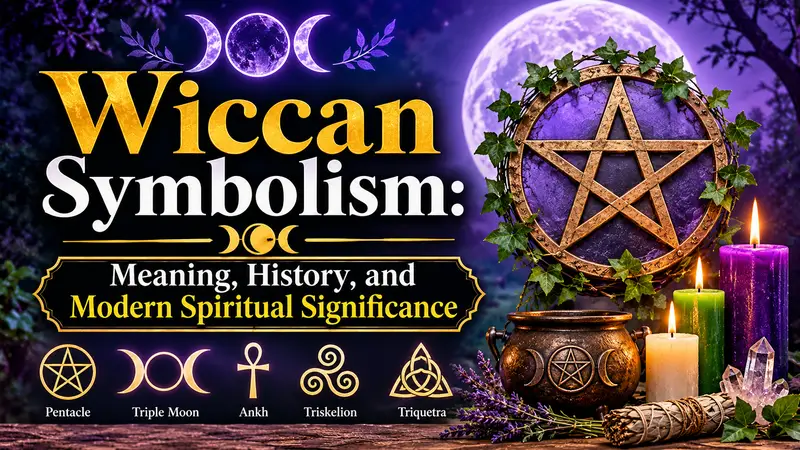
Wiccan symbolism refers to the collection of signs, sacred objects, natural elements, and spiritual images used in Wicca, a modern Pagan religion centered on nature, seasonal cycles, ritual practice, and personal spirituality. From the five-pointed pentacle to the Triple Moon, these symbols communicate ideas about protection, divine femininity, transformation, balance, and humanity’s relationship with the natural world.
For many Americans, Wiccan symbols are recognizable through jewelry, tattoos, spiritual artwork, and modern witchcraft communities. Some people use them as expressions of religious identity, while others appreciate their connections to nature, personal independence, and traditional folklore.
Understanding these symbols requires looking beyond their appearance. Their meanings developed through different historical traditions, religious interpretations, and modern spiritual movements. Although certain symbols have become widely associated with Wicca, their meanings are not always identical across every Wiccan tradition.
Quick Answer: What Does Wiccan Symbolism Represent?
Wiccan symbolism commonly represents nature, spiritual protection, balance, feminine divinity, personal transformation, and the connection between human life and the natural world. Historically, its imagery draws on older European religious symbols, folklore, ceremonial magic, and modern Pagan traditions, while contemporary American Wiccans use these symbols to express spirituality, identity, and respect for natural cycles.
TL;DR: Key Meanings of Wiccan Symbols
- Pentacle: Protection, elemental balance, and the connection between nature and spirit.
- Triple Moon: The changing phases of the Moon and aspects of feminine divinity.
- Elements: Earth, air, fire, and water represent different aspects of existence.
- Spiral: Growth, transformation, and the continuing cycles of life.
- Ankh: Life and spiritual continuity, although it originates in ancient Egypt.
- Modern identity: Wiccan symbols communicate religious beliefs and personal spiritual values.
1. What Is Wiccan Symbolism?
Wiccan symbolism is the visual and material language associated with Wicca and its different spiritual traditions. It includes geometric patterns, lunar imagery, natural objects, ritual tools, animals, and representations of deities.
Unlike religions with one universally accepted collection of sacred images, Wicca includes several traditions with different beliefs and practices. Some practitioners follow established initiatory systems, while others develop individual spiritual practices using selected Wiccan teachings.
Symbols help practitioners express ideas that can be difficult to communicate through ordinary language. A pentacle, for example, can represent the relationship between the physical world and spiritual awareness. A crescent moon may communicate an interest in lunar cycles, feminine divinity, or personal renewal.
Common themes include:
- Respect for nature and seasonal changes.
- Spiritual protection and personal responsibility.
- The relationship between masculine and feminine divine principles.
- The balance of different natural elements.
- Personal growth and transformation.
- The connection between physical and spiritual existence.
An important distinction is that Wiccan symbolism is not a single fixed system. A symbol may have a traditional interpretation in one coven and a more personal meaning for an individual practitioner.
2. The Historical Origins of Wiccan Symbols
Wicca emerged as an identifiable modern religious movement in mid-20th-century Britain. Gerald Gardner played a central role in introducing and popularizing the religion during the 1950s, although other individuals and influences contributed to its development.
Its spiritual imagery draws from several sources, including European folklore, ceremonial magic, older Pagan traditions, occult literature, and historical representations of nature and divinity.
Some symbols used by Wiccans are much older than Wicca itself. The pentagram, for example, appeared in ancient Mesopotamian and Greek contexts long before modern witchcraft developed. Similarly, the ankh originated in ancient Egyptian religion rather than Wicca.
The Triple Moon became particularly recognizable through modern Goddess-centered spirituality.
The historical distinction matters because Wicca did not simply survive unchanged from prehistoric Europe. It is a modern religion that incorporates selected older ideas, symbols, and practices into a developing spiritual tradition.
During the 1960s and 1970s, Wicca expanded into the United States. Its growth coincided with increased interest in environmentalism, feminism, alternative spirituality, and individual religious expression.
These influences helped establish the visual language that many Americans now associate with modern witchcraft.
3. The Pentacle: Protection and Elemental Balance
The Witch Shop : Pentacle Necklace : Witchcraft & Pagan Pentagram Jewelry
The pentacle is arguably the most recognizable symbol associated with Wicca. It consists of a five-pointed star enclosed within a circle.
Its most common Wiccan interpretation connects the five points with five spiritual and natural principles:
- Earth
- Air
- Fire
- Water
- Spirit
The four physical elements represent different dimensions of the natural world, while spirit represents the connecting or transcendent principle.
The surrounding circle is commonly understood as a symbol of unity, continuity, protection, and the interconnectedness of existence.
Together, these features communicate the idea that physical and spiritual life belong to a larger whole.
Why is the pentacle associated with protection?
In many Wiccan practices, the pentacle is used in rituals, displayed on altars, or worn as jewelry. Its circular boundary can represent a protected or sacred space, while the five-pointed star expresses balance among the elements.
The pentacle is not inherently a symbol of evil or Satanism. Its religious meaning depends on the tradition using it. In Wicca, an upright pentacle is generally a positive religious symbol associated with nature, protection, and spiritual balance.
4. The Triple Moon: Feminine Divinity and Life’s Stages
Sterling Silver Moon Phase Triple Goddess Rainbow Moonstone Necklace Jewelry
The Triple Moon consists of three lunar shapes arranged together: a waxing crescent, a full moon, and a waning crescent.
It is strongly associated with Goddess-centered Wiccan traditions and represents the changing phases of the Moon.
A common interpretation connects the three phases with three aspects of feminine life:
- Maiden: The waxing moon represents beginnings, independence, exploration, and possibility.
- Mother: The full moon represents maturity, creation, fertility, and nurturing.
- Crone: The waning moon represents wisdom, experience, reflection, and the closing of life cycles.
These associations are often called the Maiden, Mother, and Crone archetypes.
The symbol can also communicate the idea that change is a natural part of existence. The Moon appears to disappear and return, making it an accessible representation of renewal and continuity.
In modern American spiritual communities, the Triple Moon frequently appears in necklaces, altar decorations, tattoos, and Goddess-centered artwork.
However, its three-part interpretation is a modern religious framework rather than a universal interpretation shared by every ancient lunar culture.
5. The Four Elements in Wiccan Spirituality
Earth Element Altar: Crystals, Plants, Pentacle & Grounding Ritual Guide – Nicole’s ritual universe
Air Element Altar: Crystals, Feathers, Incense & Clarity Ritual Guide – Nicole’s ritual universe
7
The four classical elements—earth, air, fire, and water—are important in many Wiccan traditions.
They represent different qualities of existence and provide a symbolic framework for understanding the natural world.
Earth: Stability and Physical Existence
Earth represents grounding, security, patience, nourishment, and material life. Stones, soil, plants, and crystals may be used to represent this element.
Its symbolism often reflects the importance of maintaining a stable foundation.
Air: Thought and Communication
Air represents intelligence, communication, learning, inspiration, and mental clarity. Incense, feathers, bells, and certain ritual tools may represent it.
Its symbolism emphasizes the relationship between thought and understanding.
Fire: Energy and Transformation
Fire symbolizes passion, courage, creativity, determination, and change. Candles are among its most recognizable ritual representations.
Because fire transforms materials, it also represents the ability to move from one condition into another.
Water: Emotion and Renewal
Water represents emotions, intuition, cleansing, healing, and renewal. Chalices, bowls of water, and seashells may be associated with it.
Its changing forms make it a natural symbol of adaptability.
These elements are not scientific descriptions of physical matter. They are traditional symbolic categories used to organize spiritual ideas and ritual practices.
6. The Spiral: Growth and the Cycles of Life
Triskelion: Celtic Triple Spiral | Ancient Protection Symbol – Nicole’s ritual universe
The spiral is a recurring image in Wiccan and broader Pagan-inspired artwork.
It represents movement, development, renewal, and the repeating patterns found throughout nature.
Its shape can suggest a journey that moves outward, inward, or through successive stages. Unlike a straight line, a spiral communicates growth that includes repetition and change.
In spiritual interpretations, the spiral may represent:
- Personal development.
- The changing seasons.
- Birth, death, and renewal.
- The relationship between beginnings and endings.
- The movement of life through different experiences.
Spiral patterns also appear in prehistoric artwork, ancient decorative objects, and Celtic-associated artistic traditions.
However, not every historical spiral had the same religious meaning. Modern Wiccans may adopt spiral imagery for personal or spiritual reasons without claiming that every ancient example belonged to their religion.
7. The Ankh: Life and Spiritual Continuity
Ankh: Ancient Egyptian Symbol of Life, Meaning & Origins
The ankh is an ancient Egyptian symbol shaped like a cross with a loop at the top.
Its original religious significance is associated with life, vitality, and the continuation of existence. Egyptian gods and goddesses were frequently depicted holding the ankh, particularly in scenes involving divine life and royal authority.
Although it is not originally a Wiccan symbol, some modern Pagans and Wiccans incorporate it into personal spiritual collections.
Its appeal comes from its association with life, renewal, and the relationship between physical existence and the divine.
The ankh is also found in modern jewelry, alternative spiritual artwork, and popular culture.
It is important to recognize its Egyptian origins rather than treating it as a symbol invented by Wicca. Its adoption by modern spiritual communities represents the exchange and reinterpretation of religious imagery.
8. The Sun and Moon: Masculine and Feminine Principles
Golden Sun & Crescent Moon Engraving – Royalty-Free Vector | VectorStock
The Sun and Moon frequently appear together in Wiccan artwork because they represent complementary aspects of nature and spiritual existence.
In many traditional Wiccan interpretations, the Sun is associated with the Horned God, while the Moon is associated with the Goddess.
The Sun commonly represents:
- Vitality and life.
- Strength and activity.
- Growth and illumination.
- Seasonal change.
- Masculine divine imagery in some traditions.
The Moon commonly represents:
- Intuition and reflection.
- Feminine divine imagery.
- Cycles and transformation.
- Emotional awareness.
- Nighttime and renewal.
These associations are not universal rules. Some Wiccans understand deities through different frameworks, and others interpret the Sun and Moon without assigning them gender.
When combined, the two celestial bodies can represent complementary forces that sustain the natural world.
Their symbolism is particularly relevant during seasonal rituals, moon observances, and artwork celebrating the changing relationship between darkness and light.
9. The Horned God and the Goddess
Triple Moon Symbol: Complete Guide to the Goddess & Lunar Phases – Nicole’s ritual universe
Many Wiccan traditions recognize a Goddess and a Horned God as central divine figures.
The Goddess is commonly connected with fertility, the Moon, nature, birth, nurturing, and the changing stages of life.
The Horned God is often associated with wilderness, animals, hunting, fertility, seasonal cycles, and the natural world.
Their relationship represents complementary aspects of existence, including creation, growth, death, and renewal.
The Horned God should not automatically be confused with the Christian Devil. Horns have appeared in many historical representations of animals, wilderness deities, and fertility figures.
Christian religious imagery later gave horns a different association in representations of the Devil. This contributed to misunderstandings about modern Pagan traditions.
Wiccan interpretations vary considerably. Some practitioners worship both deities, others emphasize the Goddess, and some understand divine figures as archetypes rather than literal supernatural beings.
The central symbolic idea is often the relationship between different aspects of nature and creation.
10. The Book of Shadows: Knowledge and Spiritual Practice
How to Start a Book of Shadows (Step-by-Step Guide)
The Book of Shadows is a personal or tradition-specific collection of Wiccan rituals, teachings, magical practices, observations, and spiritual information.
It became particularly associated with modern Wicca through Gerald Gardner and the development of early Wiccan traditions.
Unlike a universally standardized religious scripture, a Book of Shadows can differ significantly between individuals and groups.
Some practitioners use it to record:
- Ritual instructions.
- Seasonal celebrations.
- Moon observations.
- Personal reflections.
- Herbal knowledge.
- Spiritual experiences.
- Religious teachings.
Symbolically, the book represents learning, memory, personal responsibility, and the development of spiritual understanding.
For contemporary practitioners, maintaining one can become a way of documenting how their beliefs and practices change over time.
Its significance is therefore not simply about written spells. It can also represent the relationship between knowledge, experience, and personal spiritual development.
11. Wiccan Symbols in Modern American Culture
Wiccan imagery has become increasingly recognizable in the United States through alternative spirituality, contemporary Pagan communities, literature, jewelry, television, and online culture.
American interpretations are influenced by the country’s broader traditions of religious diversity and individual expression.
Several social developments helped shape this visibility.
The growth of feminist spirituality encouraged renewed interest in Goddess-centered religious imagery. Environmental movements strengthened the appeal of nature-based spiritual practices. The counterculture of the 1960s and 1970s also contributed to public interest in alternative religions.
Today, Wiccan symbols can communicate several different things in American society.
For practicing Wiccans, they may represent religious beliefs and community membership.
For people interested in spirituality without formally identifying as Wiccan, they can represent personal reflection, nature, or alternative spiritual interests.
For others, the imagery is primarily decorative or connected to fantasy and popular culture.
This variety means that seeing a pentacle necklace or Triple Moon tattoo does not automatically establish someone’s religious identity.
12. Common Wiccan Symbols and Their Meanings Compared
Different symbols communicate different ideas, even when they appear together in the same religious setting.
The following table summarizes some commonly recognized examples.
| Symbol | Main Meaning | Common Associations | Modern Use |
|---|---|---|---|
| Pentacle | Protection and balance | Five elements and spirit | Jewelry and rituals |
| Triple Moon | Feminine divinity and cycles | Maiden, Mother, Crone | Tattoos and pendants |
| Spiral | Growth and transformation | Renewal and life’s journey | Artwork and decor |
| Ankh | Life and continuity | Ancient Egyptian religion | Jewelry and spiritual art |
| Sun and Moon | Complementary forces | Nature and divine principles | Decorations and tattoos |
| Cauldron | Creation and transformation | Goddess and rebirth | Altars and ritual settings |
These interpretations are common rather than universal. Individual practitioners may assign additional meanings based on their religious tradition or personal experience.
13. Emotional and Psychological Meanings of Wiccan Symbols
Wiccan imagery can communicate emotional ideas that extend beyond formal religious practice.
For many practitioners, these symbols provide a way to express their relationship with nature, identity, and personal development.
Protection and Reassurance
A pentacle worn as a necklace may serve as a reminder of personal boundaries, spiritual beliefs, and the desire for protection.
The object can become emotionally meaningful because it connects an individual with a particular worldview.
Acceptance of Change
Lunar symbols often communicate the idea that life develops through different stages. The changing Moon provides a visual reminder that growth, uncertainty, and renewal are normal parts of existence.
Connection with Nature
Images of trees, herbs, water, animals, and celestial bodies can express an appreciation for the natural environment.
For people who feel disconnected from modern urban life, these symbols may represent a desire to reconnect with seasonal and ecological rhythms.
Personal Independence
Some Americans use witchcraft-related imagery to express individuality and independence from conventional religious expectations.
This does not mean every person wearing a Wiccan symbol rejects mainstream religion. It simply demonstrates how spiritual imagery can communicate personal values.
From a psychological perspective, symbols can also serve as memory aids, emotional reminders, and expressions of belonging.
14. Wiccan Symbolism in Tattoos, Jewelry, and Home Decor
The Witch Shop : Pentacle Necklace : Witchcraft & Pagan Pentagram Jewelry
70 Witchy Tattoos To Activate Your Magical Power | Wiccan tattoos, Wicca tattoo, Hand tattoos
Wicca Altar with Candlelit Ritual Tools
9
Modern Wiccan symbolism is particularly visible in personal accessories and interior decoration.
Its geometric shapes and natural imagery make it suitable for different artistic styles, from minimalist designs to elaborate spiritual artwork.
Tattoos
Pentacles, Triple Moon designs, spirals, and crescent moons are popular choices in contemporary witchcraft-inspired tattoo aesthetics.
A pentacle tattoo may communicate religious identity or protection, while a Triple Moon tattoo may express an interest in Goddess spirituality and personal transformation.
Some people choose these designs because of their visual appearance rather than a specific religious commitment.
Jewelry
Pendants, rings, bracelets, and necklaces provide everyday ways to display Wiccan imagery.
The pentacle is especially recognizable, although lunar designs and natural symbols are also common.
For practicing Wiccans, wearing such jewelry may be a quiet expression of faith.
Home Decor
Wiccan-inspired home decorations frequently incorporate candles, wooden pentacles, crescent moons, natural materials, herbs, and seasonal artwork.
Some practitioners create dedicated altar spaces where these objects have ritual purposes.
Others use similar designs simply because they appreciate their connection with nature and celestial imagery.
Social Media
Platforms such as Pinterest, Instagram, and TikTok have increased the visibility of contemporary witchcraft aesthetics.
Images of moon phases, spell journals, candles, plants, and pentacles are commonly used to communicate an interest in spiritual practices.
However, social media content often mixes established religious traditions with commercial trends, personal interpretations, and fictional witchcraft imagery.
Understanding this difference helps prevent decorative representations from being mistaken for universal religious teachings.
15. Misunderstandings and Controversies Surrounding Wiccan Symbols
Wiccan symbols have sometimes been misunderstood because of historical religious conflicts and popular portrayals of witchcraft.
One of the most common misconceptions is that the pentacle represents Satanism or evil.
Although inverted pentagrams have appeared in different occult and religious contexts, the upright pentacle is widely used in Wicca as a positive symbol of elemental relationships and spiritual protection.
Another misunderstanding comes from confusing historical witchcraft accusations with modern Wiccan religious practice.
During the European witch trials, people were accused of harmful magic and participation in supposed demonic gatherings. These accusations were shaped by religious beliefs, social tensions, legal systems, and local circumstances.
Modern Wicca developed much later and should not be treated as identical to the practices imagined by early modern witchcraft prosecutors.
There are also controversies involving the adoption of symbols from other cultures.
For example, the ankh has an established Egyptian religious history. Using it without acknowledging that background can oversimplify its cultural significance.
Similarly, not every Celtic-inspired design is historically Celtic, and not every symbol associated with contemporary Paganism originated within Wicca.
Respectful interpretation requires distinguishing historical origins, modern religious adoption, and personal artistic use.
16. How Wiccan Symbolism Has Evolved Over Time
Wiccan symbolism has developed through a combination of older imagery, modern religious innovation, and changing social attitudes.
Before Wicca emerged as a recognizable religion, many of its later symbols already existed in different historical and cultural settings.
The pentagram appeared in ancient civilizations. Lunar imagery had long been associated with religious ideas about time and fertility. The four elements were established concepts in ancient Greek philosophy and later Western esoteric traditions.
Modern Wicca brought selected symbols together within a new religious framework.
During the second half of the 20th century, American Wiccan communities expanded these interpretations through feminist spirituality, environmental awareness, and alternative religious movements.
In the 21st century, the internet introduced Wiccan imagery to much wider audiences.
Today, traditional ritual symbols coexist with minimalist jewelry, digital illustrations, commercial witchcraft aesthetics, and personalized spiritual artwork.
This evolution does not mean that every modern interpretation is historically accurate. Rather, it demonstrates how religious symbols acquire new meanings as communities change.
The most important distinction is between a symbol’s original historical context and the meaning a contemporary practitioner chooses to give it.
FAQs
1. What is the most important symbol in Wicca?
The pentacle is generally considered the most recognizable symbol associated with Wicca. Its five-pointed star represents the elements of earth, air, fire, water, and spirit, while the surrounding circle commonly represents unity and protection.
2. What does a Wiccan pentacle mean spiritually?
A Wiccan pentacle commonly represents elemental balance, protection, and the connection between physical and spiritual existence. Many practitioners wear it as jewelry or use it during religious rituals.
3. Is Wiccan symbolism associated with evil?
No. Wiccan symbols are generally associated with nature, spirituality, protection, and religious practice. Their association with evil largely comes from historical misunderstandings and negative portrayals of witchcraft.
4. What does the Triple Moon mean in Wicca?
The Triple Moon represents the waxing, full, and waning phases of the Moon. In many Goddess-centered traditions, these phases correspond to the Maiden, Mother, and Crone, representing different stages of feminine life and experience.
5. What do the four elements represent in Wicca?
Earth represents stability, air represents thought, fire represents transformation, and water represents emotions and renewal. Together, they provide a symbolic framework for understanding different aspects of nature and human experience.
6. Can someone wear Wiccan symbols without being Wiccan?
Yes. People can wear Wiccan-inspired jewelry or artwork because they appreciate its aesthetic, connection with nature, or spiritual associations. Wearing a particular symbol does not automatically make someone a member of the Wiccan religion.
7. Are Wiccan symbols ancient?
Some symbols used in Wicca are ancient, but Wicca itself is a modern religion that emerged in the 20th century. The pentagram and ankh, for example, existed long before modern Wiccan traditions developed.
Conclusion:
Wiccan symbolism brings together ideas about nature, protection, balance, transformation, and spiritual identity. Symbols such as the pentacle, Triple Moon, spiral, and four elements provide recognizable ways to communicate these beliefs, although their interpretations can differ between traditions and individual practitioners.
In the United States, these images have become visible through religious communities, jewelry, tattoos, home decoration, and contemporary spiritual culture. Their popularity also reflects wider interests in environmental awareness, personal independence, and alternative approaches to spirituality.
Ultimately, understanding Wiccan symbolism means recognizing both its historical influences and its modern religious context. These symbols are not simply decorative images or signs of witchcraft; for many practitioners, they are meaningful expressions of how they understand nature, life, and their place in the world.