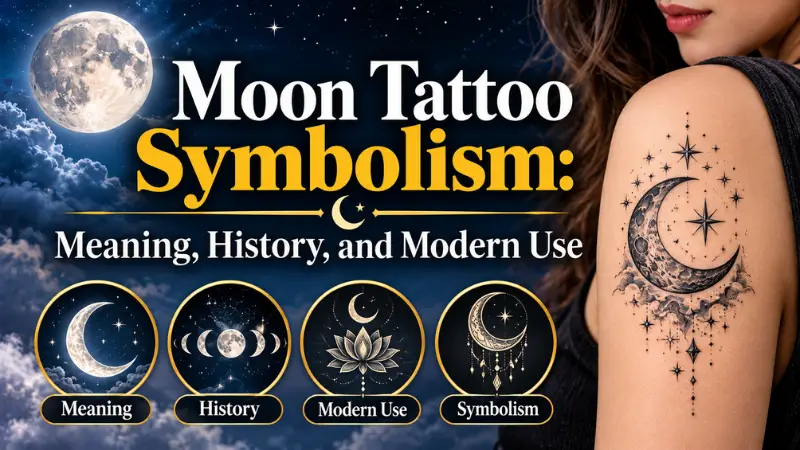
A moon tattoo is more than a decorative image of the night sky. For many people, it represents personal transformation, intuition, femininity, emotional balance, and the natural cycles of life. Its meaning can also reflect spirituality, independence, mystery, or the belief that difficult periods eventually give way to brighter days.
Moon tattoo symbolism has become especially popular in the United States because the moon offers a flexible way to express personal experiences without relying on words. A small crescent on the wrist, a detailed full moon on the shoulder, or an entire sequence of lunar phases can communicate different ideas depending on the design and the wearer’s intentions.
The moon also has a long cultural history. Ancient civilizations connected it with gods, goddesses, calendars, agriculture, fertility, and the passage of time. These associations continue to influence contemporary tattoo designs, although modern interpretations are often more personal than religious.
Understanding these meanings can help explain why the moon remains one of the most recognizable celestial symbols in tattoo art.
Quick Answer: What Does Moon Tattoo Symbolism Mean?
Moon tattoo symbolism most commonly represents personal growth, transformation, intuition, femininity, and the changing stages of life in modern American culture. Historically, the moon has also symbolized fertility, divine power, timekeeping, protection, and renewal across different civilizations and religious traditions.
TL;DR
- Transformation: The moon represents change and different stages of personal development.
- New beginnings: A crescent moon often symbolizes fresh opportunities and personal growth.
- Femininity: Lunar imagery is traditionally associated with feminine deities and life cycles.
- Emotional balance: The moon can represent intuition, reflection, and inner awareness.
- Spirituality: Different cultures connect lunar imagery with divine figures and religious traditions.
- Personal identity: Modern moon tattoos often commemorate important experiences and life transitions.
1. What a Moon Tattoo Looks Like and Why People Choose It
Moon tattoos feature the familiar celestial body in different shapes, artistic styles, and compositions. Some designs show a simple curved crescent, while others display a realistic full moon with craters, shadows, and detailed surface textures.
The most recognizable designs include:
- Crescent moon: A thin, curved section of the moon.
- Full moon: A complete circular representation.
- Half moon: A design showing one illuminated half.
- Moon phases: Multiple images illustrating the moon’s changing appearance.
- Triple moon: Three lunar shapes representing waxing, full, and waning phases.
- Moon and stars: A combination associated with dreams, hope, and the night sky.
- Moon and sun: A paired design representing contrasting forces and balance.
Full moon tattoo on the left forearm – Tattoogrid.net
9
In American tattoo culture, moon imagery appeals to people who prefer symbols that can communicate personal meaning without requiring a specific religious or cultural commitment.
Its adaptable appearance also makes it suitable for nearly any tattoo style, from traditional American designs to contemporary fine-line artwork.
2. The Main Symbolic Meanings of Moon Tattoos
Although individual interpretations differ, several meanings appear repeatedly in modern moon tattoo designs.
Transformation and Change
The moon never appears exactly the same throughout its monthly cycle. It gradually becomes more visible, reaches fullness, and then seems to disappear before beginning again.
This natural pattern makes it an understandable symbol of transformation.
Someone who has overcome a difficult experience might choose a moon tattoo to represent personal progress. Another person might use it to mark a major transition, such as starting a new career, leaving a relationship, or entering a different stage of adulthood.
The central message is that change is a normal part of life.
Mystery and the Unknown
Because the moon appears in darkness, it has traditionally been associated with things people cannot immediately see or understand.
A moon tattoo can therefore represent curiosity, imagination, independence, or comfort with uncertainty.
Some people choose this meaning because they appreciate exploring unfamiliar experiences rather than following predictable paths.
Intuition and Emotional Awareness
The moon is frequently connected with intuition and introspection in astrology, folklore, and contemporary spiritual traditions.
A lunar tattoo may represent listening to personal feelings, understanding emotional experiences, or trusting one’s judgment.
This interpretation is particularly common in designs featuring a crescent moon, stars, or delicate celestial patterns.
Femininity and Reproductive Cycles
Many ancient cultures associated the moon with feminine deities, fertility, motherhood, and childbirth.
Modern tattoo designs sometimes preserve these associations through moon goddesses, floral elements, or the triple-moon symbol.
However, lunar symbolism is not exclusively feminine. Several major historical traditions represented the moon through male deities, so the meaning depends on the cultural tradition being referenced.
3. Ancient Origins of Lunar Symbolism
The moon became an important symbol long before contemporary tattoo culture existed.
Ancient communities depended on the natural environment to understand seasons, organize agricultural activities, and measure time. Because the moon changed its appearance in a predictable pattern, it became an important reference point for calendars and religious ceremonies.
In ancient Mesopotamia, the moon was associated with the deity Nanna, also known by the Akkadian name Sin. This deity was connected with celestial order and timekeeping.
Ancient Egyptians also associated lunar activity with religious figures, including Khonsu and Thoth. These connections linked the moon with the measurement of time, knowledge, and divine organization.
In Greek mythology, Selene represented the moon as a goddess, while Artemis developed important lunar associations. Roman mythology later connected similar imagery with Luna and Diana.
Starożytni Grecy zapatrzeni w Księżyc | Zapatrzeni w Oko Nocy – Polityka.pl
Nabonide, l’ultimo re di Babilonia
Archaeo – Histories (@archeohistories) on X
6
These traditions helped establish the moon as a symbol connected with divine forces, natural rhythms, and the relationship between the heavens and human life.
Modern moon tattoos do not automatically represent these ancient religions. However, the historical associations help explain why lunar imagery carries so many different interpretations.
4. What Moon Tattoos Represent in American Culture
In the United States, moon tattoos are generally understood through personal expression, spirituality, popular culture, and contemporary tattoo aesthetics.
Unlike symbols with one strongly established national meaning, the moon has several overlapping interpretations.
For some Americans, it represents independence and individuality. Others associate it with emotional growth, feminine identity, or an appreciation of nature.
The moon also has a familiar place in American visual culture through Halloween decorations, astronomy, literature, music, and popular entertainment.
Its appearance in Halloween imagery often connects it with nighttime mystery, folklore, witches, and supernatural stories. These associations influence some contemporary tattoo designs, particularly those featuring black cats, bats, stars, or witchcraft imagery.
However, a moon tattoo does not automatically communicate an interest in witchcraft or occult practices.
In everyday American tattoo culture, its meaning is usually determined by the individual wearing it.
5. Different Moon Phases and Their Tattoo Meanings
The lunar phase is one of the most important design choices because each appearance can suggest a different interpretation.
Astronomically, the moon passes through eight recognized phases during a cycle of approximately 29.5 days. Tattoo artists frequently use these shapes to create designs representing different stages of personal development.
Lunar Phases Line Tattoo Design – Tattoos Wizard Designs
| Moon Design | Common Symbolic Meaning | Personal Interpretation |
|---|---|---|
| New moon | Beginnings and potential | Starting over |
| Waxing crescent | Growth and development | Building confidence |
| First quarter | Determination and action | Facing challenges |
| Waxing gibbous | Preparation and progress | Working toward goals |
| Full moon | Completion and clarity | Celebrating achievement |
| Waning gibbous | Reflection and gratitude | Learning from experience |
| Third quarter | Release and adjustment | Letting go |
| Waning crescent | Rest and renewal | Preparing for change |
These interpretations are symbolic rather than scientifically established meanings. People can assign their own significance to any phase.
Crescent Moon Tattoo
A crescent moon commonly represents new beginnings, potential, intuition, and gradual growth.
Because it appears as a small portion of the complete lunar circle, some people interpret it as a reminder that personal development does not happen all at once.
It is especially popular among people who prefer small, understated tattoos.
Full Moon Tattoo
Full moon tattoo on the right upper arm.
A full moon often represents completion, awareness, fulfillment, and emotional expression.
Its complete circular appearance makes it a natural choice for people celebrating an achievement or recognizing an important chapter of life.
Some designs also emphasize the moon’s craters and shadows to create a more realistic astronomical appearance.
Half Moon Tattoo
Half Moon Tattoo Design Ideas Images
A half-moon design can suggest transition, contrast, and balance.
Some people interpret it as a representation of the relationship between opposing experiences, such as happiness and sadness, strength and vulnerability, or beginnings and endings.
Moon Phases Tattoo
27 Ideias de Fases da Lua Tattoo Que Contam Sua História na Pele
A moon phases tattoo displays several stages of the lunar cycle.
It commonly represents the idea that life develops through different experiences. The design can serve as a reminder that difficult periods, successful moments, and uncertain transitions are all parts of a larger journey.
6. The Triple Moon Tattoo and Its Spiritual Meaning
neutattodesigns.com | Moon tattoo designs, Moon tattoo, Goddess tattoo
The triple moon tattoo is a recognizable design within modern Wiccan and neopagan communities.
It usually consists of three lunar shapes:
- A waxing crescent on the left.
- A full moon in the center.
- A waning crescent on the right.
In many contemporary Wiccan interpretations, these three forms represent the Maiden, Mother, and Crone.
The Maiden is associated with youth, exploration, and new possibilities. The Mother represents maturity, creation, and nurturing. The Crone symbolizes wisdom, experience, and the later stages of life.
Together, they express a symbolic understanding of feminine development and the changing stages of existence.
The triple-moon framework is particularly influential in modern goddess spirituality. However, it is important to distinguish contemporary neopagan interpretations from ancient historical evidence.
Although ancient cultures worshipped lunar goddesses, the familiar Maiden-Mother-Crone framework should not automatically be described as a universal ancient belief.
7. Moon Tattoo Symbolism Across Different Cultures
The moon has appeared in the mythology and religious traditions of many societies. Its meanings are not identical everywhere.
Chang’e: Chinese Moon Goddess | Moon and Mystery Complete – Nicole’s ritual universe
Tsukuyomi-no-Mikoto – Yokai Encyclopedia | YOKAI.JP
Показатели ума и интеллекта в джйотише
4
Chinese Culture
In Chinese mythology, the moon is associated with Chang’e, a legendary figure connected with the moon palace.
The Jade Rabbit is another familiar lunar image.
The Mid-Autumn Festival celebrates the full moon and is traditionally associated with family reunions, completeness, and togetherness.
A moon tattoo inspired by these traditions may represent family bonds, harmony, or cultural heritage.
Japanese Culture
Japanese mythology includes Tsukuyomi, a male moon deity.
The moon also appears in traditional stories involving rabbits and seasonal celebrations.
Moon imagery in Japanese-inspired artwork can communicate contemplation, natural beauty, and the relationship between humans and the changing seasons.
Hindu Traditions
In Hindu traditions, Chandra is a lunar deity associated with the moon.
Lunar imagery also has connections with calendars, religious observances, and astrological traditions.
A tattoo inspired by Chandra may carry spiritual or cultural significance, particularly when accompanied by traditional religious imagery.
Maya Culture
Maya traditions include lunar associations with fertility, agriculture, and feminine deities.
Ix Chel is an important goddess connected in different traditions with childbirth, weaving, healing, and other aspects of life.
A tattoo inspired by Maya lunar imagery should be approached with attention to its specific cultural and historical background rather than treating it as generic decoration.
8. Emotional and Psychological Meaning of Moon Tattoos
People often choose tattoos because they want a visible reminder of an experience, belief, or personal commitment.
The moon is especially suitable for this purpose because its changing appearance provides a natural metaphor for emotional development.
Healing After Difficult Experiences
A moon tattoo may represent recovery after grief, disappointment, heartbreak, or a major personal struggle.
The changing lunar cycle can serve as a reminder that difficult circumstances are not necessarily permanent.
For someone recovering from a painful relationship, a waning moon might symbolize releasing the past and making room for something new.
Self-Acceptance
The moon does not remain full every night, yet its different phases are all part of the same natural cycle.
Some people use this imagery to express acceptance of their own changing emotions, abilities, and circumstances.
Independence
A moon tattoo can also represent feeling comfortable with one’s individuality.
Unlike a design that communicates membership in a particular group, a simple lunar image can express a personal philosophy without requiring an explanation.
Connection With Nature
People who appreciate astronomy, nighttime landscapes, or outdoor experiences may choose moon tattoos to express their relationship with the natural world.
For them, the tattoo can represent curiosity about the universe and appreciation for the environment.
9. Moon and Sun Tattoo Symbolism
The sun and moon are frequently combined in tattoo artwork because they provide an immediately recognizable visual contrast.
The sun is commonly associated with daylight, activity, warmth, and outward expression. The moon is often connected with nighttime, reflection, intuition, and inward awareness.
Together, they can represent:
- Balance between opposing qualities.
- Masculine and feminine symbolism in certain traditions.
- Relationships between contrasting personalities.
- Harmony between activity and reflection.
- The relationship between light and darkness.
Couples sometimes choose matching sun and moon tattoos to represent complementary personalities.
Friends or family members may also use the pairing to express a relationship in which two different individuals support one another.
However, these interpretations are not universal. The meaning ultimately depends on the people choosing the design.
10. Why Moon Tattoos Are Popular in Modern American Tattoo Culture
Moon tattoos remain recognizable across several generations of American tattoo enthusiasts because they work with different artistic styles and personal preferences.
2026 Minimalist Tattoo Trends: Fine Lines for Subtle Contemporary Ink | Inked Mythos
13
Several factors contribute to their popularity.
Versatility: A moon can be designed as a tiny symbol or incorporated into an elaborate composition.
Personal meaning: Its associations with change, identity, and emotional development make it suitable for commemorating important experiences.
Visual simplicity: Even a basic crescent shape is recognizable without extensive detail.
Artistic flexibility: Tattoo artists can combine lunar imagery with flowers, animals, geometric patterns, stars, or portraits.
Spiritual expression: Some people use moon imagery to communicate an interest in astrology, Wicca, neopagan spirituality, or broader celestial symbolism.
Social media has also increased the visibility of fine-line moon tattoos, particularly minimalist crescents and lunar-phase sequences.
However, popularity does not mean every person assigns the same meaning to the design.
11. Moon Tattoos in Jewelry, Fashion, and Everyday Design
Moon symbolism is not limited to tattoos. The same imagery appears in American jewelry, clothing, home decoration, and digital culture.
Collier Demi Lune Argent – La Raffinée
8
Jewelry
Crescent moon necklaces, earrings, and rings are common choices for people who appreciate celestial designs.
They can represent personal identity, spirituality, or an appreciation for nighttime imagery.
Home Decoration
Moon-themed wall art, lamps, and decorative objects are often used to create a peaceful or celestial atmosphere.
A full moon image may emphasize completeness, while a sequence of lunar phases can suggest the passage of time.
Fashion
Moon imagery appears on clothing, handbags, accessories, and printed fabrics.
In fashion, the design often communicates an interest in celestial aesthetics rather than a specific religious belief.
Social Media
Moon symbols and emojis are frequently used in digital communication.
Depending on the context, they may suggest nighttime activities, peaceful moods, dreams, astrology, or an interest in spiritual subjects.
The crescent moon emoji, for example, can communicate a nighttime atmosphere without necessarily expressing a particular symbolic belief.
12. Religious Interpretations and Common Misunderstandings
Moon imagery appears in several religious and spiritual contexts, but it should not be assigned one universal religious meaning.
One common misunderstanding concerns the crescent moon and Islam.
The crescent appears on the flags of several Muslim-majority countries and has become strongly associated with Islamic visual culture. However, it is not a foundational religious symbol prescribed by the Quran.
Its association with Muslim political identity developed through historical and cultural circumstances, including the Ottoman Empire.
Similarly, the moon is not inherently a symbol of witchcraft.
Although modern Wiccan and neopagan communities use lunar imagery, the moon also appears in ancient astronomy, mythology, calendars, religious art, and ordinary decorative traditions.
Another misconception is that every moon tattoo represents femininity. This interpretation has historical foundations in several cultures, but it is not universal.
Ancient Mesopotamian, Japanese, and Norse traditions, for example, include important male lunar figures.
Understanding these differences prevents people from assuming that a tattoo communicates a religious or cultural identity its wearer never intended.
13. Is Moon Tattoo Symbolism Positive or Negative?
Moon tattoos are generally interpreted positively in contemporary American tattoo culture.
Their most common associations include growth, renewal, creativity, intuition, emotional awareness, and personal development.
However, some historical and cultural traditions also associated the moon with uncertainty, nighttime danger, supernatural beings, and unpredictable events.
These contrasting interpretations developed partly because darkness was historically associated with limited visibility and uncertainty.
In modern tattoo culture, such associations are often used artistically rather than as expressions of fear.
For example, a black moon surrounded by stars may communicate an appreciation for mystery, while a bright crescent accompanied by flowers may emphasize growth and renewal.
| Symbolic Interpretation | Positive or Negative Association | Common Context |
|---|---|---|
| Renewal | Positive | Personal transformation |
| Intuition | Positive | Spiritual and emotional expression |
| Mystery | Neutral | Celestial and gothic artwork |
| Fertility | Positive | Historical mythology |
| Uncertainty | Sometimes negative | Folklore and supernatural stories |
| Change | Generally positive or neutral | Life transitions |
A moon tattoo does not predict a person’s future, personality, or emotional experiences. Its meaning comes from the cultural associations and personal intentions attached to it.
14. How Moon Tattoo Meanings Have Changed Over Time
The moon’s symbolic meaning has developed alongside changes in human knowledge, religious traditions, and artistic expression.
In ancient societies, lunar imagery was closely connected with religious worship, agricultural timing, calendars, and mythology.
During later historical periods, the moon became a recurring feature in poetry, paintings, literature, and romantic art. Its association with nighttime and emotion made it a popular subject for artistic expression.
In the United States, traditional tattoo imagery incorporated celestial subjects alongside nautical designs, portraits, and decorative motifs.
More recently, minimalist tattoo styles have made the moon particularly popular among people seeking simple designs with personal meaning.
The growth of contemporary astrology, spiritual communities, and social media has introduced additional interpretations.
Today, someone might choose a crescent moon because it represents a new beginning, while another person might select the same image because of its connection with a favorite cultural tradition.
The symbol remains recognizable, but its meaning has become increasingly individual.
FAQs
1. What does a moon tattoo symbolize spiritually?
Spiritually, a moon tattoo can represent intuition, personal transformation, feminine energy, and the connection between natural and emotional cycles. Its meaning depends on the person’s spiritual beliefs and the particular lunar design.
2. What does a crescent moon tattoo mean?
A crescent moon tattoo commonly represents new beginnings, growth, potential, and personal development. Some people also associate it with intuition and feminine symbolism.
3. What does a full moon tattoo symbolize?
A full moon tattoo often represents completion, clarity, fulfillment, and emotional awareness. It can also commemorate reaching an important personal goal or completing a significant chapter of life.
4. What does a moon phases tattoo mean?
A moon phases tattoo usually represents the changing stages of life and the passage of time. It can remind the wearer that growth includes periods of progress, uncertainty, reflection, and renewal.
5. Does a moon tattoo represent femininity?
It can, particularly in traditions involving lunar goddesses and modern feminine spirituality. However, lunar symbolism is not exclusively feminine because several ancient cultures also worshipped male moon deities.
6. Does a moon tattoo have a connection with witchcraft?
Moon imagery has an established place in contemporary Wiccan and neopagan traditions, particularly through the triple-moon symbol. However, a simple moon tattoo does not automatically indicate that someone practices witchcraft.
7. Is a moon tattoo considered good luck?
Some cultural and spiritual traditions associate lunar imagery with protection, prosperity, fertility, or favorable changes. Nevertheless, there is no universal belief that getting a moon tattoo brings good luck.
Conclusion
Moon tattoo symbolism represents several ideas, including transformation, intuition, femininity, emotional awareness, mystery, and the changing stages of life. Its historical connections with ancient mythology, religious traditions, and natural timekeeping give the design a broader cultural background.
In modern American tattoo culture, the moon is especially valued for its flexibility. A crescent can represent a fresh beginning, a full moon can commemorate completion, and a sequence of lunar phases can express the understanding that life moves through different stages.
Ultimately, the most meaningful moon tattoo is one that reflects the wearer’s own experiences, beliefs, and identity. Its design may be simple, but the personal story behind it can make it worth keeping for a lifetime.