Animal tattoos are more than decorative images on the skin. They often represent personality, personal experiences, cultural beliefs, emotional connections, and qualities people admire in the natural world. Animal tattoo symbolism gives familiar creatures such as wolves, lions, eagles, snakes, butterflies, and elephants meanings that can reflect strength, freedom, loyalty, transformation, wisdom, and love.
In the United States, animal tattoos have become a popular form of personal expression. Some people choose an animal because it represents their character, while others use a tattoo to remember a loved one, honor a meaningful experience, or celebrate their connection with nature. A particular animal may also represent a cultural tradition, spiritual belief, or important life transition.
However, animal symbolism is not universal. A wolf may represent independence to one person and family loyalty to another. Similarly, a snake can symbolize danger, healing, renewal, or wisdom depending on its cultural background and artistic design.
Understanding these different interpretations helps explain why animal tattoos remain meaningful across generations and why people continue to choose them as permanent forms of self-expression.
Quick Answer
Animal tattoo symbolism commonly represents personal qualities such as strength, courage, freedom, loyalty, wisdom, protection, and transformation in modern American culture. Historically, animal imagery has also appeared in religious traditions, mythology, folklore, Indigenous art, and maritime tattooing, where particular creatures represented spiritual beliefs, community identity, protection, and personal experiences.
TL;DR: Animal Tattoo Symbolism at a Glance
- Strength and courage: Lions, bears, tigers, and eagles represent confidence and resilience.
- Freedom and independence: Birds, wolves, and horses express individuality and adventure.
- Transformation and renewal: Butterflies, snakes, and phoenixes symbolize personal change.
- Loyalty and relationships: Elephants, wolves, and swallows can represent family and devotion.
- Spiritual and cultural identity: Animal designs may reflect mythology, heritage, or personal beliefs.
- Personal storytelling: Animal tattoos preserve memories, milestones, and meaningful experiences.
What Animal Tattoos Represent in Modern American Culture
In the United States, animal tattoos are commonly used to communicate personal values without relying on words. The animal becomes a visual representation of something the wearer wants to remember, express, or identify with.
For example, someone who has overcome a difficult period may choose a lion to represent courage. A person who values independence might prefer an eagle or wolf, while someone honoring a family relationship may select an elephant or pair of birds.
Animal tattoos also reflect the growing acceptance of body art in American society. A 2023 Pew Research Center survey found that 32% of U.S. adults had at least one tattoo. Among tattooed adults, 69% said remembering or honoring someone or something was a reason for getting inked. These findings help explain why animal designs can function as personal memorials rather than simply decorative artwork.
In American tattoo culture, common motivations include:
- Personal identity: Showing qualities such as independence, confidence, and determination.
- Family connections: Representing parents, children, partners, or close relationships.
- Personal milestones: Remembering survival, recovery, achievement, or a major life change.
- Nature appreciation: Expressing affection for wildlife, pets, or the natural environment.
- Cultural heritage: Connecting with family traditions, folklore, or meaningful cultural imagery.
An important distinction is that the animal itself does not determine the entire message. Its posture, expression, surrounding objects, artistic style, and the wearer’s personal experience all contribute to its interpretation.
The Historical Origins of Animal Tattoo Symbolism
Animal imagery has appeared in human art, storytelling, religion, and body decoration for thousands of years. Early communities frequently used animals to represent qualities they observed in nature, including physical strength, speed, hunting ability, protection, and survival.
In ancient societies, animals could also represent gods, spiritual beings, ancestors, or connections between humans and the natural world. Their meanings developed through local environments and religious traditions rather than following one universal system.
Tattooing itself has an especially long history. One well-known example is Ötzi, the approximately 5,300-year-old naturally preserved human mummy discovered in the Alps, whose body contains numerous tattoos. Although these markings do not establish a universal animal-tattoo tradition, they demonstrate that tattooing existed long before modern tattoo studios.
Animal Imagery in Ancient Cultures
Different civilizations developed distinctive relationships with animals.
- Ancient Egypt: Cats, falcons, crocodiles, and other animals appeared in religious imagery and were associated with particular deities and sacred responsibilities.
- Ancient Greece: Lions, owls, horses, and other creatures appeared in mythology, stories, and artistic representations of human virtues.
- Ancient China: Dragons became associated with imperial authority, good fortune, protection, and auspicious power.
- Ancient India: Elephants, cows, snakes, and other animals developed religious and cultural associations that remain important in different traditions.
- Indigenous societies: Animal imagery has served varied purposes, including storytelling, clan identity, relationships with the environment, and spiritual traditions.
These examples help explain why animal tattoos can carry meanings beyond the animal’s physical characteristics.
How Animal Designs Entered American Tattoo Culture
Modern American tattoo culture developed partly through maritime travel and international cultural exchange.
During the eighteenth century, European sailors encountered tattooing traditions in the Pacific. The practice subsequently spread through British and American maritime communities. By the nineteenth century, sailors were bringing tattoo designs into American ports and cities.
Animal motifs became part of this developing visual language. Swallows, roosters, pigs, dragons, and other creatures appeared in traditional sailor tattoos. Some designs were associated with maritime achievements, personal protection, good luck, or the hope of returning home safely.
The swallow became particularly recognizable. In traditional American naval tattooing, it could represent miles traveled at sea, devotion, and the desire to return to loved ones.
By the twentieth century, animal imagery had become an established part of American traditional tattoo art, alongside anchors, ships, hearts, and patriotic designs.
Popular Animal Tattoo Meanings and Their Symbolism
Different animals suggest different qualities, although their meanings can change according to culture and personal interpretation.
The following examples describe common contemporary interpretations rather than fixed definitions.
写实主义 – AI纹身设计生成器 – 免费在线AI纹身图案制作 | 文字转纹身艺术 | Cutout.pro
Wolf-tattoo: Betekenis, Ontwerpen en Inspiratie | VEAN TATTOO
6
Lion Tattoo: Courage, Leadership, and Confidence
The lion is widely associated with courage, authority, protection, and leadership.
Its reputation as a powerful predator has made it a recognizable symbol of confidence and determination. In American tattoo culture, a lion may represent overcoming adversity, taking responsibility, or refusing to surrender during difficult circumstances.
A roaring lion often communicates boldness, while a calm lion portrait can suggest controlled strength and self-confidence.
Wolf Tattoo: Loyalty, Independence, and Family
Wolves commonly symbolize loyalty, instinct, resilience, and independence.
Their social behavior makes them especially suitable for tattoos representing family bonds, friendship, and belonging. At the same time, a solitary wolf may represent self-reliance, personal freedom, or the willingness to follow an individual path.
A wolf pack can symbolize unity and protection, while a howling wolf may express communication, identity, or a connection with nature.
Eagle Tattoo: Freedom, Vision, and Patriotism
The eagle is an especially recognizable symbol in the United States because of its association with the national identity.
The bald eagle became the national bird in 1782 and appears on the Great Seal of the United States. Consequently, an eagle tattoo may communicate freedom, independence, strength, patriotism, and ambition.
For some Americans, it also represents military service, personal achievement, or respect for the country.
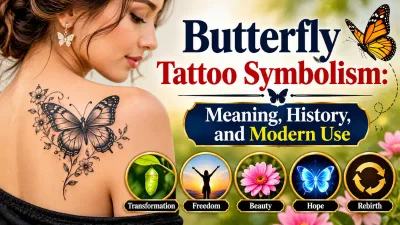
Butterfly Tattoo: Transformation, Hope, and New Beginnings
The butterfly represents transformation because of its life cycle, which involves a complete change from caterpillar to adult insect.
People frequently choose butterfly tattoos to commemorate personal growth, recovery, freedom, or a new chapter in life.
A butterfly can also represent remembrance, especially when someone associates its image with a deceased loved one. Its delicate appearance may communicate beauty and vulnerability alongside change.
Snake Tattoo: Renewal, Wisdom, and Protection
The snake has some of the most varied interpretations in animal symbolism.
Its ability to shed its skin makes it a natural image of renewal, transformation, and leaving the past behind. In some traditions, snakes also represent healing, knowledge, fertility, and protection.
However, Christian interpretations may associate the serpent with temptation and deception. This contrast makes the snake particularly interesting as a tattoo: its meaning depends heavily on the wearer’s beliefs and the design’s surrounding imagery.
Elephant Tattoo: Wisdom, Memory, and Family
Elephants are frequently associated with intelligence, patience, loyalty, and family relationships.
Their social bonds and long-term associations have made them popular symbols of family commitment and remembrance. An elephant tattoo may honor parents, children, grandparents, or an important family experience.
In Hindu traditions, the elephant-headed deity Ganesha is associated with wisdom, learning, and the removal of obstacles. This religious association gives elephant imagery additional significance for some people.
Owl Tattoo: Knowledge, Observation, and Mystery
Owls are often associated with wisdom, learning, intuition, and careful observation.
Their nocturnal behavior and distinctive appearance have also contributed to associations with mystery and the unseen.
In a tattoo, an owl holding a book might represent education, while an owl in flight may suggest awareness, independence, or the ability to see situations from a different perspective.
Horse Tattoo: Freedom, Strength, and Adventure
Horses have long represented movement, independence, endurance, and companionship.
In American culture, they also have strong connections with ranching, Western history, exploration, and the image of the open frontier.
A running horse can symbolize freedom and ambition, while a calm horse may communicate trust, patience, and a close relationship with nature.
Other Animals and Their Common Tattoo Meanings
| Animal | Common tattoo meaning | Additional associations |
|---|---|---|
| Bear | Strength and protection | Courage, parenthood, resilience |
| Tiger | Confidence and determination | Power, independence, passion |
| Fox | Intelligence and adaptability | Cleverness, observation, strategy |
| Deer | Gentleness and peace | Sensitivity, renewal, grace |
| Raven | Transformation and intelligence | Memory, mystery, folklore |
| Dolphin | Friendship and happiness | Playfulness, communication, freedom |
| Turtle | Patience and longevity | Stability, protection, endurance |
| Dragon | Strength and wisdom | Good fortune, protection, mythology |
These interpretations are useful starting points, but no animal has exactly the same meaning in every community.
Cultural and Religious Meanings of Animal Tattoos
Animal tattoos can reflect religious traditions and cultural identities, but their meanings should be understood within their original contexts.
Native American and Indigenous Traditions
Animals have important roles in many Indigenous American stories, artistic traditions, and relationships with the natural environment.
However, there is no single Native American system of animal symbolism. Different nations have their own languages, histories, spiritual practices, and relationships with particular animals.
For example, an eagle may hold special significance in certain Indigenous ceremonies, while a bear or wolf may appear in particular community stories and artistic traditions.
It is important not to treat Indigenous designs as interchangeable decorative patterns. Some traditional markings communicate specific family, community, ceremonial, or cultural identities.
Chinese Animal Symbolism
Chinese cultural traditions include several recognizable animal symbols.
The dragon is associated with auspicious power, authority, prosperity, and good fortune. The tiger can represent courage, protection, and strength, while the crane is frequently associated with longevity.
Chinese zodiac animals also provide another layer of personal symbolism. People may choose tattoos representing their birth-year animal as an expression of identity, family heritage, or cultural connection.
Hindu and Buddhist Traditions
Animal imagery appears in several Hindu and Buddhist traditions, although its interpretation varies.
In Hinduism, Ganesha’s elephant head represents wisdom and the overcoming of obstacles. The cow is also widely respected in Hindu traditions, while the snake appears in religious stories and imagery associated with particular deities.
In Buddhist art, the elephant can represent mental strength and steadiness. The deer is associated with the Buddha’s first teaching at Deer Park, giving it a particular connection with the beginnings of Buddhist instruction.
European Folklore and Christianity
European folklore often uses animals to communicate moral lessons and human characteristics.
The fox can represent cleverness, the wolf may represent danger or loyalty depending on the story, and the raven can appear as a messenger or an omen.
In Christian symbolism, the lamb is associated with innocence and Jesus Christ, while the dove commonly represents peace and the Holy Spirit. A Christian animal tattoo may therefore communicate religious devotion rather than simply admiration for wildlife.
What Animal Tattoo Designs Say About Personality and Identity
An animal tattoo can communicate something about the wearer’s personality, but it should not be treated as a psychological test. Choosing a particular creature does not prove that someone possesses its associated characteristics.
Instead, the design often represents qualities the person admires, experiences they have lived through, or values they want to keep visible.
Consider these examples:
- A person who chooses a wolf may value independence but also feel strongly connected to family.
- Someone who selects a butterfly may want to remember a period of personal growth.
- A lion tattoo may represent confidence developed after overcoming a difficult challenge.
- An elephant design may honor a grandparent or celebrate family connections.
- A bird tattoo may represent a desire for independence after a major life transition.
There is also a difference between identifying with an animal and wanting to become more like it. Someone might choose a bear because they admire its protective behavior, even if they do not consider themselves naturally strong or confident.
This makes animal tattoos a form of visual storytelling. The design communicates an idea, while the wearer’s personal history gives that idea its individual meaning.
Emotional and Psychological Meaning of Animal Tattoos
Animals can create strong emotional connections because people associate them with familiar experiences, relationships, memories, and personality traits.
A tattoo of a beloved dog, for example, may have little to do with traditional symbolism. It might simply preserve the memory of a companion who provided comfort during an important period of life.
Similarly, a bird may remind someone of a parent who loved nature, while a butterfly may commemorate recovery after a difficult experience.
Several emotional themes frequently appear in animal tattoos.
Remembrance and grief: Animals can represent deceased family members, pets, or friends. Their images become lasting reminders of relationships that remain important.
Personal recovery: A snake shedding its skin or a butterfly emerging from a cocoon can represent moving beyond hardship.
Confidence and self-respect: Predatory animals such as lions and tigers can express a commitment to personal strength and standing up for oneself.
Belonging and affection: Wolves, elephants, and pairs of birds can communicate attachment, loyalty, and family connections.
Peace and emotional balance: Deer, doves, turtles, and other gentle creatures may represent patience, compassion, and a preference for peaceful living.
An interesting feature of tattoo symbolism is that the image does not always communicate the emotion directly. A person might select a fierce animal to remember a period when they felt vulnerable, making the tattoo a reminder of courage rather than aggression.
How Tattoo Style Changes an Animal’s Meaning
The artistic style of an animal tattoo can influence how viewers interpret it.
Two people may choose the same animal but create completely different impressions through their design choices.
Image result for tatuaje lobo hombro | Hyper realistic tattoo, Jun cha tattoo, Cool tattoos
Leg Koi Fish Tattoo Meaning & Stunning Designs 2026
5
Realistic Animal Tattoos
Realistic designs reproduce an animal’s physical features, including its eyes, fur, feathers, and facial expression.
These tattoos often emphasize admiration, emotional attachment, and respect for the natural world. A realistic portrait of a family dog, for example, can serve as a personal memorial.
American Traditional Animal Tattoos
American traditional tattoos use bold outlines, recognizable shapes, and a relatively limited color palette.
Eagles, panthers, snakes, swallows, and roosters are familiar motifs within this style. Their meanings are often connected with older sailor tattoo conventions, but modern wearers frequently adapt them to personal experiences.
Minimalist Animal Tattoos
Minimalist designs use simple outlines or small silhouettes.
A tiny bird, butterfly, cat, or elephant can communicate a personal connection without requiring an elaborate composition. These designs are particularly suitable for people who prefer subtle body art.
Japanese-Inspired Animal Tattoos
Japanese tattoo traditions include animals such as koi fish, dragons, tigers, and phoenixes.
These creatures often appear within larger compositions that incorporate water, flowers, wind, and other visual elements. The complete arrangement matters because the surrounding imagery can influence the animal’s interpretation.
Geometric and Abstract Animal Tattoos
Geometric designs combine animal silhouettes with shapes, lines, and symmetrical patterns.
They may emphasize order, balance, intelligence, or an artistic connection with nature. Their meaning is usually more individual than that of traditional tattoo motifs.
How Color Influences Animal Tattoo Symbolism
Color can change the emotional impression of an animal tattoo, even when the animal itself remains the same.
However, color meanings are cultural associations rather than universal psychological rules.
| Color | Common symbolic association | Possible tattoo interpretation |
|---|---|---|
| Black | Strength, mystery, remembrance | Seriousness, protection, individuality |
| Red | Passion, courage, vitality | Determination, love, confidence |
| Blue | Calmness, trust, freedom | Peace, loyalty, emotional balance |
| Green | Nature, renewal, growth | Healing, environmental connection |
| White | Innocence, peace, purity | Hope, spiritual beliefs, remembrance |
| Gold | Achievement, prosperity, prestige | Success, ambition, celebration |
For example, a black wolf may create an impression of independence and seriousness, while a blue bird may suggest calmness and freedom.
The animal, color, background, and overall composition should work together. A tattoo does not need to follow conventional color associations if a different combination better reflects the wearer’s intention.
Animal Tattoos in American Traditional and Maritime History
Animal imagery has a particularly interesting place in American tattoo history because sailors used certain creatures as recognizable markers of experience and personal identity.
During the nineteenth and twentieth centuries, American maritime communities developed recognizable tattoo conventions. Designs could represent a sailor’s travels, achievements, hopes, relationships, and superstitions.
Some well-known examples include:
- Swallows: Traditionally associated with miles traveled, devotion, and returning home.
- Pigs and roosters: Sailors sometimes wore these animals on their feet as protective good-luck symbols against drowning.
- Dragons: Associated with luck and strength, including connections with American naval service in Asia.
- Turtles: Used to mark crossing the equator in traditional naval tattoo culture.
These meanings were connected to specific maritime customs rather than universal animal symbolism. A swallow tattoo on a modern American who has never sailed may instead represent family, travel, or a personal commitment.
This history also explains why animal imagery remains recognizable in American traditional tattoo art. Naval History and Heritage Command+2
Cultural Respect and the Problem of Misusing Traditional Designs
Not every animal tattoo is simply an individual design choice. Some images belong to cultural traditions in which tattoos communicate specific relationships, responsibilities, ancestry, or ceremonial status.
This distinction matters particularly when considering Indigenous American, Polynesian, and Māori tattoo traditions.
For example, traditional Inuit tattooing has historically included ceremonial practices connected with women’s life experiences and cultural belonging. These practices were suppressed during periods of colonial and missionary influence, and some Indigenous communities are now working to restore them.
Similarly, Māori tā moko and Samoan tatau have cultural meanings that extend beyond their visual patterns. They should not be treated as generic tribal decoration.
Someone interested in these traditions should learn about their origins, speak with knowledgeable cultural practitioners, and understand which designs are appropriate for outsiders. A culturally informed artist can help distinguish a respectful personal design from the reproduction of a marking that carries specific community significance.
It is also important to recognize that Indigenous cultures are not interchangeable. A pattern associated with one nation or community should not automatically be described as belonging to all Native American people. The Anchorage Museum+2
Common Misunderstandings About Animal Tattoo Meanings
Animal tattoos are often interpreted through popular stereotypes, but these interpretations do not always reflect the wearer’s intentions.
Here are several misunderstandings worth avoiding.
A wolf tattoo always means loneliness. Wolves are social animals, and their imagery frequently represents family, loyalty, and cooperation. A solitary wolf can communicate independence, but it does not necessarily indicate isolation.
A snake tattoo always represents evil. Snakes have negative associations in some religious traditions, but they also represent healing, renewal, knowledge, and fertility in other contexts.
An eagle tattoo always indicates political beliefs. Eagles are associated with American national identity, but an individual may choose one for freedom, nature appreciation, military memories, or artistic reasons.
A lion tattoo always represents dominance. Many people choose lions to represent courage, responsibility, or the ability to protect others.
A butterfly tattoo is only decorative. Butterflies can represent grief, recovery, family memories, and major personal transitions.
A particular animal has one universal spiritual meaning. Animal meanings differ between religions, nations, communities, and individual experiences.
The most reliable way to understand an animal tattoo is to consider its cultural background and, when appropriate, ask the wearer what it means to them.
How Animal Tattoo Symbolism Has Changed Over Time
Animal tattoo meanings have developed as tattooing has moved between different communities and generations.
In earlier societies, animal images could communicate religious identity, social belonging, protection, or relationships with the natural environment.
In American maritime communities, animal tattoos developed practical and personal associations. Sailors used recognizable designs to represent their journeys, service, relationships, and hopes for safe passage.
During the twentieth century, tattooing gradually moved beyond its earlier associations with sailors, military personnel, and particular working communities. Animal motifs became part of a wider American visual culture.
Today, people may choose an animal tattoo for almost any personal reason:
- A connection with a favorite animal.
- A reminder of an important relationship.
- A celebration of personal independence.
- An expression of cultural heritage.
- A symbol of emotional recovery.
- An appreciation of mythology or nature.
- An artistic design that simply appeals to them.
This evolution does not mean that historical meanings have disappeared. Instead, older associations often exist alongside newer personal interpretations.
Tattoo culture has also become more socially accepted. A 2023 national survey found that 80% of U.S. adults believed society had become more accepting of tattooed people over the preceding two decades. Pew Research Center+2
Choosing an Animal Tattoo That Has Personal Meaning
Choosing an animal tattoo involves more than selecting a creature with an attractive appearance. The best design is one that remains meaningful after the immediate excitement of getting inked has passed.
Before choosing an animal, consider the following questions:
- What quality do I want to represent? Decide whether the tattoo should communicate courage, loyalty, independence, patience, or another personal value.
- Does this animal have a personal connection? A childhood pet, family memory, or meaningful encounter with wildlife can provide a more individual reason for choosing a design.
- What is its cultural background? If the design comes from a religious or Indigenous tradition, understand its significance before using it.
- Which artistic style fits the message? Realistic, traditional, minimalist, and geometric styles create different visual impressions.
- Will the meaning remain relevant? Think about whether the animal represents a lasting value or a temporary interest.
- Does the composition communicate the intended idea? The animal’s posture, expression, surroundings, and color can change how the design is understood.
It is also worth discussing the design with an experienced tattoo artist. A skilled artist can help translate an abstract idea into a composition that works with the shape and movement of the chosen body area.
FAQs
1. What is the most common meaning of animal tattoos?
Animal tattoos commonly represent personality, strength, freedom, loyalty, transformation, and emotional connections. Their meaning depends on the animal, the design, and the personal experiences of the wearer.
2. Which animal tattoo symbolizes strength and courage?
Lions, bears, tigers, and eagles are commonly associated with strength and courage. A lion often represents leadership, while a bear can communicate protection and resilience.
3. What animal tattoo symbolizes family and loyalty?
Wolves and elephants are popular choices for representing family and loyalty. A wolf pack can symbolize unity and belonging, while elephants often represent family bonds, memory, and devotion.
4. What animal tattoo represents a new beginning?
Butterflies and snakes are common symbols of transformation and new beginnings. Butterflies represent the transition from one stage of life to another, while snakes can symbolize renewal through shedding their skin.
5. Are animal tattoos spiritual symbols?
Animal tattoos can have spiritual meanings when connected with religious traditions, mythology, or personal beliefs. For example, elephants have important associations in Hinduism, while eagles hold particular significance in several Indigenous traditions.
6. What animal tattoo symbolizes freedom and independence?
Eagles, horses, and solitary wolves are frequently chosen to represent freedom and independence. Eagles suggest vision and personal liberty, horses communicate movement and adventure, and solitary wolves can represent self-reliance.
7. Do animal tattoos have different meanings in different cultures?
Yes. The same animal can communicate different ideas depending on its cultural and religious background. A snake, for example, may represent temptation in some Christian interpretations but renewal and healing in other traditions
Conclusion
Animal tattoos represent a wide range of human qualities, including courage, freedom, loyalty, wisdom, family connections, and personal transformation. Their meanings come from a combination of natural characteristics, historical traditions, mythology, religious beliefs, and individual experiences.
Understanding animal tattoo symbolism helps explain why the same creature can communicate different messages to different people. A lion might represent confidence, a butterfly might commemorate recovery, and an elephant might preserve the memory of a loved one.
Ultimately, an animal tattoo does not need to follow a traditional definition to be meaningful. Its greatest significance often comes from the personal story, values, and memories that the wearer chooses to associate with it.