
Introduction
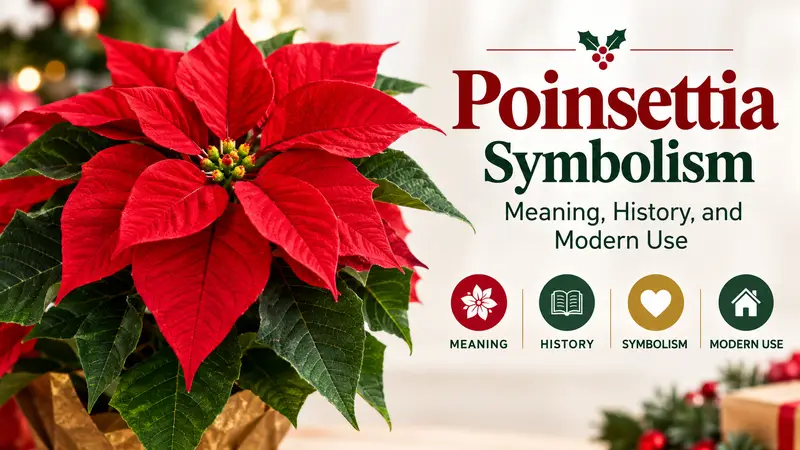
Poinsettia symbolism is closely connected to Christmas, love, generosity, and the celebration of new beginnings. With its bright red bracts and deep green leaves, the poinsettia has become one of the most recognizable plants of the American holiday season, appearing in homes, churches, offices, and public spaces every December.
However, the plant’s story began long before it became a Christmas decoration in the United States. Indigenous peoples in Mexico cultivated it for practical and ceremonial purposes, and its cultural meaning changed as the plant became associated with Christian celebrations and eventually entered American holiday traditions.
Understanding what a poinsettia represents means looking beyond its familiar red-and-green appearance. Its symbolism reflects Mexican cultural heritage, Christian storytelling, the emotional traditions of gift-giving, and the way seasonal decorations help people create a sense of belonging.
Quick Answer
Poinsettia symbolism most commonly represents Christmas, love, generosity, and holiday joy in modern American culture. Historically, the plant was cultivated by the Aztecs in Mexico and later became associated with Christian nativity celebrations, where its seasonal color came to represent faith, hope, and the spirit of giving.
TL;DR
- Christmas: Red and green poinsettias are widely recognized as American holiday decorations.
- Love and generosity: A gifted plant can express affection, gratitude, and goodwill.
- Mexican heritage: Indigenous traditions predate the poinsettia’s Christian associations.
- Christian faith: Holiday legends connect the plant with nativity scenes and humble offerings.
- Renewal: Its recurring seasonal display suggests celebration and fresh beginnings.
- Modern meaning: Different colors and arrangements suit personal gifts, festive interiors, and public celebrations.
1. What Does a Poinsettia Look Like?
A poinsettia (Euphorbia pulcherrima) is a flowering shrub native to Mexico and parts of Central America. In its natural environment, it can grow several feet tall, while the compact potted varieties commonly sold in the United States are cultivated for indoor decoration.
The familiar red portions are not petals. They are modified leaves called bracts, which surround the plant’s small, yellowish flowers. This distinction is botanically important, although it does little to diminish the plant’s decorative appeal.
Most Americans encounter poinsettias during the winter holiday season, especially in supermarkets, garden centers, churches, and living rooms. Their red bracts contrast with green foliage, creating a color combination strongly associated with Christmas.
The plant is also available in pink, white, cream, burgundy, and multicolored varieties. These differences allow people to choose a poinsettia that matches a particular mood or decorative style rather than relying exclusively on traditional Christmas colors.
2. The Main Symbolic Meanings of Poinsettias
Poinsettias do not have one universal meaning. Their symbolism depends on the culture, occasion, color, and intentions of the person displaying or giving the plant.
In contemporary American culture, several associations are especially common.
Christmas and celebration: The poinsettia is an unmistakable seasonal decoration. Its appearance often signals that holiday gatherings, religious observances, and family celebrations are approaching.
Love and affection: A poinsettia can communicate warmth and appreciation when given to a relative, friend, host, or colleague. This meaning generally comes from the act of giving rather than from a universal historical flower code.
Generosity and goodwill: The plant is frequently exchanged as a holiday gift. It can express thanks, welcome guests, and acknowledge relationships that matter throughout the year.
Faith and hope: In Christian settings, poinsettias are associated with nativity displays and the celebration of Jesus’s birth. Their presence can reinforce themes of hope, devotion, and the joy of the Christmas story.
Renewal and fresh beginnings: Because poinsettias return to prominence during the winter holiday season, people may associate them with annual traditions, reflection, and the start of another year.
These interpretations overlap, but context determines which one matters most. A poinsettia on a church altar may emphasize religious celebration, while one delivered to a neighbor may simply express friendship.
3. Ancient Aztec Origins and Indigenous Meaning
Long before poinsettias became Christmas plants, Indigenous peoples in Mexico cultivated them for their vivid color and practical uses.
The Aztecs called the plant cuetlaxochitl, a name associated with its Indigenous history. They used its colorful bracts to produce reddish-purple dye and its milky latex in traditional medicinal preparations. The plant was also valued for its ornamental and ceremonial uses.
Historical accounts associate the poinsettia with purity in Aztec culture. Some modern descriptions also connect it with themes of life, death, and the vulnerability of what is considered pure. These interpretations should be approached carefully: Indigenous traditions were complex, and a single symbolic explanation cannot represent every community or historical period.
The plant’s original cultural significance also reminds us that its history does not begin with Christmas. Its association with Christianity developed later, following European colonization and the introduction of Christian religious practices in Mexico.
Recognizing this earlier history gives the poinsettia a broader identity. It is not simply a holiday decoration; it is also a plant with a longstanding connection to Mexican Indigenous knowledge, cultivation, and cultural life.
4. How the Poinsettia Became a Christmas Symbol
The poinsettia’s association with Christmas developed in Mexico during the colonial period. By the seventeenth century, Franciscan communities near Taxco were using the plant in Christmas-related nativity celebrations and processions.
Its seasonal appearance helped make it suitable for these occasions. In its native environment, the poinsettia develops its colorful bracts in response to shorter days and longer nights, often bringing its most striking display around December.
The plant also suited the visual language of Christmas celebrations. Its red and green colors complemented nativity scenes and seasonal decorations, helping it become a familiar part of local holiday traditions.
An especially well-known Mexican legend tells of a poor child who had no valuable gift to bring to the baby Jesus. The child gathered ordinary plants along the roadside and offered them at the nativity scene. According to the story, the humble offering miraculously transformed into beautiful red poinsettias.
The tale is a religious folk legend, not a documented botanical event. Its importance lies in the lesson it communicates: a gift offered sincerely can be more meaningful than an expensive possession.
Over time, the poinsettia became known in Mexico as flor de Nochebuena, or Christmas Eve flower. Its connection with the holiday eventually spread beyond Mexico, helping establish the plant as a Christmas symbol in other countries.
5. What the Red Poinsettia Represents
Red is the traditional poinsettia color and the one most closely associated with Christmas in the United States. Its meaning comes from a combination of religious traditions, seasonal design, and the emotional associations people attach to color.
In Christian interpretations, the red bracts are sometimes connected with the blood of Christ, while the plant’s star-like arrangement is sometimes compared with the Star of Bethlehem. These are symbolic interpretations rather than established botanical meanings, and not every Christian community emphasizes them.
Red also carries familiar associations with love, affection, warmth, and celebration. When someone gives a red poinsettia to a family member or host, the gesture can communicate care without requiring an elaborate explanation.
In American homes, the color works particularly well with evergreen wreaths, Christmas trees, candles, and festive table settings. The plant can make an ordinary room feel prepared for a holiday gathering.
Red poinsettias are therefore meaningful in two related ways: they participate in the visual traditions of Christmas and provide a recognizable way to express seasonal goodwill.
6. White, Pink, and Other Poinsettia Colors
Although red poinsettias dominate traditional holiday displays, other colors offer different decorative possibilities. Their symbolic meanings are often influenced by general color associations rather than by a single established poinsettia tradition.
| Poinsettia color | Common symbolic association | Typical use |
|---|---|---|
| Red | Love, celebration, Christmas | Traditional holiday displays and gifts |
| White | Peace, simplicity, remembrance | Minimalist decor and reflective settings |
| Pink | Affection, gentleness, appreciation | Personal gifts and welcoming arrangements |
| Burgundy | Elegance, richness, formality | Refined interiors and special occasions |
| Cream or variegated | Subtlety, individuality, creativity | Contemporary seasonal arrangements |
White poinsettias can suit quiet interiors or settings where understated elegance is preferred. Some people may also choose them for memorial arrangements, although the plant does not have a universal meaning associated with mourning.
Pink varieties often feel softer and more informal than bright red ones. They can make thoughtful gifts for friends, relatives, or hosts who prefer pastel colors.
Burgundy and marbled varieties offer a more contemporary look, particularly when paired with neutral pots and simple greenery.
These meanings are flexible, not fixed rules. A white poinsettia does not automatically signify peace, nor does a pink one necessarily declare romantic love. The occasion and the giver’s intention remain important.
7. Poinsettia Symbolism in American Christmas Traditions
In the United States, the poinsettia is closely connected with the way people prepare their homes and communities for Christmas. Its meaning is reinforced by repetition: people see it in the same places, during the same season, year after year.
Families place poinsettias on mantels, dining tables, windowsills, and entryway consoles. Churches arrange them around altars, pulpits, and nativity scenes. Businesses use them to decorate reception areas, shop windows, and public spaces.
The plant’s seasonal role is also supported by its commercial availability. American growers developed compact, branching varieties that work well in containers and can maintain their colorful bracts during the holiday period. This made poinsettias practical for household decoration and gift-giving.
Yard and Garden
Several cultural meanings emerge from these everyday practices:
- Tradition: Bringing home a poinsettia can mark the beginning of a familiar seasonal routine.
- Hospitality: A plant near the entrance or on a dining table makes a space feel prepared for visitors.
- Community: Shared decorations create visual continuity across homes, schools, workplaces, and religious buildings.
- Celebration: The plant helps distinguish an ordinary winter setting from a holiday gathering.
For many Americans, these associations are personal rather than explicitly religious. Someone may display poinsettias because they recall childhood Christmases, while someone else may choose them primarily because they complement a festive interior.
Both interpretations are part of the plant’s modern cultural significance.
8. Religious Symbolism and Christian Interpretations
The poinsettia is especially recognizable in Christian Christmas settings, where plants and flowers are used to complement the nativity story.
Its association with the birth of Jesus developed through Mexican Christmas traditions. Franciscan communities incorporated the plant into seasonal religious observances, and its appearance around December helped establish it as a familiar feature of nativity celebrations.
NC State Extension
+1
Several interpretations are commonly associated with the plant in Christian contexts.
The Star of Bethlehem: The arrangement of bracts around the center can resemble a star. Some Christians interpret this shape as a reminder of the star associated with the birth of Jesus.
Sacrifice and redemption: The red bracts are sometimes understood as a reference to Christ’s blood and sacrifice. This interpretation is particularly relevant in settings where the Christmas story is connected with the broader Christian narrative of redemption.
Humility and generosity: The Mexican folk legend about the child offering roadside plants emphasizes that sincere giving matters more than the price or appearance of a gift.
Hope and celebration: Because poinsettias appear in many church decorations during Advent and Christmas, they can serve as visual reminders of expectation, joy, and the celebration of Christ’s birth.
These meanings are not mandatory interpretations for all Christians. Different churches and individuals may emphasize the nativity, generosity, or simply the beauty of seasonal flowers.
The distinction matters because a plant can have religious significance without every decorative use becoming a religious statement.
9. Mexican Heritage and Cultural Identity
The poinsettia’s Mexican origins are an important part of its story, particularly because its most familiar English name honors an American diplomat rather than its Indigenous history.
Joel Roberts Poinsett, the first U.S. minister to Mexico, helped introduce the plant to American horticultural circles in the 1820s. The plant became known in English as the poinsettia in recognition of his role in bringing it to wider attention in the Unite
In Mexico, flor de Nochebuena remains a familiar name that directly connects the plant with Christmas Eve. The Indigenous name cuetlaxochitl points toward an older cultural history that predates the holiday association.
These names highlight different parts of the same story:
- Poinsettia reflects the plant’s introduction and popularization in the United States.
- Flor de Nochebuena emphasizes its place in Mexican Christmas traditions.
- Cuetlaxochitl recognizes its Indigenous heritage and earlier uses.
For Mexican American families, the plant may carry additional personal significance through family traditions, cultural memory, and connections to Mexico. For others, it may be a simple seasonal decoration.
Respectful interpretation recognizes that these meanings can coexist. The poinsettia can be a familiar American Christmas plant without losing its origins in Mexican landscapes and cultural practices.
10. Emotional and Psychological Meaning
Plants can acquire emotional significance because people repeatedly encounter them during meaningful events. Poinsettias are a good example of how seasonal objects become connected with memory.
A person who sees poinsettias every December may associate them with childhood, family dinners, church services, or relatives who prepared the home for the holidays. The plant can bring those memories to mind even when the original people or places are no longer present.
Its emotional associations often fall into several categories.
Comfort and familiarity: Seeing a recognizable holiday plant can make a home feel consistent with past celebrations.
Connection and belonging: Shared decorations can help guests feel that they are entering a space prepared for a common occasion.
Gratitude: Receiving a poinsettia can make someone feel appreciated, particularly when the gift acknowledges hospitality or an ongoing relationship.
Reflection: For people who associate Christmas with religious observance or family remembrance, the plant may encourage reflection on what the season means to them.
Color contributes to these impressions, but individual experience matters more than any universal psychological rule. A person who does not celebrate Christmas may see a poinsettia as an attractive winter plant rather than an emotional symbol.
The plant’s meaning is therefore shaped not only by its appearance but also by the memories and relationships surrounding it.
11. Poinsettias as Gifts: Love, Gratitude, and Goodwill
Giving a poinsettia is a practical way to express a seasonal sentiment without choosing a highly personal or expensive present. Its familiar association with Christmas makes it suitable for many relationships, from close family members to neighbors and professional acquaintances.
The meaning of the gift depends on the circumstances.
- For family: A poinsettia can represent affection, shared traditions, and the pleasure of gathering together.
- For a host: It offers a gesture of thanks for an invitation or holiday meal.
- For friends: It can communicate warmth and appreciation without implying romance.
- For colleagues: It provides a friendly seasonal gesture in a workplace where personal gifts may be inappropriate.
- For someone who is grieving: It may offer a thoughtful expression of care, provided the recipient welcomes holiday gestures.
Poinsettias are especially useful when the giver wants to acknowledge a relationship without making a grand statement. They are recognizable, readily available during the season, and easy to incorporate into a home or office.
A simple card can make the intended meaning clearer. A note expressing gratitude or wishing someone peace and happiness adds a personal message that the plant itself cannot communicate precisely.
12. Poinsettia Symbolism in Modern Decor, Fashion, and Social Media
Modern poinsettia symbolism extends beyond traditional flowerpots and church displays. The plant’s distinctive shape and color make it recognizable in holiday artwork, printed fabrics, greeting cards, gift wrapping, and digital illustrations.
In home decor, red poinsettias create a traditional Christmas atmosphere, while white or pink varieties fit contemporary interiors. A single plant can serve as a focal point, and several smaller plants can bring visual consistency to a dining table or reception area.
In fashion, poinsettia motifs appear on seasonal sweaters, scarves, brooches, earrings, and other accessories. These designs generally communicate holiday participation rather than a specialized symbolic message.
On social media, photographs of poinsettias often accompany Christmas greetings, home-decorating posts, seasonal business announcements, and images of festive gatherings. The flower works well as a visual shorthand because viewers can recognize its connection with the holiday immediately.
The plant can also appear in personal artwork or tattoos. Someone who chooses a poinsettia tattoo may want to preserve a memory of a loved one, celebrate Mexican heritage, or mark an important Christmas tradition. Another person may simply appreciate its appearance.
There is no established universal meaning for a poinsettia tattoo. Its significance depends on the wearer’s personal story, the design, and the cultural context.
13. Poinsettia Day and the Plant’s Place in American Culture
December 12 is observed as National Poinsettia Day in the United States. The date commemorates the death of Joel Roberts Poinsett in 1851 and provides an opportunity to recognize the plant’s horticultural and cultural history.
Illinois
+1
The observance also highlights how thoroughly the poinsettia has become part of American seasonal life. Nurseries, florists, garden centers, and retailers feature the plant during the weeks leading up to Christmas, when it is widely used for decoration and gift-giving.
Its popularity reflects more than a preference for red flowers. The poinsettia is available at a time when people are already preparing for a major cultural and religious holiday. It fits established decorating practices, makes an accessible gift, and can remain attractive for much of the season when cared for appropriately.
This commercial role does not make its symbolism less meaningful. Many traditions rely on familiar objects that are widely available and easy to share. The poinsettia’s place in American culture reflects the interaction of horticulture, retail practices, family habits, and religious traditions.
National Poinsettia Day also offers an opportunity to remember the plant’s origins and the Mexican communities that cultivated it long before it became an American holiday staple.
14. Common Misunderstandings About Poinsettia Symbolism
Although poinsettias are widely recognized, some claims about their meaning are repeated without sufficient historical context.
Misunderstanding 1: Poinsettias have always been Christmas flowers.
The plant was cultivated by Indigenous peoples in Mexico before its association with Christian Christmas celebrations developed. Its earlier history included dye production, traditional medicinal use, and ceremonial or ornamental purposes.
Ornamental Production Ornamental Production
+1
Misunderstanding 2: The Mexican Christmas legend is a documented historical event.
The story of the child whose humble offering becomes poinsettias is a folk legend. It conveys a lesson about generosity and sincerity, but it should not be presented as verified history.
Misunderstanding 3: Every poinsettia color has an official symbolic meaning.
There is no universally accepted color code for poinsettias. Associations such as peace for white or affection for pink are interpretations influenced by broader color symbolism and personal preference.
Misunderstanding 4: A poinsettia is exclusively a Christian symbol.
Although the plant is strongly associated with Christmas in many countries, its Indigenous Mexican history predates Christian use. It can also be appreciated as a botanical specimen or decorative plant without religious significance.
Misunderstanding 5: The plant’s name tells its entire story.
The English name honors Joel Roberts Poinsett, but it does not capture the plant’s earlier Indigenous names, uses, or cultural importance. Using the name flor de Nochebuena or learning about cuetlaxochitl provides a broader perspective.
Distinguishing documented history, religious interpretation, and folklore helps preserve the plant’s cultural meaning without overstating what any one tradition establishes.
FAQs
1. What does a poinsettia symbolize spiritually?
In Christian settings, a poinsettia can represent hope, faith, generosity, and the celebration of Jesus’s birth. Some interpretations also connect its red bracts with Christ’s sacrifice and its star-like arrangement with the Star of Bethlehem.
2. What does giving someone a poinsettia mean?
Giving someone a poinsettia usually expresses seasonal goodwill, gratitude, or affection. The gesture is generally appropriate for family members, friends, neighbors, and hosts, although its precise meaning depends on the relationship.
3. What does a red poinsettia symbolize?
A red poinsettia most commonly represents Christmas, celebration, and warmth in the United States. In some Christian interpretations, its red bracts also recall Christ’s blood, although this is a religious association rather than a universal meaning.
4. What does a white poinsettia mean?
White poinsettias are often associated with peace, simplicity, and elegance because of their color. These associations are flexible, however, and the plant does not have one universally recognized meaning for every occasion.
5. What is the Mexican legend behind the poinsettia?
A popular Mexican Christmas legend tells of a child who could offer only ordinary roadside plants to the baby Jesus. When the child presented the humble gift at the nativity scene, the plants miraculously became bright red poinsettias, illustrating that a sincere gift can be more valuable than an expensive one.
6. Did the Aztecs use poinsettias before Christmas traditions developed?
Yes. The Aztecs cultivated the plant before its association with Christian Christmas celebrations, using its colorful bracts to make dye and its latex in traditional medicinal preparations. Its Indigenous history is an important part of its cultural significance.
7. What does a poinsettia tattoo symbolize?
A poinsettia tattoo may represent Christmas memories, family bonds, affection, Mexican heritage, or a meaningful personal experience. Its meaning is individual rather than fixed, so the wearer’s intentions and the design provide the best clues to its significance.
Conclusion
Poinsettia symbolism brings together several traditions, from Indigenous Mexican cultivation and cultural practices to Christian Christmas celebrations and modern American holiday customs. Today, the plant most commonly represents Christmas, generosity, affection, and the pleasure of sharing a familiar seasonal tradition.
Its meaning can change with its setting. A poinsettia in a church may evoke faith and hope, while one given to a friend may express gratitude or affection. Its colors, appearance, and seasonal timing give people a recognizable way to mark occasions that matter to them.
Ultimately, poinsettia symbolism is best understood through both its history and its everyday use. The plant’s story reminds us that a familiar holiday decoration can carry several layers of meaning while remaining a simple, thoughtful way to celebrate the season.


