Introduction
Plumeria symbolism centers on love, beauty, renewal, and the ability to embrace change. Known for its soft, five-petaled flowers and sweet fragrance, plumeria is a familiar sight in tropical gardens, floral arrangements, and Hawaiian-inspired designs. Its graceful appearance makes it a popular choice for people who want a flower to represent affection, peace, or a meaningful new beginning.
In the United States, plumeria is closely associated with Hawaii, island landscapes, and the relaxed atmosphere of tropical life. It appears in leis, resort fashion, jewelry, tattoos, and home decor. However, its meaning extends beyond vacation imagery. Depending on the cultural setting and personal experience, the flower can represent hospitality, family connections, personal growth, or remembrance.
Understanding the flower’s symbolism requires looking at its botanical origins, its place in different cultural traditions, and the ways Americans interpret it today. Although plumeria has recognizable associations, its meaning is not universal, and its significance can change according to how and where it is used.
Quick Answer
Plumeria symbolism most commonly represents love, beauty, renewal, and new beginnings in modern American culture, particularly in tropical-inspired art, jewelry, tattoos, and floral designs. In broader cultural traditions, especially in parts of South and Southeast Asia and the Pacific, plumeria may also be associated with spirituality, hospitality, devotion, and remembrance.
TL;DR
- Love and affection: Plumeria flowers often express warmth, romance, and appreciation.
- Renewal: Their seasonal growth and flowering suggest fresh starts and personal development.
- Hawaiian associations: Plumeria is widely connected with leis, hospitality, and island identity.
- Spiritual significance: Some Asian religious traditions associate the flower with sacred spaces and offerings.
- Personal expression: Tattoos and jewelry use plumeria to represent memories, relationships, and change.
- Cultural context matters: A flower’s meaning depends on its setting, tradition, and intended message.
1. What Does the Plumeria Flower Look Like?
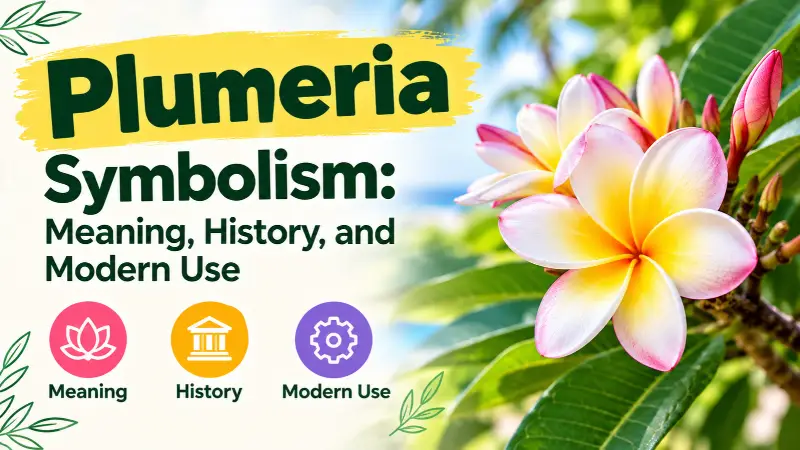
Plumeria is a flowering plant in the genus Plumeria, also commonly known as frangipani. Its flowers typically have five overlapping petals arranged around a small central area. Depending on the variety, the petals may be white, yellow, pink, red, or a combination of colors.
The flowers are especially recognizable for their smooth, rounded petals and often-sweet fragrance. Plumeria plants grow as shrubs or small trees, with thick branches and broad leaves. They thrive in warm climates and are commonly cultivated in tropical and subtropical regions.
These physical characteristics help explain the flower’s symbolic appeal. Its balanced shape can suggest harmony, while its fragrance creates an association with pleasant memories and welcoming environments. Its delicate appearance also makes it suitable for expressing tenderness without the formality sometimes associated with roses.
Plumeria is not native to Hawaii, despite its strong association with the islands. The genus originated in the tropical regions of the Americas, and different species and cultivated varieties later spread to other warm regions. This distinction matters because the flower’s botanical origin and its cultural identity are not the same thing.
2. The Core Symbolic Meanings of Plumeria
Plumeria does not have one fixed symbolic definition. Its most familiar meanings arise from its appearance, fragrance, cultural use, and role in personal rituals.
Love and affection
Plumeria commonly represents affection, tenderness, and appreciation. Its soft petals and pleasant fragrance make it suitable for gifts that communicate care without necessarily implying romantic love. It can represent friendship, family affection, or a relationship that has become more meaningful over time.
Beauty and grace
The flower’s symmetrical form and varied colors lend themselves to ideas of natural beauty and elegance. In jewelry and decorative art, plumeria often communicates a gentle, approachable kind of beauty rather than grandeur or luxury.
Renewal and new beginnings
Plumeria can symbolize a fresh chapter in life. Its flowering growth makes it an appealing image for someone beginning a new relationship, recovering from a difficult period, moving to a different place, or embracing personal change.
Peace and welcome
In tropical-inspired settings, plumeria frequently suggests relaxation, warmth, and hospitality. Its association with leis and welcoming gestures reinforces the idea of making others feel comfortable and appreciated.
These meanings overlap, but they are not interchangeable. A plumeria gift may express affection, while a tattoo may focus on renewal, and a floral arrangement may primarily create a welcoming atmosphere.
3. Historical Origins and the Spread of Plumeria
The botanical history of plumeria begins in the tropical Americas, where its species evolved before being introduced to other parts of the world. European botanical records and plant collecting helped establish the genus in scientific classification, while trade and horticulture contributed to its spread through tropical and subtropical regions.
The name Plumeria honors Charles Plumier, a French botanist and botanical illustrator associated with the study of American plants during the late seventeenth and early eighteenth centuries. The alternative name frangipani has a separate history, commonly linked to a European family name and a fragrance associated with the flower.
As plumeria reached new regions, people incorporated it into local gardens, religious settings, and decorative practices. Its symbolic meaning therefore developed differently across communities rather than emerging from a single ancient tradition.
It is important not to assume that every meaning attributed to plumeria today existed in its place of origin. Associations with romance, spirituality, hospitality, and island life reflect different cultural histories and modern interpretations. The flower’s global popularity is the result of both botanical movement and the ways communities have made it their own.
4. Plumeria Symbolism in the United States
In the United States, plumeria is strongly associated with Hawaii and the broader imagery of tropical life. Its appearance in travel advertising, resort clothing, leis, and beach-themed decor has helped establish it as a visual shorthand for warmth, relaxation, and welcome.
Hawaii plays an especially important role in this association. Plumeria is widely used in lei-making, and its flowers are familiar in gardens and landscaped public spaces. For visitors, the flower may recall a vacation or a first experience of the islands. For people with personal or family ties to Hawaii, it may carry more intimate associations with home, community, and cultural belonging.
Outside Hawaii, plumeria frequently appears in summer fashion, coastal interiors, spa branding, and tropical-themed celebrations. In these settings, its symbolism may be more aesthetic than historical. A printed plumeria on a shirt might communicate a relaxed style, while a flower worn at a family gathering may carry a personal meaning.
The American interpretation is therefore broad. Some people see plumeria as a sign of affection or renewal; others associate it primarily with travel, sunshine, or memories of a particular place. Neither interpretation automatically defines the flower for everyone.
5. Plumeria and Hawaiian Culture
Plumeria has a visible place in Hawaiian floral traditions, particularly through its use in leis. A lei can be given to welcome someone, celebrate an achievement, mark an important occasion, or express affection. The meaning of the gesture comes from the relationship, occasion, and cultural practice, not simply from the species of flower used.
Plumeria’s attractive petals, fragrance, and availability in suitable climates make it a practical and popular lei flower. Its familiar appearance has also contributed to its association with Hawaiian hospitality in the minds of visitors.
However, plumeria should not be treated as the sole or definitive symbol of Hawaiian identity. Hawaiian culture includes distinct languages, histories, customs, and native plants, including flowers with their own cultural importance. The islands’ floral traditions are much broader than the imagery used in tourism.
A respectful interpretation recognizes both the flower’s genuine place in Hawaiian life and the difference between cultural practice and commercial branding. Wearing a plumeria design may express appreciation for tropical floral art, but it does not by itself communicate a deep understanding of Hawaiian culture.
6. Spiritual and Religious Meanings in Asian Traditions
Plumeria, often called frangipani, has significance in several South and Southeast Asian settings. Its presence in temples, religious offerings, gardens, and ceremonial spaces has helped connect it with devotion, reverence, and the remembrance of spiritual values.
In Hindu contexts, flowers are commonly offered as part of worship. Plumeria may be used in some regional practices, although the flowers selected and the meanings assigned to them vary by community and occasion. It would be inaccurate to claim that every Hindu tradition gives plumeria the same significance.
In Buddhist-majority regions, frangipani may appear around temples and other religious spaces. When flowers are used as offerings, they can help express respect and serve as reminders of impermanence, since even beautiful blossoms eventually wilt. That broader Buddhist interpretation of flowers should not be confused with a universal doctrine specifically about plumeria.
Local practices differ across countries and religious communities. In some places, the flower is primarily ornamental; in others, it has established ceremonial associations. Its spiritual meaning is best understood within the particular tradition where it appears.
7. What Different Plumeria Colors Symbolize
Color can influence how people interpret plumeria, especially in gifts, tattoos, fashion, and decorative arrangements. However, color symbolism is flexible rather than a universal code. Personal preferences and local traditions may matter more than any general association.
| Plumeria color | Common symbolic association | Typical modern use |
|---|---|---|
| White with a yellow center | Purity, peace, sincerity, and simplicity | Wedding-inspired designs, jewelry, and calm interior decor |
| Pink | Affection, tenderness, and gentle romance | Gifts, personal accessories, and tattoos |
| Yellow | Happiness, warmth, optimism, and friendship | Summer decor, celebrations, and cheerful floral arrangements |
| Red or deep pink | Passion, confidence, and strong emotion | Statement jewelry, fashion, and expressive artwork |
| Mixed colors | Diversity, balance, and celebration | Tropical arrangements, colorful illustrations, and vacation-themed designs |
These associations are suggestions, not strict rules. A white plumeria can commemorate a loved one, a pink flower can represent friendship, and a yellow flower can hold sentimental value because it reminds someone of a particular place.
When choosing plumeria for a gift or design, the recipient’s preferences and the occasion are often more meaningful than assigning a fixed definition to the color.
8. Emotional and Psychological Meaning
Plumeria can communicate emotion through a combination of appearance, scent, memory, and association. Flowers often become attached to particular experiences, and a person may develop a strong connection with plumeria after seeing it during a family trip, receiving it as a gift, or growing it at home.
Its fragrance can be especially important. Smell is closely connected with memory and emotion, so a familiar floral scent may bring back a place or experience more immediately than a visual image alone. For someone who associates plumeria with Hawaii, the scent might recall a holiday; for another person, it might evoke a garden or a meaningful relationship.
The flower can also serve as a reminder of resilience and change. Someone who grows plumeria in a container, protects it during colder months, and watches it flower again may associate it with patience and the rewards of continued care.
These responses are personal rather than scientifically fixed symbolic meanings. Plumeria does not automatically produce feelings of peace or happiness. Its emotional effect depends on individual experience, cultural background, and the situation in which the flower appears.
9. Plumeria Tattoos: Love, Growth, and Personal Identity
Plumeria tattoos are popular among people who want a floral design associated with tropical landscapes, personal memories, or a new stage of life. The flower’s recognizable shape works well as a small, simple tattoo or as part of a larger composition featuring leaves, waves, birds, or other botanical elements.
A plumeria tattoo may represent:
- Personal growth: A reminder of change, recovery, or a fresh start.
- Family and affection: A tribute to someone important or to a close relationship.
- Travel and belonging: Memories of Hawaii or another meaningful tropical destination.
- Beauty and individuality: An appreciation for natural forms and personal style.
- Remembrance: A way to keep a loved one’s memory connected with a particular flower or place.
The placement and design can change the emphasis. A small flower on the wrist may function as a private reminder, while a larger floral arrangement may make the tropical aesthetic central to the artwork.
People considering a plumeria tattoo connected to Hawaiian or another Indigenous cultural identity should think carefully about the intended meaning and design. A flower can be appreciated across cultures, but it is worth distinguishing personal admiration from claims of cultural or spiritual authority.
10. Plumeria in Jewelry, Fashion, and Home Decor
Plumeria’s simple outline makes it easy to adapt to different forms of design. Its five petals are recognizable even when reduced to a small pendant, an embroidered motif, or a minimal graphic.
In jewelry, the flower may appear in earrings, necklaces, bracelets, and hair accessories. It can represent affection, a special trip, or a preference for tropical-inspired style. Some people choose a plumeria pendant as a personal keepsake rather than as a statement about a particular culture.
In fashion, plumeria prints are common in clothing and accessories designed around warm-weather settings. The motif can evoke beaches, gardens, and relaxed summer activities. Its association with tropical tourism also means that the same design may function as a style choice without carrying a specific symbolic message.
In home decor, plumeria appears in wall art, textiles, ceramics, and garden arrangements. Its light-colored petals can complement peaceful interior settings, while brighter varieties add a cheerful accent. The flower can suggest hospitality in an entryway or a connection to a memorable destination in a living space.
In each context, the meaning depends on use. A decorative flower does not necessarily indicate a spiritual belief or a personal life story.
11. Plumeria in Weddings, Gifts, and Important Life Events
Plumeria can be an appropriate choice for occasions centered on affection, celebration, and new beginnings. Its floral appearance suits weddings, anniversaries, birthdays, and gifts marking a move or other life transition.
At a wedding, plumeria may contribute a tropical aesthetic to bouquets, hair accessories, table arrangements, or destination celebrations. Its associations with beauty and affection make it a natural decorative choice, although the flower does not carry one universal wedding meaning.
As a gift, plumeria can communicate appreciation or remind someone of a shared experience. A small plant may be particularly meaningful because it requires ongoing care and can flower repeatedly in suitable conditions.
The flower can also be used for remembrance. If it was associated with a loved one, a favorite garden, or an important place, plumeria artwork or a living plant may provide a personal way to maintain that connection.
The most thoughtful choice begins with the recipient’s story. A flower selected because it recalls a shared memory can communicate more than one chosen solely because of a generalized symbolism chart.
12. Plumeria in Mourning and Remembrance
Flowers are used in many cultures to mark loss, express sympathy, and honor the memory of someone who has died. Plumeria can serve this purpose when it has personal significance or when it is appropriate within the family’s cultural and religious practices.
Its associations with beauty, continuity, and renewal may offer a way to reflect on a life that has ended while preserving memories of the person. For someone with ties to a tropical home or a meaningful visit to Hawaii, the flower may represent a place connected with the deceased.
In some cultural settings, frangipani is associated with cemeteries or memorial landscapes. These associations are not universal, and the flower’s use in one community should not be treated as evidence that it symbolizes death everywhere.
In the United States, context is especially important because funeral and memorial customs vary widely. A plumeria arrangement may be a fitting tribute for one family but unfamiliar to another. When the intended meaning is remembrance, personal relevance is a more reliable guide than assuming the flower has a fixed funeral meaning.
13. Common Misunderstandings About Plumeria Symbolism
Several misconceptions arise when a flower becomes popular across cultures.
Plumeria is not native to Hawaii. Its strong connection with the islands developed after the plant was introduced and became established in local horticulture and floral practices. Cultural importance does not require botanical origin.
It does not mean romance in every context. Plumeria may represent friendship, hospitality, devotion, memory, or simply an appreciation of flowers. A romantic interpretation is only one possibility.
Its spiritual meaning is not universal. Some communities use frangipani in religious settings, while others primarily value it as an ornamental plant. Religious practices should be understood in their own local context.
The flower is not a universal symbol of death. Associations with cemeteries or remembrance occur in particular settings, but they do not define the flower across cultures.
A plumeria design does not automatically represent Hawaiian identity. The motif is widely used in commercial and personal art, but cultural belonging involves more than adopting a recognizable floral image.
Recognizing these distinctions helps preserve the flower’s meaning without reducing diverse traditions to a single interpretation.
14. How Plumeria Symbolism Has Evolved in Modern Culture
Plumeria’s meaning has changed as the plant moved from its native range into gardens, religious landscapes, tourism, fashion, and personal art. In different regions, local communities incorporated it into their own customs and visual traditions.
In the United States, the flower’s association with Hawaii became especially visible through travel, hospitality, and resort culture. That association helped make plumeria recognizable nationwide, including among people who had never visited the islands.
Modern design has expanded its reach further. Tattoos and jewelry allow people to use the flower as a personal symbol of growth, love, or memory. Social media and digital illustration have made tropical floral motifs easy to share, remix, and incorporate into personal aesthetics.
At the same time, the flower’s popularity can blur distinctions between cultural meaning and commercial imagery. A plumeria printed on a souvenir may function mainly as a sign of vacation, while the same flower used in a local lei-making tradition may carry social and cultural significance.
Plumeria therefore has no single modern meaning. Its symbolism continues to develop through personal experiences, regional practices, and the contexts in which people choose to display it.
FAQs
What does plumeria symbolize spiritually?
Plumeria may symbolize devotion, reverence, and remembrance when used in particular religious or ceremonial settings. Its spiritual significance depends on the specific community and practice rather than on a universal meaning shared by every religion.
What does a plumeria tattoo mean?
A plumeria tattoo often represents love, personal growth, tropical memories, or a connection with an important person or place. The design may also be purely aesthetic, so its meaning is best understood through the wearer’s intention.
Is plumeria a symbol of love?
Yes, plumeria is often used to express affection, appreciation, and tenderness. However, it is not exclusively romantic and can also represent friendship, family connections, or gratitude.
Why is plumeria associated with Hawaii?
Plumeria became familiar in Hawaiian gardens and lei-making, and its use in floral arrangements helped establish a strong connection with island life. Tourism and tropical-themed design later reinforced that association throughout the United States.
Does plumeria symbolize death or mourning?
Plumeria can be used for remembrance in settings where it has a connection to memorial practices or personal memories. It is not universally a symbol of death, and its meaning varies according to local customs and individual experience.
What does a white plumeria symbolize?
White plumeria is often associated with peace, sincerity, purity, and simplicity in modern floral design. These are flexible interpretations rather than fixed cultural rules, and the flower can also represent remembrance or personal affection.
Is plumeria considered a lucky flower?
Some people associate plumeria with positive experiences, welcoming occasions, or good fortune, but it is not universally recognized as a lucky flower. Any specific belief about luck should be understood within the tradition or personal experience that supports it.
Conclusion
Plumeria symbolism brings together love, beauty, renewal, hospitality, and remembrance, but its meaning changes with cultural context and personal experience. In the United States, the flower is strongly associated with Hawaii and tropical life, while its use in some Asian religious and ceremonial settings reflects additional meanings connected with devotion and reverence.
Whether it appears in a lei, a tattoo, a piece of jewelry, or a home garden, plumeria can represent an emotion, a relationship, or a place worth remembering. Its most meaningful interpretation is the one grounded in the context in which the flower is given, worn, or grown.