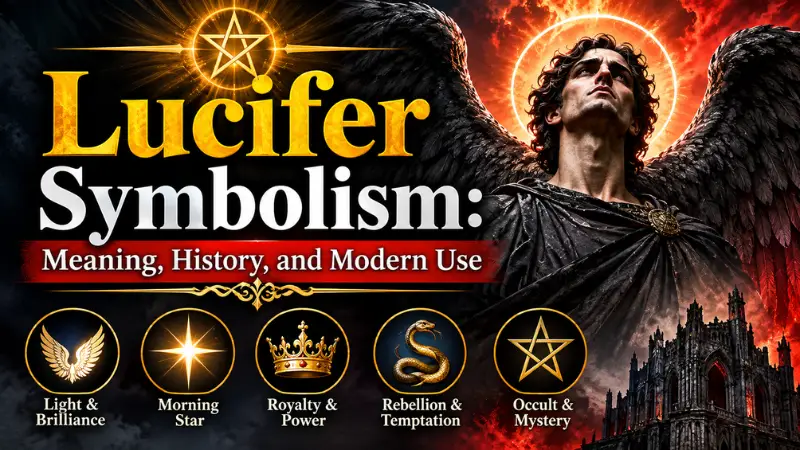
Lucifer symbolism carries several contrasting meanings, including light, knowledge, ambition, rebellion, pride, and spiritual downfall. In modern American culture, Lucifer is most commonly associated with Satan and the Christian idea of a fallen angel, but the name has a much older history connected to the morning star, the planet Venus, and the image of light appearing before sunrise.
People encounter Lucifer in religious discussions, literature, movies, music, tattoos, artwork, and alternative spiritual movements. Some view the figure as a representation of evil and temptation, while others interpret Lucifer as a symbol of independent thought, resistance to authority, or the pursuit of knowledge.
Understanding these different interpretations requires looking beyond the familiar image of the Devil. The original meaning of Lucifer was not simply evil. Its symbolic identity developed through biblical interpretation, Christian theology, literature, and modern popular culture.
Quick Answer
Lucifer symbolism most commonly represents Satan, rebellion against God, pride, temptation, and the struggle between good and evil in modern American culture. Historically, Lucifer means light-bearer and refers to the morning star, creating additional associations with illumination, ambition, knowledge, and a dramatic fall from greatness.
TL;DR
- Lucifer originally referred to Venus as the morning star.
- Christian tradition gradually associated Lucifer with Satan and fallen angels.
- Light represents knowledge, awareness, and intellectual independence.
- The fall represents pride, ambition, rebellion, and lost status.
- American popular culture often portrays Lucifer as a complex antihero.
- Modern tattoos and artwork use Lucifer to express different personal beliefs.
1. What Does Lucifer Represent as a Symbol?
Lucifer represents the complicated relationship between light and darkness, knowledge and temptation, ambition and pride, and freedom and rebellion.
Its meaning depends heavily on the cultural or religious setting.
In traditional Christian interpretation, Lucifer is associated with Satan, an angel who rebels against God and falls from heaven. This interpretation emphasizes disobedience, arrogance, temptation, and the consequences of placing personal ambition above divine authority.
In other interpretations, Lucifer’s association with light creates a different set of meanings. Light can represent intellectual awakening, awareness, discovery, and the desire to understand things that remain hidden.
These contrasting meanings explain why Lucifer can represent both a warning against destructive pride and a figure of resistance against established authority.
Several recurring symbolic associations help explain the figure:
- Light: Knowledge, awareness, illumination, and discovery.
- Rebellion: Resistance against authority and established rules.
- Pride: Excessive ambition and the desire for superiority.
- Temptation: Attraction to forbidden experiences or knowledge.
- Fall: The consequences of arrogance, disobedience, and overreaching ambition.
- Independence: Self-determination and questioning accepted beliefs.
The central point is that Lucifer does not carry one universally accepted meaning. Religious belief, historical context, and personal interpretation all influence how people understand the symbol.
2. What Does the Name Lucifer Actually Mean?
The name Lucifer comes from Latin words associated with light and carrying or bringing.
It is commonly translated as light-bearer or light-bringer.
In ancient Roman usage, Lucifer referred to the morning star, the planet Venus when it appeared in the eastern sky before sunrise. Venus is exceptionally bright, making it a natural symbol of illumination and the approaching day.
This original meaning is important because it differs from the familiar modern association with the Devil.
The morning star appears before the sun but does not replace it. Symbolically, this image can suggest anticipation, brightness, temporary prominence, and the limits of individual greatness.
The word also appeared in Latin biblical translations, particularly in Isaiah 14:12. In that passage, the morning-star imagery describes the downfall of a powerful ruler.
Over time, Christian interpreters connected this image with Satan’s fall from heaven.
Consequently, a word that originally described a celestial object became one of the most recognizable names associated with the Devil in Western religious and cultural traditions.
3. Historical Origins: From the Morning Star to the Fallen Angel
The earliest important biblical connection comes from the Book of Isaiah, particularly Isaiah 14:12–15.
The passage describes the downfall of a proud ruler of Babylon through the image of a bright morning star falling from heaven. The surrounding chapter is a poetic judgment against the Babylonian king, whose arrogance and political power are being brought to an end.
The morning star was an effective image because Venus appears bright in the sky before sunrise but eventually disappears as daylight takes over. The comparison suggests that even someone who appears exceptionally powerful can lose their position.
The passage was not originally a straightforward biography of Satan. Its immediate historical setting concerns a human ruler, although its celestial imagery later encouraged spiritual interpretations.
Early Christian writers, including Tertullian and Origen, helped establish the connection between Isaiah’s fallen morning star and Satan. As Christian theology developed, Lucifer became associated with an angel who rebelled against God and lost his heavenly position. Bible.org+2
This development created the familiar symbolic story:
- A glorious heavenly being possesses exceptional status.
- Pride and ambition lead to rebellion.
- The rebellion results in expulsion from heaven.
- Former brilliance becomes associated with darkness and opposition to God.
The transformation is significant because Lucifer’s symbolism came to represent not only rebellion but also the consequences of uncontrolled ambition.
4. Lucifer in Christian Religious Symbolism
In much of traditional Christianity, Lucifer is understood as a name associated with Satan before or in connection with his fall from heaven.
The figure represents opposition to God, spiritual deception, temptation, and the misuse of freedom.
The story is often interpreted as a warning about pride. Lucifer’s supposed desire to elevate himself above his proper position illustrates what can happen when ambition becomes more important than humility, obedience, and moral responsibility.
Several Christian themes are connected to this interpretation:
- Spiritual rebellion: Rejecting divine authority.
- Pride: Considering oneself superior to others.
- Temptation: Encouraging people to turn away from righteousness.
- Deception: Making harmful choices appear attractive.
- Spiritual separation: Losing a relationship with God through disobedience.
However, biblical terminology requires some care. The name Lucifer appears in the Latin tradition of Isaiah 14:12, rather than functioning as a consistently used personal name for Satan throughout the Bible.
Christian denominations also differ in how they explain the relationship between Lucifer, Satan, fallen angels, and the biblical passages commonly associated with them.
For many American Christians, however, Lucifer remains a recognizable representation of evil and the danger of placing personal desire above spiritual responsibility.
5. The Symbolism of Light, Knowledge, and Awareness
One of the most interesting aspects of Lucifer symbolism is the contrast between the name’s original meaning and its later religious associations.
As a light-bearer, Lucifer can be interpreted through the familiar symbolic relationship between light and knowledge.
Across many cultural traditions, light represents understanding because it allows people to see what was previously hidden. Darkness, by comparison, can represent uncertainty, ignorance, or the unknown.
This association gives Lucifer a second interpretation outside conventional Christian teaching.
In some philosophical and alternative spiritual settings, Lucifer represents:
- Intellectual curiosity.
- Independent thinking.
- Personal discovery.
- Awareness of hidden truths.
- Questioning established beliefs.
- The pursuit of knowledge.
This does not mean that all people who use Lucifer imagery support the same philosophy or religious position.
For some, light represents wisdom and education. For others, it represents forbidden knowledge or the willingness to challenge social expectations.
The distinction matters: knowledge itself is not necessarily presented as evil in Christian theology. The concern is more often about pride, disobedience, and the choices made in pursuing or using knowledge.
6. Lucifer Symbolism in the United States
In the United States, Lucifer carries several overlapping cultural meanings because American society includes different Christian traditions, secular philosophies, religious minorities, and alternative spiritual movements.
For many Americans raised in Christian communities, the name immediately brings to mind Satan, hell, temptation, and the struggle between good and evil.
In entertainment, however, Lucifer is frequently presented as a more complicated character. Films, television programs, novels, and music explore his intelligence, charisma, independence, and conflict with authority.
This does not necessarily represent a change in Christian doctrine. It reflects how American popular culture reinterprets religious characters for storytelling.
Lucifer also appears in discussions about personal freedom, censorship, religious authority, and the boundaries between acceptable and controversial expression.
For some people, the image is a statement of artistic independence. For others, it remains an offensive or disturbing religious reference.
| American context | Common symbolic meaning | Typical interpretation |
|---|---|---|
| Christianity | Pride, temptation, and evil | Warning against rebellion against God |
| Literature | Ambition and tragic downfall | A complex character with moral conflict |
| Movies and television | Charisma and rebellion | An antihero or supernatural antagonist |
| Alternative spirituality | Light and independent thought | Personal awareness and questioning |
| Tattoos and fashion | Defiance and individuality | A personal statement that varies by wearer |
The same image can therefore communicate completely different ideas depending on the audience.
7. Lucifer in Literature and Popular Culture
Literature has played a major role in shaping the modern image of Lucifer.
One of the most influential works is John Milton’s Paradise Lost, published in 1667.
Milton presents Satan as an articulate, ambitious, and rebellious character whose pride leads to his downfall. His portrayal gives readers an opportunity to examine the relationship between personal freedom, authority, ambition, and moral responsibility.
The character’s speeches have encouraged centuries of debate about whether Satan should be understood only as a villain or also as a literary representation of destructive ambition and rebellious independence.
In modern American entertainment, the figure has become even more varied.
Milton’s Paradise Lost – Infinite wrath, and infinite despair
Стиль и коварство: появились новые кадры из 4 сезона сериала «Люцифер» / Союз
6
Television series such as Lucifer portray the character through humor, relationships, personal conflict, and questions of responsibility.
In horror films and supernatural fiction, Lucifer is more commonly presented as a threatening supernatural presence.
These portrayals serve different purposes:
- Horror uses Lucifer to explore fear, evil, and spiritual danger.
- Fantasy uses the character to examine supernatural power and moral conflict.
- Drama explores guilt, identity, and personal responsibility.
- Literature uses the figure to question authority, ambition, and freedom.
The popularity of these interpretations shows how religious imagery can become part of broader American storytelling without everyone accepting its religious meaning.
8. Lucifer and Modern Satanism
Lucifer is sometimes connected with Satanism, but the relationship requires an important distinction.
Not every Satanist interprets Satan or Lucifer as a literal supernatural being.
The Church of Satan, founded by Anton LaVey in 1966, describes Satan as a symbolic figure representing pride, liberty, and individualism. Its philosophy is atheistic rather than based on worshipping a supernatural Devil. Church of Satan+1
For people following this philosophy, Satanic imagery can communicate independence, personal responsibility, and resistance to religious conformity.
Other individuals and groups have different beliefs, so it would be inaccurate to treat all forms of Satanism as identical.
It is equally important not to assume that someone wearing Lucifer-related artwork belongs to a Satanist organization.
A person may choose the imagery because of its literary history, visual appearance, philosophical associations, or interest in mythology.
9. Lucifer Symbolism in Other Religious and Cultural Traditions
Lucifer is primarily a Latin and Western Christian-associated name, but related ideas about rebellious spiritual beings appear in other religious traditions.
Islamic tradition offers an important comparison through the figure of Iblis.
In the Quran, Iblis refuses God’s command to bow before Adam. His refusal is connected with arrogance and a belief that his own nature makes him superior to the human being.
This story has similarities to the Christian theme of spiritual rebellion, particularly the emphasis on pride and disobedience. However, Iblis is not simply another name for Lucifer, and Islamic teachings have their own theological framework. The Quran identifies Iblis as one of the jinn, a distinction that should not be erased when making comparisons. St Andrews Encyclopaedia of Theology+1
Jewish traditions also contain discussions of Satan, heavenly adversaries, and spiritual testing. However, Jewish understandings of Satan differ considerably from the later Christian picture of an independent cosmic ruler of evil.
In some mystical and literary traditions, rebellious spiritual figures are explored as complex characters associated with divine judgment, pride, or the limits of human understanding.
These comparisons show why it is important to discuss each tradition on its own terms rather than treating every supernatural adversary as the same figure.
10. The Psychological and Emotional Meaning of Lucifer
Lucifer can represent several human experiences, particularly the tension between ambition and humility.
As a symbolic character, he allows people to explore what happens when the desire for recognition, control, or independence becomes more important than responsibility.
His story can also represent the emotional consequences of losing status or belonging.
For example, someone who has experienced rejection may connect with the image of a fallen figure who once occupied a position of honor. Another person may interpret the same image as a warning against allowing resentment to control their decisions.
The psychological associations can include:
Ambition: The desire to achieve something greater or move beyond existing limitations.
Pride: The belief that personal abilities or achievements make someone superior to others.
Alienation: Feeling separated from a community, institution, or accepted way of life.
Defiance: Refusing to accept rules or expectations without questioning them.
Regret: Recognizing that personal decisions have caused lasting consequences.
Self-examination: Considering whether independence is being used responsibly.
Lucifer’s appeal as a fictional and symbolic figure often comes from these conflicts. People can examine difficult emotions through a character whose story involves power, rejection, desire, and consequences.
Importantly, these are interpretive associations, not psychological diagnoses or universal reactions.
11. Lucifer Symbolism in Tattoos, Jewelry, and Personal Style
Lucifer imagery appears in modern tattoo culture, jewelry, clothing, and alternative fashion. People choose these designs for different reasons, and the meaning is not always religious.
274+ Lucifer Falling Tattoo Ideas in 2026 – BlackInk AI
Lucifer Necklace Goth Gifts Occult Jewelry Witchcraft Jewelry – Etsy
109+ Lucifer Fallen Angel Tattoo Ideas in 2026 – BlackInk AI
9
Common designs include:
- Fallen angel tattoos: Often represent rejection, personal struggle, loss, or independence.
- Angel wings: Can suggest former glory, freedom, vulnerability, or spiritual conflict.
- Morning star imagery: Represents illumination, ambition, and the original meaning of Lucifer.
- Dark angel designs: Often communicate individuality, emotional complexity, or attraction to gothic aesthetics.
- Light and darkness combinations: Explore the conflict between opposing forces or different sides of human nature.
Some people select Lucifer tattoos to express resistance to social expectations. Others appreciate the character’s literary history or the contrast between his original association with light and his later association with darkness.
Jewelry featuring Lucifer-inspired imagery may serve as a personal statement, fashion accessory, or expression of alternative spirituality.
Before choosing such a design, it is worth considering its religious associations. In the United States, some people may interpret the imagery as an explicit reference to Satan, even when the wearer intends something more philosophical or artistic.
12. Common Misunderstandings About Lucifer Symbolism
Lucifer’s complicated history has created several misunderstandings, especially when ancient meanings are confused with modern interpretations.
Misunderstanding 1: Lucifer always meant Satan.
The Latin word originally referred to the morning star, Venus. Its association with Satan developed through later religious interpretation.
Misunderstanding 2: Lucifer is directly described as a fallen angel in Isaiah.
Isaiah 14 primarily addresses the downfall of the king of Babylon. The identification of the morning-star figure with Satan developed through later interpretive traditions.
Misunderstanding 3: Lucifer always symbolizes evil.
In traditional Christian settings, Lucifer is strongly associated with evil. However, the original light-bearer meaning has also inspired philosophical and literary interpretations involving knowledge and illumination.
Misunderstanding 4: Everyone who uses Lucifer imagery worships the Devil.
Tattoos, artwork, clothing, and literary references do not automatically indicate religious belief. Personal motivations vary.
Misunderstanding 5: Lucifer and Iblis are identical in every religious tradition.
They have comparable associations with spiritual rebellion, but their identities, theological roles, and religious contexts differ.
Separating historical evidence from later interpretation makes the subject easier to understand and prevents assumptions about people’s beliefs.
13. How Lucifer’s Symbolism Has Changed Over Time
The meaning of Lucifer has developed through several major cultural stages.
Phosphorus (Morning Star) | Encyclopedia MDPI
| Historical period | Main interpretation | Symbolic emphasis |
|---|---|---|
| Ancient Roman usage | Morning star, Venus | Light and the approaching sunrise |
| Biblical Isaiah | Fallen morning star describing a ruler | Pride and loss of status |
| Early Christianity | Association with Satan | Rebellion and spiritual downfall |
| Medieval and early modern Europe | Fallen angel in religious and artistic traditions | Temptation and evil |
| Seventeenth-century literature | Complex rebellious literary character | Ambition and freedom |
| Modern America | Religious figure, literary character, or alternative icon | Different interpretations of identity and independence |
The transformation was not a simple replacement of one meaning with another. Older associations with light continued to exist even as the religious meaning became dominant in Western culture.
The nineteenth and twentieth centuries also encouraged renewed interest in occult literature, alternative spirituality, and symbolic interpretations of religious figures.
In contemporary America, Lucifer can consequently appear in a church discussion, a fantasy television series, a philosophical conversation, or a gothic tattoo design.
Each setting creates a different interpretation of the same name.
14. Positive and Negative Meanings of Lucifer
Whether Lucifer is interpreted positively or negatively depends on the beliefs and intentions behind the symbol.
In traditional Christian teaching, the negative interpretation is central. Lucifer represents pride, rebellion, temptation, and separation from God.
In some secular and alternative philosophical settings, the figure is interpreted more positively as an image of questioning authority, intellectual independence, and individual freedom.
Neither interpretation should be confused with the original astronomical meaning of the Latin word.
The following comparison summarizes the main differences.
| Positive or alternative interpretation | Negative or traditional religious interpretation |
|---|---|
| Intellectual curiosity | Temptation |
| Independent thought | Rebellion against God |
| Personal freedom | Disobedience |
| Awareness and illumination | Deception |
| Questioning authority | Excessive pride |
| Self-determination | Spiritual downfall |
This contrast explains why Lucifer remains controversial. Two people can recognize the same image but attach entirely different moral meanings to it.
A thoughtful interpretation should consider the context rather than assuming that one meaning applies everywhere.
FAQs
1. What does Lucifer symbolize spiritually?
Lucifer spiritually symbolizes rebellion, pride, temptation, and the consequences of rejecting divine authority in traditional Christianity. In some alternative spiritual interpretations, the light-bearer association represents knowledge, awareness, and independent thought.
2. Does Lucifer symbolize light or darkness?
Lucifer originally referred to the morning star and carries the Latin meaning of light-bearer. Its later Christian association with Satan introduced the contrasting symbolism of darkness, evil, and spiritual rebellion.
3. What does a Lucifer tattoo mean?
A Lucifer tattoo can represent independence, rebellion, ambition, personal transformation, or an interest in religious and mythological imagery. Its meaning depends on the individual, although some observers may interpret it as a reference to Satan.
4. Is Lucifer the same as Satan?
In much of Christian tradition, Lucifer is identified with Satan, particularly in interpretations of the fallen angel. Historically, however, Lucifer originally referred to the morning star, and the identification developed through later biblical interpretation.
5. What does Lucifer symbolize in literature?
In literature, Lucifer often represents ambition, rebellion, pride, and the conflict between individual freedom and authority. John Milton’s Paradise Lost is especially influential in shaping the literary portrayal of Satan as a complex and ambitious character.
6. Is Lucifer symbolism always negative?
No. Traditional Christian interpretations are generally negative, but literary, philosophical, and alternative spiritual interpretations can associate Lucifer with knowledge, independence, and resistance to conformity. The intended meaning depends on the context.
7. What is the difference between Lucifer and Iblis?
Lucifer is a name associated with the Christian interpretation of Satan and the fallen morning star. Iblis is the spiritual being in Islamic tradition who refuses God’s command to bow before Adam, with his rebellion connected to arrogance and pride.
Conclusion
Lucifer symbolism represents a complicated combination of light, knowledge, ambition, rebellion, pride, and spiritual downfall. Its original connection to Venus as the morning star differs considerably from its later identification with Satan in Christian tradition.
In modern American culture, Lucifer can represent religious evil, literary rebellion, alternative spirituality, or personal independence. Its appearance in tattoos, entertainment, philosophy, and art demonstrates how one historical figure can acquire different meanings across generations.
Ultimately, understanding Lucifer requires looking at both sides of its history: the original image of a bright morning star and the later story of a fallen heavenly figure. The difference between those interpretations explains why Lucifer remains one of the most debated symbols in Western culture.