
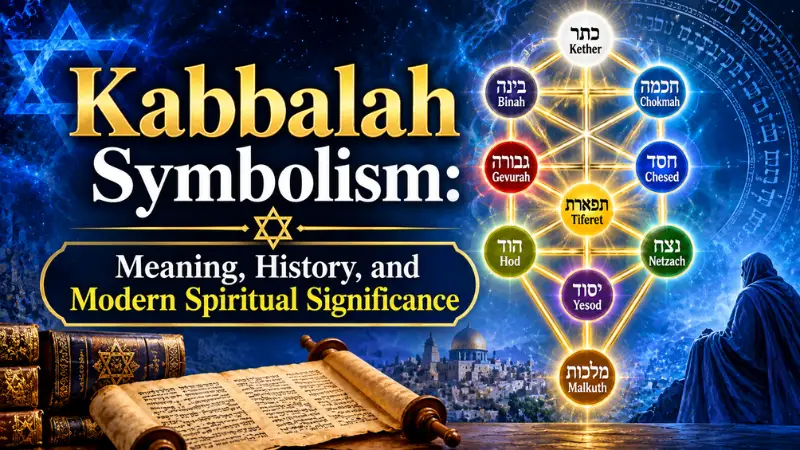
Kabbalah symbolism refers to the collection of spiritual images, numbers, letters, diagrams, and teachings associated with Kabbalah, a Jewish mystical tradition that explores the relationship between God, creation, and human life. Its best-known visual symbol is the Tree of Life, a diagram of ten interconnected spiritual attributes that represents how divine existence relates to the physical world.
People encounter Kabbalistic imagery in religious art, jewelry, spiritual books, decorative designs, and contemporary wellness culture. In the United States, these symbols are often associated with spiritual awareness, personal transformation, wisdom, protection, and the search for a meaningful connection with something greater than oneself.
However, Kabbalah is more than a collection of attractive spiritual designs. Its symbols come from centuries of Jewish religious thought, and understanding their original meanings helps distinguish traditional teachings from modern interpretations.
Quick Answer
Kabbalah symbolism commonly represents spiritual wisdom, the connection between God and creation, personal growth, and the search for divine understanding. Historically, its symbols developed within Jewish mysticism to explain the relationship between the infinite God, the universe, and humanity, particularly through the ten sefirot and the Tree of Life.
TL;DR
- The Tree of Life represents the relationship between divine attributes and creation.
- The ten sefirot symbolize different expressions of divine qualities.
- Kabbalah developed within Jewish mystical traditions during the medieval period.
- American popular culture associates Kabbalah with wisdom, spirituality, and personal transformation.
- Hebrew letters and numbers carry religious and symbolic significance.
- Modern jewelry and red-string bracelets have popularized selected Kabbalistic associations.
1. What Does Kabbalah Symbolism Represent?
At its foundation, Kabbalah symbolism represents the relationship between the unknowable divine and the world people experience.
In traditional Jewish mystical thought, God is described as Ein Sof, meaning the Infinite. This term emphasizes that God’s ultimate nature cannot be completely understood or limited by human language. Kabbalistic teachings use symbolic structures to explore how the divine relates to creation without suggesting that God can be fully represented by a physical object.
Several important meanings emerge from this tradition:
- Divine connection: The relationship between God, humanity, and the universe.
- Wisdom: The pursuit of spiritual understanding through religious study and contemplation.
- Balance: The relationship between compassion, strength, judgment, and mercy.
- Creation: The process through which the spiritual and physical worlds are connected.
- Transformation: The importance of ethical action and spiritual development.
- Unity: The understanding that different aspects of existence belong to a larger divine order.
These meanings are interconnected rather than separate beliefs. For example, the idea of balance is connected to divine attributes, while personal transformation is connected to the responsibility of living in accordance with spiritual principles.
For many contemporary Americans, these ideas also provide a language for discussing mindfulness, purpose, and self-improvement.
2. What Does the Kabbalistic Tree of Life Symbolize?
“Sefirot and the Tree of Life” by Empathetic Magic | Medium
The Tree of Life, known in Hebrew as Etz Chaim, is the most recognizable diagram associated with Kabbalah.
It consists of ten interconnected circles, usually arranged in three vertical columns and joined by connecting pathways. Each circle represents a sefirah, one of the ten sefirot, which are understood as divine attributes or emanations through which the Infinite relates to creation.
The diagram is sometimes called the Tree of the Sefirot.
Its central symbolic message is that creation is connected through an ordered relationship of divine qualities. The circles are not simply ten independent spiritual powers. They form a connected structure in which each attribute contributes to the larger pattern.
The three-column arrangement also communicates the importance of balance. Qualities associated with generosity and compassion are placed in relationship with qualities associated with strength and restraint, while the central column expresses a harmonizing relationship.
In traditional Jewish thought, the Tree of Life is a theological and contemplative framework, not simply a diagram of personality traits.
In American decorative culture, the design is sometimes interpreted more broadly as a symbol of interconnectedness, personal development, and spiritual growth.
3. The Ten Sefirot and Their Symbolic Meanings
Understanding the ten sefirot is essential to understanding the visual language of Kabbalah.
Their names and translations can vary slightly across traditions, but the following descriptions represent commonly used interpretations.
Combining Energies – Smuggling Grace
| Sefirah | Common Meaning | Symbolic Association |
|---|---|---|
| Keter | Crown | Divine will and transcendence |
| Chokhmah | Wisdom | Insight and creative potential |
| Binah | Understanding | Reflection and discernment |
| Chesed | Loving-kindness | Generosity and compassion |
| Gevurah | Strength | Discipline and restraint |
| Tiferet | Beauty | Harmony and balance |
| Netzach | Endurance or victory | Persistence and determination |
| Hod | Splendor | Humility and acknowledgment |
| Yesod | Foundation | Connection and transmission |
| Malkhut | Kingdom | Divine presence within creation |
Each sefirah contributes a different dimension to the overall structure.
Keter represents the highest level of the arrangement, associated with divine will and what lies beyond ordinary human comprehension.
Chokhmah and Binah represent wisdom and understanding. Together, they suggest the relationship between an initial insight and the process of developing that insight into something meaningful.
Chesed and Gevurah represent two complementary qualities. Chesed expresses generosity, while Gevurah introduces limits, discipline, and judgment. Their relationship illustrates why compassion without restraint and restraint without compassion can both become unbalanced.
Tiferet occupies the central position between these opposing qualities. It represents beauty and harmony, reflecting the importance of bringing different qualities into proportion.
The remaining sefirot extend this structure toward practical expression and the created world.
It is important to recognize that these translations are introductory explanations. Traditional Kabbalistic interpretations are considerably more complex than a simple list of personality characteristics.
4. The Historical Origins of Kabbalah
Kabbalah did not appear as one fully developed system at a particular moment. Its foundations developed through earlier Jewish discussions about creation, divine attributes, sacred language, and the nature of God.
Early Jewish mystical traditions included explorations of the divine throne described in the Book of Ezekiel and reflections on how God created the universe.
One important early text was the Sefer Yetzirah, commonly translated as the Book of Formation. It explored creation through numbers, letters, and fundamental arrangements of existence.
Kabbalah emerged as a recognizable mystical movement in medieval Jewish communities, particularly in Provence in southern France during the twelfth century. It developed further in thirteenth-century Spain, where the Sefer ha-Bahir and the Zohar became important works.
The Zohar, whose name means Book of Splendor, became one of the central texts of Jewish mystical literature. Traditionally associated with the second-century sage Rabbi Shimon bar Yochai, it became historically prominent in medieval Spain.
Its teachings explored the Torah through symbolic interpretation, discussing divine attributes, creation, the soul, and the relationship between spiritual and physical existence.
These developments established much of the symbolic vocabulary associated with Kabbalah today. My Jewish Learning+2
5. The Meaning of Ein Sof: The Infinite Divine
One of the most important concepts in Kabbalistic thought is Ein Sof.
The Hebrew expression means without end or infinite. It describes God beyond every limitation, definition, or physical representation.
This concept addresses an important theological question: If God is infinite and beyond human understanding, how can people understand the divine relationship with the created world?
Kabbalistic teachings approach this question through the sefirot.
Rather than presenting God as a physical being with ordinary human characteristics, the tradition uses symbolic descriptions to explain how divine qualities become recognizable within creation.
Ein Sof therefore represents:
- The unlimited nature of God.
- The limitations of human understanding.
- The spiritual source of existence.
- The relationship between divine transcendence and creation.
For someone encountering Kabbalah for the first time, this distinction is important. The sefirot are not simply ten separate gods. They belong to a theological framework concerned with the relationship between the one infinite God and the created universe.
In modern American spiritual discussions, Ein Sof is sometimes loosely compared with universal consciousness or an unlimited source of existence. Such comparisons may help introduce the idea, but they are not exact replacements for its Jewish theological meaning.
6. Hebrew Letters and Numbers in Kabbalah
Tefilah mi-kol ha-shanah me-ha-ari (Prayer for the Whole Year According to the Ari) | Posen Library
Hebrew letters are another important part of Kabbalistic symbolism.
In traditional Jewish thought, Hebrew is not treated merely as a practical communication system. Its letters also participate in religious interpretations of creation, sacred language, and divine revelation.
The Sefer Yetzirah connects the structure of creation with ten sefirot and twenty-two Hebrew letters.
Together, these elements form what is traditionally described as thirty-two paths of wisdom.
Kabbalistic interpretations also use gematria, a system in which Hebrew letters have numerical values. Words and expressions with matching numerical values may be compared to explore possible relationships between religious concepts.
For example, a scholar might examine the numerical value of a Hebrew word alongside another word to investigate a symbolic connection.
However, gematria does not mean that every numerical coincidence reveals a hidden message. Its use depends on established interpretive traditions and the context of a particular teaching.
For contemporary Americans, Hebrew lettering in Kabbalistic jewelry and artwork often represents wisdom, faith, heritage, or a desire for spiritual understanding.
A Hebrew inscription should be checked carefully before being used as a tattoo or decorative object because individual letters, spelling, and religious context matter.
7. The Symbolism of Balance, Mercy, and Strength
One of the most practical themes in Kabbalistic symbolism is balance.
The sefirot include qualities that may appear to oppose each other. Chesed represents loving-kindness, generosity, and giving, while Gevurah represents strength, discipline, and restraint.
Their relationship offers a way to think about ethical behavior.
Consider a parent deciding how to respond when a child makes a mistake. Compassion encourages patience and forgiveness. Discipline encourages accountability and boundaries. Either quality, when separated from the other, can become ineffective.
Kabbalistic symbolism presents these qualities as part of a larger arrangement rather than isolated virtues.
Tiferet, associated with beauty and harmony, helps express the importance of bringing these qualities into balance.
This theme has particular relevance in modern American interpretations of spirituality, where balance is frequently associated with emotional maturity, responsible decisions, and healthier relationships.
Nevertheless, the traditional symbolism is theological first. Applying it to everyday decisions is an interpretation of the teaching rather than its complete religious meaning.
8. Kabbalah Symbolism in American Culture
Kabbalah has had several different forms of visibility in the United States.
For many Jewish Americans, it belongs to a broader religious and intellectual tradition connected to Torah study, Jewish prayer, spirituality, and the interpretation of sacred texts.
For other Americans, particularly those introduced to it through popular spirituality, Kabbalah may represent personal development, meditation, protection, or the search for meaning.
Its visibility increased considerably through contemporary spiritual movements and celebrity interest, particularly during the late twentieth and early twenty-first centuries.
The Kabbalah Centre became one of the organizations associated with introducing selected Kabbalistic teachings to a wider international audience. Its approach attracted people from different religious backgrounds but also generated criticism concerning its relationship with traditional Judaism.
As a result, American interpretations are not uniform.
| American Context | Common Interpretation | Important Distinction |
|---|---|---|
| Jewish religious study | Divine wisdom and mystical theology | Rooted in Jewish teachings |
| Spiritual communities | Personal growth and awareness | Often uses simplified interpretations |
| Jewelry and accessories | Faith, protection, or identity | Not every item has an authentic Kabbalistic origin |
| Decorative artwork | Interconnection and balance | May omit theological context |
| Books and popular culture | Mysticism and hidden knowledge | Sometimes mixes unrelated traditions |
Understanding these differences prevents the assumption that everyone who uses Kabbalistic imagery follows the same beliefs.
The American story of Kabbalah is therefore partly about religious continuity and partly about the modern movement of spiritual ideas across cultural boundaries. Compass Hub+2
9. Red String Symbolism and the Evil Eye
Kabbalah Gelang Benang Merah: Benarkah? – Jewishcentersurabaya.org
jewishcentersurabaya.wordpress.com
The red string bracelet is one of the most recognizable objects popularly associated with Kabbalah.
In contemporary American culture, it is often marketed as a symbol of protection against the evil eye, jealousy, negative attention, and misfortune.
The evil eye, known in Jewish tradition as ayin hara, refers to harmful effects associated with an envious or hostile gaze.
However, an important historical distinction is necessary: the widespread modern red-string bracelet is not a universally accepted Kabbalistic requirement or practice.
Jewish discussions of red thread and protective customs have different historical interpretations. Red thread traditions have also appeared in numerous cultures outside Judaism.
Some contemporary bracelets are associated with Rachel’s Tomb in Bethlehem, and sellers sometimes describe the thread as having been wrapped around the site.
Jewish authorities disagree about the legitimacy and religious value of wearing these bracelets. Some accept particular folk customs, while others question their origins or discourage treating them as spiritual guarantees.
For American consumers, the red string can communicate several ideas:
- A wish for protection from jealousy.
- A reminder to approach life with humility.
- A personal connection to Jewish spirituality.
- A fashionable expression of interest in mysticism.
- A sentimental gift expressing care and goodwill.
The bracelet’s popularity should not be confused with universal Jewish agreement about its religious authenticity. Chabad+2
10. The Hamsa, Protective Imagery, and Related Traditions
Ornate hamsa, Gold amulet against the evil eye and spoilage. Vector
The hamsa is a hand-shaped protective symbol found in several Middle Eastern and North African cultural traditions, including Jewish and Muslim communities.
It is frequently decorated with an eye, geometric patterns, Hebrew inscriptions, or other protective imagery.
In American homes, jewelry stores, and gift shops, the hamsa is commonly associated with protection, good fortune, and the rejection of harmful attention.
Although people sometimes connect the hamsa with Kabbalah, it is important not to treat the two as interchangeable.
The hamsa has a broader cultural history, and its use is not exclusive to Kabbalistic Judaism.
It is also different from the Tree of Life. The Tree of Life is a central diagram of Kabbalistic theology, while the hamsa belongs to a wider history of protective symbolism.
In modern American interiors, a hamsa may appear as a wall hanging, necklace, keychain, or decorative object. Its meaning depends partly on the owner’s religious background and partly on the way it is used.
11. Emotional and Psychological Meaning of Kabbalistic Symbols
Kabbalistic imagery can communicate emotional ideas even to people who have limited knowledge of Jewish mysticism.
The Tree of Life, for instance, presents a visual arrangement in which different elements are connected. This can encourage viewers to think about relationships, responsibility, and the ways different aspects of life influence one another.
Other symbols may carry more personal associations.
The Tree of Life can represent the desire to understand one’s place within a larger structure of existence.
Hebrew letters may express a connection to religious heritage, sacred language, or intellectual curiosity.
The red string may provide a physical reminder of protection, hope, or the care of someone who gave it as a gift.
The sefirot can encourage reflection on qualities such as kindness, patience, discipline, and understanding.
Psychologically, a meaningful object can serve as a personal reminder of values or intentions. Someone who wears a bracelet during a difficult period may associate it with reassurance, even if the object itself does not provide supernatural protection.
This distinction matters because personal emotional significance does not automatically establish a religious or historical claim.
Kabbalistic symbols can be meaningful without requiring every modern interpretation to be treated as traditional doctrine.
12. Kabbalah in Tattoos, Jewelry, and Modern Design
tree life world tree life tree sephiroth sephira jewish judaism
Kabbalistic imagery appears in contemporary American personal style, particularly through tattoos, necklaces, bracelets, and decorative artwork.
The Tree of Life is popular among people interested in spirituality because its structure can represent interconnectedness, wisdom, and personal development.
Hebrew lettering is also used in tattoos, although some people choose inscriptions without fully understanding their translations or religious implications.
Jewelry featuring the sefirot or other mystical imagery may appeal to individuals who want an object connected to spiritual study.
Design choices can communicate different intentions:
- A Tree of Life pendant may represent interconnectedness.
- A Hebrew inscription may express religious or cultural identity.
- A red string bracelet may communicate a wish for protection.
- A sefirot design may represent interest in Jewish mystical philosophy.
- A decorative geometric pattern may reflect an appreciation for religious art.
For people considering a Kabbalistic tattoo, understanding the original context is especially important. Jewish attitudes toward tattoos are shaped by religious law and personal observance, so a design that appears purely decorative to one person may carry religious significance for another.
A thoughtful design begins with understanding what the symbol actually represents.
13. Kabbalah Symbolism in Art, Architecture, and Home Decor
Kabbalistic designs have become recognizable in spiritual artwork, illustrated books, decorative prints, and contemporary interior design.
The Tree of Life is particularly suitable for visual representation because its symmetrical arrangement creates an organized geometric pattern. Artists may reproduce it using traditional Hebrew labels, minimalist lines, colored circles, or elaborate ornamental details.
Color can influence how modern viewers interpret these designs, although color associations vary between artistic traditions and are not universal Kabbalistic rules.
For example:
- Gold may suggest royalty, spiritual illumination, or divine majesty.
- Blue may suggest heaven, spirituality, or protection.
- White may communicate purity and simplicity.
- Red may suggest strength, intensity, or judgment in particular symbolic contexts.
- Green may suggest growth and renewal in contemporary decorative interpretations.
In American homes, these designs may appear in meditation spaces, study rooms, bedrooms, and personal collections.
However, a decorative Tree of Life should not automatically be interpreted as a complete representation of traditional Kabbalistic teachings. Many contemporary designs simplify or modify the original diagram for artistic purposes.
14. Different Interpretations Across Religious and Spiritual Traditions
Kabbalah belongs specifically to Jewish religious history, but its ideas and imagery have influenced other intellectual and spiritual movements.
During the Renaissance and early modern period, Christian thinkers developed forms of Christian Kabbalah. They adapted selected Jewish mystical concepts to fit Christian theological interests.
Later, Western esoteric movements incorporated Kabbalistic diagrams into systems involving astrology, ceremonial magic, alchemy, and tarot.
These developments helped spread Kabbalistic imagery beyond Jewish communities.
However, Jewish Kabbalah and Western esotericism are not identical.
| Tradition | Relationship to Kabbalistic Ideas | Main Emphasis |
|---|---|---|
| Jewish Kabbalah | Original religious and mystical tradition | God, creation, Torah, and divine attributes |
| Christian Kabbalah | Adaptation of selected Jewish concepts | Christian theological interpretation |
| Hermetic Qabalah | Western esoteric reinterpretation | Spiritual correspondences and occult philosophy |
| New Age spirituality | Selective use of Kabbalistic imagery | Personal growth and universal spirituality |
These distinctions are particularly important when examining symbols found in American bookstores and spiritual shops.
A modern Tree of Life illustration might combine Jewish imagery with tarot, astrology, or other systems. Such a design may be meaningful within its own spiritual framework, but it should not be presented as a historically accurate expression of Jewish Kabbalah.
15. Misunderstandings and Misuse of Kabbalah Symbols
Kabbalah’s popularity has also created misunderstandings about its religious teachings and symbols.
One common misconception is that Kabbalah is simply a collection of magical objects, secret codes, or methods for attracting wealth.
Although some historical Kabbalistic practices involved amulets, divine names, and protective traditions, the broader tradition is a complex form of Jewish religious interpretation.
Another misunderstanding is that the Tree of Life is simply a diagram of human personality. Modern self-development communities sometimes use it to explain character traits, emotional states, or stages of personal growth. These interpretations may be useful as contemporary reflections, but they do not capture the complete theological meaning of the sefirot.
The red string bracelet is another example. It is frequently advertised as an essential Kabbalistic object, despite disagreement among Jewish authorities about its religious legitimacy.
There are also concerns about commercializing sacred symbols without explaining their cultural background.
Respectful use involves several considerations:
- Learn the historical meaning before adopting a symbol.
- Distinguish Jewish religious teachings from modern spiritual adaptations.
- Avoid claiming that an object guarantees protection, success, or healing.
- Treat Hebrew inscriptions and sacred imagery with care.
- Recognize that Jewish communities have different opinions about particular customs.
These distinctions allow people to appreciate Kabbalistic art without reducing a religious tradition to a fashion trend.
16. How Kabbalah Symbolism Has Evolved Over Time
The meaning and presentation of Kabbalistic symbols have changed as the tradition developed and reached different communities.
In its earlier mystical settings, Kabbalah was primarily concerned with interpreting Jewish religious teachings and exploring the relationship between God and creation.
Medieval scholars developed increasingly detailed explanations of the sefirot, while the Zohar became a central text for later generations.
In sixteenth-century Safed, Rabbi Isaac Luria introduced a major mystical system that transformed later Kabbalistic thought. His teachings included concepts such as tzimtzum, divine contraction; shevirat ha-kelim, the breaking of the vessels; and tikkun, restoration or repair.
These ideas offered an elaborate account of creation, spiritual disorder, and the possibility of restoration through religious practice.
During later centuries, Kabbalistic thought influenced Hasidism and other Jewish religious movements, bringing aspects of Jewish mysticism into broader religious life.
Eventually, Kabbalistic concepts also entered European intellectual and esoteric movements.
In modern America, selected symbols became visible through spiritual organizations, popular books, celebrity culture, jewelry, and decorative art.
The result is a tradition with several layers of meaning: its original Jewish theological foundations, later religious interpretations, and contemporary cultural adaptations. My Jewish Learning+3
FAQs
1. What is the most important symbol in Kabbalah?
The Tree of Life is generally considered the most recognizable symbol associated with Kabbalah. It represents the ten sefirot and their relationship to the infinite divine and the created universe.
2. What does the Kabbalah Tree of Life mean spiritually?
The Tree of Life represents the relationship between divine attributes, creation, and spiritual existence. Its interconnected structure also illustrates how qualities such as wisdom, compassion, strength, and harmony relate to one another.
3. What does a red Kabbalah bracelet symbolize?
A red bracelet is commonly worn as a symbol of protection against the evil eye and negative attention. However, its status as a specifically Kabbalistic practice is disputed, and it is not a universal requirement of Jewish religious life.
4. Is Kabbalah part of Judaism?
Yes. Kabbalah is a major tradition of Jewish mysticism that developed through centuries of Jewish religious interpretation. It explores the divine, creation, sacred texts, and the spiritual dimensions of Jewish religious practice.
5. Is Kabbalah symbolism positive or negative?
Kabbalistic symbolism is generally concerned with understanding divine qualities, spiritual relationships, and the balance between different forces. Individual concepts may address judgment, restraint, or spiritual disorder, but these are not inherently symbols of evil.
6. Can anyone use Kabbalah symbols?
People encounter and appreciate Kabbalistic imagery across different cultures and religious backgrounds. However, anyone using these symbols should understand their Jewish origins and avoid presenting personal interpretations as established Jewish teachings.
7. What is the difference between Kabbalah and the Tree of Life?
Kabbalah is the broader Jewish mystical tradition, while the Tree of Life is one of its most important symbolic diagrams. The diagram represents the ten sefirot and provides a visual framework for understanding certain Kabbalistic teachings.
Conclusion
Kabbalah symbolism represents the relationship between the infinite divine, creation, and human spiritual life. Its most recognizable expression, the Tree of Life, illustrates ten interconnected sefirot associated with qualities such as wisdom, compassion, strength, beauty, and divine presence.
Although contemporary American culture often associates these symbols with personal growth, protection, and spiritual awareness, their origins are rooted in Jewish religious thought. Understanding that background helps distinguish authentic historical teachings from modern decorative and spiritual adaptations.
Ultimately, Kabbalah symbolism offers a way to explore how different qualities and dimensions of existence relate to one another. Its significance becomes clearer when its imagery is understood not simply as decoration, but as part of a longstanding tradition of Jewish reflection on God, creation, and the responsibilities of human life.


