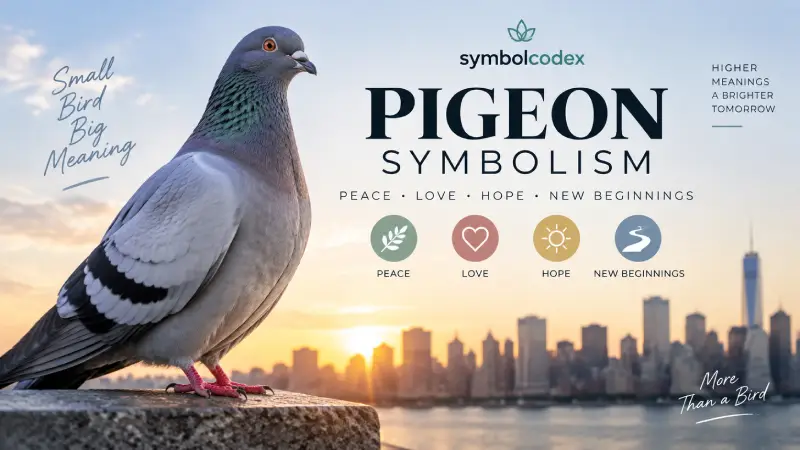
The pigeon is one of the most familiar birds in human environments. Found in cities, parks, farms, gardens, and public spaces around the world, pigeons have lived alongside people for thousands of years. Because of this close relationship, pigeon symbolism has developed around peace, love, loyalty, communication, home, adaptability, resilience, and freedom.
Pigeons are sometimes overlooked because they are so common. Yet their history with humans is remarkable. Pigeons have been domesticated, used to carry messages, kept for food and sport, and represented in religious and artistic traditions.
The pigeon is also a powerful example of adaptation. Urban pigeons can find food, nesting locations, and shelter in environments created by humans. This makes them a useful modern symbol of survival, flexibility, and finding opportunity in changing circumstances.
Quick Answer
Pigeon symbolism commonly represents peace, love, loyalty, communication, home, adaptability, freedom, resilience, and companionship. Because pigeons have long relationships with humans and have historically been used to carry messages, they can also symbolize connection, communication, and bringing news from one place to another.
Spiritually, a pigeon may be interpreted as a reminder to seek peace, communicate honestly, remain loyal to what matters, or adapt to changing circumstances. These spiritual meanings are personal and cultural interpretations rather than scientifically proven messages.
TL;DR
- Peace: Calmness, reconciliation, and harmony.
- Love: Affection, companionship, and emotional connection.
- Loyalty: Commitment and returning to familiar bonds.
- Communication: Messages, news, and staying connected.
- Home: Belonging, familiarity, and finding your way back.
- Adaptability: Adjusting to changing environments.
- Resilience: Surviving challenges and difficult conditions.
- Freedom: Flight, movement, and independence.
- Community: Living alongside others and social connection.
- Hope: A peaceful future or positive message.
- Dream meaning: Communication, relationships, peace, home, or change.
- Tattoo meaning: Love, peace, freedom, loyalty, remembrance, and connection.
What Makes the Pigeon a Symbol?
Pigeons have a long and unusual relationship with humans.
The rock pigeon is the species most people associate with familiar urban pigeons. It was domesticated thousands of years ago, and its descendants can now be found in cities across much of the world.
Pigeons are also highly social birds. They communicate through calls and body language and often gather in groups.
Their ability to navigate and return to familiar locations has contributed to their historical reputation as dependable messengers.
These characteristics naturally create symbolic associations with communication, home, loyalty, community, and resilience.
What Does a Pigeon Commonly Represent?
Pigeon symbolism can be understood through several important characteristics:
| Pigeon Trait | Symbolic Meaning | Modern Interpretation |
|---|---|---|
| Flight | Freedom | Independence and movement |
| Social behavior | Community | Belonging and cooperation |
| Homing ability | Home | Returning to what matters |
| Historical messenger role | Communication | Sharing news and connection |
| Pair bonding | Love | Partnership and companionship |
| Adaptability | Resilience | Adjusting to change |
| Familiarity with people | Connection | Living alongside others |
| White pigeon imagery | Peace | Harmony and reconciliation |
These meanings are symbolic interpretations. Different cultures and historical periods have assigned pigeons different roles and meanings.
Pigeon Symbolism in the United States
Pigeons are especially common in American cities.
They can be seen in parks, sidewalks, plazas, train stations, rooftops, bridges, and other urban environments.
Because of their constant presence, pigeons are sometimes treated as ordinary background wildlife. Yet this familiarity also gives them a unique symbolic meaning.
In modern American culture, pigeons can represent urban survival, adaptability, community, communication, and resilience.
The bird’s ability to live successfully around humans demonstrates how wildlife can adjust to dramatically altered environments.
Pigeon Symbolism and Peace
The association between pigeons and peace is one of the best-known symbolic meanings.
A white dove is especially famous as a peace symbol, and pigeons belong to the same bird family as doves.
In modern visual culture, a white bird carrying an olive branch is widely understood as a symbol of peace, reconciliation, and hope.
It is important, however, not to treat every ordinary city pigeon as automatically carrying the exact same symbolism as a white dove.
The broader symbolic connection comes from the shared cultural history of pigeons and doves.
Pigeon Symbolism and Love
Pigeons can represent love, companionship, affection, and partnership.
Pigeons are social birds, and pairs can form strong associations during breeding and nesting.
This has helped create a symbolic connection between pigeons and romantic relationships.
A pair of pigeons may therefore represent two people who remain connected while building a shared life.
The symbolism is less about dramatic romance and more about companionship, familiarity, and staying connected.
Pigeon Symbolism and Loyalty
Loyalty is another important pigeon meaning.
The historical association between pigeons and returning to familiar locations has made the bird a natural metaphor for coming back home.
Symbolically, this can represent loyalty to:
- Family
- Partners
- Friends
- Personal values
- Hometowns
- Important memories
- Long-term goals
The pigeon can therefore represent someone who explores the world but still remembers where they belong.
Pigeon Symbolism and Communication
Pigeons have an unusually strong historical connection with communication.
Before modern telecommunications, trained homing pigeons were used to transport written messages over significant distances.
This historical role has made the pigeon a symbol of messages, news, connection, communication, and reaching someone despite distance.
In symbolic terms, a pigeon may represent the importance of saying something that needs to be said.
It can also represent reconnecting with someone after a period of separation.
Pigeon Symbolism and Home
The pigeon is closely associated with the idea of home.
Homing pigeons became famous for their ability to return to their home loft from unfamiliar locations.
This behavior inspired a powerful metaphor:
No matter how far you travel, you can still know where you belong.
For this reason, pigeon symbolism can represent homecoming, family, belonging, stability, and emotional roots.
A pigeon appearing in artwork can therefore have special meaning for someone who has moved away from home or is beginning a new chapter.
Pigeon Symbolism and Freedom
Like many birds, pigeons can symbolize freedom because they can fly across spaces that humans cannot easily cross.
Their flight can represent:
- Independence
- Travel
- New opportunities
- Escape from limitations
- Personal growth
- A fresh beginning
However, pigeon symbolism creates an interesting balance between freedom and home.
The bird can travel while still maintaining a connection with familiar places.
This makes it a useful symbol of freedom without losing your roots.
Pigeon Symbolism and Adaptability
Few bird symbols demonstrate urban adaptation as clearly as the pigeon.
Pigeons have learned to live around buildings, roads, bridges, rooftops, parks, and other human structures.
This makes them a powerful modern symbol of adaptability.
The pigeon does not need ideal conditions to survive.
Symbolically, it can represent the ability to look at a difficult environment and ask:
How can I make this situation work?
This interpretation makes the pigeon especially relevant to people going through career changes, relocation, financial challenges, or other major life adjustments.
Pigeon Symbolism and Resilience
Pigeons are often exposed to busy urban environments, changing weather, limited resources, and human disturbance.
Their ability to persist in such environments has created an association with resilience.
Pigeon symbolism can therefore represent quiet strength.
It is not the dramatic strength of an eagle or the intimidating strength of a large predator.
Instead, it represents the kind of strength that keeps going every day.
What Does a Pigeon Represent Spiritually?
Spiritually, a pigeon may symbolize peace, communication, love, home, loyalty, freedom, and renewal.
A person may interpret a pigeon encounter as a reminder to resolve conflict, reconnect with someone, communicate honestly, or return to something meaningful.
Some spiritual traditions also associate doves and related birds with purity, divine presence, or messages.
However, these interpretations vary by culture and religion. There is no scientific evidence that a pigeon appearing at a particular moment carries a supernatural message.
A practical spiritual interpretation is to use the bird as a reminder to choose peace, stay connected, and pay attention to meaningful relationships.
Pigeon Symbolism and White Pigeons
A white pigeon can have stronger symbolic associations than the typical gray city pigeon.
White is often associated with:
- Peace
- Purity
- Innocence
- Hope
- Renewal
- Calmness
- Reconciliation
Because pigeons and doves belong to the same family, white pigeon imagery can sometimes overlap with traditional dove symbolism.
However, color symbolism varies by culture, so white does not have one universal meaning.
Pigeon Symbolism in Religious Traditions
Pigeons and doves have appeared in several religious and cultural traditions.
In Christianity, the dove is strongly associated with the Holy Spirit, particularly in biblical imagery surrounding the baptism of Jesus.
In the Hebrew Bible, a dove is also associated with Noah’s story, where a bird returns with an olive leaf, becoming an enduring image of hope and the end of the flood.
In Islamic history and tradition, pigeons and doves have also appeared in cultural stories and associations, although specific beliefs vary and should not be generalized.
Because pigeons and doves are closely related, modern discussions sometimes use the terms interchangeably. Historically and biologically, however, different species should be distinguished.
Pigeon Symbolism in Ancient History
Pigeons have been associated with humans for thousands of years.
Rock pigeons were domesticated long ago, and pigeons appear in historical art and written records.
Their relationship with people made them useful for food, breeding, sport, communication, and religious or decorative purposes.
Their long history with humans contributes to a symbolic meaning that is different from that of a completely wild and rarely encountered animal.
The pigeon represents a form of connection between human life and the natural world.
Pigeon Symbolism in Love and Relationships
In relationships, pigeon symbolism can represent commitment, communication, companionship, loyalty, and returning to one another.
A pair of pigeons may symbolize a relationship built on familiarity and shared life rather than dramatic intensity.
The messenger association adds another layer.
A pigeon can symbolize the importance of keeping communication open, especially when physical distance separates two people.
Pigeon Symbolism in Dreams
Pigeon dreams can have many interpretations depending on what happens in the dream.
Seeing a Pigeon in a Dream
A pigeon may symbolize communication, peace, home, companionship, or an important message.
A White Pigeon
A white pigeon may represent peace, hope, forgiveness, renewal, or emotional calm.
A Pigeon Flying
A flying pigeon may symbolize freedom, communication across distance, travel, or a desire for independence.
A Pigeon Returning Home
This may represent homecoming, reconnecting with family, returning to your values, or finding emotional stability.
A Flock of Pigeons
A flock may symbolize community, social connections, teamwork, or feeling surrounded by people.
An Injured Pigeon
An injured pigeon may represent vulnerability, damaged trust, loneliness, communication problems, or concern for someone close to you.
Dreams are personal experiences and should not be treated as predictions. Your emotions and current circumstances are more important than any fixed dream dictionary.
Pigeon Symbolism in Native American Contexts
Pigeons require careful treatment in discussions of Native American symbolism.
The rock pigeon is not native to North America; it was introduced by humans. Therefore, it would be misleading to present one universal “Native American pigeon meaning.”
Indigenous nations have distinct cultural traditions, and native bird species often have much deeper historical roles in specific traditions.
If discussing Indigenous bird symbolism, it is best to identify the specific nation and documented tradition rather than assigning a generalized meaning to all Native American cultures.
Pigeon Symbolism in Tattoos
A pigeon tattoo can represent peace, love, communication, home, freedom, loyalty, remembrance, or resilience.
The design can change the symbolic meaning.
| Pigeon Tattoo Design | Common Symbolic Meaning | Personal Interpretation |
|---|---|---|
| Flying pigeon | Freedom | Independence and new beginnings |
| White pigeon | Peace | Hope and reconciliation |
| Pair of pigeons | Love | Partnership and loyalty |
| Pigeon carrying a letter | Communication | Important message or connection |
| Pigeon with olive branch | Peace | Forgiveness and harmony |
| Pigeon returning home | Home | Family and belonging |
| Pigeon with flowers | Renewal | Healing and growth |
| Flock of pigeons | Community | Friendship and belonging |
| Pigeon with a city skyline | Adaptability | Urban identity and resilience |
A pigeon tattoo can be particularly meaningful for someone who has experienced separation, relocation, reconciliation, or an important journey home.
Pigeon Symbolism in Art and Home Décor
Pigeon imagery can create a surprisingly broad range of moods.
A white pigeon with an olive branch creates a peaceful and traditional feeling.
A flock flying through an urban landscape can represent freedom, community, or modern city life.
A realistic pigeon on a rooftop can symbolize adaptation and survival.
Minimalist pigeon designs can represent communication, peace, travel, or personal freedom without appearing overly decorative.
Positive Pigeon Symbolism
The most positive interpretations of pigeon symbolism include:
- Peace
- Love
- Loyalty
- Communication
- Home
- Freedom
- Adaptability
- Resilience
- Companionship
- Community
- Hope
- Renewal
- Connection
These meanings emphasize the pigeon as a symbol of everyday strength and human connection.
Negative Pigeon Symbolism
Pigeon symbolism can also have negative interpretations.
Because pigeons are extremely common in cities, they are sometimes associated with overcrowding, disorder, nuisance, or unwanted attention.
A pigeon may therefore symbolize something that has become too familiar or difficult to ignore.
The bird’s association with groups can also be interpreted negatively as conformity or following the crowd.
These meanings are largely based on human attitudes toward urban pigeons rather than the bird’s biological qualities.
Pigeon Symbolism and Urban Survival
One of the most interesting modern interpretations of the pigeon is urban resilience.
Cities are constantly changing. Buildings are demolished and constructed, food sources move, traffic patterns change, and green spaces may disappear or expand.
Yet pigeons often find ways to adjust.
Symbolically, this represents the ability to survive without waiting for perfect conditions.
The pigeon teaches a practical lesson:
Adapt to the environment while keeping your direction.
Common Misunderstandings About Pigeon Symbolism
One common misunderstanding is that pigeons are simply “dirty city birds.”
Pigeons are highly adaptable animals with complex behavior, navigation abilities, social interactions, and a long relationship with humans.
Another misunderstanding is that pigeons and doves are completely unrelated. They belong to the same family, Columbidae, and the common distinction between “pigeon” and “dove” is largely based on naming conventions rather than a strict biological division.
It is also incorrect to assume that every pigeon encounter has a supernatural meaning.
Symbolism is a human interpretation of an animal’s appearance, behavior, history, and cultural associations.
How Pigeon Symbolism Has Evolved
Pigeon symbolism has changed as the relationship between pigeons and humans has changed.
Historically, pigeons were valued for food, breeding, communication, and religious or cultural purposes.
In the modern city, many people see them primarily as urban wildlife.
This has created a symbolic contrast.
The pigeon can represent both historic human connection and modern urban survival.
Its messenger history continues to influence ideas about communication, while its ability to thrive in cities has strengthened associations with resilience and adaptability.
Pigeon Symbolism in Modern American Culture
In modern American culture, pigeons have a mixed image.
Some people see them as peaceful and familiar urban birds. Others view them as nuisances because of their large populations around buildings and public spaces.
At the same time, pigeons appear in photography, street art, wildlife education, cartoons, fashion, tattoos, and online culture.
This mixed reputation actually makes the pigeon an interesting modern symbol.
It can represent being underestimated, surviving difficult environments, remaining adaptable, and finding value in something people often overlook.
Pigeon Symbolism and Personal Growth
The pigeon offers a simple lesson about personal growth:
Do not underestimate yourself because you are familiar or ordinary.
Pigeons are common, but their abilities are impressive.
They can navigate complex environments, maintain social relationships, adapt to cities, and survive alongside humans.
Symbolically, this suggests that strength does not always look extraordinary.
Sometimes resilience means simply continuing to build a meaningful life under imperfect circumstances.
Pigeon Symbolism and Environmental Awareness
Urban pigeons also raise interesting questions about how humans share environments with wildlife.
Cities are ecosystems too. Buildings, parks, food waste, waterways, and green spaces all influence urban animal populations.
The pigeon can therefore symbolize the complicated relationship between humans and adaptable wildlife.
Instead of viewing urban animals only as nuisances, modern environmental thinking encourages people to consider how human behavior shapes the species living around us.
FAQs
What does a pigeon symbolize spiritually?
Spiritually, a pigeon may symbolize peace, communication, love, loyalty, home, freedom, and renewal. These meanings vary by culture and personal belief and are not scientifically proven messages.
What does seeing a pigeon symbolize?
Seeing a pigeon may be interpreted as a reminder to communicate, seek peace, reconnect with someone, or remain adaptable during change. The meaning depends on your personal circumstances.
What does a pigeon symbolize in love?
In love, pigeons can symbolize companionship, loyalty, communication, partnership, and staying connected despite distance.
What does a white pigeon symbolize?
A white pigeon may symbolize peace, hope, purity, reconciliation, and renewal. Its symbolism can overlap with traditional associations of white doves.
What does a pigeon tattoo symbolize?
A pigeon tattoo can represent peace, freedom, love, communication, home, loyalty, remembrance, resilience, or personal transformation.
What does a pigeon symbolize in dreams?
A pigeon in a dream may represent communication, peace, relationships, homecoming, freedom, or an important message. The meaning depends on the dream’s details and your emotional response.
Conclusion
Pigeon symbolism commonly represents peace, love, loyalty, communication, home, freedom, adaptability, resilience, and companionship. Its long relationship with humans, historical role as a messenger, social behavior, and ability to survive in cities give it a surprisingly rich symbolic meaning.
The pigeon is especially valuable as a symbol because it shows that meaningful strength does not always look dramatic.
It can represent the person who keeps going, stays connected with loved ones, adapts to difficult surroundings, and remembers where they came from.
The central lesson of pigeon symbolism is simple: stay connected, adapt when life changes, and never underestimate the strength of something just because it is familiar.