
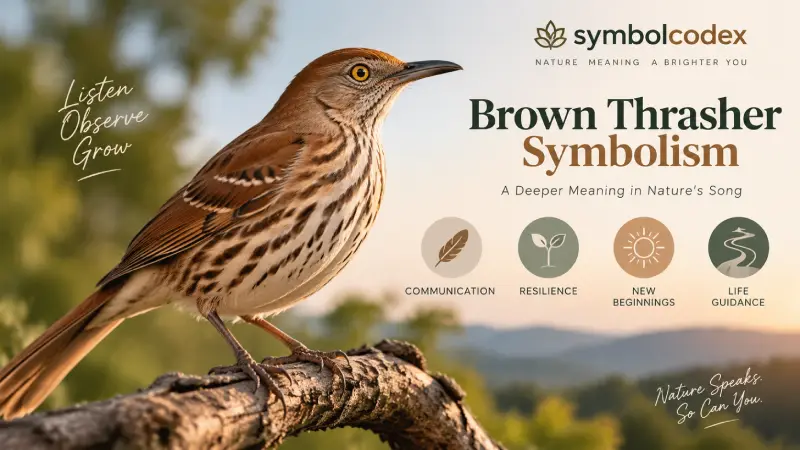
The brown thrasher is a distinctive North American songbird recognized by its warm brown feathers, streaked breast, long tail, and bright yellow eyes. Brown thrasher symbolism commonly connects the bird with communication, persistence, independence, protection, and confidence.
Unlike symbols that come mainly from mythology or religion, much of the brown thrasher’s modern symbolism comes from observing the bird itself. Its remarkable song, secretive habits, territorial behavior, and ability to imitate other sounds give people several natural qualities to associate with it.
The bird also has a strong connection with the American landscape. It can appear in backyards, brushy fields, woodland edges, parks, and suburban areas, making it familiar to many people while still being less conspicuous than birds such as cardinals or blue jays.
Quick Answer
Brown thrasher symbolism commonly represents communication, independence, persistence, protection, and confidence in modern American interpretations. Its long and varied song also makes it a natural symbol of self-expression, while its secretive behavior can represent privacy and careful observation.
TL;DR
- Brown thrashers symbolize communication and expressive individuality.
- Their persistence reflects determination and resilience.
- Territorial behavior connects them with protection and boundaries.
- Their hidden lifestyle can represent privacy and observation.
- Their songs make them popular symbols of creativity.
- Modern interpretations often emphasize independence and self-expression.
What Makes the Brown Thrasher a Symbol?
The symbolism starts with the bird’s physical appearance and behavior.
The brown thrasher is a fairly large songbird with reddish-brown upperparts, a heavily streaked breast, a long tail, and striking yellow eyes. Its coloring helps it blend into brush and leaf litter, while its long bill is well suited to searching through vegetation and soil for food.
Its behavior is even more interesting from a symbolic perspective.
Brown thrashers are known for their large vocal repertoires. They can produce many different song phrases and often repeat a phrase before moving to another. They also imitate sounds from other birds and their surroundings.
That makes communication, creativity, memory, and self-expression natural modern associations.
The bird’s habit of staying within dense vegetation adds another layer. A brown thrasher may be heard before it is seen. Symbolically, that can represent someone whose presence is noticeable through their words or actions even when they prefer to remain private.
What Does a Brown Thrasher Commonly Represent?
Brown thrashers are most often associated with communication, independence, persistence, protection, creativity, and awareness.
Communication is especially important because of the bird’s extensive vocal behavior. Its songs can be complex and varied, making it an appealing symbol for someone who has something important to say.
Independence comes from its behavior and habitat. Brown thrashers spend much of their time searching for food alone or in pairs rather than forming the large, highly visible flocks associated with some other birds.
Persistence is another fitting interpretation. The bird spends considerable time searching through leaves and vegetation for insects and other food. Its common name even refers to the way it moves through ground cover while foraging.
Protection comes from its territorial behavior. Brown thrashers can defend nesting and feeding areas, especially during the breeding season.
Together, these qualities create a symbolic profile centered on being observant, expressive, self-reliant, and willing to defend what matters.
Brown Thrasher Symbolism in the United States
In the United States, the brown thrasher is strongly associated with ordinary natural landscapes.
It is widespread across much of the eastern and central United States and is the official state bird of Georgia. That state connection gives the species an additional place in American regional identity.
For many Americans, the bird represents the quieter side of backyard nature. A brown thrasher may live near a home without constantly appearing at a feeder. Instead, people may notice rustling leaves, hear an impressive song, and only occasionally catch sight of the bird.
That experience supports meanings such as:
- Privacy
- Observation
- Connection with nature
- Independence
- Patience
- Quiet confidence
The bird’s symbolism is therefore less about being constantly visible and more about having a distinctive presence without demanding attention.
The Brown Thrasher’s Song and the Meaning of Communication
The brown thrasher’s song is one of its most important symbolic features.
It has one of the larger known song repertoires among North American songbirds. Males can produce many distinct phrases, often borrowing or imitating sounds associated with other birds.
This makes the brown thrasher a useful symbol for finding your voice.
A person who identifies with the bird might see its song as a reminder that communication does not have to sound like everyone else’s. Creativity can come from learning, observing, remembering, and combining different influences into something recognizable as your own.
The bird can therefore represent:
- Speaking with confidence
- Creative expression
- Storytelling
- Musical ability
- Curiosity
- Learning from others
- Developing an individual voice
Its song also gives the symbol an important distinction: communication is not necessarily about being loud. The brown thrasher often remains hidden while producing a remarkably noticeable song.
Brown Thrasher Symbolism and Independence
The brown thrasher can represent independence because of the way it uses space and searches for food.
It often spends time alone or in pairs, especially outside periods when young birds are dependent on their parents. It searches through leaf litter, shrubs, and ground vegetation rather than relying solely on open feeding areas.
Symbolically, this behavior can represent a person who prefers to work independently and choose their own path.
That does not mean isolation. Independence and connection can coexist.
A brown thrasher can symbolize knowing when to cooperate and when to trust your own judgment. This makes it a useful image for people entering a new stage of life, beginning a creative project, or becoming more comfortable making decisions for themselves.
What Does the Brown Thrasher Represent Spiritually?
In modern spiritual interpretations, the brown thrasher often represents finding your voice, trusting yourself, staying alert, and protecting your personal space.
There is no single universal spiritual doctrine that assigns these meanings to every brown thrasher. Much of the modern interpretation comes from the bird’s observable characteristics rather than a formal religious system.
Its song can encourage reflection on communication. Its hidden movements can suggest patience and observation. Its territorial behavior can represent the need to maintain healthy boundaries.
For someone using animal symbolism as a personal reflection tool, the brown thrasher can therefore serve as a reminder to speak honestly while still protecting privacy.
Brown Thrasher Symbolism in Native American and Folk Traditions
It is important not to assign one universal Indigenous meaning to the brown thrasher.
Native nations have different languages, oral traditions, histories, and relationships with animals. A story from one nation cannot automatically be presented as the belief of all Indigenous peoples.
Compared with animals such as the eagle, bear, wolf, or raven, the brown thrasher has a less prominent role in widely discussed pan-North American symbolic traditions.
That absence is meaningful in itself. It is better to acknowledge limited or tradition-specific evidence than to invent a universal spiritual meaning.
American folk interpretation has often been more closely connected with the bird’s behavior and song. Its unusual ability to imitate sounds makes it especially suitable for stories and observations about cleverness, communication, and mimicry.
Brown Thrasher Symbolism in Love and Relationships
In relationship symbolism, the brown thrasher can represent loyalty, communication, independence, and protecting a shared space.
The bird is not usually associated with dramatic romantic symbolism. Instead, it offers a more practical image of relationships.
Its meaning can fit couples who value personal independence while maintaining commitment to one another. The bird’s vocal nature also makes it a useful metaphor for honest communication.
A brown thrasher can therefore symbolize a relationship where both partners:
- Communicate openly
- Respect personal space
- Protect their home
- Maintain individuality
- Support each other’s growth
The symbolism is less about constant closeness and more about healthy connection without losing independence.
Brown Thrasher Symbolism in Dreams
Dream symbolism is personal, so a brown thrasher does not have one fixed meaning in every dream.
A singing brown thrasher may suggest communication, creativity, or something you want to express.
A hidden bird may point toward privacy, uncertainty, or the need to pay attention to something that is easy to overlook.
A defensive or aggressive bird could reflect conflict over personal boundaries.
The setting also matters. A brown thrasher in a familiar backyard may carry a different emotional meaning from one appearing in an unfamiliar forest.
Instead of treating the bird as a prediction, consider what the bird was doing and how you felt when you noticed it. Those details usually provide a more useful interpretation.
Brown Thrasher Meaning in Tattoos and Personal Style
A brown thrasher tattoo can represent independence, communication, creativity, persistence, or a connection with American wildlife.
Its long tail and warm earth tones make it visually different from more commonly tattooed birds.
A realistic design can emphasize appreciation for nature and birdwatching. A singing bird can focus on self-expression, while a bird surrounded by leaves can emphasize privacy and connection with the natural world.
| Design | Common Meaning | Emotional Theme | Best Fit |
|---|---|---|---|
| Singing brown thrasher | Communication | Self-expression | Writers, musicians, speakers |
| Brown thrasher in leaves | Privacy and awareness | Observation | Quiet personalities |
| Flying brown thrasher | Independence | Freedom | Personal transitions |
| Brown thrasher pair | Loyalty | Partnership | Couples or family |
| Brown thrasher with native plants | Nature connection | Grounding | Wildlife lovers |
The personal story behind the tattoo matters more than any standardized symbolism list.
Brown Thrasher Symbolism in Home Décor and Art
The brown thrasher fits naturally into artwork inspired by American landscapes.
Its earthy colors work well with illustrations of forests, shrubs, gardens, fields, and autumn scenery. A brown thrasher perched among branches can suggest quiet observation, while one shown singing can emphasize communication and creativity.
Because the species is associated with brushy habitats and leaf litter, it can also represent a less polished side of nature. Its beauty is not based on dramatic tropical colors. Instead, its character comes from its markings, movement, eyes, and voice.
For home décor, that can make the bird a symbol of natural simplicity and understated character.
Positive and Negative Brown Thrasher Symbolism
The brown thrasher has mostly positive modern associations, but its symbolism can have a less comfortable side.
Positive meanings include:
- Communication
- Creativity
- Independence
- Persistence
- Awareness
- Protection
- Confidence
- Privacy
- Adaptability
Negative interpretations can include:
- Excessive criticism
- Defensiveness
- Isolation
- Distrust
- Being overly private
- Speaking without listening
The negative side comes mainly from interpreting the bird’s territorial and vocal behavior as human personality traits.
This creates a useful symbolic balance. The brown thrasher can represent finding your voice, but it can also remind you that communication works best when speaking and listening remain connected.
Why the Brown Thrasher Can Symbolize Persistence
The brown thrasher’s feeding behavior gives persistence a practical foundation.
It commonly searches through leaf litter and vegetation for insects and other food. The bird’s movements can look almost like deliberate probing and turning as it works through its environment.
That behavior makes the brown thrasher a fitting metaphor for continuing to search when the answer is not immediately visible.
In personal symbolism, the bird may represent someone who keeps investigating, learning, or trying different approaches rather than stopping at the first obstacle.
This meaning also connects with the bird’s song. A large vocal repertoire suggests repeated practice and variation rather than reliance on one simple sound.
Brown Thrasher Symbolism and the Meaning of Privacy
Privacy is one of the less obvious but more distinctive meanings associated with the bird.
Brown thrashers often spend time in dense vegetation, where their streaked coloring provides camouflage. People may hear the bird before seeing it.
That creates a useful contrast between expression and privacy.
The brown thrasher does not need to choose between having a strong voice and remaining difficult to see. Symbolically, this can represent a person who communicates clearly but does not reveal every part of their private life.
For modern readers, that interpretation can be especially relevant in a culture where personal expression is often public and constant. The brown thrasher offers a different model: be expressive without surrendering your privacy.
Common Misunderstandings About Brown Thrasher Symbolism
A common mistake is treating every bird as if it has a universal spiritual dictionary.
Animal symbolism does not work that way. Meanings change according to culture, personal experience, artwork, folklore, and context.
Another misunderstanding is assuming that the brown thrasher’s name means it is an aggressive bird that “thrashes” other animals. The name refers to its characteristic foraging behavior as it moves through ground cover and leaf litter.
It is also easy to confuse the brown thrasher with other streaked brown birds. The species has distinctive yellow eyes, a long tail, and a particular combination of warm brown upperparts and heavily streaked underparts.
These factual details matter because symbolism becomes stronger when it begins with the real animal rather than an invented personality.
How Brown Thrasher Meaning Has Evolved
The modern symbolic image of the brown thrasher is shaped more by natural history and observation than by a single ancient mythology.
Older American observers could notice its striking song and secretive movements without needing a formal symbolic system to explain them. As birdwatching became a more established hobby, people gained greater appreciation for individual species and their behaviors.
Today, the brown thrasher can represent a combination of traits that fit contemporary ideas about identity: speak clearly, think independently, protect your boundaries, and remain persistent.
Its symbolism has therefore become less about supernatural prediction and more about using nature as a framework for personal reflection.
Brown Thrasher Symbolism in Modern American Culture
The brown thrasher has a particularly strong regional identity in the United States because it is Georgia’s state bird.
That official status gives the species a connection with state identity and local pride. Outside Georgia, it remains familiar through birdwatching, wildlife photography, gardens, parks, and backyard habitats.
Modern uses can include:
- Wildlife artwork
- Birdwatching communities
- Nature photography
- Tattoos
- Jewelry
- Garden décor
- Educational materials
- Regional identity
- Conservation messaging
Its appeal comes partly from being recognizable without being overly common in popular symbolism.
A cardinal may immediately suggest holiday imagery or romance. An eagle may suggest national identity. A brown thrasher creates a quieter message: individual character, voice, persistence, and connection with the local landscape.
Frequently Asked Questions About Brown Thrasher Symbolism
What does a brown thrasher symbolize spiritually?
A brown thrasher can symbolize communication, independence, awareness, privacy, and protecting personal boundaries. These are modern interpretive meanings rather than universal religious teachings.
What does seeing a brown thrasher mean?
A personal interpretation may focus on communication, persistence, or paying closer attention to your surroundings. The meaning depends on the circumstances and your own emotional response to the encounter.
What does a brown thrasher tattoo symbolize?
A brown thrasher tattoo can represent independence, creativity, self-expression, persistence, privacy, or appreciation for American wildlife. A singing design usually emphasizes communication, while a hidden bird may emphasize observation and privacy.
Is the brown thrasher a good symbol?
Yes. Its common positive associations include confidence, creativity, communication, persistence, and independence. Its territorial behavior can also provide a reminder about healthy boundaries.
What does a brown thrasher symbolize in love?
In relationships, the brown thrasher can represent communication, loyalty, independence, and protecting shared space. It suits relationships where both people value commitment without giving up their individual identities.
Is the brown thrasher a Native American symbol?
There is no single Native American meaning for the brown thrasher. Indigenous traditions differ by nation, and the bird should not be assigned one universal interpretation without identifying a specific cultural tradition.
Conclusion
The brown thrasher offers a different kind of bird symbolism. Its meaning does not depend on being visually spectacular or surrounded by elaborate mythology. Instead, it comes from observable qualities: an impressive voice, careful movement, persistence while foraging, and a willingness to defend its space.
For modern Americans, brown thrasher symbolism can represent communication, creativity, independence, awareness, privacy, persistence, and healthy boundaries. The bird’s combination of a strong voice and a hidden lifestyle makes it especially useful as a symbol of expressing yourself without giving away everything about yourself.
Its most practical lesson may be the simplest one: you can have a distinctive voice while still choosing when to be seen.