Meta Description: Discover what plum blossoms symbolize, explore their Chinese and Japanese origins, and learn how their meanings appear in modern American art, tattoos, and design.
Introduction
Plum blossom symbolism centers on resilience, hope, renewal, and the ability to flourish despite difficult conditions. These delicate flowers often appear in late winter, sometimes opening while snow still covers the ground. Their timing gives them a natural association with perseverance and the promise of spring.
For many Americans, plum blossoms are recognizable through East Asian paintings, decorative ceramics, floral tattoos, gardens, and traditional patterns. Their five-petaled flowers and twisting branches create an image that feels both understated and expressive. Unlike spring flowers that represent celebration after winter has passed, plum blossoms suggest that better days can begin before hardship has completely disappeared.
Understanding the flower’s symbolism means looking beyond its appearance. Chinese literary traditions, Japanese artistic practices, and contemporary American design all contribute to the ways people interpret plum blossoms today. Although these traditions share some associations, their meanings are not identical, and the significance of a particular image often depends on its cultural and personal context.
Quick Answer
Plum blossom symbolism commonly represents resilience, hope, renewal, and perseverance in modern American culture, especially in tattoos, artwork, gardens, and decorative designs. Historically, the flower has held particular importance in Chinese culture as an emblem of integrity and endurance, while Japanese traditions have also associated plum blossoms with early spring, refinement, and the arrival of a new season.
TL;DR
- Core meaning: Plum blossoms represent resilience, hope, renewal, and perseverance.
- Historical roots: Chinese poetry and painting connected the flower with integrity and endurance.
- Japanese associations: Plum blossoms often signify early spring, refinement, and seasonal renewal.
- American interpretation: The flower commonly communicates strength, optimism, and appreciation for nature.
- Modern use: Tattoos, jewelry, textiles, and home decor feature plum blossoms as meaningful motifs.
- Cultural context: The flower’s interpretation varies with artistic tradition, setting, and individual experience.
What Do Plum Blossoms Look Like?
<AsyncImageGroup query={[“white plum blossoms delicate five petals on dark twisting branches winter”,”pink plum blossom flowers close up against blue sky”,”traditional East Asian ink painting plum blossoms branches”]} aspectRatio=”5:4″ layout=”bento” size=”lg”/>
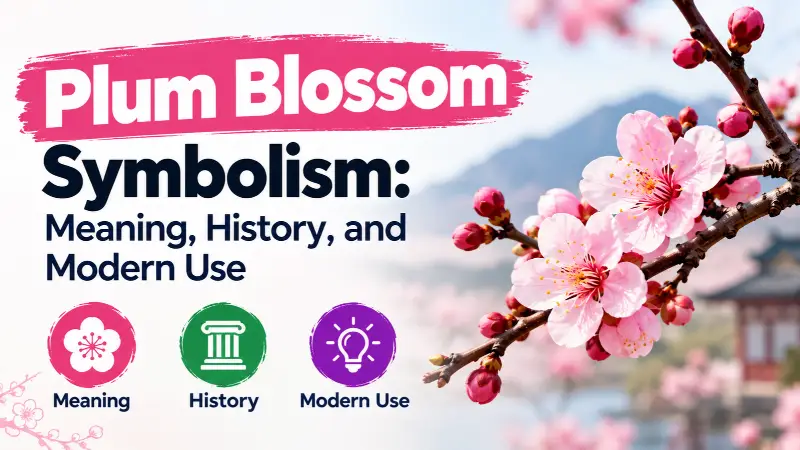
Plum blossoms grow on plum trees in the genus Prunus. Depending on the species and variety, the flowers may be white, pale pink, deep pink, or occasionally reddish. Many have five rounded petals surrounding prominent stamens, and they grow along woody branches that may appear bare when the flowers emerge.
In East Asia, flowering plum trees are particularly associated with the transition from winter to spring. Some varieties bloom while temperatures remain cold, creating a striking contrast between fragile petals and weathered branches.
This contrast explains much of the flower’s symbolic appeal. The blossoms look delicate, but the tree’s early flowering suggests endurance. In paintings, the dark, angular branches often reinforce the idea that beauty and vitality can emerge from difficult conditions.
Plum blossoms should not be confused with cherry blossoms, which are especially associated with the fleeting beauty of spring in Japanese culture. Both flowers can represent renewal, but plum blossoms have a particularly strong connection to endurance through winter and the promise of new growth.
The Core Meanings of Plum Blossoms
Although individual interpretations differ, several associations appear repeatedly in plum blossom art and cultural traditions.
Resilience and perseverance
The flower’s ability to bloom during cold weather makes it a natural emblem of persistence. Rather than waiting for comfortable circumstances, the plum tree produces flowers while winter is still present.
People may connect this meaning to recovering from setbacks, completing a difficult period, or continuing to work toward a goal despite uncertainty. A plum blossom tattoo, for example, can serve as a personal reminder that progress does not require perfect conditions.
Hope and new beginnings
Because plum blossoms often precede the full arrival of spring, they suggest that change may already be underway even when circumstances still look bleak.
This meaning can suit someone starting a new chapter, rebuilding after a loss, or approaching a transition with cautious optimism. The flower does not promise that difficulties will disappear immediately. Instead, it represents evidence that a more favorable season is approaching.
Integrity and inner strength
In Chinese cultural traditions, plum blossoms have been associated with moral character, dignity, and steadfastness. Their early flowering became a way to express strength that does not depend on external approval or favorable surroundings.
In contemporary personal symbolism, this association can represent remaining faithful to one’s principles under pressure.
Beauty and refinement
The flower’s delicate shape and restrained colors also make it a symbol of elegance. In art and design, plum blossoms can communicate sophistication without relying on elaborate ornament.
These meanings often overlap, but the emphasis changes with the context. A flowering branch in a winter landscape may highlight endurance, while a small blossom embroidered on a garment may communicate refinement and appreciation for nature.
Ancient Chinese Roots and Early Symbolism
Plum blossoms have a long history in Chinese poetry, painting, and garden culture. Their importance developed partly from their seasonal behavior: they could flower before many other plants, offering a visible sign of returning life during the cold months.
Chinese poets and painters used the plum tree to explore themes such as perseverance, solitude, integrity, and the relationship between nature and moral character. A flowering branch could suggest an individual who remained principled despite political pressure or personal adversity.
The plum blossom also became associated with cultivated taste and scholarly culture. In traditional paintings, a few carefully placed blossoms on a dark branch could convey an entire emotional atmosphere without a detailed landscape. Sparse composition emphasized the artist’s judgment and the character of the subject.
One important development was the plum blossom’s association with the Four Gentlemen, a group of plants commonly featured in Chinese literati painting: plum blossom, orchid, bamboo, and chrysanthemum. Each plant could express a quality of cultivated character. Plum blossoms were particularly suited to themes of perseverance because they flowered in conditions that appeared inhospitable.
These traditions do not mean every Chinese plum blossom image carries a single fixed message. Its interpretation can depend on the poem, inscription, artistic style, and historical setting. Nevertheless, endurance and integrity remain among its best-established cultural associations.
Plum Blossom Symbolism in Japanese Culture
<AsyncImage query=”Japanese ume plum blossoms traditional garden early spring pink white flowers” aspectRatio=”16:9″ width=”100%”/>
In Japan, plum blossoms are known as ume. They have been appreciated for centuries in poetry, gardens, decorative arts, and seasonal celebrations.
Plum blossoms arrived in Japanese cultural life through connections with the Asian mainland, including the movement of plants, literature, and artistic ideas. During earlier periods of Japanese court culture, ume blossoms were especially admired and appeared frequently in poetry. Over time, cherry blossoms became the more dominant national image of spring in many popular contexts, but plum blossoms retained their own distinctive identity.
Ume is associated with the first signs of spring, elegance, fragrance, and the transition from winter to warmer weather. Because plum trees may bloom early in the year, their flowers can mark a seasonal change before the landscape has fully awakened.
Plum blossom viewing, sometimes called ume matsuri when organized as a festival, remains a seasonal activity at Japanese gardens and shrines. These events emphasize the flower’s place in the natural calendar rather than treating it solely as an abstract symbol.
The Japanese interpretation shares the Chinese emphasis on endurance but often places particular attention on seasonal beauty, fragrance, and the anticipation of spring. The two traditions overlap without being interchangeable.
What Plum Blossoms Mean in the United States
In the United States, plum blossoms do not have one universally recognized national meaning. Their significance is shaped by East Asian cultural traditions, exposure to botanical gardens and museums, personal relationships, and contemporary visual design.
For many Americans, the flower represents resilience and optimism. Its winter-blooming character makes it an appealing image for people who want to express the idea of moving forward during a difficult period. It may appear in a tattoo commemorating recovery, a framed print celebrating a new beginning, or a garden chosen for its early flowers.
Plum blossoms also appear in American collections of Asian art, Asian American cultural spaces, restaurants, textiles, and decorative objects. In these settings, the flower may communicate an appreciation for East Asian aesthetics or reflect a meaningful cultural connection.
It is important, however, not to assume that everyone who uses the design intends the same message. Someone may choose plum blossoms because they love the color and shape, while another person may select them because of family heritage or the flower’s association with perseverance.
In American public culture, plum blossoms are generally less standardized than familiar national symbols such as the bald eagle or the rose. Their meaning is therefore more dependent on the individual image and the person interpreting it.
The Five Petals and Their Traditional Associations
Plum blossoms are often depicted with five petals. In Chinese symbolic traditions, the five petals have been associated with the Five Blessings: longevity, wealth, health or peace, virtue, and a natural or peaceful death.
This association makes five-petaled plum blossom motifs especially meaningful in some traditional decorative contexts. They may appear on objects intended to communicate wishes for well-being, prosperity, and a fortunate life.
The five-petal design can also serve a straightforward artistic purpose. Its balanced shape is easy to recognize and works well in embroidery, painting, ceramics, and jewelry.
Not every five-petaled plum blossom image is deliberately intended to represent the Five Blessings. In botanical illustration, the five petals may simply reflect the flower’s natural structure. The cultural association is most relevant when the design appears in a context that draws on traditional Chinese symbolism.
Plum Blossoms in Art, Poetry, and Literature
Plum blossoms have served as a compact visual language in East Asian art. An artist can place pale petals against dark, twisting branches to suggest contrast between delicacy and endurance.
In Chinese ink painting, the flower often appears with restrained brushwork. The artist’s control over each branch and petal matters as much as botanical accuracy. The resulting image may communicate discipline, solitude, or the beauty of an unadorned natural scene.
Poetry gives the flower another dimension. Because plum blossoms can emerge in cold weather, writers have used them to explore the relationship between difficult circumstances and personal character. The blossom becomes evidence that hardship does not necessarily prevent beauty or achievement.
In Japanese poetry and garden design, plum blossoms also invite attention to seasonality, fragrance, and anticipation. Their arrival signals a change that is not yet complete, giving them a different emotional character from flowers associated with the height of spring.
American readers may encounter these associations in translated poetry, museum collections, illustrated books, and contemporary art. Understanding the original context helps prevent the flower from being reduced to a generic symbol of beauty.
Plum Blossom Symbolism by Color
Color can influence the impression a plum blossom design creates, although there is no single universal color code shared across all cultures.
<box gap={3}> <row align=start gap={3}> <AsyncImage query=”white plum blossom flowers dark branches close up” aspectRatio=”3:4″ maxWidth=”112px”/> <box flex=”1″ gap={1}> **White plum blossoms**
  White flowers often suggest purity, simplicity, sincerity, and quiet dignity. In contemporary American decor, they can create a calm, understated atmosphere, particularly when paired with dark branches or neutral backgrounds.
</box>
</row> <divider color=”subtle”/> <row align=start gap={3}> <AsyncImage query=”soft pink ume plum blossoms flowering branch close up” aspectRatio=”3:4″ maxWidth=”112px”/> <box flex=”1″ gap={1}> **Pink plum blossoms**
  Pink blossoms can convey tenderness, affection, gentleness, and the excitement of new beginnings. They are popular choices for floral illustrations, romantic gifts, and delicate tattoo designs.
</box>
</row> <divider color=”subtle”/> <row align=start gap={3}> <AsyncImage query=”deep red crimson plum blossoms on dark winter branches” aspectRatio=”3:4″ maxWidth=”112px”/> <box flex=”1″ gap={1}> **Red plum blossoms**
  Red flowers may suggest vitality, celebration, good fortune, and confidence, particularly in Chinese-inspired decorative contexts. In American designs, red can also add warmth and visual intensity.
</box>
</row> </box>
These interpretations are useful starting points, not strict rules. A white blossom can represent a personal memory, and a pink one can stand for perseverance just as readily as affection. The surrounding imagery and the owner’s intention often matter more than the color alone.
Plum Blossoms in Tattoos and Personal Style
<AsyncImageGroup query={[“minimalist plum blossom branch fine line tattoo forearm”,”Japanese style pink ume blossoms black branch tattoo design”,”delicate plum blossom floral tattoo shoulder”]} aspectRatio=”5:4″ layout=”bento”/>
Plum blossom tattoos are appealing to people who want floral imagery with a meaning beyond physical beauty. The flower’s association with endurance makes it a fitting choice for someone who has navigated a challenging period, while its early blooming can represent a fresh start.
Design choices can change the message:
- A single blossom can suggest a small but meaningful beginning.
- A flowering branch can emphasize growth, continuity, and perseverance.
- Blossoms against snow can make the connection to endurance more explicit.
- A branch with buds and open flowers can suggest potential becoming reality.
- A traditional ink-style design can acknowledge the visual language of East Asian painting.
People also incorporate plum blossoms into jewelry, scarves, embroidered clothing, and accessories. A small pendant may serve as a private reminder of resilience, whereas a large floral pattern may be chosen mainly for its visual elegance.
Anyone choosing a design inspired by Chinese or Japanese art can benefit from learning the differences between the traditions. Using a culturally meaningful motif thoughtfully does not require claiming an identity or belief that is not one’s own; it requires understanding the context and avoiding inaccurate claims about what the image represents.
Plum Blossoms in Home Decor, Gardens, and Design
In American homes, plum blossom imagery works in both traditional and contemporary settings. A monochrome branch painting may complement minimalist interiors, while pink blossoms on a screen, ceramic vase, or fabric can add color to a room without overwhelming it.
The design’s natural contrast is one reason it works so well. Angular branches provide structure, while rounded petals soften the composition. This balance makes plum blossoms suitable for wall art, stationery, tableware, textiles, and seasonal decorations.
Living plum trees offer a different experience. Depending on the species and local climate, flowering plums can provide early-season interest in a garden before many other ornamental trees bloom. Gardeners may appreciate them for their flowers, fragrance, or fruit, rather than for symbolism alone.
In landscape design, the tree can suggest patience and seasonal awareness. Watching buds open after winter offers a concrete reminder that change often begins gradually. However, not every ornamental tree sold as a flowering plum is the same species as the East Asian Prunus mume, so identification matters when selecting a plant.
Emotional and Psychological Meaning
The appeal of plum blossoms often comes from the relationship between their appearance and their growing conditions. The flowers look fragile, yet their emergence during cold weather suggests persistence. That contrast makes the image useful for expressing feelings that might otherwise be difficult to put into words.
For someone recovering from a disappointment, a plum blossom can represent progress without requiring a claim that the experience was easy. For someone entering a new phase of life, it can express cautious optimism. For another person, it may simply evoke a peaceful winter morning or a beloved garden.
The flower can also symbolize independence. A branch blooming before the surrounding landscape has changed suggests that a person can develop at a different pace from everyone else. This interpretation may appeal to people who are building a career, learning a skill, or following an unconventional path.
These are interpretations rather than established psychological effects. A plum blossom image does not automatically make someone more resilient or optimistic. Its emotional value depends on the memories, associations, and intentions that the individual brings to it.
Religious and Spiritual Interpretations
Plum blossoms appear in some East Asian Buddhist and Zen artistic contexts, but they do not have one universal meaning across Buddhism or other religions.
In certain Japanese ink paintings, the plum tree’s arrival in spring can be connected with seasonal renewal and, depending on the artwork, broader ideas about perception and enlightenment. The interpretation depends on the painting’s composition, inscriptions, and religious setting.
Chinese plum blossom art is also associated with Confucian ideals of cultivated character, especially perseverance and integrity. These associations are ethical and literary as much as they are spiritual; they should not automatically be treated as religious doctrine.
In the United States, someone may incorporate plum blossoms into a meditation space, personal altar, or contemplative artwork. Such use can reflect an individual practice rather than a prescribed religious requirement.
It is therefore more accurate to describe plum blossoms as culturally and spiritually meaningful in particular contexts than to label them universally sacred, lucky, or religious.
Common Misunderstandings About Plum Blossom Symbolism
Several misconceptions can lead people to overstate or misinterpret the flower’s meaning.
Plum blossoms and cherry blossoms are not interchangeable. Both are associated with spring in East Asian culture, but plum blossoms are especially known for flowering early and enduring cold conditions. Cherry blossoms are more widely associated with the fleeting beauty of spring in Japanese cultural imagery.
The five petals do not always represent the Five Blessings. That interpretation belongs to a particular Chinese symbolic tradition. A botanical illustration or modern floral tattoo may use five petals without intending that meaning.
The flower is not exclusively Japanese or Chinese. Its cultural history includes movement across East Asia, and plum blossom imagery also appears in Korean art and other regional traditions. A design’s specific origin should be identified before assigning it a single national meaning.
It is not automatically a symbol of good luck. Auspicious associations exist, particularly in traditional Chinese and Japanese decorative contexts, but resilience, integrity, and seasonal renewal are often more central interpretations.
Finally, a modern floral design does not have to carry an elaborate cultural message. Some people choose plum blossoms because they appreciate the shape, the colors, or the association with a favorite season. Personal meaning and historical meaning can coexist without being identical.
How Plum Blossom Meaning Has Evolved
The flower’s symbolism has developed as it has moved between literature, painting, gardens, and modern visual culture.
In Chinese traditions, its early flowering helped establish associations with endurance and moral character. The plum tree became a recurring subject in scholarly painting, where its weathered branches and fresh flowers could express a relationship between hardship and integrity.
As plum cultivation and artistic practices spread to Japan, the ume became part of Japanese seasonal life. Poetry, garden viewing, decorative patterns, and auspicious motifs developed around the flower. In some settings, the emphasis fell on refinement and the first signs of spring; in others, the plant represented strength under difficult conditions.
Today, these historical associations coexist with contemporary uses in American fashion, tattoo culture, illustration, and interior design. A modern image may retain traditional symbolism, reinterpret it, or simply borrow the flower’s visual qualities.
The result is not a single meaning that has remained unchanged. It is a family of related interpretations shaped by climate, artistic practice, cultural exchange, and individual experience.
Plum Blossom Symbolism at a Glance
| Context | Common meaning | Typical association | Important distinction |
|---|---|---|---|
| Chinese art | Integrity and perseverance | The Four Gentlemen; winter flowering | Often linked to cultivated moral character |
| Japanese culture | Early spring and refinement | Ume viewing, poetry, auspicious designs | Distinct from the more prominent cherry blossom tradition |
| American tattoos | Resilience and new beginnings | Personal milestones and recovery | The meaning is usually chosen by the wearer |
| Home decor | Elegance and calm | Floral prints, ceramics, textiles | Design preferences may matter more than symbolism |
| Traditional Chinese motifs | Blessings and good fortune | Five-petaled flowers | The Five Blessings association is context-specific |
FAQs
What does a plum blossom symbolize spiritually?
Plum blossoms can represent perseverance, renewal, integrity, and the ability to remain steady during difficult circumstances. In particular Buddhist, Zen, and Confucian-influenced artistic settings, the flower may carry additional contemplative or ethical meanings, but these interpretations are not universal religious rules.
What does a plum blossom tattoo mean?
A plum blossom tattoo commonly represents resilience, hope, personal growth, or a fresh start. The wearer may emphasize these meanings through imagery such as winter branches, emerging buds, or flowers opening against a stark background.
Are plum blossoms considered lucky?
Plum blossoms can have auspicious associations in traditional Chinese and Japanese decorative culture. In Chinese symbolism, the five petals are sometimes connected with the Five Blessings, although not every plum blossom design is intended as a good-luck symbol.
What is the difference between plum blossoms and cherry blossoms symbolically?
Plum blossoms are particularly associated with endurance through cold weather, integrity, and the first signs of spring. Cherry blossoms are widely associated with the beauty and brevity of life, especially in Japanese cultural traditions, although meanings can overlap.
What do white plum blossoms mean?
White plum blossoms may suggest purity, simplicity, dignity, and quiet elegance. Their interpretation depends on context, and the color alone does not establish a fixed cultural or spiritual message.
What do the five petals of a plum blossom represent?
In some Chinese traditions, the five petals correspond to longevity, wealth, health or peace, virtue, and a peaceful death—the Five Blessings. In other settings, the petals are simply part of the flower’s natural appearance or a decorative design choice.
Can plum blossoms symbolize a new beginning?
Yes. Because plum blossoms can open before winter has fully ended, they are often interpreted as signs of hope and the beginning of change. They can be especially appropriate for commemorating a fresh start that follows a difficult period.
Conclusion
Plum blossom symbolism brings together resilience, hope, integrity, and renewal through the image of a flower that opens while winter still lingers. Chinese literary and artistic traditions emphasize endurance and cultivated character, while Japanese culture also celebrates the ume as a sign of early spring, refinement, and seasonal change.
In modern America, the flower appears in tattoos, artwork, gardens, jewelry, and home decor, where its meaning may draw on cultural history or personal experience. Understanding those distinctions makes it easier to appreciate the flower without reducing its traditions to a single universal definition.
A plum blossom does not promise an easy season ahead. Its symbolism rests on a simpler observation: new growth can begin even when conditions are still difficult.