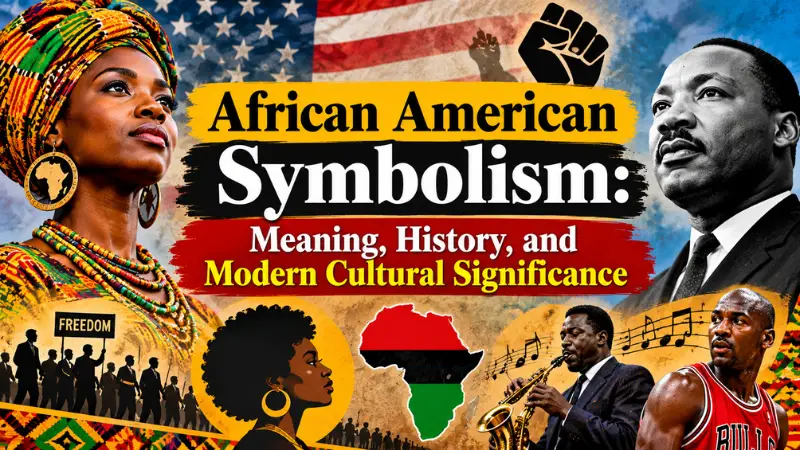
African American symbolism represents the cultural identity, historical experiences, shared memories, and creative traditions of Black Americans. From the raised fist and Pan-African colors to natural hairstyles, spiritual music, and traditional textiles, African American symbolism communicates ideas about freedom, resilience, ancestry, equality, and community.
These symbols developed through generations of African American life, including the experience of slavery, emancipation, the Civil Rights Movement, the Harlem Renaissance, and contemporary cultural expression. Some emerged from political movements, while others grew from everyday practices such as music, clothing, storytelling, worship, and family traditions.
Understanding these symbols requires looking beyond their appearance. A raised fist, for example, can represent solidarity and resistance, while an Afro hairstyle can communicate cultural pride and the rejection of narrow beauty standards. Their meanings often depend on the historical period, the person using them, and the surrounding cultural context.
Quick Answer
African American symbolism commonly represents Black identity, cultural pride, freedom, equality, resilience, and community in modern American culture. Historically, these meanings developed through African heritage, the struggle against slavery and racial discrimination, religious traditions, and movements for civil rights and self-determination.
TL;DR
- Identity: Symbols celebrate African American heritage and cultural belonging.
- Freedom: Many represent emancipation, equality, and resistance to oppression.
- Ancestry: African-inspired patterns, textiles, and traditions connect generations.
- Pride: Natural hairstyles and clothing express confidence in Black identity.
- Community: Music, churches, storytelling, and shared traditions strengthen belonging.
- Modern expression: Art, fashion, tattoos, and public celebrations preserve cultural memory.
1. What African American Symbols Look Like
African American cultural symbols do not belong to one particular visual category. They appear in clothing, hairstyles, flags, artwork, music, religious objects, historical monuments, and everyday household decorations.
Some are immediately recognizable. The raised Black Power fist, for instance, is a familiar political image associated with solidarity and resistance. Red, black, and green are widely recognized Pan-African colors, while kente cloth is associated with African heritage and cultural pride.
Other symbols are less obvious because they are expressed through traditions rather than individual objects.
Examples include:
- Gospel music and spiritual singing.
- Traditional African-inspired hairstyles, including cornrows and Bantu knots.
- Quilting and textile-making traditions.
- Church gatherings and community celebrations.
- African American storytelling and oral history.
- Family reunions and commemorative traditions.
These expressions communicate cultural knowledge even when they do not contain an explicitly political message.
It is also important to recognize that African American culture is not uniform. Regional backgrounds, family histories, religious beliefs, and individual experiences influence how people interpret cultural symbols.
2. The Core Meanings Behind African American Symbolism
Several interconnected ideas appear repeatedly in African American cultural expression.
Freedom and independence are among the most recognizable meanings. Symbols connected to emancipation, voting rights, and civil rights recall the long struggle to secure legal and social equality.
Cultural pride is another central theme. Hairstyles, clothing, literature, and artistic traditions can affirm the beauty and value of Black identity, particularly in response to historical discrimination.
Resilience and survival reflect the ability of African American communities to preserve traditions and develop new forms of expression despite slavery, segregation, and exclusion.
Ancestral connection links contemporary African Americans with African cultural traditions and the generations who came before them.
Unity and solidarity appear in political movements, religious gatherings, community organizations, and cultural celebrations.
These meanings overlap, but they are not interchangeable. A symbol associated with ancestral heritage may not necessarily communicate political resistance, while a protest symbol may express a specific demand for social change.
3. African Roots and the Historical Development of Black Identity
African American cultural symbolism has roots in the diverse societies of West and Central Africa. Enslaved Africans brought with them languages, artistic practices, musical traditions, spiritual beliefs, craftsmanship, and systems of community organization.
Although slavery disrupted families and attempted to suppress African cultural practices, many traditions survived through adaptation and cultural exchange. African influences became part of a distinct African American culture that developed in the United States.
Textiles, geometric designs, oral storytelling, music, dance, and communal celebrations became important ways of preserving cultural knowledge. These traditions did not remain unchanged. They developed through contact with European American and Indigenous cultures and through the experiences of successive generations.
The nineteenth century added new meanings to cultural expression. Under slavery, religious songs and communal practices could communicate hope, suffering, and spiritual endurance. After emancipation, African American churches, educational institutions, newspapers, and cultural organizations became important spaces for expressing independence and collective identity.
The Harlem Renaissance of the 1920s and 1930s brought another important development. Writers, musicians, visual artists, and intellectuals presented Black life as a subject worthy of serious artistic and cultural recognition.
Later, the Civil Rights and Black Power movements gave familiar cultural expressions more explicitly political meanings. Natural hairstyles, African-inspired clothing, and visual references to African heritage became public statements of pride and self-determination.
4. The Pan-African Colors and Their Cultural Meaning
File:Flag of the UNIA.svg – Wikimedia Commons
The red, black, and green Pan-African flag is among the most recognizable symbols associated with African heritage and Black unity.
The flag was adopted in 1920 by Marcus Garvey’s Universal Negro Improvement Association (UNIA). Garvey promoted international solidarity among people of African descent and encouraged pride in African identity.
The colors are commonly interpreted as follows:
- Red: The blood and sacrifices of people of African descent, including those who struggled against oppression.
- Black: The people of African ancestry and their collective identity.
- Green: The land, natural resources, and future possibilities associated with Africa.
These interpretations became widely recognized through Pan-African movements, although explanations can vary among organizations and communities.
In the United States, the colors became especially visible during the Black Power era. They appeared on clothing, flags, posters, community organizations, and cultural events.
Today, people use Pan-African colors during Black History Month, cultural festivals, educational programs, and celebrations of African heritage. Wearing them can express solidarity with the wider African diaspora rather than allegiance to a particular political organization.
5. Kente Cloth: Ancestry, Achievement, and Cultural Pride
What Is Kente Cloth? A Look at the African Textile
Kente cloth is a brightly colored woven textile originating among the Akan peoples of Ghana, particularly associated with Asante and Ewe weaving traditions.
Its intricate patterns and colors make it recognizable in African-inspired clothing and ceremonial dress. Different designs can carry names, histories, and cultural associations.
Kente became especially visible in African American cultural expression during the twentieth century. Ghana’s independence in 1957 helped increase international interest in African identity, and the cloth became associated with Pan-African pride.
In the United States, kente is often worn during:
- College and university graduation ceremonies.
- African American cultural celebrations.
- Black History Month events.
- Religious and community ceremonies.
- Family celebrations and commemorations.
For many African Americans, wearing kente represents a connection with African ancestry and a desire to recognize heritage publicly.
However, kente is not simply a generic African decoration. Its specific origins belong to living Ghanaian cultural traditions. Appreciating its symbolism means recognizing the people, craftsmanship, and cultural history behind the textile.
6. Natural Hair, the Afro, and the Meaning of Black Beauty
The Many Times Women Led World Revolutions | by Christyl Rivers, Phd. | Fourth Wave | Medium
24 Cornrow Styles for Afro Hair Women – Bold Hairstyles
6
Hair is one of the most personal and recognizable expressions of African American cultural identity.
Styles such as Afros, cornrows, twists, locs, and Bantu knots have different histories and practical purposes. Some hairstyles also carry connections to particular African communities and traditions.
During the 1960s and 1970s, the natural Afro became closely associated with the Black Is Beautiful movement. Wearing natural hair challenged beauty standards that treated European features and straighter hair textures as the preferred norm.
The Afro therefore came to communicate several ideas:
- Acceptance of natural Black features.
- Pride in African ancestry.
- Resistance to racialized beauty standards.
- Personal independence and self-expression.
- Solidarity with Black cultural movements.
The meaning of natural hair has continued to evolve. Today, someone may wear an Afro simply because they enjoy the style, while another person may understand it as an expression of cultural pride or political identity.
Hair discrimination also remains part of this history. Restrictions and negative stereotypes concerning Black hairstyles have contributed to legal and workplace debates, including the movement behind the CROWN Act, which addresses race-based hair discrimination.
The Smithsonian’s National Museum of African American History and Culture highlights how hair connects identity, personal expression, cultural transmission, and social history. National Museum of African American History+1
7. The Raised Fist and Black Power Symbolism
Political Tension at the Olympics: A History [Interactive Timeline] | KQED
The raised fist is one of the most recognizable symbols of Black political resistance in modern American history.
Although the clenched fist existed as a symbol of solidarity and protest before the twentieth century, it became particularly associated with Black Power during the 1960s.
One defining moment occurred on October 16, 1968, at the Mexico City Olympics. American athletes Tommie Smith and John Carlos raised their black-gloved fists during the medal ceremony for the men’s 200-meter race.
Their demonstration drew attention to racial inequality and human rights. Their clothing and accessories also carried messages: their black socks without shoes highlighted Black poverty, while beads represented opposition to lynching.
The gesture became an internationally recognized image of protest and solidarity.
Today, the raised fist appears in:
- Civil rights memorials and historical exhibitions.
- Protest posters and political artwork.
- T-shirts and fashion designs.
- Social media graphics.
- Murals and public installations.
Its meaning generally includes resistance, collective strength, dignity, and the demand for equal rights. However, it can also represent broader struggles against injustice outside African American communities.
8. Spirituals, Gospel Music, and the Symbolism of Faith
Hogan Archive of New Orleans Music and New Orleans Jazz | Tulane University Libraries
Music has been one of the most enduring forms of African American cultural expression.
African American spirituals developed among enslaved people in the American South, particularly during the eighteenth and nineteenth centuries. Their lyrics frequently drew on biblical stories involving Moses, Daniel, deliverance, suffering, and hope.
These songs expressed Christian faith while addressing the emotional realities of enslavement.
For example, the biblical story of the Israelites escaping bondage in Egypt offered a meaningful framework through which enslaved people could express their longing for liberation.
Call-and-response singing also reflected musical practices with African roots. A leader would sing a phrase, and a congregation or group would respond.
Spirituals commonly symbolize:
- Faith during hardship.
- Hope for liberation.
- Collective memory.
- Religious endurance.
- Community and shared experience.
Gospel music continued and transformed these traditions, developing into a major influence on American popular music.
It is important not to assume that every spiritual contained a secret escape message. Some songs were used in specific historical circumstances for communication, but claims about particular coded meanings require evidence. The Library of Congress documents both the religious foundations and varied historical functions of these musical traditions. Library of Congress+2
9. Quilting, Storytelling, and the Preservation of Family History
Evolving Perspectives on Quilts as Folk Art | Art & Object
Quilting represents craftsmanship, family relationships, creativity, and cultural continuity in many African American communities.
One especially recognized example comes from Gee’s Bend, Alabama, where generations of Black women developed distinctive quiltmaking traditions. Their work often features geometric arrangements, unusual combinations of fabric, and individual artistic decisions.
These quilts demonstrate how practical household objects can also become cultural artwork.
For many families, quilts preserve memories through the reuse of clothing and fabric associated with relatives. A piece of material from a loved one’s dress or shirt can become part of an object passed down through generations.
African American quilting is also connected with women’s labor, community cooperation, and the preservation of artistic knowledge.
An important historical distinction concerns the popular Underground Railroad quilt-code story. The claim that specific quilt patterns systematically communicated escape instructions to freedom seekers remains unsubstantiated by convincing historical documentation. The National Park Service and Smithsonian folklorists caution against presenting that theory as established fact.
This distinction does not diminish the cultural importance of African American quilting. Its documented artistic, domestic, and community significance is substantial without requiring an unsupported secret-code explanation. National Park Service+2
10. African American Symbolism in Religion and Community Life
Religion has played an important role in the history of African American communities, particularly through the development of independent Black churches.
During slavery and after emancipation, religious gatherings provided opportunities for worship, fellowship, education, and community organization.
The Black church became more than a place of religious services. It also served as a meeting space, a source of leadership, and an institution supporting civil rights and social development.
Several religious expressions carry recognizable cultural associations:
- The church: Community support, faith, education, and collective leadership.
- The cross: Christian belief, sacrifice, salvation, and spiritual hope.
- The choir: Shared worship, musical heritage, and fellowship.
- The pulpit: Religious teaching, public leadership, and social commentary.
- The dove: Peace, hope, and the Holy Spirit in Christian traditions.
Not every African American identifies as Christian or religious. African American culture also includes Muslim communities, other religious traditions, and secular perspectives.
For that reason, religious symbols should be understood as important parts of a diverse cultural history rather than universal expressions of Black identity.
11. African American Symbolism in Juneteenth and Black History Month
JUNETEENTH FLAG: THE MEANING BEHIND THE COLORS AND SYMBOLS – FSFlag
2024 Homewood-Flossmoor Juneteenth Festival – Eventeny
Honoring Black History. Inspiring Youth.
7
Public celebrations provide some of the clearest examples of how historical experiences become shared cultural symbols.
Juneteenth, observed on June 19, commemorates the announcement of emancipation in Galveston, Texas, in 1865, when Union General Gordon Granger announced the end of slavery there. The event occurred more than two years after the Emancipation Proclamation took effect.
The Juneteenth flag uses red, white, and blue, connecting the history of emancipation with American citizenship. Its central star represents Texas and the freedom of African Americans across the country, while the surrounding burst suggests a new beginning.
Red foods, family gatherings, historical reenactments, music, and community events have also become recognizable parts of Juneteenth celebrations, although practices differ from place to place.
Black History Month, observed nationally in February, provides another setting for cultural symbolism.
Images of influential writers, musicians, educators, activists, and historical leaders help communicate the achievements and experiences of African Americans.
The two observances serve related but distinct purposes: Juneteenth emphasizes emancipation and the unfinished history of freedom, while Black History Month recognizes the broader contributions and experiences of Black Americans.
12. How African American Symbols Are Used in Modern American Culture
African American symbolism is visible in contemporary American life far beyond historical museums and commemorative events.
| Symbol or Expression | Common Meaning in the USA | Where It Appears |
|---|---|---|
| Pan-African flag | African heritage and international Black unity | Clothing, flags, cultural events |
| Kente cloth | Ancestry, achievement, and cultural pride | Graduation ceremonies, formal clothing |
| Raised fist | Resistance, solidarity, and equality | Murals, protests, artwork |
| Afro hairstyle | Natural beauty and cultural confidence | Fashion, photography, personal style |
| Gospel music | Faith, hope, and community | Churches, concerts, recordings |
| Juneteenth flag | Emancipation and a new beginning | Festivals, public celebrations |
In fashion, African-inspired prints, natural hairstyles, and culturally meaningful accessories allow people to express individual identity.
In visual art, Black artists frequently explore ancestry, family memory, racial justice, and the relationship between African and American experiences.
In entertainment, hip-hop, jazz, blues, gospel, and other musical traditions continue to communicate cultural history while influencing mainstream American culture.
Social media has also changed how symbols circulate. Historical photographs, cultural slogans, educational illustrations, and images of community celebrations can reach audiences far beyond their original settings.
However, contemporary use does not always carry the same meaning as historical use. A fashion accessory may be primarily decorative for one person and an expression of heritage for another.
13. Cross-Cultural Connections Across the African Diaspora
African American symbolism is connected to a wider African diaspora that includes communities in the Caribbean, Latin America, Europe, and other parts of the world.
These communities share certain historical experiences, including the forced migration of Africans through the transatlantic slave trade. However, their cultural traditions developed differently according to local histories, languages, religions, and social conditions.
Several examples illustrate these connections.
Adinkra symbols: Originating among Akan communities in Ghana, these visual symbols communicate ideas such as wisdom, perseverance, unity, and responsibility. They are increasingly used in African American artwork, jewelry, and educational settings.
Ankh: An ancient Egyptian symbol resembling a cross with a loop at the top, traditionally associated with life. It appears in some contemporary African American jewelry and Afrocentric artwork as a reference to African heritage.
Kente patterns: These woven designs connect contemporary African American cultural expression with specific Ghanaian textile traditions.
African-inspired drumming: Rhythmic traditions from different African regions influenced musical developments in African American communities, particularly through call-and-response, improvisation, and communal performance.
These connections demonstrate cultural continuity, but they should not be treated as evidence that all African societies share identical beliefs or symbols.
14. Emotional and Psychological Significance
Cultural symbols can influence how individuals understand themselves and their relationship with their communities.
For African Americans, symbols associated with ancestry and heritage may provide a visible connection to family history, especially when historical slavery disrupted genealogical records and separated generations.
A person wearing a Pan-African necklace, for example, might feel connected to a wider cultural community. Someone choosing to wear natural hair may experience confidence through embracing features that were historically criticized or discriminated against.
Different symbols can communicate different emotional experiences:
- Belonging: Recognizing shared cultural traditions and community experiences.
- Pride: Appreciating African ancestry and Black achievements.
- Remembrance: Honoring ancestors and historical struggles.
- Hope: Recognizing progress while continuing to pursue equality.
- Solidarity: Expressing support for people experiencing discrimination.
- Self-acceptance: Celebrating personal appearance and cultural identity.
These meanings are not automatic psychological effects. Individuals interpret symbols through their own experiences, beliefs, and relationships.
For some people, an African American cultural symbol represents family and celebration. For others, it recalls historical injustice or political activism. Both interpretations can be meaningful.
15. Controversies, Misinterpretations, and Cultural Appropriation
African American symbols sometimes become controversial when their historical background is ignored, simplified, or misrepresented.
One example is the use of traditional African textiles and designs without acknowledging their cultural origins. Wearing African-inspired clothing is not inherently disrespectful, but treating culturally significant objects as meaningless decoration can overlook the communities and craftsmanship behind them.
Another issue involves reducing all African American symbols to images of oppression. Black cultural identity includes hardship and resistance, but it also encompasses creativity, intellectual achievement, humor, celebration, spirituality, and everyday family life.
Historical misinformation creates additional problems.
The Underground Railroad quilt-code story is a particularly important example. Although it is frequently presented as established history, historians have not found sufficient contemporary evidence to verify the claimed system of coded quilt patterns.
Similarly, the meaning of the raised fist should not be reduced to a single political organization. Its broader history includes international solidarity, labor movements, human rights activism, and Black political expression.
Respectful interpretation requires three things:
- Recognizing the historical origin of a symbol.
- Distinguishing documented history from popular stories.
- Respecting the diversity of people who use or interpret it.
A symbol’s meaning can change, but its historical background should not be rewritten to suit a modern interpretation.
16. How African American Symbolism Continues to Evolve
African American cultural expression continues to develop as new generations reinterpret inherited traditions.
Older symbols remain relevant, but they increasingly appear alongside contemporary forms of expression.
For example, younger artists may combine traditional African textile patterns with modern graphic design. Musicians may incorporate gospel influences into hip-hop and contemporary R&B. Fashion designers may use historical hairstyles and clothing references in entirely new ways.
Digital culture has also expanded the visibility of African American symbolism. Historical images, cultural discussions, artwork, and commemorative messages now circulate through social platforms.
At the same time, conversations about representation, cultural ownership, racial equality, and historical education influence how these symbols are understood.
This evolution does not mean that traditional meanings disappear. Instead, new interpretations develop alongside older ones.
The continued presence of African American symbolism in art, education, music, public celebrations, and personal style demonstrates how cultural heritage can remain relevant without becoming fixed in one historical period.
FAQs
1. What is the main meaning of African American symbolism?
African American symbolism primarily represents Black identity, cultural heritage, freedom, resilience, equality, and community. Its individual meanings depend on the historical origins of a symbol and the context in which someone uses it.
2. What colors represent African American heritage?
Red, black, and green are widely recognized as Pan-African colors. They commonly represent the sacrifices of African people, Black identity, and African land and heritage, respectively.
3. What does the raised Black Power fist symbolize?
The raised fist represents solidarity, resistance, dignity, and the pursuit of racial equality. It became particularly recognizable through the Black Power movement and the 1968 Olympic demonstration by Tommie Smith and John Carlos.
4. What does African American symbolism mean in tattoos?
African American-inspired tattoos can represent ancestry, family history, cultural pride, personal identity, or social justice. Common designs include Pan-African colors, African-inspired patterns, meaningful portraits, and raised fists.
5. What is the significance of kente cloth in African American culture?
Kente cloth represents a connection to African heritage, cultural achievement, and identity. In the United States, it is frequently worn at graduations, cultural celebrations, and ceremonies recognizing African ancestry.
6. Are African American symbols always connected to slavery and oppression?
No. Although historical resistance and emancipation are important themes, African American symbolism also represents creativity, family, spirituality, achievement, beauty, education, and community celebration.
7. How is African American symbolism different from general African symbolism?
African symbolism includes traditions from the many distinct societies and cultures across the African continent. African American symbolism reflects the experiences and cultural development of Black Americans, incorporating African influences alongside traditions created in the United States.
Conclusion
African American symbolism represents a broad cultural history shaped by African ancestry, the struggle for freedom, artistic creativity, religious traditions, and the development of Black American identity. Its meanings appear in recognizable symbols such as the Pan-African flag and raised fist, as well as in everyday expressions such as natural hairstyles, music, textiles, and family traditions.
Understanding these symbols means recognizing both their historical origins and their contemporary interpretations. They are not simply decorative images or reminders of past struggles; they also express achievement, belonging, creativity, and the continued development of African American culture.
Ultimately, African American symbolism helps preserve cultural memory while giving present and future generations ways to express who they are, where their communities come from, and what they want to carry forward.