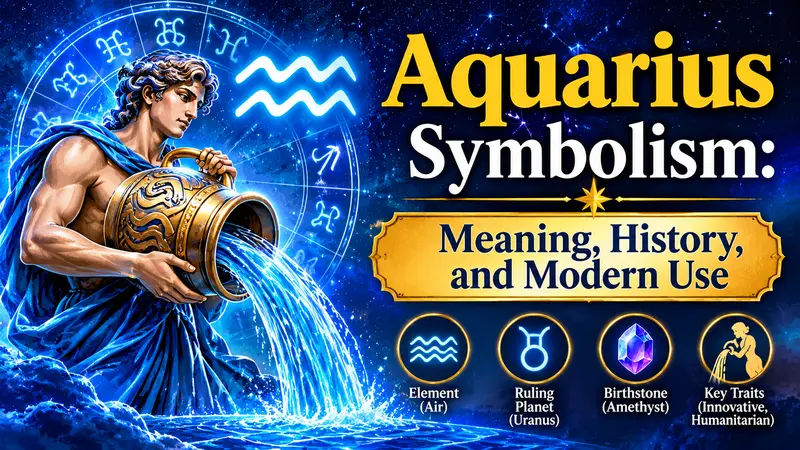
Aquarius symbolism is closely associated with independence, originality, humanitarian values, intellectual curiosity, and social progress. Represented by the Water Bearer, the eleventh sign of the zodiac carries an image of someone pouring water for the benefit of others. Although its name suggests a connection to water, Aquarius is actually an air sign in Western astrology, making its symbolism especially interesting.
People encounter Aquarius in astrology charts, zodiac jewelry, tattoos, birthday decorations, personality descriptions, and popular culture. For many Americans, it represents an independent thinker who questions conventional ideas and believes society can improve through knowledge, creativity, and cooperation.
Understanding this symbol requires looking beyond personality stereotypes. Its imagery has roots in ancient astronomy, seasonal observations, and mythology, while its modern interpretation reflects changing ideas about individuality, community, and human progress.
Quick Answer: What Does Aquarius Symbolize?
Aquarius symbolism commonly represents independence, originality, humanitarianism, intellectual freedom, and progressive thinking in modern American culture. Historically, its Water Bearer image was connected with seasonal rainfall, water, fertility, and the life-sustaining resources that communities depended on.
TL;DR
- Core meaning: Independence, innovation, humanitarianism, and intellectual freedom.
- Ancient origin: Associated with water-bearing figures in Babylonian and Greek traditions.
- Zodiac identity: The eleventh sign of the Western zodiac and a fixed air sign.
- American interpretation: Often represents individuality, equality, and progressive ideas.
- Modern appearance: Common in tattoos, jewelry, fashion, and astrology-themed designs.
- Emotional message: Encourages originality, open-mindedness, and concern for others.
1. What Is the Aquarius Symbol?
Aquarius is the eleventh sign of the Western zodiac, traditionally associated with people born approximately between January 20 and February 18. Exact dates can vary slightly depending on the year and astrological system.
Its most recognizable representation is the Water Bearer, usually illustrated as a person carrying a vessel and pouring water onto the earth. The figure may appear as a man, a youthful person, or a simplified human silhouette, depending on the artistic tradition.
The zodiac glyph is different from the full Water Bearer illustration. It consists of two horizontal, wavy lines stacked above one another.
These lines resemble rippling water, electrical waves, or flowing energy. In astrological interpretation, they represent the movement and distribution of knowledge, ideas, and life-sustaining resources.
Aquarius appears in several familiar settings:
- Astrology charts and horoscope publications.
- Zodiac pendants, rings, and bracelets.
- Constellation maps and astronomy illustrations.
- Tattoos featuring waves or the Water Bearer.
- Birthday cards and zodiac-themed decorations.
- Digital astrology profiles and social media graphics.
The symbol’s meaning depends on its setting. In astronomy, Aquarius identifies a constellation. In astrology, it represents a zodiac sign with an established collection of traditional associations.
2. The Core Symbolic Meaning of Aquarius
The Water Bearer provides the foundation for understanding Aquarius. Rather than simply representing water, the figure represents the act of carrying and distributing something necessary for life.
This image has several connected interpretations.
Independence: Aquarius is associated with people who prefer forming their own opinions instead of automatically accepting popular beliefs. Its symbolism celebrates individuality and personal freedom.
Innovation: The sign is commonly connected with invention, experimentation, and new ways of approaching familiar problems. It represents the willingness to imagine alternatives when existing systems are no longer effective.
Humanitarianism: A person distributing water offers a useful image of service to a larger community. This has helped establish associations with generosity, equality, social responsibility, and collective well-being.
Intellectual freedom: As an air sign, Aquarius is traditionally associated with communication, reasoning, curiosity, and the exchange of ideas.
Social progress: Modern interpretations frequently connect Aquarius with reform, technological development, and efforts to make institutions more inclusive.
These meanings are related, but they are not identical. Independence concerns personal freedom, while humanitarianism concerns responsibility toward other people. Aquarius symbolism brings both ideas together.
3. Ancient Origins of the Aquarius Symbol
Aquarius has much older roots than modern newspaper horoscopes.
The constellation was recognized in ancient Mesopotamian astronomical traditions. Babylonian observers identified groups of stars along the Sun’s apparent yearly path and associated them with recognizable figures and seasonal patterns.
Aquarius belonged to a region of the sky connected with water-related imagery. This association made sense in societies where rainfall, rivers, irrigation, and seasonal flooding directly influenced agriculture and survival.
Ancient Babylonian representations included a figure pouring water from a vessel. The imagery was connected with divine and seasonal associations involving rain and flowing water.
The Greeks later incorporated Aquarius into their own astronomical and mythological traditions. The familiar image of a person carrying a water vessel became established across different artistic representations.
Over time, the constellation’s imagery and the astrological sign became closely connected. The result was a symbol that carried both astronomical and cultural significance.
Its original emphasis on water and seasonal life eventually developed into the broader modern associations with sharing, knowledge, and social responsibility.
4. The Water Bearer and Its Connection to Greek Mythology
One of the best-known mythological associations of Aquarius involves Ganymede.
In Greek mythology, Ganymede was a beautiful Trojan youth who attracted the attention of Zeus. Zeus brought him to Olympus, where he became the cupbearer of the gods.
His responsibility was to serve drinks to the divine community. In later astronomical interpretations, Ganymede became associated with the figure of Aquarius.
This connection provides another way to understand the Water Bearer’s symbolism.
A cupbearer does not necessarily produce the substance being served. Instead, the figure carries it, distributes it, and makes it available to others.
That role creates associations with:
- Service and generosity.
- Sharing valuable resources.
- Supporting a community.
- Providing nourishment.
- Bringing something beneficial to others.
Not every ancient representation of Aquarius depicts Ganymede. The Water Bearer existed in earlier traditions, and Greek mythology supplied one influential explanation for the human figure.
The distinction matters because Aquarius symbolism did not originate from a single mythological story.
5. Why Aquarius Is an Air Sign Instead of a Water Sign
One of the most common misunderstandings about Aquarius comes directly from its name and illustration.
Because Aquarius is represented by a person pouring water, many people assume it belongs to the water element. However, Western astrology classifies it as a fixed air sign.
The three air signs are Gemini, Libra, and Aquarius.
In traditional astrological interpretation, air represents intellectual activity, communication, reasoning, and the exchange of information. Water, by comparison, is commonly associated with emotional experience, sensitivity, and intuition.
Aquarius therefore combines two different symbolic ideas:
- Water Bearer: Sharing, distribution, nourishment, and contribution.
- Air element: Ideas, intellectual independence, communication, and innovation.
This combination helps explain why Aquarius is frequently associated with distributing knowledge rather than simply expressing emotion.
Its water imagery describes the figure’s symbolic role, while its air classification describes its astrological element.
6. The Meaning of Aquarius as a Fixed Sign
Astrology divides the twelve zodiac signs into three modalities: cardinal, fixed, and mutable.
Aquarius belongs to the fixed category, alongside Taurus, Leo, and Scorpio.
Fixed signs are traditionally associated with persistence, stability, commitment, and determination. They occupy the middle portions of their respective seasons and symbolize maintaining or developing what has already begun.
For Aquarius, this quality creates an interesting contrast.
The sign is frequently associated with innovation and change, but its fixed nature suggests determination in pursuing those ideas.
This can symbolize:
- Commitment to personal principles.
- Persistence when challenging established practices.
- Loyalty to long-term goals.
- Resistance to pressure from popular opinion.
- Determination to complete ambitious projects.
The less favorable interpretation is stubbornness. An individual who values independent thinking may become unwilling to consider another perspective.
In symbolic terms, Aquarius represents both the desire to improve existing systems and the determination to stand behind a particular vision.
7. Aquarius and Its Ruling Planets: Saturn and Uranus
Aquarius has two planetary associations in Western astrology: Saturn, its traditional ruler, and Uranus, its modern ruler.
These planetary associations add different dimensions to the sign.
Saturn: Structure and responsibility
In traditional astrology, Saturn represents discipline, boundaries, responsibility, time, and established structures.
Its connection with Aquarius emphasizes organized thinking, long-term commitments, and the importance of creating practical systems.
This interpretation suggests that meaningful progress requires more than exciting ideas. It also requires patience, planning, and responsibility.
Uranus: Innovation and independence
Uranus became associated with Aquarius in modern astrology following its discovery in 1781.
In astrological symbolism, Uranus represents originality, sudden change, unconventional thinking, technological development, and resistance to restrictive traditions.
Its influence is commonly used to explain Aquarius’s association with experimentation and social reform.
Together, Saturn and Uranus create a useful symbolic contrast: Saturn represents the structures that organize society, while Uranus represents the impulse to question and transform them.
8. What Aquarius Symbolism Means in the United States
In the United States, Aquarius is widely recognized through popular astrology, zodiac merchandise, personality descriptions, and contemporary spiritual culture.
Its modern American interpretation often emphasizes independence and individuality. These ideas fit familiar cultural themes surrounding personal freedom, self-expression, innovation, and the right to question conventional expectations.
Aquarius is also frequently associated with humanitarian concerns.
The Water Bearer offers an understandable visual metaphor for distributing resources rather than keeping them for personal benefit. As a result, the sign is often used to represent community involvement, social awareness, equality, and cooperation.
Americans may encounter these associations in several settings:
Personal identity: People born under Aquarius sometimes use the sign to express independence or an unconventional personality.
Fashion and accessories: Zodiac pendants, constellation necklaces, and birth-sign bracelets allow people to display their astrological identity.
Creative culture: Aquarius appears in illustrations, album artwork, posters, and designs associated with originality and experimentation.
Social media: Astrology profiles frequently use Aquarius as a shorthand for independent thinking, unconventional opinions, and intellectual curiosity.
Personal development: Some people use the sign as a framework for reflecting on their values, relationships, and approach to life.
These interpretations are cultural and astrological associations rather than scientifically established personality characteristics.
9. Aquarius Symbolism Across Different Cultural Traditions
Although modern Western astrology provides the most familiar interpretation in the United States, water-bearing imagery has appeared in several ancient cultures.
| Cultural tradition | Associated imagery | Symbolic interpretation |
|---|---|---|
| Babylonian | Divine figure pouring water | Rain, seasonal cycles, and life-giving water |
| Greek | Ganymede serving the gods | Service, nourishment, and divine hospitality |
| Roman | Water-bearing celestial figure | Seasonal moisture and flowing water |
| Indian astronomical traditions | Water pitcher imagery | Water and seasonal associations |
| Islamic astronomical art | Water bucket or water pourer | Celestial representation of the zodiac |
The ancient Indian association is particularly interesting because water-pitcher imagery was also used in astronomical representations outside the Mediterranean world.
In Islamic astronomical manuscripts, Aquarius was represented through familiar zodiac imagery, including a water bucket or a human figure pouring water.
These examples demonstrate that the water-bearing constellation was not limited to one religious or cultural tradition.
However, similar images do not necessarily indicate identical beliefs. Each culture interpreted the heavens through its own mythology, agricultural practices, artistic conventions, and astronomical knowledge.
10. The Emotional and Psychological Meaning of Aquarius
Aquarius symbolism often appeals to people who value individuality but also want to contribute to something larger than themselves.
Its emotional meaning can be understood through the relationship between independence and belonging.
The sign represents the desire to think freely, explore unfamiliar ideas, and maintain a personal identity. At the same time, its Water Bearer image suggests that individual abilities can benefit a wider community.
This combination produces several psychological associations.
The need for independence: Aquarius can represent a desire for personal space, freedom of thought, and the ability to make individual decisions.
Intellectual curiosity: Its air-element association connects it with learning, experimentation, discussion, and questioning assumptions.
Concern for others: The Water Bearer suggests that personal knowledge and resources can be shared to improve collective well-being.
Acceptance of differences: Modern interpretations often associate Aquarius with tolerance and respect for unconventional identities or perspectives.
Emotional distance: A less favorable interpretation connects the sign with detachment, overthinking, or difficulty expressing vulnerable feelings.
These qualities should not be treated as a psychological assessment of everyone born under this sign. Astrology offers a symbolic language for interpreting personality, not a reliable scientific method for predicting individual behavior.
11. Aquarius Symbolism in Tattoos, Jewelry, and Personal Style
Aquarius has become a recognizable design choice in American tattoo and jewelry culture.
Its simple glyph is especially suitable for small, minimalist designs. The two wavy lines can be placed on the wrist, ankle, shoulder, behind the ear, or along the forearm.
The Water Bearer illustration offers a more detailed alternative.
Common Aquarius tattoo designs include:
- Two flowing horizontal waves.
- A person pouring water from a vessel.
- The Aquarius constellation.
- A water jug surrounded by stars.
- Zodiac lettering combined with celestial artwork.
- Abstract designs featuring waves and geometric patterns.
Each design can communicate a slightly different message.
A minimalist glyph may represent personal identity or independence. A constellation tattoo may reflect an interest in astronomy or astrology. A Water Bearer design may emphasize generosity, service, and community.
Aquarius jewelry follows similar patterns.
Silver pendants, blue gemstones, constellation necklaces, and zodiac bracelets are popular design directions. Amethyst is frequently associated with Aquarius in contemporary birthstone and astrology-inspired merchandise, although gemstone correspondences vary between traditions.
For some people, these accessories are simply birthday gifts. For others, they provide a subtle way to express personal values or an interest in astrology.
12. Aquarius Colors, Stones, and Related Symbolic Associations
Modern astrology-inspired design often connects Aquarius with particular colors, gemstones, and visual elements.
These associations are not universal historical rules. They are conventions that developed through different astrological, decorative, and commercial traditions.
Blue: Light blue and electric blue are frequently associated with Aquarius. Blue can suggest openness, clarity, communication, and the sky.
Silver: Silver is common in Aquarius jewelry and celestial designs. Its reflective appearance creates associations with modernity, technology, and the night sky.
Purple: Purple, particularly when paired with amethyst, is often used in spiritual and zodiac-themed artwork.
Amethyst: This gemstone is frequently marketed as an Aquarius-associated stone and is connected in contemporary spiritual practices with reflection, clarity, and intuition.
Stars and constellations: These elements emphasize Aquarius’s astronomical identity and connection with celestial imagery.
Water waves: The familiar wavy glyph is used to communicate the Water Bearer’s identity without requiring a detailed illustration.
A combination of blue, silver, stars, and flowing lines creates a recognizable Aquarius aesthetic in American fashion, jewelry, and interior decoration.
13. The Age of Aquarius and Its Cultural Significance
The phrase “Age of Aquarius” became especially recognizable in American popular culture during the late 1960s and early 1970s.
It was associated with ideas of social transformation, peace, freedom, spiritual exploration, and changing cultural values.
The expression became widely familiar through the musical Hair, particularly its song “Aquarius,” which helped connect the zodiac sign with the countercultural atmosphere of the period.
The concept itself comes from astrological ideas about the movement of the vernal equinox relative to the zodiacal constellations.
Astrologers disagree about when the Age of Aquarius begins, and there is no universally accepted date.
In popular American culture, however, the expression developed a meaning beyond technical astrology. It became shorthand for hopes about a more peaceful, cooperative, progressive, and socially conscious future.
This cultural association strengthened Aquarius’s connection with humanitarian ideals and collective change.
It also explains why the sign sometimes appears in artwork and discussions about alternative lifestyles, social movements, and changing attitudes toward authority.
14. Common Misunderstandings About Aquarius Symbolism
Aquarius is frequently misunderstood because its name, imagery, and astrological classification appear to point in different directions.
Several distinctions help clarify its symbolism.
Misunderstanding 1: Aquarius is a water sign.
Aquarius is an air sign in Western astrology. Its Water Bearer image does not determine its elemental classification.
Misunderstanding 2: Everyone born under Aquarius has the same personality.
Astrological descriptions are general symbolic interpretations. Individual personalities are influenced by many factors, and a zodiac sign cannot reliably determine someone’s behavior.
Misunderstanding 3: Aquarius only represents rebellion.
Independence and unconventional thinking are common associations, but the sign also represents responsibility, persistence, knowledge-sharing, and community involvement.
Misunderstanding 4: Aquarius originated with Greek mythology.
The water-bearing imagery has much older Mesopotamian roots. Greek mythology later connected the constellation with Ganymede.
Misunderstanding 5: The Age of Aquarius has an agreed starting date.
Astrologers use different calculations and interpretations. No universally established beginning date exists.
It is also important not to confuse astrological symbolism with astronomy. The constellation Aquarius is a recognized region of the sky, but astrology’s personality interpretations are not scientific conclusions about people born during a particular period.
15. How Aquarius Symbolism Has Evolved Over Time
Aquarius has undergone several interpretive changes as different societies developed their own astronomical and astrological traditions.
In ancient Mesopotamia, water-bearing imagery was associated with seasonal rainfall, divine figures, and the agricultural importance of water.
Greek and Roman traditions incorporated the constellation into mythology, including the story of Ganymede and his role as cupbearer to the gods.
During the development of Western astrology, Aquarius became associated with Saturn and the qualities of discipline, structure, and persistence.
Modern astrology added Uranus as a planetary ruler, strengthening associations with originality, technological innovation, independence, and unconventional thinking.
American popular culture later expanded these ideas through the countercultural movements of the twentieth century, particularly the popularity of the Age of Aquarius concept.
Today, the symbol can communicate several related ideas depending on the context:
- An ancient image of water and seasonal renewal.
- A zodiac identity connected with intellectual independence.
- A modern symbol of humanitarian values.
- A visual expression of originality and individuality.
- A cultural reference to social progress and collective transformation.
The symbol has not lost its original water-bearing identity. Instead, its meaning has expanded from the distribution of physical resources to the sharing of ideas, knowledge, and opportunities.
FAQs
1. What does the Aquarius symbol mean spiritually?
In contemporary spiritual interpretations, Aquarius often represents personal freedom, knowledge-sharing, humanitarianism, and openness to new ideas. Its Water Bearer image can symbolize distributing something beneficial to others rather than keeping it for oneself.
2. Is Aquarius a positive or negative symbol?
Aquarius is generally interpreted positively because of its associations with independence, innovation, equality, and generosity. However, its less favorable associations include stubbornness, emotional detachment, and excessive resistance to established ideas.
3. What does an Aquarius tattoo symbolize?
An Aquarius tattoo commonly represents individuality, intellectual freedom, originality, or humanitarian values. A Water Bearer design may emphasize generosity, while the two-wave glyph often serves as a simpler expression of zodiac identity.
4. Why is Aquarius represented by a water bearer?
The water-bearing figure comes from ancient astronomical traditions that associated this region of the sky with water and seasonal rainfall. Greek mythology later connected the constellation with Ganymede, the divine cupbearer who served the gods.
5. Why is Aquarius an air sign if its symbol represents water?
Its elemental classification comes from Western astrological traditions rather than its physical illustration. Air symbolizes intellectual activity, communication, and ideas, while the Water Bearer represents sharing and distributing life-sustaining resources.
6. What does the Aquarius glyph represent?
The Aquarius glyph consists of two horizontal wavy lines that resemble flowing water or rippling waves. In modern astrological interpretations, it is commonly associated with the movement of knowledge, communication, and ideas.
7. What is the Age of Aquarius supposed to represent?
The Age of Aquarius is an astrological concept associated with an anticipated period of social, cultural, and spiritual transformation. In American popular culture, it became especially connected with peace, equality, freedom, and progressive ideals during the late 1960s and early 1970s.
Conclusion
Aquarius symbolism brings together several ideas that initially seem different: water, intellectual freedom, individuality, innovation, and responsibility toward others. Its ancient Water Bearer image represents the distribution of something necessary for life, while its modern astrological associations emphasize the sharing of knowledge, independent thinking, and social improvement.
From Babylonian astronomical traditions and Greek mythology to American popular culture, the sign has developed meanings that reflect changing beliefs about society and individual identity. Its presence in tattoos, jewelry, fashion, and digital astrology continues to make it recognizable.
Ultimately, Aquarius represents the idea that independence and community responsibility can exist together. It is a symbol of thinking differently while recognizing that what individuals contribute can make a difference to the wider world.