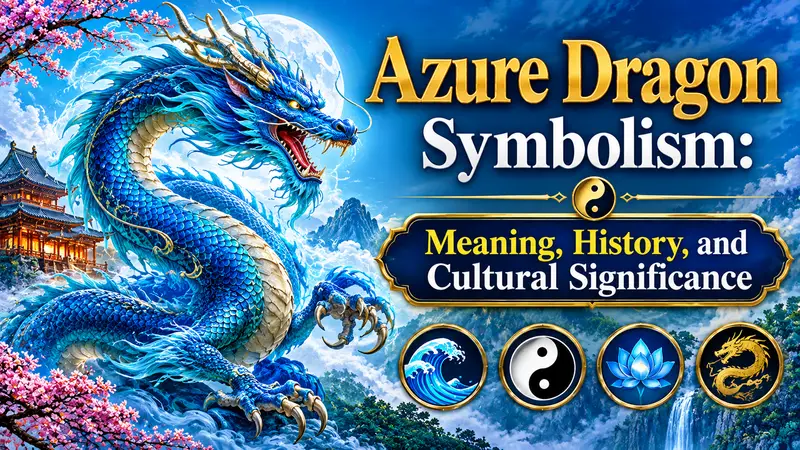
The Azure Dragon is one of the most recognizable mythical creatures in traditional Chinese cosmology. Known as Qinglong (青龙 or 青龍), it is a celestial dragon associated with the eastern direction, spring, the Wood element, and the natural cycle of renewal. Unlike many Western dragons, which are frequently portrayed as dangerous monsters or treasure guardians, the Azure Dragon traditionally represents an auspicious force connected with balance, protection, and the orderly movement of nature.
Azure Dragon symbolism has roots in ancient Chinese astronomy, mythology, philosophy, and religious traditions. Its image appeared in historical tomb decorations, ceremonial objects, architectural designs, and representations of the four directions. Over time, it also became associated with good fortune, authority, vitality, and the protection of sacred spaces.
In the United States, people encounter this symbol through Asian art, Chinese cultural celebrations, mythology-inspired tattoos, fantasy entertainment, jewelry, and decorative designs. Understanding its original cultural context helps explain why the Azure Dragon means much more than simply a blue or green mythical creature.
Quick Answer: What Does Azure Dragon Symbolism Mean?
Azure Dragon symbolism commonly represents protection, renewal, vitality, prosperity, and good fortune. In traditional Chinese cosmology, the Azure Dragon guards the East and represents spring, the Wood element, and the life-giving movement of nature.
TL;DR
- Protection: Traditionally guards the eastern direction against harmful influences.
- Renewal: Represents spring, growth, and the beginning of new cycles.
- Prosperity: Connects with favorable circumstances, abundance, and flourishing life.
- Balance: Forms part of the four celestial guardians in Chinese cosmology.
- Authority: Historically associated with imperial power and celestial order.
- Modern meaning: Appears in tattoos, jewelry, Asian art, and fantasy-inspired designs.
1. What Is the Azure Dragon?
Taoist Five Divine Beasts(道教五方神兽) – My Store
The Azure Dragon is a mythical celestial creature from Chinese tradition. Its Chinese name, Qinglong, combines the characters for a blue-green color and dragon. The English word azure emphasizes its blue appearance, although traditional Chinese color terminology does not always distinguish blue and green in the same way modern English does.
The creature is generally illustrated as a long, serpentine dragon with scales, claws, horns, whiskers, and an elongated body. Traditional artistic representations often show it moving through clouds or stretching across the heavens.
Unlike a dragon designed simply as a fictional monster, Qinglong has a specific cosmological position. It represents the eastern region of the sky and belongs to a larger system of celestial guardians.
Its traditional associations include:
- East and the rising sun.
- Spring and seasonal renewal.
- The Wood element in Chinese philosophy.
- Growth, vitality, and flourishing nature.
- Protection and favorable fortune.
- Celestial authority and cosmic order.
These connections explain why the Azure Dragon is treated as an auspicious figure rather than an ordinary mythical animal.
2. The Four Main Meanings of Azure Dragon Symbolism
Although its associations are numerous, four meanings are especially useful for understanding the creature.
Taoist Five Divine Beasts(道教五方神兽) – My Store
Protection and guardianship
The Azure Dragon traditionally protects the eastern direction. Its position among the four celestial guardians gives it a protective role connected with maintaining order and keeping harmful influences away.
Growth and renewal
Its connection with spring and Wood makes it a natural symbol of new beginnings. Trees, plants, and other living things begin growing again during spring, making the dragon an appropriate representation of vitality and development.
Prosperity and favorable fortune
The dragon’s associations with rain, seasonal cycles, and flourishing nature connect it with agricultural abundance and favorable conditions. In contemporary interpretations, people may associate it with success, opportunity, and personal progress.
Balance and harmony
The Azure Dragon is one part of a larger symbolic arrangement. Its meaning becomes clearer when considered alongside the other three celestial creatures, each of which represents a different direction and element.
These meanings are interconnected, but they are not interchangeable. Protection comes from its guardian role, while renewal comes primarily from its relationship with spring and Wood.
3. Ancient Origins of the Azure Dragon
The history of Qinglong is closely connected to the development of ancient Chinese astronomy and ideas about the organization of the universe.
Early Chinese observers divided the celestial sky into groups of stars and lunar mansions. The eastern portion became associated with a dragon-shaped celestial figure. This eventually developed into the Azure Dragon, one of four creatures representing the principal directions.
During the Han dynasty (206 BCE–220 CE), the system of the Four Symbols became particularly established in Chinese cultural and ceremonial life.
The four creatures appeared in tomb decorations, architectural objects, mirrors, and other artifacts. Their presence was not merely decorative. They helped express ideas about cosmic order, protection, and the relationship between earthly life and the heavens.
Archaeological objects from the Eastern Han period also demonstrate how these four celestial figures were incorporated into artistic and ceremonial designs.
The Azure Dragon therefore developed from a combination of astronomical observation, traditional mythology, and philosophical interpretations of nature.
Its historical importance comes from its place in this larger system rather than from a single isolated legend. Vol. 18. No. 1. (2026)+2
4. Why the Azure Dragon Represents the East
Category:Four Directional Animals of China – Wikimedia Commons
Direction is one of the most important parts of the Azure Dragon’s identity.
In traditional Chinese cosmology, the four main celestial creatures correspond to the four cardinal directions:
- Azure Dragon: East.
- Vermilion Bird: South.
- White Tiger: West.
- Black Tortoise: North.
The eastern direction is particularly significant because it is associated with sunrise. The appearance of the sun in the east makes this direction a natural representation of beginnings, awakening, and the return of activity.
The Azure Dragon consequently became associated with the transition from darkness toward daylight and with the beginning of the annual growing season.
This connection also explains why the creature is frequently portrayed as an auspicious guardian. It does not simply occupy the eastern sky; it represents the qualities traditionally associated with that region.
In symbolic artwork, its eastern position can communicate movement, new opportunities, and the restoration of balance.
5. Connection With Spring and the Wood Element
Spring is one of the strongest symbolic associations of the Azure Dragon.
In the traditional Five Phases system, known as Wu Xing, the Wood phase corresponds to spring, the eastern direction, and the growth of living things.
Wood represents more than physical trees. It expresses the principle of development: seeds becoming plants, branches extending outward, and dormant life becoming active again.
The Azure Dragon represents this movement through its connection with the Wood phase.
This creates several related interpretations:
- New beginnings: Spring marks the beginning of a fresh natural cycle.
- Personal development: Growing plants provide a metaphor for learning and improvement.
- Creativity: The upward and outward movement of Wood can represent developing ideas.
- Vitality: New growth reflects health, activity, and renewed strength.
- Adaptability: Living plants respond to changing conditions, suggesting flexibility.
For an American reader, the connection is similar to the way spring flowers, budding trees, and green landscapes communicate renewal.
However, the Azure Dragon’s meaning comes from a specific Chinese philosophical system, not simply from modern color psychology.
6. Azure Dragon and the Four Celestial Guardians
The Azure Dragon is traditionally understood alongside three other celestial creatures called the Four Symbols, or Si Xiang.
Together, they establish a symbolic framework for understanding direction, seasons, and the Five Phases.
| Celestial creature | Direction | Element | Season | Common associations |
|---|---|---|---|---|
| Azure Dragon (Qinglong) | East | Wood | Spring | Growth and protection |
| Vermilion Bird (Zhuque) | South | Fire | Summer | Vitality and transformation |
| White Tiger (Baihu) | West | Metal | Autumn | Strength and protection |
| Black Tortoise (Xuanwu) | North | Water | Winter | Endurance and longevity |
Each creature has a different responsibility within the symbolic arrangement.
The Azure Dragon represents the beginning of the seasonal cycle. The Vermilion Bird corresponds to summer’s heat and activity, while the White Tiger represents autumn and the qualities of Metal.
The Black Tortoise represents winter and Water. It is commonly depicted as a tortoise intertwined with a snake.
These figures should not be understood as competing supernatural animals. Their significance comes from the way they work together as representations of an organized universe.
The fifth phase, Earth, is associated with the center and is sometimes represented through the Yellow Dragon in related traditions. chinastory.cn+2
7. Spiritual and Religious Significance
The Azure Dragon also has associations with Chinese spiritual traditions, particularly Daoist cosmology.
In Daoist contexts, the four directional creatures can function as divine guardians connected with the organization and protection of sacred space.
The Azure Dragon is sometimes associated with the celestial guardian figure Mengzhang Shenjun. Its protective role appears in traditions involving temples, ritual arrangements, and symbolic representations of the directions.
Its spiritual significance can involve several ideas:
Protection of sacred spaces: The eastern guardian can represent security and order within a religious or ceremonial environment.
Harmony with nature: Its connection with spring and Wood reflects the importance of living in accordance with natural cycles.
Cosmic balance: Its position among the Four Symbols expresses the relationship between different forces and directions.
Favorable circumstances: Its auspicious associations make it suitable for symbolic representations of well-being and protection.
It is important to recognize that not every image of a Chinese dragon represents a religious deity. Some images are historical decorations, artistic interpretations, cultural emblems, or fictional designs.
The meaning depends on the context in which the creature appears.
8. Azure Dragon Symbolism in Chinese Culture
Chinese Carved Jade ‘Dragon Among Clouds’ Medallion from Qing Dynasty
Chinese culture gives dragons a broader significance than the familiar Western image of a fire-breathing monster.
Traditional Chinese dragons are frequently associated with favorable natural forces, authority, rain, fertility, and prosperity. They can also represent the relationship between earthly rulers and the heavens.
The Azure Dragon participates in this wider tradition while maintaining its particular eastern identity.
Historically, dragon imagery appeared in imperial art and ceremonial objects. The dragon became closely associated with imperial authority, although specific colors, designs, and dragon types could have different meanings depending on the dynasty and setting.
The Azure Dragon also appeared in Han-period tomb art and decorative objects, where the Four Symbols helped express ideas about protection and the afterlife.
In contemporary Chinese cultural settings, the dragon remains a recognizable emblem of heritage and cultural identity.
However, it is useful to distinguish between the general Chinese dragon and Qinglong. Not every traditional dragon is the Azure Dragon, and not every dragon design represents the same historical or philosophical meaning.
9. What Azure Dragon Symbolism Means in the United States
In the United States, the Azure Dragon does not have one universally established meaning. Its interpretation depends largely on whether someone encounters it through Chinese cultural heritage, mythology, spiritual interests, or contemporary design.
For many Americans, the creature is first recognized as a figure from Chinese mythology.
It may communicate:
- Appreciation for Chinese history and traditional art.
- Protection and personal strength.
- Renewal and new beginnings.
- Interest in Asian mythology.
- A connection with Eastern philosophical ideas.
- Cultural identity and heritage.
Chinese American communities also have a broader relationship with dragon imagery through public celebrations, community traditions, and cultural institutions.
Chinese New Year parades, for example, frequently feature dragon dances. These performances are important expressions of cultural continuity, community participation, and public celebration.
The historical use of dragon imagery in Chinese American celebrations also demonstrates how cultural symbols can communicate both heritage and belonging within American public life.
However, the dragon used in a New Year parade is not automatically Qinglong. The general Chinese dragon and the specific Azure Dragon are related but distinct images. AHA+1
10. Azure Dragon Meaning in Tattoos and Personal Style
Tattoo uploaded by Robert Davies • Tattoodo
AI Tattoo Generator — Designs in Any Style + Try-On Preview
Minimalist Small Dragon Tattoo Design
The Azure Dragon is an appealing tattoo subject because its traditional associations can communicate several personal ideas.
Someone choosing this design might be interested in protection, personal development, cultural heritage, or the symbolism of spring.
Different artistic approaches can emphasize different aspects of the creature.
Traditional Chinese dragon tattoo
A detailed dragon with scales, claws, whiskers, and flowing movement emphasizes its connection with Chinese mythology and cultural history.
Blue-green dragon tattoo
The blue-green coloring highlights its eastern identity and relationship with spring and Wood.
Dragon with clouds
Clouds can reinforce the celestial setting and the creature’s connection with the heavens.
Dragon with flowers or trees
Natural elements can emphasize renewal, growth, and the beginning of a new stage in life.
Minimalist dragon tattoo
A simpler outline can represent an appreciation for the creature without using an elaborate traditional composition.
For people considering this tattoo, cultural context matters. Learning the difference between Qinglong and other Chinese dragons can help ensure that the selected design reflects the intended meaning.
11. Azure Dragon in Jewelry, Art, and Home Decor
Chinese Blue Dragon Meaning: Symbolism, Culture, and Spiritual Power
Natural Blue-Green Jade Dragon Pendant–“Prosperity & Peace” Hand-Carve – FengshuiGallary
Modrý drak čínská malba | Mandarinská továrna | Mandarin Factory
The Azure Dragon’s distinctive appearance makes it suitable for different decorative and artistic forms.
In jewelry, it may appear as a carved pendant, metal ornament, engraved bracelet, or decorative charm.
A jade or stone carving can emphasize its historical association with traditional Chinese craftsmanship. A blue-green pendant may highlight its relationship with the eastern direction and Wood.
In home decor, the creature can appear in:
- Traditional paintings and wall art.
- Decorative ceramic objects.
- Carved wooden panels.
- Textile patterns.
- Sculptures and collectible figures.
Some people display the Azure Dragon because they appreciate Chinese mythology, while others choose it for its protective or auspicious associations.
In traditional feng shui discussions, the Azure Dragon also appears in directional arrangements. Its placement and relationship with other symbolic guardians can matter more than the creature’s appearance alone.
A decorative dragon should not automatically be assumed to follow a traditional feng shui arrangement. Contemporary artwork frequently combines historical motifs with modern artistic choices.
12. Emotional and Psychological Meaning of the Azure Dragon
The Azure Dragon can also be interpreted through the emotions and personal ideas associated with its traditional characteristics.
Its connection with spring makes it a natural metaphor for moving forward after a difficult period.
For someone starting a new career, recovering from a setback, or developing a personal project, the image can represent the decision to begin again.
Its guardian role may communicate a desire for security and confidence. People who select protective animal imagery sometimes use it as a reminder of their boundaries, responsibilities, or personal resilience.
Its relationship with Wood offers another useful interpretation.
Wood grows, changes direction, and responds to its surroundings. As a metaphor, this can suggest that progress does not always require a straight path.
The creature may therefore communicate:
- Confidence during periods of change.
- Hope when beginning something new.
- A desire for personal independence.
- Commitment to long-term development.
- A sense of connection with cultural heritage.
These are modern personal interpretations rather than established psychological effects. There is no universal emotional response to the Azure Dragon, and people can attach different meanings to the same image.
13. Azure Dragon Symbolism Compared With Western Dragons
One reason the Azure Dragon attracts attention in American popular culture is its difference from many familiar Western dragon traditions.
European medieval stories frequently portray dragons as dangerous creatures that threaten communities, guard treasure, or must be defeated by a hero.
Chinese dragon traditions developed different associations. Dragons have often represented favorable natural forces, authority, rain, and prosperity.
The Azure Dragon belongs to this broader Chinese tradition, but its specific meaning is connected with the East, spring, and Wood.
| Feature | Azure Dragon | Common Western dragon traditions |
|---|---|---|
| Traditional identity | Celestial guardian | Mythical creature or monster |
| Main associations | Renewal, protection, growth | Danger, power, treasure |
| Natural connection | Spring and Wood | Often fire and wilderness |
| Cultural background | Chinese cosmology | European folklore and literature |
| Artistic appearance | Long, serpentine body | Often winged, reptilian body |
These are broad comparisons rather than absolute rules.
Western stories also contain benevolent dragons, while Chinese mythology includes dangerous or destructive dragons. Neither tradition has a single universal interpretation.
The distinction is most useful when explaining why the Azure Dragon should not automatically be interpreted through Western fantasy conventions.
14. Misunderstandings and Misuse of the Azure Dragon
Although the Azure Dragon is generally considered auspicious, modern representations can sometimes create confusion about its historical meaning.
Confusing it with every Chinese dragon
The Azure Dragon is a specific celestial figure. A generic Chinese dragon does not necessarily represent the eastern guardian.
Assuming azure means only blue
The traditional character qing can refer to blue-green shades and is not limited to the modern English meaning of blue.
Treating it as a Western fire dragon
Its traditional associations emphasize the East, spring, and Wood rather than automatically emphasizing fire or destruction.
Assuming every dragon image has religious significance
Some images are artistic or decorative. Their presence does not necessarily indicate religious worship or a spiritual practice.
Reducing it to a good-luck charm
Good fortune is one possible association, but the creature also has astronomical, philosophical, historical, and directional significance.
Cultural misuse can also happen when traditional symbols are presented without context or combined with unrelated religious imagery as though all Asian traditions share identical beliefs.
For American artists and designers, the most respectful approach is to understand the symbol’s cultural background before using it as a decorative element.
15. How the Meaning of the Azure Dragon Has Evolved
The Azure Dragon’s meaning has changed as its image has moved between historical, religious, artistic, and popular settings.
In ancient Chinese cosmology, its primary role involved the eastern sky and the organization of celestial space.
During the Han dynasty, the Four Symbols became increasingly visible in tomb decorations, mirrors, architectural objects, and ceremonial art. The Azure Dragon’s protective associations became part of this larger visual tradition.
In later periods, its imagery continued through religious art, traditional decorative practices, and representations of Chinese cultural identity.
Today, the creature appears in international entertainment, video games, fantasy illustrations, tattoos, collectibles, and contemporary artwork.
For American audiences, its meaning may be more personal than its original cosmological role. Someone might choose an Azure Dragon illustration to represent growth, while another person might appreciate it primarily as an example of traditional Chinese mythology.
These modern interpretations do not erase its historical meaning. They show how a traditional symbol can acquire additional meanings when it enters new cultural environments.
The central associations with the East, spring, Wood, and guardianship remain important for understanding the original figure.
Frequently Asked Questions
1. Is the Azure Dragon a good or bad symbol?
The Azure Dragon is traditionally considered an auspicious symbol. It is associated with protection, favorable fortune, renewal, and the natural growth of life rather than representing an inherently evil creature.
2. What does an Azure Dragon tattoo symbolize?
An Azure Dragon tattoo can represent protection, personal growth, strength, renewal, and appreciation for Chinese mythology. Its meaning can become more specific through details such as its color, surrounding clouds, flowers, and other traditional elements.
3. Is the Azure Dragon the same as the Chinese zodiac Dragon?
No. The Azure Dragon is a celestial guardian representing the East, while the Chinese zodiac Dragon is one of the twelve animals in the traditional birth-year cycle. Both belong to Chinese cultural traditions, but they serve different symbolic purposes.
4. Why is the Azure Dragon associated with spring?
It represents the East, which corresponds to spring in the traditional Chinese system of directions and seasons. Its association with the Wood element also connects it with plant growth, renewal, and the return of natural activity.
5. What religion is the Azure Dragon associated with?
The Azure Dragon has connections with traditional Chinese religious and philosophical systems, particularly Daoist cosmology. However, it also belongs to broader Chinese mythology and astronomy, so it should not be understood as belonging exclusively to one religion.
6. Is the Azure Dragon the strongest of the Four Symbols?
Traditional cosmology does not establish a universal ranking in which the Azure Dragon is automatically stronger than the other three creatures. Each guardian represents a different direction and element, and their significance comes from their complementary roles.
7. What is the difference between the Azure Dragon and the Green Dragon?
Both names commonly refer to Qinglong, the eastern celestial dragon. The difference comes from translating the traditional Chinese color character qing, which can describe blue, green, or blue-green shades.
Conclusion
The Azure Dragon is much more than a colorful creature from Chinese mythology. Its traditional identity connects it with the eastern direction, spring, the Wood element, celestial protection, and the natural process of renewal. As one of the Four Symbols, it also represents the relationship between different directions, seasons, and forces within Chinese cosmology.
In contemporary American culture, Azure Dragon symbolism appears in tattoos, jewelry, decorative art, mythology-inspired entertainment, and expressions of cultural appreciation. Although modern interpretations may emphasize personal growth or good fortune, its original meaning remains rooted in Chinese history and philosophy.
Understanding the Azure Dragon means recognizing both its traditional role and the ways people interpret it today. It represents a reminder that growth, protection, and balance are connected to the natural cycles of life.