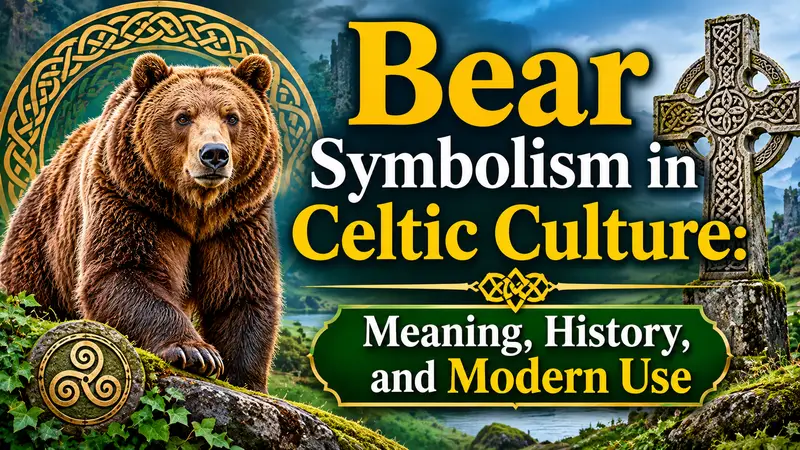
Bear symbolism in Celtic culture is closely associated with strength, courage, protection, leadership, and the natural world. The bear was a formidable animal in ancient Europe, and its physical power made it a meaningful figure in the imagination, personal names, religious imagery, and warrior traditions of some Celtic communities.
Unlike animals such as the stag, horse, and boar, the bear appears less frequently in surviving Celtic artwork and historical records. However, its connections to ancient divine figures, particularly the bear-associated goddess Artio, make it an important subject for understanding Celtic relationships with wildlife and spirituality.
Today, Americans interested in Celtic mythology, ancestry, tattoos, jewelry, and nature-based symbolism often interpret the bear as an emblem of resilience and personal strength. Understanding its historical background helps distinguish documented Celtic traditions from newer spiritual interpretations.
Quick Answer
Bear symbolism in Celtic culture commonly represents strength, courage, protection, leadership, and independence. Historically, bears were associated with warrior identity, powerful animal imagery, and the goddess Artio, while modern interpretations also connect them with resilience, guardianship, and a strong relationship with nature.
TL;DR
- Strength: The bear represented physical power, courage, and endurance.
- Protection: Its formidable nature made it a natural symbol of guardianship.
- Warrior identity: Bear-related names connected some Celtic traditions with bravery and leadership.
- Divine association: The goddess Artio provides important archaeological evidence of bear-related worship.
- Nature: The bear represented humanity’s relationship with the wild environment.
- Modern meaning: Celtic-inspired designs use bears to express resilience, independence, and heritage.
1. What the Bear Represents in Celtic Culture
The bear represented qualities that ancient Celtic communities could recognize through direct observation: physical strength, territorial behavior, endurance, and the ability to survive in demanding natural environments.
Its symbolism generally revolves around several connected ideas:
- Physical strength: The ability to overpower threats and defend territory.
- Courage: Facing danger without easily retreating.
- Protection: Defending oneself, family, or community.
- Leadership: Representing authority and the qualities expected of a warrior or ruler.
- Independence: Living according to its own instincts rather than relying on others.
These meanings should not be treated as a single official Celtic belief system. Celtic-speaking communities existed across different regions and periods, and their religious traditions varied.
Nevertheless, linguistic evidence, archaeological discoveries, and surviving religious imagery demonstrate that the bear held recognizable importance in parts of the ancient Celtic world.
The animal’s significance came partly from its physical presence. A bear was not simply another forest creature. It was a large predator capable of challenging humans, making it an understandable representation of strength and authority.
2. Ancient Celtic Words for the Bear and Their Significance
Language provides some of the clearest evidence of the bear’s importance in Celtic traditions.
Two reconstructed ancient Celtic words are particularly relevant:
- *Artos: An ancient Celtic word meaning bear, with related forms appearing in Irish and Welsh.
- *Matus: Another Celtic bear-related word, sometimes interpreted as a respectful or indirect name for the animal.
The second term is especially interesting. Some scholars suggest that calling the bear by an alternative name may have reflected a naming taboo, a practice found in several European traditions in which people avoided speaking an animal’s ordinary name.
Bear-related elements also appeared in personal names. Examples include Art, Artán, Artacán, and Mathgen. These names demonstrate that the animal’s identity could be incorporated into how individuals were named and remembered.
This linguistic evidence is important because surviving Celtic stories do not contain as many detailed bear narratives as modern readers might expect. Names and inscriptions therefore help reveal associations that written mythology alone cannot fully explain. Academia+1
3. The Goddess Artio: The Most Recognizable Celtic Bear Association
One of the most significant historical connections between bears and Celtic religion involves Artio, a goddess whose name is connected with the ancient Celtic word for bear.
The best-known representation comes from a bronze group discovered at Muri, near Bern in present-day Switzerland. The object depicts a large bear facing a seated female figure. The woman holds a vessel, and the composition includes a tree.
An accompanying Latin inscription identifies the goddess as Dea Artio, meaning Goddess Artio.
The sculpture is particularly interesting because the bear is not presented as a defeated enemy or hunting trophy. Instead, it appears in the presence of a female divine figure, creating an association between the goddess and the animal.
Artio is commonly interpreted as a bear-associated protective or nature-related deity. However, the surviving evidence does not provide a complete account of her worship, personality, or religious responsibilities.
For modern readers, Artio offers a historically grounded reason to associate Celtic-inspired bear imagery with feminine protection, nature, and divine guardianship. These are reasonable interpretations of the surviving imagery, rather than a complete list of beliefs documented in ancient texts.
4. Bears and Celtic Warrior Identity
Strength and warrior identity are among the better-supported interpretations of bear symbolism in ancient Celtic contexts.
The bear’s size, muscular body, powerful movements, and ability to defend itself made it an understandable comparison for a formidable fighter.
Bear-related words also appeared in personal names associated with ancient Celtic communities. Some scholars have suggested that bear images on Gaulish coins could communicate the strength or identity of a ruler.
However, there is another possibility: the image might have represented the ruler’s actual name rather than a general religious message.
This distinction matters because ancient symbols did not always have one universal meaning. A bear on a coin might identify a particular leader, communicate authority, or draw upon an established association with strength.
In modern Celtic-inspired interpretations, this warrior connection explains why bears frequently appear in designs representing:
- Personal courage.
- Determination during difficult circumstances.
- Leadership and responsibility.
- Physical and emotional resilience.
- The ability to protect others.
The historical association with warriors is more defensible than the claim that every Celtic warrior followed a formal bear cult. Academia+1
5. Protection, Guardianship, and Family Connections
A bear can be threatening, but it can also be understood as a guardian.
Its ability to defend itself and its territory makes protection a natural modern interpretation of the animal. This meaning also fits the imagery of Artio, although the exact protective functions of the ancient goddess remain uncertain.
In contemporary Celtic-inspired symbolism, the bear often represents someone who takes responsibility for others.
For example, a parent might choose a bear pendant to express the desire to protect their children. Someone recovering from a difficult period might use a bear image as a reminder to remain strong and defend personal boundaries.
There is also a connection between bears and motherhood in wider European folklore. Stories and beliefs about female bears protecting their young helped establish associations between the animal, nurturing, and family defense.
It is important not to assume that every European bear tradition originated with the Celts. Nevertheless, these broader associations help explain why modern bear symbolism can communicate both strength and care.
6. The Bear in Ancient Celtic Religion and Nature Worship
Animals played important roles in ancient Celtic religious imagery. Their appearance in religious objects, sculptures, and stories suggests that wildlife provided a familiar language for expressing relationships between humans, the divine, and the natural world.
The bear was one part of this larger animal tradition.
Other animals, including horses, bulls, stags, and boars, appear more frequently in surviving Celtic artwork. Bears are comparatively uncommon, which makes their surviving representations particularly interesting.
The difference may partly reflect geography. Bears had disappeared from Ireland long before the period for which most surviving Irish literary evidence was recorded. Continental Celtic communities had different experiences with the animal.
Consequently, it would be inaccurate to suggest that every Celtic community worshipped bears or considered them sacred.
A more careful interpretation is that some Celtic communities attached religious, personal, or symbolic importance to bears, while others may have encountered them less directly.
This distinction makes the surviving evidence more meaningful: the bear was significant without necessarily being the central animal of Celtic religion. Academia+1
7. The Connection Between Bears and Celtic Names
Bear-related personal names offer another way to understand the animal’s cultural importance.
Ancient Celtic naming traditions sometimes incorporated animal names or qualities associated with particular creatures. This practice allowed an animal’s recognizable characteristics to become part of a person’s identity.
The following examples illustrate the linguistic connection:
| Name or word | Historical connection | Symbolic interpretation |
|---|---|---|
| Art | Ancient Celtic bear-related word | Strength and warrior identity |
| Artán | Bear-related personal-name element | Courage and distinction |
| Mathgen | Name containing the bear-related element Math | Bear association and identity |
| Math | Celtic bear-related word | The bear as a respected animal |
| Artio | Name of a bear-associated goddess | Divine and natural association |
One especially interesting example is the surname McMahon, which is connected with the Irish name element Mathghamhain.
These linguistic connections should not be interpreted as proof that everyone carrying a bear-related name belonged to a bear-worshipping family. They demonstrate the cultural importance of bear-related vocabulary, not a complete religious genealogy.
8. Is King Arthur Connected to Celtic Bear Symbolism?
Romans de la Table ronde | BnF Essentiels
The name King Arthur is frequently discussed in connection with the ancient Celtic word for bear.
The proposed connection comes from the similarity between Arthur and the Celtic bear-related word artos or its related forms.
This has encouraged interpretations of Arthur as a bear-associated figure representing courage, strength, and kingship.
However, the etymology of Arthur remains debated. The name’s exact origin is not universally established, and its similarity to the Celtic bear word does not prove that the legendary king was named after the animal.
Arthurian literature also developed over many centuries, combining British traditions, medieval storytelling, and later literary imagination.
For this reason, it is better to describe the Arthur-bear connection as a possible linguistic association rather than an established historical fact.
Nevertheless, the proposed relationship helps explain why some modern Celtic-inspired artwork places bears alongside legendary kings, shields, swords, and other images of leadership.
9. What Bear Symbolism Means in the United States Today
In the United States, Celtic-inspired bear symbolism is often encountered through heritage-related artwork, jewelry, tattoos, mythology books, and nature-themed decoration.
Americans may interpret the bear as a combination of physical strength and emotional independence.
For someone interested in Irish, Scottish, Welsh, or broader Celtic ancestry, a bear design can represent an interest in historical European traditions. Others may simply appreciate the animal’s qualities without claiming a particular ancestral connection.
Several modern interpretations are especially common:
Personal strength: The bear represents the ability to face challenges and continue moving forward.
Family protection: Its defensive behavior makes it a recognizable emblem of loyalty and guardianship.
Leadership: The animal communicates confidence, authority, and independence.
Nature connection: Bear imagery can express respect for wildlife and a preference for a life connected with the outdoors.
Cultural identity: Celtic patterns combined with bear imagery can communicate an interest in European mythology and heritage.
These modern meanings are not necessarily identical to ancient Celtic beliefs. They reflect how Americans adapt historical symbols to contemporary personal identities.
10. Emotional and Psychological Meaning of the Celtic Bear
The bear can represent a balance between qualities that might initially seem opposite: strength and gentleness, independence and family responsibility, confidence and patience.
This contrast explains much of its emotional appeal.
Consider the following interpretations:
- Confidence: A bear can represent believing in your abilities without needing constant approval.
- Resilience: Its image can serve as a reminder to recover after setbacks.
- Patience: The bear’s seasonal behavior can inspire associations with waiting, preparation, and conserving energy.
- Boundaries: Its defensive nature can represent knowing when to protect your personal space.
- Inner strength: The animal can symbolize remaining composed during difficult situations.
There is also a psychological distinction between strength and aggression. A bear does not need to be interpreted as a symbol of constant confrontation. Its ability to retreat, rest, and defend itself only when necessary offers a more balanced interpretation.
For people using Celtic bear imagery as a personal reminder, this balance can be more meaningful than simply associating the animal with physical power.
11. Celtic Bear Symbolism in Tattoos, Jewelry, and Personal Style
Celtic Bear Tattoo Designs and Meanings | AI Art Generator | Easy-Peasy.AI
Celtic Bear Necklace in Sterling Silver – Walker Metalsmiths
10
Celtic bear imagery has become an appealing design choice for people interested in ancient European animals, mythology, and traditional decorative patterns.
Different objects communicate slightly different interpretations.
Celtic bear tattoos
A bear combined with interlacing Celtic knots can represent personal resilience, cultural interest, and determination. Some people choose a standing bear to emphasize confidence, while a resting bear may communicate patience and self-control.
Bear pendants
A silver or bronze bear pendant can represent protection, strength, or a connection with nature. Designs inspired by Artio may appeal to people interested in the historical relationship between bears and Celtic religious imagery.
Celtic bear rings
A ring featuring a bear or knotwork design can represent commitment to personal values, family, or cultural heritage.
Home decoration
Bear sculptures, wall art, and carved wooden figures can communicate appreciation for wildlife and traditional European decorative styles.
One important design consideration is historical accuracy. Celtic knotwork is a recognizable decorative tradition, but a modern combination of a bear and elaborate knotwork should not automatically be described as an authentic ancient Celtic artifact.
12. Bear Symbolism Across Other European and Global Traditions
Understanding the bear’s wider cultural significance helps explain why its symbolism can feel familiar even outside Celtic history.
However, similar interpretations do not necessarily indicate a shared origin.
Norse traditions: Bears appear in Scandinavian folklore and warrior-related imagery. The berserker tradition is often associated with bear-like or animal-inspired fighting behavior, although its precise historical interpretation remains debated.
Slavic traditions: Bears have appeared in folklore as formidable forest creatures, sometimes associated with protection, strength, and human-like characteristics.
Greek traditions: The bear is associated with Artemis, particularly through the ancient story of Callisto and the constellation Ursa Major.
Indigenous North American traditions: Bears hold distinct cultural and spiritual meanings in numerous Indigenous nations. These meanings vary considerably and should not be treated as extensions of Celtic mythology.
The important distinction is that a bear can independently become a symbol of strength or protection in different cultures because people observe similar characteristics in the animal.
Its appearance in multiple traditions does not establish that those cultures shared the same religious beliefs.
13. Common Misunderstandings About Celtic Bear Symbolism
Modern discussions of Celtic spirituality sometimes present interpretations as established historical facts even when the available evidence is limited.
Several misunderstandings deserve attention.
Myth: Every ancient Celt worshipped the bear.
There is no evidence that bear worship was universal among Celtic communities. Bear-related religious imagery is documented, but its geographical and cultural distribution was limited.
Myth: Artio was the supreme Celtic bear goddess.
Artio is a documented bear-associated goddess, but surviving evidence does not establish that she was the supreme deity of all Celtic peoples.
Myth: King Arthur definitely means bear king.
The proposed connection between Arthur and the ancient Celtic bear word is debated. It should not be presented as a confirmed translation.
Myth: The bear was the most important Celtic animal.
Other animals, especially horses, bulls, stags, and boars, appear much more frequently in surviving Celtic artistic and archaeological evidence.
Myth: Celtic bear tattoos reproduce ancient religious designs.
Many contemporary designs combine modern artistic choices with traditional knotwork. Without archaeological evidence, they should be understood as modern interpretations rather than exact historical reconstructions.
Recognizing these distinctions does not diminish the bear’s importance. It makes the historical interpretation more reliable.
14. How Celtic Bear Symbolism Has Evolved Into Modern Spiritual Meaning
The meaning of the bear has changed as Celtic traditions have been studied, reinterpreted, and incorporated into modern popular culture.
In ancient contexts, its significance can be traced through animal names, warrior associations, religious imagery, and regional traditions.
During later centuries, much of the older religious context became less visible as Christianity and changing cultural practices transformed European religious life.
In the modern era, renewed interest in Celtic mythology, ancestry, folklore, and historical art has encouraged people to revisit animal symbolism.
Contemporary spiritual interpretations sometimes describe the bear as a spirit animal, guardian, or symbol of personal transformation.
These ideas can be meaningful as modern personal beliefs, but they should not automatically be attributed to ancient Celtic religious practice.
For example, the idea that every person has a specific Celtic bear spirit guide is not established by the surviving historical evidence.
A more historically responsible modern interpretation connects the bear with recognizable characteristics such as strength, independence, protection, and leadership while acknowledging that personal spiritual meanings can differ.
15. Positive and Negative Meanings of the Celtic Bear
The bear is not exclusively a positive symbol. Its physical characteristics also create associations with danger, aggression, and overwhelming force.
Understanding both sides gives the animal a more complete symbolic identity.
| Bear symbolism | Positive interpretation | Possible negative interpretation |
|---|---|---|
| Strength | Courage and resilience | Excessive force |
| Protection | Loyalty and guardianship | Overprotectiveness |
| Independence | Self-reliance | Isolation |
| Leadership | Authority and confidence | Domination |
| Aggression | Defending boundaries | Uncontrolled anger |
| Patience | Self-control and preparation | Withdrawal or passivity |
The negative interpretations do not mean the bear is an unlucky symbol in Celtic culture.
Instead, they reflect the fact that the same characteristic can have different consequences depending on how it is expressed.
For example, protecting loved ones is generally considered positive, but attempting to control every aspect of their lives can become harmful.
The bear therefore works well as a symbol of balanced strength: having the ability to act without allowing power to become aggression.
Frequently Asked Questions
1. What does a bear symbolize in Celtic culture?
A bear generally symbolizes strength, courage, protection, and warrior identity in Celtic-inspired interpretations. Historical connections include bear-related personal names, continental Celtic imagery, and the goddess Artio.
2. Who was the Celtic bear goddess Artio?
Artio was a goddess associated with bears in the ancient Gallo-Roman religious world. A bronze sculpture discovered near Bern, Switzerland, depicts a bear facing a seated female figure and provides important archaeological evidence of this association.
3. Does the bear represent strength in Celtic mythology?
Yes, strength is one of the most recognizable interpretations of the Celtic bear. Its physical power and association with warrior-related names support connections with courage, authority, and determination.
4. What does a Celtic bear tattoo mean?
A Celtic bear tattoo commonly represents resilience, protection, independence, and personal courage. When combined with Celtic knotwork, it can also express an interest in Celtic heritage, mythology, and traditional European art.
5. Is the bear a positive or negative symbol in Celtic culture?
The bear is generally interpreted positively as a symbol of strength, courage, and protection. However, its aggressive characteristics can also represent excessive force, territorial behavior, or uncontrolled anger.
6. Is the bear connected to King Arthur?
There is a proposed linguistic connection between Arthur and the ancient Celtic bear-related word artos. However, the origin of Arthur’s name remains debated, so the bear interpretation is a possibility rather than an established historical fact.
7. What does the bear represent spiritually today?
In contemporary spiritual interpretations, the bear often represents inner strength, personal boundaries, independence, and protection. Some people also associate it with patience and personal growth, although these modern beliefs should be distinguished from documented ancient Celtic practices.
Conclusion
Bear symbolism in Celtic culture reflects an association with physical strength, courage, warrior identity, protection, and the natural world. Historical evidence, including bear-related names, continental Celtic artwork, and the goddess Artio, demonstrates that the animal held significance in certain ancient Celtic communities.
For modern Americans, the Celtic bear can represent resilience, family protection, independence, and an appreciation for European mythology and heritage. Its meaning can also be expressed through tattoos, jewelry, decorative artwork, and personal spiritual beliefs.
Ultimately, the bear offers a grounded reminder that genuine strength involves more than physical power. It also involves knowing when to stand firm, when to protect others, and when to exercise restraint.