Introduction
Rocks are among the most familiar features of the natural world, yet their symbolic meaning goes far beyond their physical appearance. Rock symbolism commonly connects these natural objects with strength, stability, endurance, protection, and the ability to withstand difficult circumstances. A boulder that remains in place for centuries can represent reliability, while a small stone carried in a pocket may serve as a reminder of a loved one, a personal milestone, or a meaningful experience.
In the United States, rocks appear in monuments, memorial gardens, hiking trails, jewelry, home décor, religious imagery, and personal rituals. People stack stones to mark a trail, collect them during meaningful trips, or use a particular rock as a keepsake. These everyday practices show how an ordinary object can acquire personal significance.
Rocks also have a long history in human culture. Communities have used them to build sacred places, mark graves, record events, establish boundaries, and create images on landscapes. Although specific interpretations differ across cultures, the durability of stone has repeatedly made it a natural material for expressing ideas about permanence, memory, and belonging.
Quick Answer
Rock symbolism commonly represents strength, stability, resilience, protection, and endurance in modern American culture, especially in expressions such as being someone’s rock or standing firm during adversity. Historically, rocks and stones have also served as sacred objects, memorials, boundary markers, and enduring records of cultural beliefs.
TL;DR
- Strength and stability: Rocks represent reliability, firmness, and the ability to withstand pressure.
- Resilience: Weathered stones suggest endurance through changing circumstances.
- Historical significance: Stone monuments have marked sacred places, burials, and important events.
- American expressions: Calling someone a rock communicates trust and dependable support.
- Personal meaning: Collected stones can preserve memories of people, places, and experiences.
- Cultural respect: Indigenous rock markings may hold sacred meanings beyond their appearance.
What Do Rocks Symbolize?
The symbolism of a rock often begins with its physical qualities. Rocks are solid, heavy, and frequently long-lasting. Unlike leaves or flowers, which change noticeably with the seasons, many rocks remain recognizable for generations. People naturally draw comparisons between these qualities and human experiences.
Strength is one of the most familiar meanings. A large boulder can represent physical power, while a small, hard stone may suggest firmness of character. The comparison is common in everyday speech when someone is described as strong as a rock.
Stability refers to something dependable. A rock beneath a structure provides support, making stone an intuitive metaphor for a stable relationship, a secure home, or a reliable foundation.
Endurance emphasizes surviving the passage of time. Rocks can crack, erode, and change, but their slow transformation makes them useful symbols of patience and persistence.
Protection comes from the practical use of stone in walls, shelters, and defensive structures. Symbolically, a rock may represent a boundary that keeps danger out or a person who helps others feel safe.
These meanings are common rather than universal. A rock may also represent an obstacle, emotional hardness, or an unwanted burden. Its meaning depends on how it appears in a story, expression, artwork, or personal experience.
Ancient Origins of Rock Symbolism
People have used stone for practical and ceremonial purposes since prehistoric times. Stone tools helped early communities hunt, prepare food, and shape their environments. Later, carefully arranged stones became part of burial places, monuments, and structures associated with communal gatherings.
These practical uses helped establish associations between stone and permanence. A wooden marker might decay, but a stone monument could preserve a name or commemorate an event long after the people involved had died.
Stone circles, standing stones, cairns, and megalithic structures also demonstrate how rocks could become part of shared cultural landscapes. Their original purposes are not always known. Some sites may have served ceremonial, funerary, agricultural, or astronomical functions, and interpretations can differ according to archaeological evidence.
The important distinction is that rocks did not acquire one universal symbolic meaning at a single moment. Their significance developed independently across communities as people used them to build, remember, communicate, and mark places considered important.
Rock Symbolism in Native American Traditions
Rocks and stone landscapes hold varied meanings across Indigenous nations in North America. It would be inaccurate to describe all Native American traditions as having one shared interpretation, because different communities maintain distinct languages, histories, spiritual practices, and relationships with particular places.
In parts of the American Southwest and other regions, Indigenous peoples created images by carving or pecking into rock surfaces and by painting on stone. These markings may communicate stories, identify places, document events, express spiritual beliefs, or convey practical knowledge. Some remain part of living cultural traditions.
Such markings are sometimes called petroglyphs when carved into stone and pictographs when painted onto a surface. Their meanings cannot always be determined by looking at the images alone. Location, surrounding features, community knowledge, and oral traditions can all matter.
For this reason, ancient rock markings should not automatically be treated as decoration or as puzzles that outsiders can solve without cultural context. Some meanings are known through continuing Indigenous knowledge, while others remain uncertain.
The rock itself may also form part of a sacred landscape rather than simply serve as a surface for images. For the communities connected to such places, the relationship between land, history, and cultural identity can be more important than any single visual interpretation.
What Rocks Mean in Modern American Culture
In contemporary American life, rocks often symbolize dependability, toughness, and emotional support. One of the clearest examples is the expression “You’re my rock.” It describes someone who remains reliable when circumstances become stressful or uncertain.
The phrase works because it turns a physical quality into a human one. A rock provides a stable point of reference; a trusted friend, parent, partner, or mentor can provide similar reassurance during a difficult period.
Rocks also appear in public memorials, engraved plaques, commemorative gardens, and monuments. Their durability makes them suitable for preserving names, dates, and messages that communities want future generations to remember.
In outdoor culture, rocks can represent a connection to nature and a sense of perspective. Hikers may remember a distinctive formation, collect a permitted small stone where collection is allowed, or associate a rocky overlook with an important personal experience.
In home design, natural stone can communicate permanence, craftsmanship, and simplicity. Granite countertops, stone fireplaces, and exposed rock features are often valued for their durability as well as their appearance.
These uses show why rock symbolism remains accessible to Americans: it connects an everyday natural object with familiar ideas about trust, memory, home, and perseverance.
Different Types of Rocks and Their Symbolic Meanings
Not every rock creates the same impression. Size, shape, texture, color, and the circumstances in which a stone is found can influence what it represents. The meanings below reflect common contemporary interpretations rather than fixed cultural rules.
| Rock or Stone | Common Symbolic Meaning | Typical Association |
|---|---|---|
| Boulder | Strength and permanence | A firm foundation or lasting support |
| Smooth river stone | Calm and adaptability | Change shaped by time and experience |
| Jagged rock | Difficulty and resistance | Obstacles, conflict, or perseverance |
| Granite | Durability and dependability | Enduring structures and commitments |
| Small keepsake stone | Memory and connection | A meaningful trip or relationship |
| Stacked stones | Balance and intention | A marker, memorial, or personal reflection |
A smooth stone may suggest patience because its surface has been shaped by natural processes. A jagged rock, by contrast, can evoke a difficult situation that has not yet been resolved. A massive boulder may communicate permanence, while a small pebble can hold meaning because of where it came from.
The symbolism comes partly from the rock’s physical features and partly from the story people attach to it. A pebble picked up during a memorable family trip may be more emotionally significant than an expensive stone purchased from a store.
Rock Symbolism in Religion and Spirituality
Stone appears in religious traditions around the world, although its significance varies considerably. It may serve as a foundation, an altar, a marker of sacred space, or a material used to create objects associated with worship.
In the Bible, rocks and stones appear in several contexts involving refuge, foundations, covenant, remembrance, and faith. Biblical imagery sometimes compares God to a rock, emphasizing reliability and protection. Other passages describe stones set up as memorials to mark significant events. These associations have influenced Christian language, art, architecture, and devotional practices.
In Hindu traditions, particular stones and stone forms may be associated with deities, sacred places, and ritual worship. Their meanings depend on the specific tradition and object involved rather than on a universal belief about all rocks.
Buddhist communities have also used stone in stupas, sculptures, temples, and memorial structures. In these settings, stone can support religious teaching and preserve devotional imagery across generations.
Some Indigenous communities maintain spiritual relationships with particular rocks, mountains, and geological formations. Such connections are specific to their cultural traditions and should not be reduced to a generic claim that all stones contain the same spiritual force.
In modern American spirituality, people sometimes choose a stone as a physical reminder of an intention, prayer, or period of reflection. That personal practice can be meaningful without implying that every rock has an inherent supernatural property.
The Emotional and Psychological Meaning of Rocks
A rock can become emotionally significant because it is tangible, familiar, and easy to keep. Unlike a memory that exists only in the mind, a physical object offers something a person can see, touch, and return to.
This is one reason people preserve small stones from places associated with important experiences. A rock from a childhood beach, a hiking trip, or a place visited with a loved one can act as a reminder of a particular time in life.
The object does not need to be rare or valuable. Its significance comes from the connection between the stone and the experience it represents.
Rocks can also symbolize emotional steadiness. Someone who describes themselves as needing to be grounded may use a stone as a personal reminder to slow down, consider the facts, or remain focused during stress.
There is another side to this association. Describing someone as “cold as a stone” suggests emotional distance, while calling someone “hard as a rock” can imply stubbornness or an unwillingness to change. These expressions demonstrate that the same physical quality—hardness—can be interpreted positively or negatively.
The emotional meaning depends on whether firmness is experienced as support or as resistance.
Why People Keep Rocks as Personal Keepsakes
Collecting stones is a simple way to preserve a connection with a particular place or moment. People may keep a pebble from a beach, a distinctive rock from a hiking trip, or a small stone given by a friend.
In these situations, the stone functions as a personal memory object. It can remind someone of a conversation, an accomplishment, a family tradition, or a period when life felt different.
Some people also write short messages on stones and place them in gardens or shared spaces. Depending on the setting, these stones can express encouragement, gratitude, remembrance, or community spirit.
Memorial stones are another example. An engraved stone may preserve a name or date, while a naturally shaped stone placed in a garden may quietly mark the memory of someone who has died. These practices vary, and not every memorial tradition uses stones in the same way.
A keepsake rock does not need an established historical meaning to matter. Its importance can be entirely personal, provided the story attached to it remains meaningful to the person who keeps it.
Rock Stacking and the Meaning of Balanced Stones
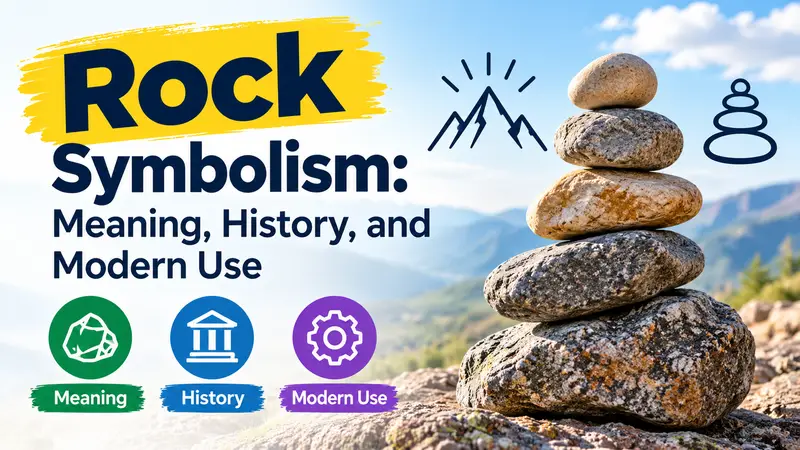
Stacked stones are recognizable in hiking areas, gardens, meditation spaces, and photographs shared online. A carefully balanced arrangement may suggest patience, concentration, balance, or the effort required to create order from separate pieces.
The meaning depends on where the stack appears. In some places, stone cairns serve practical purposes such as marking routes or identifying locations. In other settings, stone arrangements have historical, ceremonial, or memorial significance.
Modern decorative stone stacking is not automatically equivalent to these established practices. A stack created for a photograph may simply be an artistic experiment, while a cairn placed by a trail authority may have an important navigational function.
There is also an environmental consideration. Building unauthorized stone stacks can disturb small habitats, expose organisms living beneath rocks, and confuse hikers when existing trail markers are moved or copied.
For that reason, it is best to follow local land-management guidance rather than assume that stacking stones is harmless everywhere. In protected areas, leaving rocks where they are may be the most respectful choice.
Rock Symbolism in Tattoos, Jewelry, and Fashion
Rocks and stones can communicate personal values through wearable designs. A tattoo featuring a boulder, mountain, or cracked stone may represent endurance, determination, or the ability to continue despite adversity.
A small stone pendant or ring may carry a quieter message. It might commemorate a relationship, represent a connection to nature, or serve as a reminder to remain grounded during periods of change.
Design also affects interpretation. A mountain made of solid rock can suggest ambition or an obstacle to overcome. A cracked stone may communicate survival after hardship, while a weathered rock can evoke the passage of time.
Some people choose stones associated with birth months, family traditions, or particular spiritual practices. In these cases, the meaning may depend more on the material or its cultural associations than on the general symbolism of rocks.
A useful distinction is that a decorative stone design does not automatically reveal the wearer’s personality. Someone might choose a rock tattoo because they love climbing, geology, or a particular landscape rather than because they identify with strength or resilience.
Common Misunderstandings About Rock Symbolism
One common misconception is that every rock carries a fixed spiritual meaning. In reality, interpretations vary by culture, religious tradition, historical period, and personal experience. A stone that serves as a sacred object in one setting may be an ordinary building material in another.
Another misunderstanding is that all ancient stone structures were created for the same purpose. Standing stones, burial monuments, cairns, and carved rock surfaces have different histories. Their functions must be considered individually, and some remain uncertain.
It is also inaccurate to assume that every Indigenous rock marking can be understood through a general online symbol guide. The meaning of an image may be specific to a community, place, or living cultural tradition. A simplified interpretation can overlook the knowledge and relationships that give the marking its significance.
Finally, the symbolism of toughness should not be confused with the idea that people must remain unaffected by hardship. A rock may represent stability, but human resilience can also include flexibility, asking for help, and adapting when circumstances change.
Recognizing these distinctions makes the symbol more useful rather than less meaningful.
How Rock Symbolism Continues to Evolve
The meanings attached to rocks have changed as people have used stone in new ways. In earlier societies, stone could be a tool, a building material, a sacred object, or a marker of territory and remembrance. In modern life, it continues to serve practical functions while also appearing in personal rituals, design, and popular expressions.
Social media has made images of stacked stones, dramatic cliffs, and unusual rock formations easy to share. Captions may connect these images with balance, mindfulness, or perseverance, even when those interpretations are modern rather than historical.
At the same time, geological and archaeological knowledge has expanded how people understand stone. A rock can now prompt questions about Earth’s age, changing landscapes, ancient environments, and the people who lived in a particular place.
This combination of scientific interest and personal meaning allows rocks to communicate different ideas to different audiences. A geologist may see evidence of mineral composition and geological processes, while a traveler sees a memory of a meaningful journey.
Neither interpretation needs to erase the other. The natural object can be understood scientifically and still hold cultural or personal significance.
FAQs
What does a rock symbolize spiritually?
A rock may symbolize stability, protection, faith, grounding, or a connection to a sacred place. Its spiritual meaning depends on the religious tradition or personal practice in which it appears.
Is seeing a rock a sign of good luck?
Some people associate particular stones with good fortune or protection, especially when the stone belongs to a cultural or personal tradition. However, there is no universal belief that encountering an ordinary rock predicts good luck.
What does a rock symbolize in a dream?
A rock in a dream might be interpreted as stability, an obstacle, emotional resistance, or something a person considers dependable. Dream meanings are subjective, so the setting and the dreamer’s personal associations matter more than any fixed symbolic dictionary.
What does giving someone a rock mean?
Giving someone a rock can represent friendship, encouragement, remembrance, or a shared experience. The meaning often comes from why the stone was chosen and the relationship between the giver and recipient.
What does a cracked rock symbolize?
A cracked rock can represent hardship, change, vulnerability, or survival after a difficult experience. Some people interpret the image as evidence that something can remain valuable even after it has been damaged.
Are rocks considered symbols of protection?
Yes, rocks can symbolize protection because stone has historically been used to build walls, shelters, and defensive structures. In particular religious and cultural traditions, certain stones may also carry protective significance, although those beliefs are not universal
Conclusion
Rock symbolism connects the physical qualities of stone with familiar human experiences: strength, stability, endurance, protection, and remembrance. Its historical meanings range from sacred landscapes and memorial monuments to practical markers and religious imagery, while modern Americans often use rocks to express trust, preserve memories, and represent perseverance.
The meaning of a particular rock ultimately depends on its context. A stone can be a geological specimen, a sacred object, a keepsake, or a metaphor for someone who provides support. Sometimes its significance comes from centuries of cultural tradition; other times, it comes from a single moment that a person chooses to remember.
A rock may appear ordinary, but the meaning people attach to it can make it a lasting reminder of what they value.