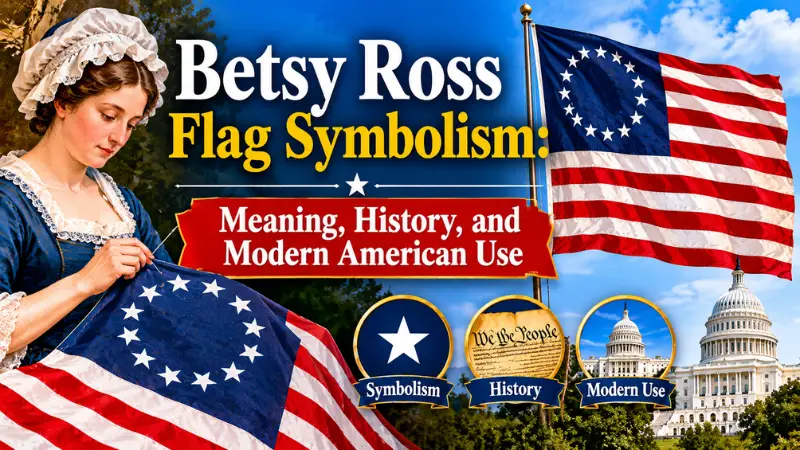
The Betsy Ross flag symbolism is closely associated with American independence, national unity, freedom, and the birth of the United States. Recognized by its 13 white stars arranged in a circle against a blue background, alongside 13 alternating red and white stripes, this historic design represents the original 13 colonies that declared independence from Great Britain.
The flag is named after Betsy Ross, a Philadelphia seamstress whose family helped popularize the story that she made the first American flag. Although historians have not found reliable evidence confirming that she designed or sewed the original national flag, her name remains firmly connected to this early American emblem.
Today, the design carries several meanings beyond its Revolutionary-era associations. Some Americans display it to express patriotism, respect for the nation’s founding, and appreciation for American history. Others recognize it as a reminder of the country’s original political ideals and the ongoing debate over how those ideals should be understood.
Quick Answer: What Does the Betsy Ross Flag Symbolize?
The Betsy Ross flag commonly symbolizes American independence, patriotism, national unity, and the country’s founding ideals. Its 13 stars represent the original colonies, while its circular arrangement is commonly interpreted as a visual expression of equality among them; the historical connection to Betsy Ross, however, remains unproven.
TL;DR
- Independence: Represents America’s separation from British colonial rule.
- Thirteen stars: Stand for the original 13 American colonies.
- Circular arrangement: Commonly suggests equality and unity among the colonies.
- Red and white stripes: Reflect the original design of the American national flag.
- Betsy Ross: Represents the popular story of women’s contributions to America’s founding.
- Modern use: Appears in patriotic displays, historical decorations, clothing, and political imagery.
1. What Is the Betsy Ross Flag?
3×5 Ft Betsy Ross Flag US Flags American Revolution Patriotic 13 Star | eBay
The Betsy Ross flag is an early American flag design featuring 13 white five-pointed stars arranged in a circle inside a blue canton, with 13 alternating red and white horizontal stripes.
Its recognizable features include:
- 13 white stars: Arranged in a circular pattern.
- Blue field: Holds the stars in the upper-left corner.
- 13 alternating stripes: Seven red stripes and six white stripes.
- Five-pointed stars: A familiar design associated with early American flags.
The circular arrangement distinguishes this flag from many later versions of the American flag, where stars appear in organized rows.
The design is generally associated with the American Revolutionary period and the country’s original 13 colonies. However, the specific flag commonly called the Betsy Ross flag should not automatically be treated as a documented original design created by Ross herself.
Its recognizable appearance makes it especially popular in American history displays, patriotic decorations, museums, and Independence Day celebrations.
2. The Main Symbolic Meaning of the Betsy Ross Flag
The flag’s central symbolism revolves around the creation of an independent American nation.
When the United States separated from British rule, the former colonies needed symbols that communicated their new political identity. A shared flag offered a recognizable image of collective independence rather than separate colonial interests.
The Betsy Ross design is now associated with several important ideas.
American independence: The 13 stars and stripes recall the revolutionary generation that established a separate nation.
National unity: The stars appear together within one blue field, representing the idea of separate colonies belonging to a common political union.
Equality: The circular arrangement is commonly interpreted as suggesting that no individual colony occupies a superior position.
Patriotism: The flag provides a visual connection to America’s founding period and the people who fought for independence.
Historical remembrance: Its appearance encourages interest in the Revolutionary War, early American craftsmanship, and the formation of the United States.
These meanings are connected to the flag’s historical setting and later cultural interpretations. Not every symbolic association was explicitly established by the people who originally used the design.
3. What Do the 13 Stars Represent?
Brick Church in the American Revolution: Kindred Minds | Brick Church
The 13 stars represent the original 13 colonies that became the first states of the United States.
These colonies were:
- Delaware
- Pennsylvania
- New Jersey
- Georgia
- Connecticut
- Massachusetts
- Maryland
- South Carolina
- New Hampshire
- Virginia
- New York
- North Carolina
- Rhode Island
Their decision to unite against British colonial authority helped establish the foundation of the American republic.
The stars communicate an important political idea: individual colonies could maintain their identities while participating in a larger union.
Why Are the Stars Arranged in a Circle?
The circular arrangement is commonly understood as a representation of equality among the original colonies.
Unlike a design that places one star above the others, a circle gives every star a similar visual position. No single colony appears to occupy the center or top of the arrangement.
This makes the circle a natural symbol of shared responsibility, cooperation, and collective identity.
However, it is important to distinguish interpretation from documented historical intention. The 1777 congressional flag resolution specified 13 stars but did not require a circular arrangement or explain that the stars represented equality in that particular configuration.
The equality interpretation is therefore a widely recognized symbolic reading rather than a confirmed statement of the original designers’ intentions.
4. What Do the Red, White, and Blue Colors Symbolize?
The colors of the Betsy Ross flag connect it visually to the broader American flag tradition. Each color has acquired familiar patriotic associations in American culture.
Red: Courage and Bravery
Red is traditionally associated with valor, courage, and sacrifice. In the context of the American Revolution, it can remind viewers of the determination and risks involved in fighting for independence.
It also gives the flag a strong visual presence, making the alternating stripes immediately recognizable.
White: Purity and Innocence
White is traditionally associated with purity and innocence. In American patriotic interpretations, it can also suggest honesty, peaceful intentions, and the aspiration to establish a government based on principles rather than hereditary rule.
Blue: Vigilance, Perseverance, and Justice
Blue is commonly associated with vigilance, perseverance, and justice. Because the stars appear within the blue canton, this color visually connects the individual colonies to the larger national union.
One historical distinction matters here: the original 1777 congressional resolution specified the flag’s colors and arrangement but did not officially assign each color these individual meanings. These familiar interpretations developed as part of later American flag traditions.
5. The Historical Origins of the Betsy Ross Flag
The history of the Betsy Ross flag involves both documented events and a popular family story.
On June 14, 1777, the Continental Congress adopted its first official flag resolution. It established a national flag with 13 alternating red and white stripes and 13 white stars on a blue field, describing the stars as representing a new constellation.
This decision established the foundation of the Stars and Stripes.
The resolution did not specify exactly how the stars should be arranged. As a result, early American flags appeared in several configurations, including circles and rows.
The circular-star design now associated with Betsy Ross became one of the recognizable early versions of the national flag. Government historical records indicate that the familiar Betsy Ross-style design appeared in the early 1790s.
The historical distinction is important: the 1777 resolution is documented, but the precise origin of the circular-star arrangement is less certain.
The design eventually became one of the most recognizable visual representations of America’s Revolutionary beginnings. History, Art & Archives+1
6. Who Was Betsy Ross, and Did She Really Make the First American Flag?
The Topics That Dominate U.S. History Classes—And the Ones Teachers Want Help On
Betsy Ross, born Elizabeth Griscom in 1752, was a Philadelphia upholsterer and seamstress. She operated a business during the Revolutionary period and is remembered as one of the women who contributed to early American textile and flag-making work.
According to the familiar family story, George Washington, Robert Morris, and Colonel George Ross visited her in 1776. They supposedly showed her a proposed flag design containing 13 stars and asked her to produce it.
The story also claims that Betsy suggested replacing six-pointed stars with five-pointed stars because they were easier to cut.
However, historians have not found contemporary documents confirming this meeting or establishing that she designed the first American flag.
The story first became public in 1870, when her grandson, William Canby, presented the account to the Historical Society of Pennsylvania. It subsequently gained popularity through newspapers, books, illustrations, and school history lessons.
There is evidence that Ross made flags. A 1777 payment record documents payment to her for making naval colors. This supports her role as a flagmaker but does not establish that she created the original national design.
Her historical importance should not depend entirely on the disputed story. She was a working businesswoman in a period when women faced substantial economic and social restrictions. Her life provides a meaningful example of women’s participation in the developing American economy.HISTORY+2
7. What Does the Circular Star Pattern Mean for American Unity?
The circle is one of the most recognizable features of the Betsy Ross flag.
In modern American interpretations, it often represents a nation formed through cooperation among separate political communities.
The original colonies had different economies, regional interests, religious communities, and political traditions. Their decision to unite against British authority did not erase those differences. Instead, it created a shared national identity.
The circle provides a useful visual expression of that relationship.
It can suggest:
- Equal standing among the original colonies.
- Cooperation rather than competition.
- A shared national purpose.
- Collective responsibility.
- Unity without requiring complete uniformity.
For Americans who value the country’s founding principles, the arrangement can serve as a reminder that national identity depends on cooperation between different communities.
It is also important not to confuse this interpretation with an explicit historical explanation of the original star arrangement. The circular pattern makes the equality interpretation appealing, but the original congressional resolution did not prescribe that meaning.
8. What Does the Betsy Ross Flag Symbolize in American Culture?
In the United States, the Betsy Ross flag is primarily understood as a historical and patriotic symbol.
It recalls the Revolutionary War, the original colonies, and the early development of the American government. Unlike the modern 50-star flag, it represents a specific period before the country expanded across the continent.
Americans encounter the design in several cultural settings.
Independence Day: On July 4, the flag appears in decorations, parade displays, historical reenactments, and patriotic celebrations.
American history education: Teachers and museums use it to introduce children to the Revolutionary period and the evolution of the national flag.
Military and veterans’ displays: Some people include it in collections honoring the nation’s founding and the history of American military service.
Historic architecture: It appears on signs, merchandise, and decorations associated with colonial-era homes and Revolutionary War landmarks.
National heritage events: Historical societies and patriotic organizations use the design to represent early American identity.
Its cultural meaning is not identical for every American. Some see it as a straightforward expression of national pride, while others associate it with particular political movements or debates about national identity.
The setting in which it appears often determines how people interpret it.
9. How the Betsy Ross Flag Differs From the Modern American Flag
Betsy Ross Flag – Library of Congress Store
Both flags belong to the same American national tradition, but they represent different stages of the country’s development.
| Feature | Betsy Ross Flag | Modern American Flag |
|---|---|---|
| Stars | 13 white stars | 50 white stars |
| Star arrangement | Circular pattern | Nine rows of alternating five and six stars |
| Colonies and states | Original 13 colonies | 50 states |
| Historical association | Revolutionary-era America | Present-day United States |
| Main symbolism | Independence and founding unity | National identity and the continuing union |
The modern American flag developed through several changes as new states joined the Union.
The original 13 stripes remained, representing the first colonies, while the number of stars increased with statehood.
The Flag Act of 1818 established the lasting principle of retaining 13 stripes and adding a star for each new state. The present 50-star design became official on July 4, 1960, following Hawaii’s admission.
The Betsy Ross flag therefore represents the country’s original political foundation, while the modern flag represents the expanded United States. USAGov+2
10. Emotional and Psychological Symbolism of the Betsy Ross Flag
National flags often create emotional responses because they connect individual experiences with a larger collective identity.
The Betsy Ross flag can evoke several feelings, depending on someone’s background and personal understanding of American history.
Pride: For some Americans, the design creates a sense of pride in the country’s independence and founding generation.
Belonging: Its 13 stars can represent membership in a national community built from separate colonies.
Nostalgia: The historical design can bring to mind childhood history lessons, Independence Day celebrations, and traditional American imagery.
Respect: Some people display it to honor Revolutionary-era soldiers, early American communities, and the sacrifices associated with independence.
Reflection: The flag can also encourage people to consider whether the country has fulfilled the ideals of liberty and equality associated with its founding.
From a psychological perspective, familiar national symbols help people express group identity without explaining their beliefs in words.
However, emotional responses are not universal. A person may view the flag as a historical artifact, while another may see it as a statement about contemporary American politics.
11. How the Betsy Ross Flag Is Used in Modern Fashion, Tattoos, and Decor
The Real Reason The US Flag Has Been Redesigned Several Times
Vintage Betsy Ross Flag Art Print, 13 Star Americana Wall Decor (digital Download) – Etsy
America Betsy Ross Flag 1776 Vintage Distressed T-Shirt
8
The design remains popular because its historical appearance is easy to recognize and visually different from the modern American flag.
Tattoos
A Betsy Ross flag tattoo can represent patriotism, family heritage, military appreciation, or an interest in American history.
Some people combine it with an eagle, a Revolutionary-era soldier, the Declaration of Independence, or other historical imagery.
The meaning usually depends on the additional elements and the wearer’s personal connection to the design.
Home Decor
The flag appears on wall art, framed prints, wooden signs, banners, and vintage-style decorations.
People often choose it for traditional American interiors, historical collections, or Fourth of July decorations.
Clothing and Fashion
T-shirts, jackets, hats, and accessories sometimes feature the circular-star design.
In fashion, it can communicate an interest in American heritage or a preference for traditional patriotic imagery.
Jewelry and Personal Accessories
Small versions of the design appear on pendants, pins, bracelets, and collectible accessories.
These items allow people to carry a recognizable piece of American historical imagery without displaying a full-size flag.
Social Media and Digital Culture
The design also appears in digital illustrations, profile graphics, historical posts, and patriotic messages.
Its interpretation depends heavily on context. A historical education post communicates something different from a contemporary political campaign graphic.
12. Religious and Cross-Cultural Interpretations
The Betsy Ross flag is primarily an American national and historical symbol, not a religious emblem.
Its stars, stripes, and colors do not have an established universal religious meaning. Nevertheless, people from different religious backgrounds may connect its themes of freedom, responsibility, and community with their own moral or spiritual beliefs.
For example, some Christians interpret the country’s founding ideals through religious ideas about human dignity, moral responsibility, and freedom of conscience. Others view the flag strictly as a secular representation of American political history.
Outside the United States, the design is generally recognized as an American historical symbol rather than an emblem with a separate traditional meaning in other cultures.
Its association with American independence may appeal to people interested in revolutionary movements, national self-determination, and the history of democratic government.
The distinction matters because the flag’s symbolism comes primarily from a particular historical experience, not from a universal religious or spiritual tradition.
13. Political Associations and Controversies Surrounding the Flag
Although the Betsy Ross flag has longstanding patriotic associations, its modern use has sometimes become politically controversial.
One reason is that historical flags can acquire new meanings when political groups adopt them.
In contemporary America, some individuals and organizations use the design to express traditional patriotism, constitutional values, national pride, or a desire to reconnect with the country’s founding period.
However, the flag has also appeared in political demonstrations and arguments about American identity. Consequently, some observers interpret its display as a political statement rather than simply a historical tribute.
A notable example occurred in 2019, when Nike withdrew a planned sneaker featuring the Betsy Ross flag after criticism that the design could be associated with historical racial oppression. The controversy reflected disagreement over how early American imagery should be interpreted in the present.
There is no historical basis for claiming that the original 13-star design was created as a symbol of a modern political movement. Its original historical context predates those contemporary associations.
It is also important to distinguish the flag itself from the actions or beliefs of people who display it.
A person might use it to honor the Revolutionary period, while another might employ it to communicate a particular political position. The image alone does not establish an individual’s beliefs.National Geographic+1
14. How the Meaning of the Betsy Ross Flag Has Changed Over Time
The design’s meaning has evolved considerably since the Revolutionary period.
Initially, the 13-star and 13-stripe national flag represented a newly independent political union. Early American flags served practical purposes, including identifying ships, military forces, and the developing nation.
Over time, the circular-star design became connected with the story of Betsy Ross.
Her grandson’s account, published in the late nineteenth century, helped transform her from a relatively obscure Philadelphia businesswoman into a familiar national figure.
The story became especially popular through paintings, educational materials, commemorative stamps, and patriotic merchandise.
During the twentieth century, the flag became an increasingly recognizable symbol of America’s founding period. It appeared in schools, public celebrations, historical displays, and popular culture.
Its meaning expanded again as modern political groups began using historical American imagery to communicate contemporary ideas.
Today, the design can represent several related but distinct things:
- The original 13 colonies and their struggle for independence.
- The historical development of the United States.
- The popular story of Betsy Ross and women’s contributions.
- Patriotism and traditional American identity.
- Contemporary political positions, depending on the setting.
This evolution demonstrates how national symbols can retain their historical identity while acquiring new associations through changing social and political circumstances.
15. Quick Comparison: Betsy Ross Flag Symbolism in Different Contexts
The meaning of the flag depends on where it appears and why someone chooses to display it.
| Context | Common Symbolic Meaning | Main Association |
|---|---|---|
| American history | Revolutionary independence | Founding of the nation |
| Patriotic celebrations | National pride | American heritage |
| Circular stars | Equality and cooperation | Unity among colonies |
| Tattoos | Personal patriotism | Individual identity |
| Historical decor | Respect for early America | Colonial and Revolutionary history |
| Political displays | Traditional national identity | Contemporary political expression |
The table highlights an important distinction: historical meaning and modern personal interpretation are related, but they are not always identical.
A museum displaying the flag is usually presenting an artifact of American history. Someone wearing it on a shirt may be communicating personal identity, political beliefs, or simply an appreciation for traditional American imagery.
16. Why Does the Betsy Ross Flag Still Matter Today?
The Betsy Ross flag remains recognizable because it connects modern Americans with the country’s earliest national identity.
Its 13 stars provide a visual reminder of the colonies that formed the original United States. Its stripes preserve the design tradition established during the Revolutionary period.
The story of Betsy Ross adds another dimension. Although her supposed role in creating the first national flag cannot be verified, her reputation has become part of American cultural memory.
Her story also raises an interesting historical question: whose contributions become part of a nation’s official history, and whose contributions are overlooked?
For this reason, the flag has significance beyond its appearance. It provides an opportunity to discuss independence, national unity, women’s work, historical storytelling, and the changing interpretation of patriotism.
Its continued presence in American culture reflects the country’s interest in preserving its founding history while debating what that history means for later generations.
FAQs
1. What does the Betsy Ross flag symbolize spiritually?
The Betsy Ross flag does not have an established spiritual meaning in a particular religion. Some individuals connect its themes of freedom, unity, and responsibility with their personal religious or moral beliefs.
2. What does a Betsy Ross flag tattoo mean?
A Betsy Ross flag tattoo commonly represents American patriotism, national heritage, independence, or appreciation for Revolutionary-era history. Additional imagery, such as an eagle or historical dates, can make the tattoo more personal.
3. Why are there 13 stars on the Betsy Ross flag?
The 13 stars represent the original 13 colonies that formed the United States. They are arranged in a circle, a pattern commonly interpreted as representing equality and unity among the colonies.
4. Is the Betsy Ross flag an official American flag?
The circular-star design is a historical early American flag pattern, but it is not the current official national flag. The United States now uses a 50-star flag representing all 50 states.
5. Did Betsy Ross really make the first American flag?
There is no reliable contemporary documentation proving that Betsy Ross designed or sewed the first American flag. The story became publicly known in 1870 through her grandson, although historical records do confirm that she worked as a flagmaker.
6. Is the Betsy Ross flag considered offensive?
The flag is not inherently offensive and has longstanding associations with American history and patriotism. However, its use in particular political settings has created disagreement about its modern associations, so context matters.
7. Is the Betsy Ross flag the same as the Revolutionary War flag?
The Betsy Ross flag is one early design associated with the Revolutionary-era American flag tradition. However, several different flag arrangements existed during the period, and historians cannot establish that the familiar circular-star design was the original flag used by the Continental Army.
Conclusion
The Betsy Ross flag represents American independence, national unity, patriotism, and the founding ideals associated with the original 13 colonies. Its circular arrangement of stars offers a familiar visual interpretation of equality and cooperation, while its red, white, and blue colors connect it to the broader American flag tradition.
Although the story that Betsy Ross created the first American flag remains historically unverified, her name has become an enduring part of American cultural memory. Today, the design appears in historical education, patriotic celebrations, personal fashion, tattoos, and political expression.
Ultimately, Betsy Ross flag symbolism is about more than an early flag design. It reflects how Americans remember their beginnings, interpret national identity, and continue to debate the meaning of freedom and unity.