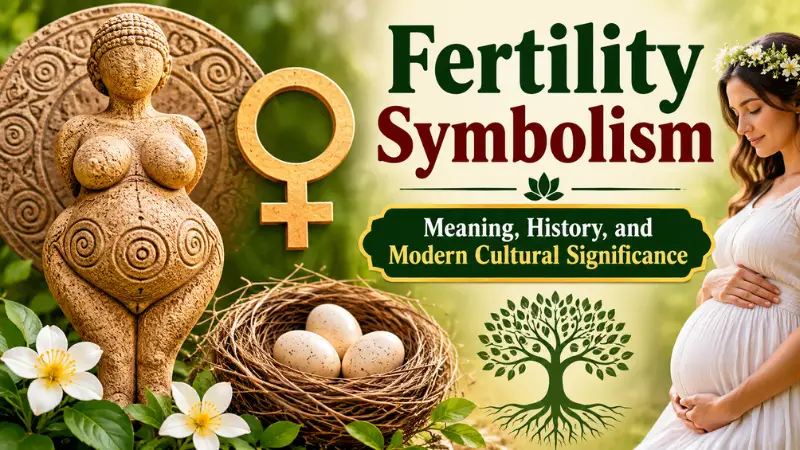
Fertility symbolism represents the ability to create life, nurture growth, encourage abundance, and continue future generations. Across different societies, fertility symbolism has appeared in natural objects, religious figures, plants, animals, and everyday traditions. Images such as eggs, pomegranates, rabbits, flowers, and pregnant female figures have traditionally represented reproduction, motherhood, prosperity, and the renewal of life.
People have used fertility symbols for thousands of years, sometimes as expressions of religious belief and sometimes as personal reminders of family, hope, and new beginnings. Their meanings have changed as societies developed, but the connection between fertility and the natural cycles of life remains recognizable.
In the United States, these symbols appear in spring celebrations, wedding decorations, jewelry, tattoos, home design, and personal expressions of family aspirations. They can also represent something broader than having children: creativity, personal development, productive relationships, and the desire to build something lasting.
Quick Answer: What Does Fertility Symbolism Represent?
Fertility symbolism commonly represents new life, reproduction, pregnancy, motherhood, abundance, and the possibility of new beginnings in modern American culture. Historically, it has also represented agricultural prosperity, divine protection during childbirth, seasonal renewal, and the continuation of family and community life.
TL;DR
- New life: Eggs, seeds, and flowers represent birth and fresh beginnings.
- Abundance: Pomegranates and harvest imagery symbolize prosperity and fruitfulness.
- Motherhood: Female figures represent pregnancy, nurturing, and family continuity.
- Nature: Spring, flowering plants, and growing crops represent renewal.
- Protection: Ancient amulets were associated with pregnancy and safe childbirth.
- Modern meaning: Fertility symbols express family hopes, creativity, growth, and personal identity.
1. What Are Fertility Symbols?
Fertility symbols are images, objects, animals, and natural elements associated with reproduction and the ability to produce new life. Some refer directly to human pregnancy and childbirth, while others represent the reproductive cycles of plants, animals, and agricultural communities.
Unlike symbols with one clearly established design, fertility imagery takes many forms. A decorated egg, a fruit filled with seeds, a flowering tree, or a figure with a pregnant belly can all communicate related ideas.
Common examples include:
- Eggs: Potential, birth, and the beginning of life.
- Pomegranates: Fertility, abundance, and prosperity.
- Rabbits: Reproduction, spring, and new life.
- Flowers: Growth, natural cycles, and renewal.
- Seeds: Potential, development, and future generations.
- Pregnant female figures: Motherhood, reproduction, and the continuation of life.
- Harvest imagery: Productivity, nourishment, and agricultural abundance.
People encounter these images in religious art, seasonal celebrations, traditional jewelry, cultural ceremonies, and contemporary decorative designs.
Their meaning depends on context. A flower might symbolize romance in one setting and fertility in another. A pomegranate might represent abundance in a family celebration but carry additional religious or mythological meanings elsewhere.
2. Ancient Origins of Fertility Symbolism
Fertility symbolism developed alongside early human communities’ understanding of reproduction, food production, and seasonal change.
For agricultural societies, successful reproduction was essential to survival. Families needed children to maintain communities, while crops and livestock provided food and economic security.
This relationship encouraged people to associate fertility with the natural world.
Seeds offered an especially clear comparison. A small seed could eventually become a plant producing food for an entire household. Similarly, pregnancy represented the development of new life and the continuation of a family.
Ancient communities expressed these connections through figurines, religious offerings, protective objects, and seasonal ceremonies.
Prehistoric Female Figurines
Some of the earliest known representations of the human female form are small prehistoric sculptures commonly called Venus figurines.
The famous Venus of Willendorf is one example. Created during the Upper Paleolithic period, it has exaggerated breasts, a rounded abdomen, and prominent hips.
Frauen in der Altsteinzeit: Vergöttert oder unterjocht? – Spektrum der Wissenschaft
Die „Venus vom Hohle Fels“ hat ihr neues Zuhause bezogen | Universität Tübingen
Venus of Dolní Věstonice, Upper Paleolithic
4
These figures have often been interpreted as representations of fertility, pregnancy, motherhood, or female abundance.
However, archaeologists do not agree on one universal explanation. Some researchers suggest that particular figures represented reproductive potential, while others consider possibilities involving identity, survival, social status, or religious practices.
It would therefore be inaccurate to claim that every prehistoric female figurine was a fertility goddess or pregnancy charm. Their original purposes remain uncertain. Wiley Online Library+2
3. Fertility Symbols in Ancient Egyptian Culture
Ancient Egyptian culture provides some of the clearest historical examples of fertility symbolism connected with pregnancy and childbirth.
One important figure was Taweret.
Taweret – World History Encyclopedia
6
Taweret was commonly depicted as a combination of human and animal features, including the body of a pregnant hippopotamus. Her image communicated protection, motherhood, and the safeguarding of women and children.
Ancient Egyptian households used small protective amulets representing deities. Some were worn as jewelry, while others were placed in domestic or religious settings.
These objects were associated with protection against illness, infertility, dangerous childbirth, and other threats to family life.
The goddess’s unusual appearance was not intended simply as decoration. Her animal features represented strength and the ability to defend vulnerable mothers and children.
This tradition demonstrates that fertility symbolism historically involved more than the ability to conceive. It also addressed the risks of pregnancy, the safety of childbirth, and the survival of infants. The Metropolitan Museum of Art+2
4. The Pomegranate as a Symbol of Fertility and Abundance
Bhumi Exports | Premium Agricultural & Food Exports from India to the World
The pomegranate is among the most recognizable historical symbols of fertility.
Its association comes largely from its physical appearance. When opened, the fruit reveals numerous individual seeds arranged inside a protective outer covering. This abundance makes it a natural image of fruitfulness, prosperity, and reproductive potential.
Ancient Greek Meaning
In ancient Greek traditions, the pomegranate was associated with several female deities, including Hera and Demeter.
It also played an important role in the myth of Persephone.
According to the myth, Persephone ate pomegranate seeds while in the underworld. This act connected her to Hades and became part of the explanation for her seasonal separation from Demeter.
The story linked the fruit with marriage, fertility, the agricultural seasons, and the relationship between life and death.
Interestingly, the pomegranate was not exclusively a positive fertility symbol. Its connection to Persephone also gave it associations with mortality and the underworld.
Meaning in Modern Traditions
Pomegranates continue to carry cultural and religious significance.
In some Jewish communities, the fruit is eaten during Rosh Hashanah as an expression of the hope for blessings, abundance, and numerous good deeds in the coming year.
In modern American homes, pomegranate imagery also appears in artwork, textiles, table decorations, and jewelry. ARCHAEOLOGICAL MUSEUM OF THESSALONIKI+2
5. Eggs and Rabbits as Symbols of New Life
Rabbit and easter eggs in green grass with blue sky | Free Photo
Eggs and rabbits are two familiar fertility-related images in American culture, particularly during Easter.
Their association comes from their connection with reproduction and the arrival of spring.
The Egg
An egg contains the potential for a new living organism. This makes it a natural symbol of birth, beginnings, and development.
Decorated eggs became part of various European spring and Easter traditions. Christian communities also adopted egg customs, with the egg acquiring an association with resurrection and the emergence of new life.
In the United States, decorated eggs are now a familiar feature of Easter celebrations, including children’s egg hunts, family gatherings, and seasonal decorations.
The Rabbit
Rabbits are known for reproducing frequently, making them recognizable symbols of fertility and abundance.
The American Easter Bunny tradition developed partly through German immigrant customs brought to Pennsylvania during the eighteenth century. The German Easter hare, known as the Osterhase, eventually became the familiar character who brings eggs and treats to children.
Although the rabbit’s reproductive associations are clear, popular claims connecting the Easter Bunny directly to a specific ancient fertility goddess are not firmly established by historical evidence.
The American Easter Bunny is best understood as a figure shaped by European folklore, immigration, seasonal celebrations, and modern commercial traditions. Smithsonian Magazine+2
6. Fertility Symbolism in Nature: Flowers, Seeds, and Trees
Nature provides some of the most accessible expressions of fertility symbolism.
Plants grow from seeds, produce flowers, develop fruit, and generate new seeds. These visible stages make plant life a natural comparison for reproduction and the continuation of generations.
How to plant pomegranate trees in fall and enjoy fruit for decades
Mature sunflower with seeds, close up.
4
Different natural elements communicate different aspects of fertility.
| Natural Symbol | Common Symbolic Meaning | Traditional Association |
|---|---|---|
| Flowering plants | Growth and reproduction | Spring and renewal |
| Seeds | Potential and future development | New beginnings |
| Fruit-bearing trees | Abundance and fruitfulness | Prosperity and family |
| Sunflowers | Growth and vitality | Warmth and productivity |
| Green leaves | Renewal and development | Seasonal change |
Flowers are especially common in modern fertility-related designs because they communicate growth without necessarily referring directly to pregnancy.
A flowering tree can represent the development of a family, while a seedling may represent the beginning of a new project or stage of life.
These interpretations also make plant imagery useful for people who want a fertility-related design that feels natural rather than explicitly reproductive.
7. Fertility Symbolism in Different Cultures and Religions
Fertility has never had one universal religious or cultural meaning. Different traditions connect reproduction with divine protection, family continuity, prosperity, agriculture, and spiritual renewal.
Several examples demonstrate this diversity.
Ancient Greek Traditions
Greek mythology connected fertility with agricultural and family deities.
Demeter represented agriculture and the growth of crops, while Hera was associated with marriage and family. Their stories connected human reproduction with the productivity of the natural world.
Ancient Egyptian Traditions
Egyptian religious imagery frequently emphasized protection during pregnancy and childbirth.
Taweret’s protective role illustrates how fertility could be understood as both reproduction and the preservation of mother and child.
Jewish Traditions
The pomegranate appears in Jewish symbolism as an image of fruitfulness and abundance.
During Rosh Hashanah, some families eat pomegranate seeds while expressing hopes for a year filled with blessings and good deeds.
Hindu Traditions
In Hindu religious art, the lotus is associated with creation, purity, spiritual development, and divine abundance.
It appears in the imagery of deities such as Lakshmi.
The lotus should not automatically be interpreted as a direct fertility symbol in every Hindu context. Its meaning is broader and depends on the deity, artwork, and religious tradition.
Christian Traditions
Christian interpretations often connect eggs, flowers, and spring imagery with resurrection, renewal, and new life.
These associations overlap with older seasonal imagery, although Christian meanings should be understood within their own theological context.
The important distinction is that similar images can carry different meanings across religious traditions. A symbol should not be assigned one interpretation simply because it appears in several cultures.
8. What Fertility Symbolism Means in the United States
In the United States, fertility-related imagery appears in a variety of cultural and personal settings.
For many Americans, it is associated with pregnancy, family planning, motherhood, and the hope of having children. For others, it represents creativity, personal growth, or the ability to develop something meaningful.
American culture also brings together traditions from different immigrant communities, religious backgrounds, and artistic movements.
This diversity influences how fertility symbols are understood.
For example, a pomegranate might appear in a Jewish New Year celebration, while eggs and rabbits are associated with Easter. Flowering branches may appear in spring home decorations without having a specifically religious meaning.
Fertility imagery also appears in:
- Baby showers and pregnancy announcements.
- Wedding and anniversary decorations.
- Family-oriented artwork.
- Spring festivals and seasonal displays.
- Jewelry representing motherhood and family.
- Personal artwork celebrating reproductive experiences.
There is also a growing distinction between biological fertility and symbolic fruitfulness.
Someone may choose a seed or flowering tree tattoo to represent personal development rather than pregnancy. A couple may use pomegranate imagery to express hopes for a prosperous family.
In this way, American interpretations often combine traditional meanings with individual experiences.
9. Emotional and Psychological Meaning of Fertility Symbols
Fertility symbols can communicate several emotions because reproduction and growth are closely connected with major human experiences.
Hope and Anticipation
Seeds and eggs represent something that has not yet developed but has the potential to become real.
For someone hoping to start a family, these images may represent anticipation and the possibility of pregnancy.
Love and Nurturing
Pregnant figures, flowering plants, and protective animals can communicate care, responsibility, and emotional connection.
These meanings often appear in gifts exchanged between partners or family members.
Continuity and Family Identity
Trees with branches and multiple generations of fruit can represent family history and the continuation of relationships across generations.
This interpretation is especially relevant to family artwork and heirloom jewelry.
Creativity and Personal Development
Fertility does not always refer to biological reproduction.
Writers, artists, entrepreneurs, and other creative individuals may use fertility imagery to represent the ability to generate ideas and bring new projects into existence.
A seed becoming a tree offers a straightforward visual comparison for an idea developing into something substantial.
Vulnerability and Uncertainty
Fertility imagery can also carry complicated emotions.
For people experiencing infertility, pregnancy loss, or difficult reproductive decisions, images traditionally associated with motherhood may bring sadness rather than happiness.
Recognizing this emotional complexity is important when using fertility-related imagery in public messages, gifts, or personal celebrations.
10. Fertility Symbolism in Tattoos and Jewelry
126 pomegranate tattoo ideas in 2021 – meanings designs and more – Artofit
Tiny Black Sprout Temporary Tattoo – Set of 3 – Tatteco
10
Fertility-related designs are popular choices for people who want to express family connections, new beginnings, and personal growth through body art or accessories.
Popular Tattoo Designs
Common choices include:
- Pomegranate tattoos: Abundance, fruitfulness, and family continuity.
- Flower tattoos: Growth, renewal, and personal development.
- Seedling tattoos: New beginnings and the development of potential.
- Tree tattoos: Family roots, generations, and lasting relationships.
- Egg imagery: Creation, birth, and new opportunities.
- Pregnant figure tattoos: Motherhood, pregnancy, and personal experiences.
Some people also choose floral arrangements representing a child’s birth month or combine several flowers to represent different family members.
Jewelry and Personal Accessories
Pomegranate pendants, floral necklaces, seed-inspired charms, and mother-and-child designs can all communicate fertility-related meanings.
Jewelry is particularly meaningful because it can be worn privately as a reminder of a personal goal, family experience, or important relationship.
Not every person who wears these designs is trying to conceive. Some simply appreciate their connection with growth, abundance, and the natural world.
11. Fertility Symbols in Weddings, Family Celebrations, and Home Decor
Fertility imagery has traditionally appeared in celebrations connected with marriage, family formation, and household prosperity.
In modern American weddings, these associations often appear through flowers, fruit arrangements, garden-inspired decorations, and natural motifs.
Elegantize Weddings | Luxury Decor & Design NY & NJ
Red Ceramic Pomegranates – Palma
How to plan an itimate micro wedding in Tenerife
6
Common examples include:
Wedding flowers: Flowers communicate love, growth, and the beginning of a shared life.
Pomegranate decorations: The fruit can represent abundance, prosperity, and family blessings, particularly when used within traditions that recognize its symbolism.
Tree artwork: Family trees represent relationships, ancestry, and future generations.
Nursery decorations: Animals, flowers, and growing plants can create a welcoming environment associated with childhood and development.
Seasonal displays: Spring decorations use blossoms, eggs, and greenery to represent renewal.
However, fertility imagery in weddings does not necessarily mean that a couple intends to have children. Many couples select these decorations because they appreciate the associations with prosperity, love, and a flourishing shared future.
12. Fertility Symbolism in Modern Art and Social Media
Modern artists and online communities have expanded the ways people communicate fertility-related experiences.
Traditional imagery such as flowers, pregnant figures, eggs, and fruit now appears in digital illustrations, personalized gifts, educational artwork, and social media posts.
Some creators use these images to celebrate pregnancy announcements and motherhood. Others use them to discuss infertility, reproductive health, pregnancy loss, or the emotional challenges of family planning.
One particularly important development is the use of the human body itself as a symbolic subject.
The uterus, for example, can represent reproductive identity, medical experiences, personal autonomy, and the social expectations surrounding motherhood.
A 2025 study examining experiences with fertility treatment in the United States explored how the uterus can acquire meanings connected with identity, relationships, and medical intervention beyond its biological function. PubMed
This broader interpretation helps explain why contemporary fertility artwork is not always celebratory. It can also communicate frustration, uncertainty, resilience, and the desire for greater understanding.
13. Misunderstandings and Misuse of Fertility Symbols
Fertility symbols are sometimes presented online as though every image has one fixed ancient meaning. This creates confusion, especially when modern interpretations are incorrectly described as established historical facts.
Several misunderstandings deserve attention.
Myth 1: Every prehistoric female figurine represents a fertility goddess.
There is no universal agreement about the purpose of prehistoric female sculptures. Some may have had fertility-related meanings, but others could have represented different aspects of identity, society, or belief.
Myth 2: The Easter Bunny is definitely an ancient pagan fertility deity’s companion.
The rabbit has clear fertility associations, but the popular connection between the Easter Bunny and a specific ancient goddess is historically uncertain.
Myth 3: Every flower represents pregnancy.
Flowers more commonly communicate beauty, growth, affection, and seasonal renewal. Their fertility meaning depends on context.
Myth 4: Fertility symbolism is exclusively feminine.
Historical representations often focus on pregnancy and motherhood, but fertility also involves male reproductive health, couples, agriculture, animals, and the wider continuation of life.
Myth 5: Fertility symbols guarantee conception.
Traditional charms and protective objects reflect historical beliefs and hopes. They should not be confused with scientifically established fertility treatments or medical advice.
There is also an important cultural consideration: fertility imagery should not be used to suggest that every woman must become a mother or that reproductive ability determines someone’s worth.
Respectful interpretation recognizes that parenthood is a personal experience, not a universal requirement.
14. How Fertility Symbolism Has Changed Over Time
The meaning of fertility imagery has developed as human societies have changed.
In prehistoric communities, representations of the human body may have expressed ideas about survival, reproduction, identity, and social life.
In ancient civilizations, fertility became closely connected with religious deities, protective amulets, agricultural abundance, and family continuity.
During the development of European seasonal traditions, eggs, rabbits, and flowering plants became associated with spring celebrations and religious observances.
In modern America, these older associations coexist with contemporary ideas about reproductive health, personal identity, family planning, and creativity.
The following table illustrates this development.
| Historical Period or Context | Main Fertility Association | Common Examples |
|---|---|---|
| Prehistoric societies | Survival and reproductive potential | Female figurines |
| Ancient civilizations | Divine protection and childbirth | Taweret amulets, pomegranates |
| Ancient agricultural societies | Crop productivity and abundance | Seeds, fruit, harvest imagery |
| European seasonal traditions | Spring and new life | Eggs, rabbits, flowers |
| Modern United States | Family, growth, and personal identity | Tattoos, jewelry, artwork |
The most important change is that fertility imagery is no longer limited to reproduction.
People now use it to represent many forms of creation and development, including relationships, artistic projects, personal achievements, and the desire to build a meaningful future.
FAQs
1. What is the most common symbol of fertility?
The egg is one of the most recognizable fertility symbols because it represents the potential for new life. Pomegranates, rabbits, flowers, and seeds are also widely associated with reproduction, fruitfulness, and abundance.
2. What flower symbolizes fertility?
Flowers such as lotus blossoms, roses, and other flowering plants can represent fertility, growth, and renewal, depending on the cultural tradition. The lotus has additional religious meanings in Hindu and Buddhist traditions, so its interpretation should not be limited to reproduction.
3. What does a pomegranate symbolize spiritually?
A pomegranate commonly represents abundance, fruitfulness, prosperity, and life. In Greek mythology, it is connected with Persephone, while in Jewish traditions it can represent blessings and the hope for numerous good deeds.
4. What animal symbolizes fertility?
Rabbits are among the most widely recognized fertility animals because of their reproductive capacity. Other animals, including certain birds and livestock, can also represent reproduction, motherhood, nourishment, and abundance in particular cultural traditions.
5. What does fertility symbolism mean in a tattoo?
A fertility-related tattoo can represent motherhood, pregnancy, family aspirations, new beginnings, or personal growth. The exact interpretation depends on the chosen design and the personal experience behind it.
6. Is fertility symbolism always connected to having children?
No. Fertility can also represent creativity, productivity, prosperity, and the development of new ideas. Someone may choose fertility-inspired artwork to celebrate personal growth without making any statement about pregnancy or parenthood.
7. What is the difference between fertility symbolism and motherhood symbolism?
Fertility symbolism generally concerns reproduction, fruitfulness, and the potential for new life. Motherhood symbolism focuses more specifically on nurturing, raising, protecting, and maintaining relationships with chil
Conclusion
Fertility symbolism represents more than the biological ability to reproduce. Eggs, pomegranates, rabbits, flowers, seeds, and ancient protective figures communicate ideas about new life, abundance, family continuity, and the development of potential. Their meanings emerged from human relationships with reproduction, agriculture, religious belief, and the natural cycles of life.
In modern American culture, fertility symbolism continues to appear in Easter traditions, wedding decorations, jewelry, tattoos, artwork, and personal expressions of family identity. Its interpretation has also expanded to include creativity, personal growth, and the ability to build something meaningful.
Ultimately, fertility imagery reminds us of the many ways life develops and continues. Whether represented by a small seed, a flowering tree, or a fruit filled with seeds, its central message is about potential becoming something that can grow, flourish, and endure.