Introduction
Myrtle flower symbolism centers on love, marriage, fidelity, peace, and new beginnings. With its small, fragrant white flowers, glossy evergreen leaves, and delicate appearance, myrtle has long been associated with relationships that endure beyond a single season. Today, it remains especially recognizable in wedding traditions, where a sprig of myrtle can represent a lasting commitment between partners.
The plant’s story reaches back to ancient Greece and Rome, where it was associated with love and the goddess Aphrodite, known to the Romans as Venus. Its symbolism later developed through Jewish religious traditions, Christian imagery, European wedding customs, and the Victorian practice of assigning meanings to flowers.
In the United States, myrtle is less universally recognized than roses or lilies, but its associations still matter in wedding bouquets, garden design, botanical art, and symbolic gifts. Understanding its history helps explain why this understated flowering plant can communicate affection, loyalty, and hope without relying on elaborate decoration.
Quick Answer
Myrtle flower symbolism most commonly represents love, marriage, and lasting commitment in modern American floral traditions. Historically, myrtle was associated with Aphrodite and Venus in ancient Greece and Rome, while Jewish and Christian traditions connected the evergreen plant with peace, renewal, and religious devotion.
TL;DR
- Core meaning: Myrtle represents love, fidelity, marriage, peace, and new beginnings.
- Ancient origins: Greek and Roman traditions associated myrtle with Aphrodite and Venus.
- Wedding customs: Myrtle became a recognizable emblem of enduring love in European bridal traditions.
- American interpretation: Its meaning is most visible in weddings, gardens, and meaningful floral gifts.
- Religious connections: Myrtle appears in Jewish scripture and later Christian symbolism.
- Modern use: People incorporate myrtle into bouquets, botanical designs, jewelry, and personal artwork.
1. What the Myrtle Plant Looks Like
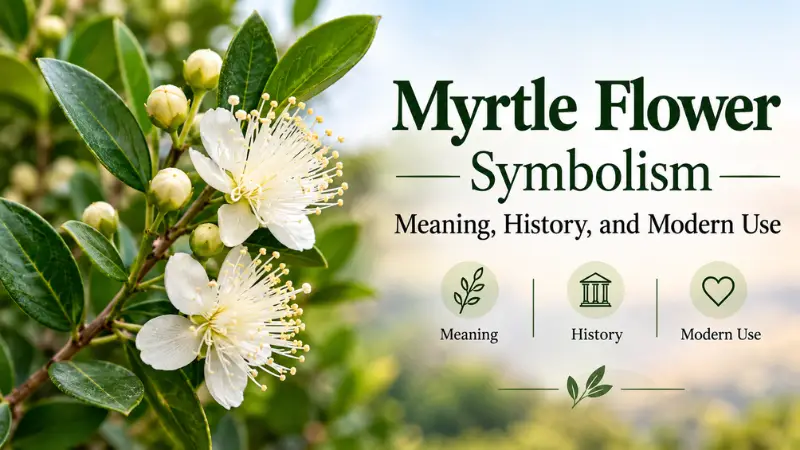
True myrtle, botanically known as Myrtus communis, is an evergreen shrub native to the Mediterranean region and parts of western Asia. It has small, glossy leaves, delicate white flowers with prominent stamens, and dark berries that develop after flowering. The leaves and flowers are aromatic, giving the plant an association with freshness and fragrance.
Myrtle is not the same plant as crape myrtle, a popular ornamental tree found in many American landscapes. Despite the shared common name, crape myrtle belongs to a different botanical genus and is not the traditional plant behind the ancient Mediterranean and European wedding symbolism discussed here.
The distinction matters because symbolic meanings are often attached to a particular species, its historical use, and its cultural setting. A garden containing crape myrtles may suggest beauty and seasonal renewal, but it does not automatically carry the same historical associations as true myrtle.
2. The Main Symbolic Meanings of Myrtle
Myrtle has several related meanings, each shaped by the plant’s appearance, religious associations, and ceremonial use.
Love and romance are among its oldest associations. Its connection with ancient love goddesses helped establish it as a plant suitable for romantic celebrations.
Marriage and fidelity developed through wedding customs in which myrtle was worn or carried by brides. Its evergreen foliage also makes it a fitting emblem of affection intended to last.
Peace and reconciliation appear in accounts of ancient customs and religious interpretations. The plant’s associations with harmony make it appropriate for ceremonies celebrating restored relationships or shared hopes.
Renewal and continuity arise from its evergreen nature. While many plants lose their leaves during colder seasons, myrtle retains its foliage in suitable climates, providing a natural image of life continuing through change.
These meanings overlap, but they are not identical. A bridal bouquet emphasizes commitment, a religious arrangement may emphasize peace, and a garden planting may suggest continuity or renewal.
3. Ancient Greek Origins and the Goddess Aphrodite
In ancient Greek tradition, myrtle was closely associated with Aphrodite, the goddess of love, beauty, and desire. The Romans adopted many Greek religious and cultural traditions, associating the plant with their goddess Venus.
This connection helped give myrtle a place in ceremonial life. Wreaths made from its branches could be worn during celebrations, while the plant appeared in artistic and literary traditions connected with love and beauty.
The association was not simply about romantic attraction. In the ancient Mediterranean world, love, fertility, family continuity, and marriage were closely connected ideas. A plant linked to a love goddess could therefore suit ceremonies that celebrated the formation of a household as well as affection between individuals.
Ancient traditions were not entirely uniform, and not every appearance of myrtle carried a single fixed meaning. Nevertheless, its association with Aphrodite and Venus provides a strong historical foundation for its later reputation as a flower of love.
4. Roman Traditions of Marriage, Peace, and Honor
Roman culture carried myrtle symbolism into domestic and public life. The plant was associated with Venus and appeared in wreaths, gardens, and ceremonial settings. Its connection with weddings helped establish a lasting relationship between myrtle and married love.
Some classical accounts also associate myrtle with reconciliation and peaceful resolution. These traditions offer a useful contrast with the laurel wreath, which became especially recognizable as an emblem of victory and public achievement.
Myrtle could communicate honor without emphasizing military conquest. Its softer associations made it suitable for celebrations, social occasions, and expressions of affection.
The Romans helped preserve and spread the plant’s ceremonial reputation, although the exact meanings varied across periods and communities. Later European traditions inherited elements of this classical symbolism and adapted them to their own religious and social practices.
5. Myrtle in the Bible and Jewish Tradition
Myrtle has a distinct place in Jewish religious history. The Hebrew name Hadassah, traditionally identified with myrtle, is the original name of Esther in the biblical Book of Esther. This connection has helped link the plant with Jewish identity, righteousness, and the story of a woman who acted courageously to protect her people.
Myrtle branches are also associated with Sukkot, the Jewish Festival of Booths or Tabernacles. In this celebration, branches are used in constructing temporary shelters and in religious observances, connecting the plant with communal worship and the remembrance of the Israelites’ wilderness journey.
Biblical passages add another layer to its meaning. Isaiah 55:13 describes myrtle replacing a thorn-bearing plant in an image of restoration and renewal. The contrast suggests a movement away from hardship toward a more fruitful condition.
These associations make myrtle more than a romantic emblem. In Jewish contexts, it can carry meanings related to religious practice, communal continuity, and hope after adversity. Those meanings should be understood within their Jewish setting rather than reduced to general ideas about good luck.
6. Christian Symbolism: Purity, Hope, and Renewal
In some Christian traditions, myrtle acquired associations with purity, peace, and devotion. Medieval and later European religious imagery sometimes connected the plant with the Virgin Mary, adapting older Mediterranean associations with love and femininity to Christian ideas about sacred love and spiritual innocence.
Its evergreen leaves also made it a natural image of continuity and hope. In a religious setting, a plant that remains green through much of the year can suggest life that persists through difficult circumstances.
However, myrtle is not a universal Christian symbol, and its meaning varies between denominations, regions, and artistic traditions. It does not have one fixed interpretation prescribed for every Christian ceremony.
For an American reader, the important distinction is that a myrtle arrangement can be chosen for its general associations with peace and renewal without necessarily making a religious statement. When used in a church ceremony, its meaning may instead depend on the congregation’s particular traditions and the intentions of the people arranging the flowers.
7. Why Myrtle Became a Wedding Flowe
Myrtle’s place in wedding traditions grew from its ancient association with love and its later adoption into European bridal customs. Brides and grooms used wreaths and branches of the plant in some historical settings, while its evergreen foliage offered a fitting image of affection intended to endure.
During the nineteenth century, myrtle became particularly prominent in German and British wedding traditions. Queen Victoria helped establish its visibility in royal weddings, especially through the continued use of myrtle associated with her Osborne House garden on the Isle of Wight.
The tradition continued among British royal brides, including Princess Diana and Catherine, Princess of Wales. These weddings brought renewed public attention to a plant that many people might otherwise overlook.
In the United States, couples can borrow this tradition without adopting its royal history. A few myrtle sprigs in a bouquet may represent fidelity, a shared future, and the hope that a marriage will remain strong as circumstances change.
Myrtle is especially suitable for couples who prefer a subtle botanical detail over an elaborate display of symbolic flowers.
8. Myrtle in Victorian Flower Language
During the nineteenth century, flower dictionaries and illustrated books popularized floriography, the practice of assigning meanings to flowers and combining them into symbolic bouquets. In this tradition, myrtle was commonly associated with love and marriage.
The appeal was partly social. In settings where direct expressions of affection could be constrained by etiquette, a bouquet offered a graceful way to communicate feelings. Readers could consult flower dictionaries to choose plants that expressed romance, devotion, or particular wishes.
Yet Victorian flower language was never a perfectly consistent code. Different publications sometimes assigned different meanings to the same plant, and authors often drew on mythology, religion, literature, and personal interpretation.
Myrtle’s association with marriage was more firmly rooted in established ceremonial practice than some of the more elaborate flower-dictionary meanings. Its appearance in bridal bouquets therefore connected literary symbolism with an existing tradition.
Today, Americans can still use Victorian flower language as inspiration, but it is best treated as a cultural tradition rather than a universal dictionary understood by every recipient.
9. Myrtle Flower Symbolism in the United States
American interpretations of myrtle often reflect a blend of European wedding customs, classical imagery, religious heritage, and contemporary floral design.
Unlike the red rose, which has broad recognition as a romantic flower, myrtle is relatively specialized. Many Americans may recognize its evergreen foliage without knowing its historical meaning. Its symbolism is therefore often communicated through the setting in which it appears.
At a wedding, myrtle can suggest fidelity and a lasting partnership. In a garden, it may evoke Mediterranean landscapes, botanical refinement, or continuity through changing seasons. In an artistic arrangement, its small flowers and fragrant leaves can create a restrained expression of affection.
American wedding culture also allows couples to personalize floral meaning. One person might select myrtle because of its historical connection to marriage; another might value its fragrance, appearance, or connection to a family tradition.
There is no single national interpretation. The plant’s meaning is shaped by the people who use it and the occasion in which it appears.
10. What Different Myrtle Colors and Settings Can Communicate
The symbolism of myrtle depends more on its cultural history and use than on a standardized color code. Still, the colors surrounding the plant can influence the impression a floral arrangement creates.
| Context | Common symbolic association | Typical impression |
|---|---|---|
| White myrtle flowers | Love, marriage, sincerity | Gentle and ceremonial |
| Evergreen myrtle leaves | Fidelity and continuity | Steadiness and endurance |
| Myrtle in a bridal bouquet | Commitment and shared life | Romantic and traditional |
| Myrtle in a garden | Renewal and lasting growth | Calm and natural |
| Myrtle in a religious setting | Peace, hope, or devotion | Reflective and reverent |
These interpretations are guides rather than strict rules. White flowers do not automatically signify purity in every culture, and green foliage does not carry one universal emotional meaning.
In practical terms, the surrounding arrangement matters. Myrtle paired with white roses may emphasize romance, while an arrangement featuring natural foliage and understated blooms may communicate simplicity and continuity.
11. The Emotional and Psychological Meaning of Myrtle
Myrtle’s emotional appeal comes partly from the qualities people can observe directly. Its evergreen leaves suggest continuity, its fragrance makes it memorable, and its delicate flowers create an impression of restraint rather than spectacle.
These qualities can support several personal interpretations.
Steadiness: Evergreen foliage offers a natural image of remaining present through changing conditions. This makes myrtle suitable for marking a long relationship or a new commitment.
Affection: Its long association with love and marriage allows people to express tenderness without relying on a familiar red rose.
Hope: The plant’s religious and historical connections with renewal can make it appropriate for a new beginning, a reconciliation, or a meaningful personal milestone.
Simplicity: Myrtle’s small flowers and fine leaves can communicate care without an extravagant arrangement.
These are cultural and personal associations, not scientifically established psychological effects. There is no evidence that looking at myrtle produces the same emotional response in everyone.
Its usefulness as a symbol lies in the connection between its visible characteristics, its history, and the meaning someone chooses to give it.
12. Myrtle in Tattoos, Jewelry, Fashion, and Home Decor
Myrtle’s compact leaves and small blossoms lend themselves to contemporary designs, especially those inspired by botanical illustration.
- Tattoos: A myrtle sprig can represent enduring love, marriage, personal renewal, or a meaningful relationship. The wearer may also choose it simply for its understated appearance.
- Jewelry: Myrtle-inspired pendants, engraved leaves, and floral motifs can serve as reminders of a partnership, wedding, or family connection.
- Fashion: Myrtle embroidery or botanical prints can evoke classical elegance and Mediterranean influences.
- Home decor: Framed botanical illustrations, floral arrangements, and garden-inspired designs can communicate calm, continuity, and natural beauty.
- Social media: A myrtle image accompanying a wedding announcement or anniversary post may suggest commitment, particularly when the historical meaning is explained in a caption.
The symbolism of a tattoo or decorative object is ultimately personal. A myrtle branch does not automatically announce marital status, religious beliefs, or a particular relationship history.
For a design intended to honor a specific tradition, it is worth learning about that tradition before using the plant as a decorative motif.
13. Myrtle Across Cultures and Religious Traditions
Myrtle’s meaning extends beyond ancient Greece, Rome, and European wedding customs.
In Jewish tradition, it has connections with Sukkot, biblical imagery, and the name Hadassah. These associations include communal religious practice and the hope of restoration.
In some Christian traditions, myrtle has been associated with Mary, devotion, and spiritual purity. Its older classical associations with love continued to influence European religious art and wedding customs.
Myrtle also appears in ritual practices among different communities in the eastern Mediterranean and the Middle East. Historical and contemporary uses vary, reflecting local beliefs, religious practices, and the movement of botanical traditions between neighboring cultures.
These traditions should not be collapsed into a single universal definition. A plant can be used in different religious settings for distinct reasons, even when its fragrance, evergreen foliage, or ceremonial role provides a common starting point.
For American readers, this diversity is a reminder that floral symbolism depends on cultural context. Learning why a community uses myrtle is more accurate than assuming every tradition assigns it the same meaning.
14. Common Misunderstandings About Myrtle Symbolism
Several misconceptions can arise when historical flower meanings are presented as universal facts.
Myrtle does not have one meaning in every culture. Love and marriage are prominent associations, but religious traditions also connect it with peace, restoration, and devotion.
Crape myrtle is not the same as true myrtle. The two plants share a common name but belong to different botanical groups. Historical references to Myrtus communis should not automatically be applied to every plant called myrtle.
A myrtle sprig is not a universal sign of engagement or marriage. Someone may choose it for its botanical beauty, cultural background, or personal significance without intending a specific message.
Victorian flower meanings were not standardized. Historical flower dictionaries sometimes disagreed, so individual definitions should be understood within their original context.
Myrtle is not inherently unlucky or negative. Its most established historical associations are generally favorable, although the meaning of any flower can change according to local customs or personal experiences.
Separating these misconceptions from documented traditions helps preserve the plant’s history without turning symbolism into an inflexible set of rules.
15. How Myrtle Symbolism Has Evolved Into Modern Use
Myrtle’s history shows how a plant can retain a recognizable central meaning while acquiring new interpretations.
In antiquity, its association with Aphrodite and Venus linked it to love, beauty, and ceremonial life. Jewish religious practice developed different associations connected with sacred observance and restoration. Christian traditions subsequently incorporated myrtle into some interpretations of purity and devotion.
European wedding customs helped keep the plant visible, while nineteenth-century flower dictionaries made its romantic associations easier to communicate through bouquets. Royal wedding traditions later renewed public interest in the plant.
In contemporary America, myrtle occupies a quieter position. It is not as familiar as a rose or an Easter lily, and many people encounter it through wedding photography, gardening, botanical art, or floral design rather than through a widely recognized national custom.
That relative rarity can be an advantage. Couples and designers who choose myrtle can draw on a long tradition without relying on a flower whose meaning is immediately obvious to everyone.
Its modern significance is therefore both inherited and personal: the history provides a starting point, while the person using the plant determines what it represents in a particular moment.
FAQs
1. What does myrtle flower symbolism mean in love?
Myrtle traditionally represents romantic love, fidelity, and lasting commitment. Its association with Aphrodite and Venus in ancient Mediterranean traditions helped establish its connection with affection and marriage.
2. Why is myrtle used in wedding bouquets?
Myrtle became a traditional bridal flower because of its historical associations with love and marriage. Its evergreen leaves also provide a natural image of continuity, making it appropriate for ceremonies celebrating a lasting partnership.
3. What does myrtle symbolize in the Bible?
Myrtle appears in several biblical passages, including Isaiah 55:13 and Nehemiah 8:15. It is associated with restoration and is connected with the observance of Sukkot in Jewish tradition.
4. Is myrtle a symbol of good luck?
Myrtle is sometimes associated with good fortune in marriage and positive beginnings. However, good luck is not its only or universal meaning; love, fidelity, and peace are more central to its established symbolism.
5. What does a myrtle tattoo mean?
A myrtle tattoo can represent enduring love, commitment, renewal, or a personal connection to botanical and classical traditions. Its meaning depends on the wearer’s intention rather than a universally recognized tattoo code.
6. Is myrtle a symbol of purity?
Myrtle has been associated with purity and innocence in some European religious and floral traditions. These meanings developed alongside its older associations with love and marriage, but they are not shared uniformly across all cultures.
7. Is myrtle the same as crape myrtle?
No. True myrtle is Myrtus communis, an evergreen shrub with small, fragrant flowers, while crape myrtle belongs to the genus Lagerstroemia. Their similar common names do not mean they share the same historical symbolism.
Conclusion
Myrtle flower symbolism brings together love, marriage, fidelity, peace, and renewal. Its associations developed through ancient Greek and Roman traditions, Jewish religious practice, Christian imagery, and European bridal customs before becoming part of the broader history of floral design.
In the United States, myrtle is especially meaningful when used in wedding bouquets, personal gifts, gardens, and botanical artwork. Its history gives these uses context, but its meaning does not have to be limited to marriage or romance.
Ultimately, myrtle offers a thoughtful way to represent a lasting bond or a hopeful beginning. Its small blossoms and evergreen leaves remind us that a meaningful symbol does not need to be elaborate to express a lasting intention.