Introduction
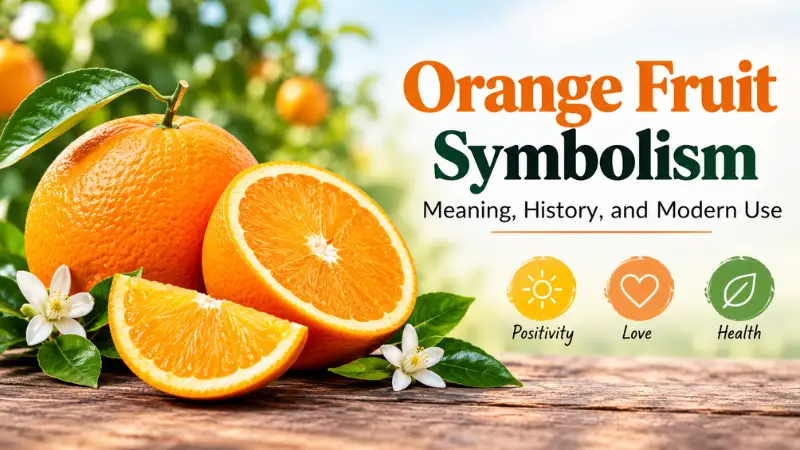
The orange fruit symbolism is commonly associated with happiness, vitality, prosperity, warmth, and fresh beginnings. With its bright peel, refreshing scent, and sweet-tart flavor, the orange often represents the simple pleasures of life. In American culture, it appears in holiday traditions, kitchen decor, gift baskets, wellness imagery, and art that celebrates abundance and optimism.
The orange has also carried meanings beyond its appearance. In different historical settings, citrus fruits have been associated with fertility, marriage, hospitality, wealth, and good fortune. These connections developed through trade, agricultural traditions, religious art, and the fruit’s practical value as a food that could be treasured when it was difficult to obtain.
Today, an orange can communicate different things depending on its setting. A bowl of oranges on a kitchen counter might suggest nourishment and hospitality, while an orange tree covered in fruit may evoke abundance and growth. Understanding these associations helps explain why this familiar fruit remains a meaningful image in American homes, celebrations, and creative expression.
Quick Answer
Orange fruit symbolism most commonly represents happiness, vitality, abundance, prosperity, and new beginnings in modern American culture. Historically, citrus fruits have also been associated with fertility, marriage, hospitality, and good fortune, although their meanings vary across cultures and traditions.
TL;DR
- Joy and optimism: The orange’s bright color suggests warmth, cheerfulness, and positive energy.
- Abundance and prosperity: A fruit-laden orange tree can represent harvest, success, and material well-being.
- Love and fertility: Citrus fruits have appeared in marriage customs and artistic traditions associated with fruitfulness.
- Health and renewal: Oranges suggest nourishment, freshness, and everyday self-care.
- American holiday traditions: Oranges can evoke Christmas stockings, family memories, and seasonal generosity.
- Modern design: Orange imagery brings a natural, welcoming, and lively quality to decor and personal style.
1. What the Orange Fruit Represents
An orange is a round citrus fruit with a peel that ranges from yellow-orange to deep orange, depending on the variety and ripeness. Its familiar appearance makes it easy to recognize in paintings, advertisements, packaging, gardens, and everyday household settings.
Symbolically, the fruit brings together several qualities. Its vivid color suggests warmth and enthusiasm, its edible flesh represents nourishment, and its seeds and fruit-bearing trees can suggest growth and continuity. These associations are not universal rules; they are interpretations shaped by experience and culture.
The orange’s symbolism also depends on how it appears. A freshly peeled orange may evoke comfort and sensory pleasure, while a flowering citrus tree can suggest the beginning of something promising. A large harvest, meanwhile, naturally lends itself to ideas of abundance and reward.
2. Joy, Happiness, and Optimism
One of the most familiar associations of the orange is happiness. Its bright appearance stands out against green foliage, brown wood, and neutral surroundings, making it an effective visual shorthand for cheerfulness.
In American design, orange tones often appear in playful graphics, seasonal decorations, food photography, and products intended to communicate friendliness. A bowl of oranges can make a kitchen feel lively, while orange illustrations can add warmth to greeting cards and cheerful packaging.
The fruit’s flavor reinforces this interpretation. Its combination of sweetness and acidity can evoke refreshment and pleasure, particularly in memories of breakfast, picnics, and freshly squeezed juice.
This does not mean that an orange always symbolizes happiness. In a still life, it may simply represent everyday life or the beauty of ordinary food. Its cheerful associations are strongest when the surrounding colors, words, or setting support that interpretation.
3. Vitality, Health, and Renewal
Oranges are widely associated with health because they provide vitamin C, water, and other nutrients. This practical connection has helped establish the fruit as a familiar symbol of nourishment and wellness.
In American culture, oranges frequently appear in breakfast advertising, nutrition illustrations, school materials, and images promoting fresh food. Their presence suggests an accessible form of self-care rather than an elaborate health ritual.
The symbolism of renewal follows naturally from this association. Eating fresh fruit, preparing a healthy breakfast, or bringing seasonal produce into a home can represent a renewed commitment to daily well-being.
However, symbolic meaning should not be confused with medical claims. An orange can represent health without guaranteeing it, and eating oranges alone does not prevent illness or replace a balanced diet.
4. Prosperity, Wealth, and Abundance
A ripe orange can symbolize abundance because it represents the result of growth and cultivation. A tree carrying numerous fruits suggests a successful harvest, while a full bowl of citrus can communicate generosity and plenty.
Historically, citrus fruits were not equally accessible everywhere. In colder regions, fresh oranges could be seasonal treats or relatively expensive imports, depending on the period and local market. Their arrival sometimes made them suitable for gifts and special occasions.
In modern American homes, oranges can suggest prosperity in a more understated way. A fruit bowl on a dining table conveys that food is available to share, while an orange grove in a painting may suggest agricultural success and a fruitful landscape.
The meaning is not necessarily about luxury. More often, it points to having enough: a good harvest, a welcoming household, or the satisfaction of seeing work produce tangible results.
5. Love, Fertility, and Marriage Traditions
Citrus fruits have appeared in various cultural traditions connected with marriage, fertility, and family continuity. These associations are particularly understandable when fruit is viewed as a product of flowering trees and as a source of seeds that can produce new plants.
In European decorative and artistic traditions, citrus fruits and their blossoms sometimes appeared in contexts associated with marriage, fertility, or prosperity. Orange blossoms became especially recognizable as wedding flowers in parts of Europe and later in broader Western wedding culture.
The blossom and the fruit should not be treated as interchangeable symbols, however. Orange blossoms have a more established connection with bridal attire and wedding customs, whereas the fruit itself may communicate abundance, sweetness, or domestic happiness.
In contemporary American settings, an orange may serve as a subtle emblem of affection, shared nourishment, or a flourishing relationship. Its meaning is usually contextual rather than a fixed romantic code.
6. Hospitality, Generosity, and Family Life
Food often communicates welcome, and oranges are particularly suited to this role. They can be shared without elaborate preparation, placed in a communal bowl, packed for a journey, or offered as part of a meal.
An orange on a table may therefore suggest generosity and domestic comfort. A parent peeling an orange for a child, for example, can represent care expressed through an ordinary act rather than through a grand gesture.
This symbolism is especially relevant to family memories. Many people associate citrus fruit with packed lunches, school snacks, winter breakfasts, or visits to relatives. Those experiences can make the orange a personal emblem of home.
In a still life or illustration, a group of oranges may communicate the same welcome visually. The fruit suggests that something simple and nourishing is available to guests, family members, or anyone who gathers around the table.
7. Ancient Roots and the Historical Spread of Citrus
The orange’s symbolic history is connected to the long movement of citrus fruits across Asia, the Middle East, the Mediterranean, Europe, and eventually the Americas. Citrus cultivation developed over many centuries, and different varieties spread through trade, migration, horticultural exchange, and agricultural experimentation.
The sweet orange familiar in American supermarkets is not identical to every citrus fruit that appeared in earlier historical records. Ancient references to citrus may involve citron, bitter orange, or other related fruits. It is therefore inaccurate to assign every historical citrus custom directly to the modern sweet orange.
As citrus trees became established in different regions, their flowers, fragrance, evergreen foliage, and fruit offered several possible symbolic associations. Blossoms could suit celebrations, while productive trees could represent abundance and the rewards of cultivation.
The fruit’s meaning evolved as it became more available. A rare or expensive citrus fruit could suggest status and special treatment; a widely available orange could become an everyday sign of nourishment and seasonal pleasure.
8. Orange Fruit Symbolism in American Culture
In the United States, oranges occupy an unusual position: they are ordinary groceries but can also evoke holidays, travel, regional identity, and nostalgia.
Florida and California are strongly associated with commercial orange growing. Citrus imagery appears in regional branding, agricultural displays, souvenirs, and depictions of warm-weather landscapes. An orange grove can represent productive land and a connection between local identity and agriculture.
For many Americans, the fruit also belongs to the visual language of breakfast and healthy eating. Orange juice advertisements and fresh-fruit displays have helped make oranges recognizable symbols of energy and nourishment.
At the same time, the orange has a place in everyday hospitality. A bowl of fruit on a counter can make a space feel lived-in and welcoming without requiring a deliberate symbolic message.
The meaning often comes from the setting: in a citrus-growing region, the orange may suggest local pride; at a holiday gathering, it may evoke tradition; in a wellness advertisement, it may stand for freshness.
9. Oranges at Christmas and Other Seasonal Celebrations
Oranges have a notable place in American Christmas memories. In some families, an orange placed in a stocking or given as a small gift recalls older traditions in which fresh citrus was a welcome seasonal treat. The practice has varied by household, region, and generation, so it should not be treated as a universal American custom.
Part of the association comes from seasonality and availability. In earlier periods, a fresh orange could feel special during winter, especially in places where local fruit was scarce. Its bright color also offered a cheerful contrast to winter weather and darker seasonal decorations.
Today, oranges appear in holiday gift baskets, table arrangements, potpourri, and decorations made with dried citrus slices. These uses combine fragrance, color, and the idea of natural abundance.
The orange does not have a formal religious meaning in Christmas observance. Its significance is mainly cultural and domestic, connecting food, generosity, family memories, and the pleasure of receiving a small gift.
10. Cross-Cultural Meanings of Citrus Fruits
Citrus symbolism varies across cultures, and the same fruit can communicate different ideas depending on local customs.
In Chinese cultural settings, oranges and mandarins are commonly associated with good fortune and prosperity, particularly around Lunar New Year. Their golden color, pleasant taste, and role as customary gifts contribute to these associations. Mandarin oranges are especially prominent in these celebrations, and they should not automatically be treated as identical to every other citrus variety.
In parts of Europe, orange blossoms became linked with weddings and bridal traditions. The association with fertility and marriage developed through custom and artistic convention rather than from a universal rule about the fruit.
In Mediterranean regions, citrus trees have also been connected with cultivated landscapes, gardens, food, and agricultural plenty. In these contexts, the tree itself may matter as much as the fruit.
These examples demonstrate why cultural context matters. An orange given as a Lunar New Year gift, worn as a wedding-flower motif, or displayed in an American kitchen can communicate different messages even though each use involves citrus.
11. The Emotional and Psychological Associations of Oranges
An orange can trigger emotional responses through memory, color, smell, taste, and personal experience. The fruit’s scent may remind someone of winter holidays, while its flavor may recall childhood snacks or family breakfasts.
Color also plays a role. Orange shades are often used in visual design to create impressions of warmth, energy, playfulness, and approachability. These effects depend on surrounding colors and individual preferences, so they are tendencies rather than universal psychological laws.
The physical act of peeling an orange can also carry meaning. It involves a brief pause, a familiar fragrance, and the division of the fruit into shareable segments. For some people, that simple routine represents comfort, patience, or care.
Personal associations may differ sharply. Someone who grew up around citrus farms may connect oranges with work and regional identity, while another person may associate them with a particular holiday or a favorite drink. The fruit’s emotional symbolism is often strongest when it connects a visible object with a specific memory.
12. Orange Fruit Symbolism in Art, Decor, and Design
Oranges are popular subjects in still-life painting, food photography, illustration, and interior decoration because their round shapes and saturated color create a clear visual focal point.
In traditional still-life art, fruit can represent ordinary pleasures, domestic abundance, or the passing of time. The meaning depends on the composition: a fresh orange may emphasize freshness and beauty, while peeled or aging fruit can draw attention to change and impermanence.
In contemporary American interiors, real oranges in a ceramic bowl can introduce color without the permanence of a painted wall or decorative object. Citrus prints, kitchen towels, table linens, and botanical illustrations similarly create a fresh, informal atmosphere.
Restaurants and food brands also use orange imagery to communicate flavor and freshness. In those contexts, the image is often practical advertising rather than a deliberate symbolic statement.
| Context | Common symbolic meaning | Typical association | Important distinction |
|---|---|---|---|
| Kitchen decor | Welcome and nourishment | A bowl of fresh oranges | Often practical as well as decorative |
| Christmas gifts | Generosity and nostalgia | An orange in a stocking | A family tradition, not a universal custom |
| Weddings | Fertility and celebration | Orange blossoms | Blossoms have a stronger bridal association than the fruit |
| Chinese New Year | Good fortune and prosperity | Gifted mandarins or oranges | Customs vary by community and citrus variety |
| Wellness imagery | Vitality and freshness | Orange juice or sliced fruit | Symbolism is not a medical claim |
13. Oranges in Tattoos, Jewelry, and Personal Style
An orange tattoo can represent optimism, health, creativity, personal growth, or a connection to family and place. Its interpretation depends on the design and the reason the person chooses it.
A single orange may suggest enjoying life’s ordinary pleasures. A branch with blossoms and fruit can evoke growth, continuity, or the balance between beginnings and results. A peeled orange may communicate openness, playfulness, or a personal memory of sharing food.
In jewelry and fashion, citrus motifs often work as lively decorative elements. Earrings shaped like oranges, fruit-patterned clothing, and botanical accessories can signal a preference for colorful, playful, or nature-inspired style.
There is no established universal code for orange tattoos or jewelry. Someone may choose the image simply because they love citrus, grew up in an orange-growing region, or associate the fruit with a person or experience. Personal explanation is more reliable than assuming a hidden meaning.
14. Common Misunderstandings and Symbolic Misuse
One common mistake is treating every orange-related tradition as evidence of a single ancient meaning. Citrus varieties differ, and customs associated with mandarins, bitter oranges, citrons, or orange blossoms do not necessarily apply equally to the sweet orange.
Another misunderstanding is assuming that orange fruit symbolism always means good luck. Prosperity and fortune are well-established associations in some cultural settings, but they are not universal. In many American contexts, the fruit simply suggests food, color, health, or a familiar seasonal memory.
It is also important to distinguish the fruit from the color orange. Color symbolism can involve visibility, warning signs, sports teams, political branding, or seasonal design. Those associations do not automatically transfer to an orange as food.
Finally, commercial images may use oranges to suggest that a product is fresh, natural, or healthy without proving those claims. The symbol communicates an impression; it does not establish the quality of a product or the truth of an advertisement.
15. How the Meaning of the Orange Has Evolved
The orange’s symbolism has changed alongside its availability and its place in daily life. Where citrus was once difficult to obtain, it could serve as a special gift or a sign of access to distant trade networks. As commercial growing and distribution expanded, oranges became familiar everyday foods in many parts of the United States.
This change did not erase older associations. The fruit can still suggest generosity, prosperity, or celebration when presented as a gift, even though it is widely sold in supermarkets. Familiarity has added new meanings rather than simply replacing the old ones.
Modern design and digital culture have broadened its visual use. Orange illustrations can communicate cheerful simplicity, food culture, seasonal style, or a preference for natural motifs. A photograph of citrus fruit may be chosen for its composition as much as for any symbolic message.
Ultimately, the orange’s meaning is flexible because it connects several recognizable experiences: eating, sharing, growing, celebrating, and remembering. Its symbolism remains accessible precisely because it does not require specialized knowledge to understand.
FAQs
What does an orange symbolize spiritually?
An orange may represent renewal, gratitude, abundance, or appreciation for everyday blessings in a personal spiritual interpretation. There is no single spiritual meaning accepted across all religions, so the setting and the individual’s beliefs matter.
Is an orange a symbol of good luck?
Yes, oranges and related citrus fruits are associated with good fortune in some cultural traditions, particularly Chinese Lunar New Year celebrations. In the United States, the fruit is more commonly associated with freshness, nourishment, happiness, and seasonal generosity.
What does an orange tattoo mean?
An orange tattoo can represent optimism, vitality, creativity, growth, or a meaningful personal memory. Its meaning is individual rather than standardized, and accompanying elements such as blossoms, leaves, or other fruit can influence the interpretation.
Why are oranges associated with Christmas?
Oranges became part of some Christmas traditions because fresh citrus could be a special winter gift in places where it was not readily available. Today, oranges in stockings and citrus decorations often evoke family nostalgia, generosity, and seasonal warmth.
What do oranges symbolize in Chinese culture?
Oranges and mandarins commonly represent good fortune and prosperity in Chinese cultural celebrations, especially around Lunar New Year. Their role as gifts and their golden appearance help support these associations, although specific customs differ between families and communities.
Are oranges a symbol of love and fertility?
Citrus fruits have been associated with fertility and marriage in certain historical and artistic traditions. Orange blossoms, however, have a more recognizable connection with Western bridal customs than the edible fruit itself.
Is orange fruit symbolism always positive?
No. Oranges often suggest joy, abundance, health, and renewal, but they do not have one universal meaning. An orange in a painting might simply be food, a reminder of a personal experience, or an element chosen for its color and shape.
Conclusion
Orange fruit symbolism brings together happiness, vitality, prosperity, nourishment, and the promise of growth. Its historical associations with gifts, marriage customs, and good fortune show how an ordinary food can acquire meaning through trade, tradition, and everyday experience. In modern American culture, oranges remain familiar symbols of freshness, family memories, hospitality, and seasonal celebration.
The most accurate interpretation depends on context. An orange in a holiday stocking may represent generosity, a fruit-bearing tree may suggest abundance, and a citrus tattoo may express a personal connection to home or optimism. Ultimately, orange fruit symbolism is best understood as a collection of cultural and personal associations—not a fixed code, but a familiar fruit whose meaning grows from how people use, share, and remember it.