Orthodox Christian Symbolism:
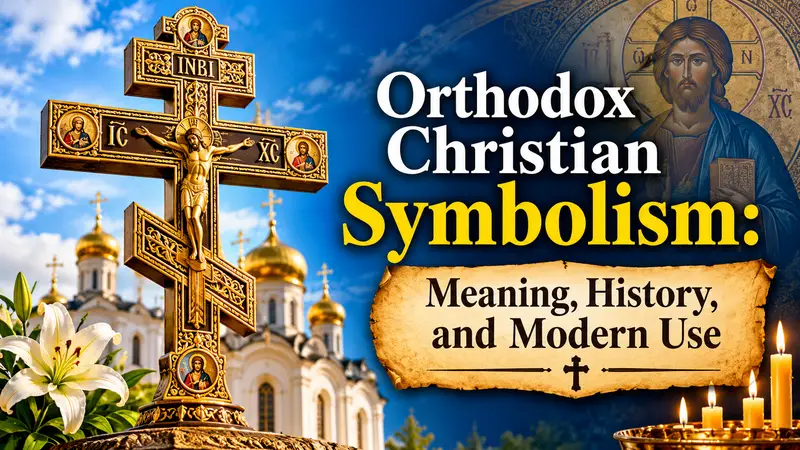
Orthodox Christian symbolism is a visual language of faith that communicates beliefs about Jesus Christ, the Virgin Mary, the saints, salvation, and the relationship between heaven and earth. It appears in painted icons, church architecture, crosses, religious clothing, candles, incense, and the traditional artwork found in Eastern Orthodox churches.
For Orthodox Christians, these images and objects are not simply decorative religious accessories. They help communicate biblical teachings, preserve the memory of important events, and provide a visible connection to the Church’s spiritual traditions. An icon of Christ, for example, represents more than a portrait; it points to the Christian belief that God became human through Jesus.
In the United States, Orthodox Christian symbols are increasingly encountered outside traditional church settings. People see Byzantine crosses in jewelry, icons in homes, and Orthodox-inspired artwork in religious communities and cultural spaces. Understanding their meaning requires looking at their biblical foundations, historical development, and continued importance in Orthodox Christian life.
Quick Answer
Orthodox Christian symbolism commonly represents faith in Jesus Christ, the Holy Trinity, salvation, eternal life, and the spiritual connection between heaven and earth. Historically rooted in early Christianity and Byzantine religious art, it uses icons, crosses, sacred colors, candles, and church imagery to communicate Orthodox beliefs and the continuity of Christian tradition.
TL;DR
- The cross represents Christ’s sacrifice, resurrection, and victory over death.
- Icons communicate biblical teachings and honor Christ, Mary, and the saints.
- Byzantine art shaped many recognizable Orthodox visual traditions.
- Candles and incense represent prayer, worship, and spiritual devotion.
- Orthodox symbols connect religious identity with family and cultural heritage.
- Modern uses include jewelry, home icons, tattoos, and church architecture.
1. What Is Orthodox Christian Symbolism?
Orthodox Christian symbolism refers to the visual signs, sacred objects, artistic traditions, and ceremonial practices used in Eastern Orthodox Christianity to express religious beliefs.
The word Orthodox comes from Greek roots commonly translated as correct belief or correct worship. Orthodox Christianity emphasizes continuity with the teachings and worship practices of the early Christian Church.
Its symbolism includes several recognizable elements:
- The cross, representing Christ’s crucifixion and resurrection.
- Icons, depicting Jesus, Mary, angels, and saints.
- The halo, indicating holiness and participation in God’s grace.
- Candles, associated with Christ as the Light of the World.
- Incense, representing prayers offered to God.
- The church dome, often associated with heaven and God’s kingdom.
- Liturgical vestments, communicating the sacred character of worship.
These elements work together. An Orthodox church is not simply a building containing religious pictures. Its artwork, architecture, lighting, and ceremonial objects contribute to an organized visual expression of Christian theology.
The Orthodox Church in America explains that Christian symbols are intended to direct believers beyond the physical objects themselves toward spiritual realities.
2. The Historical Origins of Orthodox Christian Symbols
Golden Mosaic of jesus Christ at hagia Sophia church near istanbul city Turkey
Full-day Private Tour to Meteora from Athens | Manawa
7
Orthodox Christian symbolism developed from the religious practices of early Christianity, biblical imagery, and the artistic traditions of the eastern Mediterranean.
During the first centuries of Christianity, believers used relatively simple images to communicate their faith. Fish, anchors, shepherds, doves, and other recognizable figures appeared in early Christian art.
As Christianity expanded and eventually gained legal recognition in the Roman Empire, Christian artwork became more visible in churches and public religious settings.
The Byzantine Empire played a particularly important role in shaping Orthodox visual traditions. Constantinople became a major center of Christian art, theology, architecture, and religious education.
Artists developed recognizable ways of portraying Christ, Mary, biblical events, and saints. Gold backgrounds, symbolic gestures, carefully arranged figures, and distinctive facial expressions became important features of Byzantine iconography.
The use of icons also became the subject of major theological debate. During the eighth and ninth centuries, the Byzantine controversy over religious images challenged whether sacred pictures could appropriately be used in Christian worship.
The restoration of icon veneration in 843, commemorated as the Triumph of Orthodoxy, became an important event in Eastern Orthodox history.
Today, Byzantine artistic traditions remain central to Orthodox churches, even though individual communities have developed different regional styles.
3. The Orthodox Cross and Its Spiritual Meaning
22K Gold Men’s Eastern Orthodox Cross Pendant
Cross and mosaic fresco inside St. Mark’s Church. Belgrade, Serbia – March 31, 2023.
Kríž osmikonečný osemramenný, brúsený (D02)
6
The cross is the most recognizable symbol of Orthodox Christianity. It represents the crucifixion of Jesus Christ, but its meaning does not end with suffering or death.
For Orthodox believers, the cross also communicates resurrection, forgiveness, redemption, and victory over death.
One familiar design is the three-bar Orthodox cross. It generally includes:
- The upper bar: Associated with the inscription placed above Jesus during the crucifixion.
- The central bar: Represents the crossbeam on which Christ’s hands were attached.
- The lower slanted bar: Traditionally interpreted in connection with the footrest and the two crucified criminals, with its upward and downward directions sometimes associated with their different responses to Christ.
The slanted footrest is particularly recognizable in Russian and some other Eastern Orthodox traditions.
However, not every Orthodox cross has three bars. Orthodox Christians also use simpler crosses, Byzantine designs, and other regional variations.
In American Orthodox communities, the cross appears in church buildings, baptismal gifts, necklaces, prayer corners, and religious artwork. For many believers, wearing one is an expression of faith and a reminder of Christ’s teachings rather than merely a fashion choice.
4. Icons: Why Sacred Images Matter in Orthodoxy
Hristos cheamă la mântuire pe toţi oamenii*
Blessed Virgin Mary Icons: Virgin and Child Icon | Monastery Icons
Купить икону Сергия Радонежского с мощевиком.
Icons are among the defining features of Orthodox Christian symbolism.
An icon is a sacred image depicting Jesus Christ, the Virgin Mary, angels, saints, or significant events in Christian history. These images are commonly painted on wooden panels, although they can also appear in mosaics, frescoes, and other artistic forms.
Orthodox Christians do not understand icons as ordinary portraits. They are intended to communicate the presence and reality of the heavenly kingdom within the life of the Church.
An important theological foundation is the Incarnation: the Christian belief that God became human through Jesus Christ. Because Christ took on a visible human nature, Orthodox theology considers his depiction in sacred images appropriate.
Icons serve several purposes:
- They help believers remember biblical events.
- They communicate Christian teachings visually.
- They encourage prayer and reflection.
- They honor the saints as examples of faithful Christian living.
- They connect contemporary worship with earlier generations of believers.
Orthodox Christians distinguish between worship, which belongs to God alone, and veneration, which is the respectful honor shown to sacred images and the people represented in them.
This distinction is essential to understanding why kissing or bowing before an icon is not considered worship of wood, paint, or the physical image itself.
5. The Symbolism of Jesus Christ in Orthodox Art
OrthPhoto – The Annunciation Greek Orthodox Cathedral in Columbus, Ohio, USA – Andreas.Ch
Jesus Christ occupies the central position in Orthodox Christian symbolism.
One of the most familiar images is Christ Pantocrator, a Greek title commonly translated as Ruler of All or Almighty.
In this iconographic tradition, Christ is usually shown facing the viewer, often holding a Gospel book and raising his right hand in blessing.
His appearance communicates several ideas:
- Divine authority: Christ is understood as Lord and ruler of creation.
- Human nature: His visible human appearance reflects the Incarnation.
- Teaching: The Gospel book represents his teachings and the Christian message.
- Judgment and mercy: His expression communicates both divine authority and compassion.
Orthodox churches frequently place Christ Pantocrator in the central dome, where the image looks down toward the congregation.
This arrangement expresses the belief that Christ is present and sovereign over the entire created world.
Other important depictions include the Nativity, Crucifixion, Resurrection, Transfiguration, and Christ’s descent into Hades, a traditional Orthodox representation of the Resurrection.
6. The Virgin Mary and Theotokos Symbolism
Virgin Mary Hodegetria Icon – Orthodox Icons – BlessedMart
The Virgin Mary holds a particularly honored position in Orthodox Christianity.
She is commonly called Theotokos, meaning God-bearer. This title emphasizes that Jesus Christ, whom she gave birth to, is truly God incarnate.
Orthodox images of Mary frequently show her holding the infant Jesus. One familiar style is the Hodegetria, in which Mary gestures toward Christ as the way of salvation.
Her symbolism includes:
- Motherhood and devotion.
- Humility and obedience to God.
- The Incarnation of Jesus Christ.
- Faithfulness and spiritual courage.
- The relationship between humanity and divine grace.
Mary is not considered a goddess in Orthodox Christianity. Rather, she receives exceptional honor because of her role in Christian salvation history.
In American Orthodox churches, icons of the Theotokos are commonly placed near the sanctuary and appear in homes, prayer books, and religious jewelry.
For many Orthodox families, these images also represent inherited faith and connections to earlier generations.
7. The Holy Trinity and Its Symbolism
About God | Office of Religious Education-UOCofUSA
The Holy Trinity is one of the foundational beliefs of Orthodox Christianity. It teaches that God is one in essence and exists as three distinct persons: the Father, the Son, and the Holy Spirit.
Orthodox religious art communicates this belief through several images and artistic arrangements.
One famous example is the Holy Trinity icon traditionally associated with the Russian iconographer Andrei Rublev. It depicts three angels seated around a table, drawing on the biblical account of Abraham’s visitors at the Oak of Mamre.
The three figures are commonly understood in relation to the Trinity, although the image’s interpretation requires theological care.
Other representations include:
- Three interlocking circles, sometimes used as a simplified explanation of the Trinity.
- The dove, traditionally associated with the Holy Spirit.
- The hand of God, sometimes used in historical Christian artwork to represent the Father.
- Christ, represented through the Son’s human appearance.
Orthodox iconography does not treat every geometric design as an official or universal representation of the Trinity. Traditional church images follow particular theological and artistic conventions.
The central message is that the Father, Son, and Holy Spirit are distinct persons who share one divine nature.
8. Angels, Saints, and Their Spiritual Significance
Εικόνα Του Αρχάγγελου Μιχαήλ |Εργαστήριο Βυζαντινών Εικόνων Ή Άμπελος
7
Angels and saints appear frequently in Orthodox Christian artwork because they communicate different aspects of the relationship between God and creation.
Angels are understood as spiritual beings who serve God. They appear in biblical accounts as messengers, protectors, and participants in heavenly worship.
Two especially recognizable figures are:
- Archangel Michael: Commonly associated with protection, spiritual struggle, and victory over evil.
- Archangel Gabriel: Associated with delivering God’s message to Mary about the birth of Jesus.
Saints represent people whose lives are remembered for holiness, faith, sacrifice, and devotion to God.
Their icons frequently include halos, which symbolize holiness and participation in divine grace rather than physical light surrounding the head.
Orthodox Christians may pray for the intercession of saints, asking them to pray to God on their behalf. This practice reflects the belief that the Church includes both the living and those who have died in faith.
In the United States, families sometimes keep icons of patron saints in their homes, particularly when a child receives a saint’s name at baptism.
9. Sacred Colors and Their Orthodox Christian Meanings
Что означают цвета облачений священнослужителей
Color is an important part of Orthodox church decoration and worship. Vestments, altar coverings, icons, and other religious objects may change in appearance according to the liturgical calendar.
However, Orthodox Christianity does not have one universally enforced color system. Practices vary among jurisdictions, local churches, and regional traditions.
Common associations include:
| Color | Common Orthodox Association | Typical Context |
|---|---|---|
| Gold | Divine glory, kingship, and celebration | Sundays and major feasts |
| White | Light, purity, and resurrection | Pascha and certain major feasts |
| Red | Life, sacrifice, and martyrdom | Feasts of the Cross and martyrs in some traditions |
| Green | New life and renewal | Pentecost and Palm Sunday in many traditions |
| Blue | The Virgin Mary and heavenly associations | Marian feasts in some traditions |
| Black | Repentance, mourning, and solemnity | Certain Lenten services |
Gold is particularly recognizable in Byzantine religious art. Gold backgrounds help communicate heavenly glory rather than attempting to reproduce an ordinary earthly setting.
White is strongly associated with the celebration of Christ’s Resurrection, especially during Pascha, the Orthodox celebration of Easter.
Green is frequently connected with the Holy Spirit and new life, although specific applications vary.
It is important not to assume that every color has an identical meaning in every Orthodox community. Liturgical practice developed differently across national and ecclesiastical traditions.
10. Candles, Incense, and Light in Orthodox Worship
Prières orthodoxes : prière de Jésus, chapelet chotki, prières du matin et soir
Νηστεία Μεγάλου Σαββάτου: Τι τρώμε μετά την Πρώτη Ανάσταση – Dnews
Why Do We Burn Incense in the Orthodox Church? | Church Blog
7
Orthodox Christian symbolism extends beyond paintings and religious objects. Ordinary physical elements become part of worship through their connection to biblical teachings.
Candles and light
Candles represent prayer, spiritual attentiveness, and Christ as the Light of the World.
Orthodox believers commonly light candles before icons when entering a church. The act can accompany prayers for family members, people who are ill, or those who have died.
The candle’s flame also serves as a reminder of the Christian call to live with faith and spiritual awareness.
Incense
Incense is another important feature of Orthodox worship. Its rising smoke is associated with prayers ascending toward God.
This symbolism has biblical foundations, particularly in the Psalms, where prayer is compared to incense offered before God.
During services, clergy use a censer to distribute incense around the church, including before icons, the congregation, and sacred objects.
Church light
Natural light, candles, and lamps help establish the atmosphere of Orthodox worship. Light commonly represents God’s presence, truth, and the promise of eternal life.
These elements are not simply decorative choices. Together, they create an environment in which worship engages sight, smell, hearing, and movement.
11. The Iconostasis and Orthodox Church Architecture
Mitropolia Chişinăului şi a Întregii Moldove
One of the most distinctive features of an Orthodox church is the iconostasis.
An iconostasis is a screen or structure containing religious icons that separates the altar area from the main congregation space. It usually includes doors known as the Royal Doors, through which the clergy enter and exit during particular parts of the liturgy.
Its arrangement communicates important theological ideas.
Icons of Christ and the Theotokos commonly occupy prominent positions. Other sections may include images of apostles, saints, important biblical events, and major church feasts.
The iconostasis is not intended simply to hide the altar. Orthodox explanations emphasize its role in expressing the unity between the earthly congregation and the heavenly kingdom.
Church architecture also carries symbolic meaning.
- The dome: Often associated with heaven and Christ’s authority.
- The altar: Represents the sacred center of the Eucharistic celebration.
- The Royal Doors: Mark the ceremonial entrance to the altar.
- The nave: Provides the gathering space for the worshipping community.
- The icons: Visually communicate the biblical story and the communion of saints.
The exact architectural arrangement differs among Greek, Russian, Serbian, Antiochian, Romanian, and other Orthodox traditions. Orthodox Church in America+1
12. Orthodox Christian Symbolism in American Culture
House of God | St. Athanasios Greek Orthodox Church
Holy Myrrhbearers Orthodox Christian Church
Photo Gallery from Pascha 2023 – Saint Seraphim Orthodox Cathedral
9
Orthodox Christianity has a diverse history in the United States. Its communities include people with Greek, Russian, Serbian, Ukrainian, Arab, Romanian, Albanian, Ethiopian, Eritrean, and other cultural backgrounds.
This diversity affects how Orthodox symbols appear in American public and private life.
For many Greek American families, Orthodox imagery connects religious practice with Greek cultural heritage. Russian American communities may maintain traditional icon styles and customs associated with Russian Orthodox history. Antiochian Orthodox communities often preserve Arabic-language hymns and regional artistic traditions.
However, Orthodox Christianity is not limited to people from historically Orthodox countries. Americans from different backgrounds also convert to the faith and participate in its religious traditions.
Several settings make Orthodox symbolism visible in the United States:
Family celebrations: Baptisms, weddings, and religious holidays often include crosses, icons, and ceremonial candles.
Pascha celebrations: Orthodox Easter features processions, candles, decorated churches, and the traditional greeting celebrating Christ’s Resurrection.
Home prayer spaces: Families may arrange icons, prayer books, and candles in a dedicated corner of their homes.
Religious jewelry: Cross necklaces and saint medals can communicate personal faith and family heritage.
Community identity: Church buildings and religious artwork help preserve connections with ancestral traditions while creating a shared American Orthodox identity.
In this context, symbolism serves both religious and cultural purposes. A family icon may represent Christian devotion while also reminding its owners of grandparents, migration, language, and community history.
13. Emotional and Psychological Meaning of Orthodox Symbols
Orthodox Christian symbols can carry strong emotional associations because they connect religious beliefs with everyday experiences.
Their significance often depends on the person, family, and circumstances in which they are encountered.
Comfort during difficult periods: An icon of Christ or the Theotokos may remind someone of prayer, compassion, and the possibility of finding hope during suffering.
Connection with family: Religious objects inherited from parents or grandparents can preserve memories of family traditions and earlier generations.
Identity and belonging: Wearing an Orthodox cross may communicate commitment to a religious community and its teachings.
Remembrance and mourning: Candles and memorial icons can provide a familiar setting for remembering deceased relatives and praying for them.
Spiritual discipline: Seeing an icon in a home or prayer space can encourage reflection and remind believers to practice patience, forgiveness, and humility.
These emotional associations are not universal psychological effects. A symbol’s personal meaning depends on an individual’s religious beliefs and life experiences.
For an Orthodox Christian, an icon may be part of an established devotional practice. For someone outside the tradition, the same image might primarily represent Byzantine art, family history, or cultural heritage.
14. Modern Uses, Misunderstandings, and the Evolution of Orthodox Symbols
Orthodox Icon of Christ the Good Shepherd | Free Shipping
9
Orthodox Christian symbolism continues to appear in contemporary American life, although its use has expanded beyond traditional church settings.
Modern uses
Jewelry: Orthodox crosses and saint medals are popular religious accessories. Some people wear them as expressions of faith, while others receive them as baptismal or confirmation-style gifts.
Tattoos: Some Orthodox-inspired tattoos feature crosses, saints, angels, or short religious inscriptions. However, attitudes toward religious tattoos differ among Orthodox clergy and communities.
Home decoration: Icons are displayed in homes, sometimes as part of a dedicated prayer corner containing a Bible, candles, and other devotional objects.
Digital culture: Orthodox images appear in online religious communities, educational posts, digital prayer materials, and social media discussions.
Art and architecture: Byzantine-inspired patterns, gold backgrounds, and traditional iconographic compositions influence contemporary religious art.
Common misunderstandings
Despite their visibility, Orthodox symbols are sometimes interpreted incorrectly.
One common misunderstanding is that Orthodox Christians worship icons. They distinguish between worship owed to God and veneration offered to the people represented in sacred images.
Another misconception is that all Orthodox crosses have three bars. Although the three-bar design is recognizable, other cross forms are also used.
Some people also assume that every decorative feature in an Orthodox church has a fixed theological meaning. In reality, certain architectural and artistic details developed through practical decisions and regional customs.
The Orthodox Church in America specifically cautions against inventing symbolic explanations for objects whose shapes or arrangements developed for practical reasons. Orthodox Church in America+1
How the symbolism has evolved
Orthodox Christian symbolism has changed in its artistic expression while maintaining important theological foundations.
Early Christian images were relatively simple. Byzantine artists later established elaborate iconographic conventions, and different Orthodox communities developed their own recognizable styles.
Immigration brought these traditions to the United States, where churches preserved inherited practices while adapting to new surroundings.
Today, digital reproductions, contemporary jewelry, home decoration, and modern artwork provide additional ways for people to encounter Orthodox imagery.
The forms may change, but the central purpose remains the communication of Christian faith, worship, and spiritual tradition.
FAQs
1. What is the main meaning of Orthodox Christian symbolism?
Orthodox Christian symbolism expresses beliefs about Jesus Christ, salvation, the Holy Trinity, and eternal life. Icons, crosses, candles, and sacred architecture help communicate these teachings through visual and ceremonial traditions.
2. Why do Orthodox Christians use icons?
Orthodox Christians use icons to represent Christ, the Virgin Mary, angels, and saints and to support prayer and worship. They believe icons help communicate the reality of the heavenly kingdom and honor the people depicted without treating the physical images as gods.
3. What does the three-bar Orthodox cross mean?
The three-bar cross represents Christ’s crucifixion, with the additional bars traditionally associated with the inscription above his head and the footrest below. Its slanted lower bar also carries traditional interpretations connected with the two criminals crucified alongside Jesus.
4. What does the halo symbolize in Orthodox Christian art?
A halo represents holiness and participation in God’s grace. It identifies Christ, the Virgin Mary, angels, and saints as figures associated with divine holiness rather than indicating a physical light surrounding their heads.
5. Are Orthodox Christian symbols different from Catholic symbols?
There is considerable overlap because Eastern Orthodox and Roman Catholic Christianity share many early Christian traditions, including the cross, biblical imagery, and veneration of saints. However, Orthodox iconography has distinctive Byzantine artistic conventions, and Orthodox churches commonly feature an iconostasis and particular styles of religious imagery.
6. What does wearing an Orthodox cross symbolize?
Wearing an Orthodox cross commonly expresses Christian faith, devotion to Jesus Christ, and identification with Orthodox religious tradition. For some Americans, it also represents family heritage, baptismal memories, and a connection with their cultural community.
7. Are Orthodox Christian symbols appropriate for tattoos?
Some people choose Orthodox crosses, icons, or religious inscriptions as permanent expressions of faith. However, sacred imagery is treated with particular respect in Orthodox Christianity, so anyone considering a religious tattoo may wish to discuss the decision with an Orthodox priest.
Conclusion
Orthodox Christian symbolism communicates the central beliefs of Eastern Orthodox Christianity through crosses, icons, sacred colors, candles, incense, angels, and church architecture. Each element has a particular place within a tradition shaped by biblical teachings, early Christianity, and centuries of Byzantine artistic development.
In the United States, these symbols also connect religious devotion with family heritage, community identity, personal prayer, and cultural traditions. Their appearance in homes, churches, jewelry, and contemporary artwork demonstrates how historical religious imagery remains relevant in modern life.
Ultimately, Orthodox Christian symbolism is a visual expression of faith that connects the teachings of Jesus Christ with the worship, history, and everyday spiritual practices of Orthodox believers.