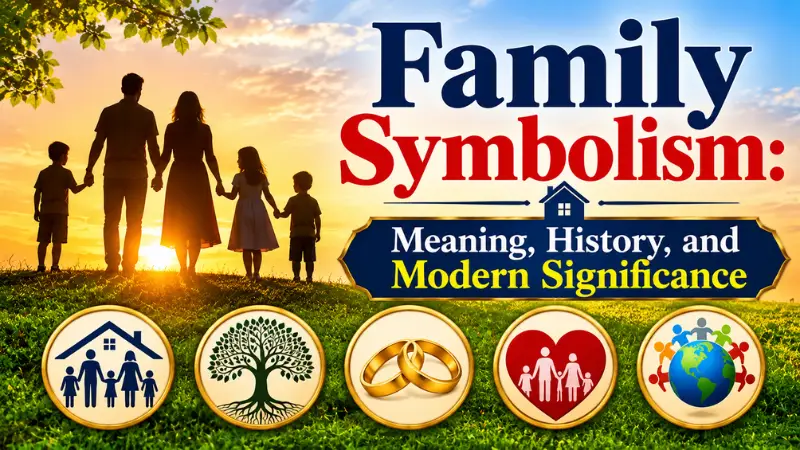
Family is one of the most familiar ideas in human life, but the symbols used to represent it can communicate much more than a simple connection between relatives. Family symbolism represents love, belonging, shared history, loyalty, protection, ancestry, and the relationships that connect generations. In the United States, these meanings appear in family trees, wedding rings, photographs, household traditions, memorial objects, and personalized artwork.
People often choose family-related symbols to honor their parents, remember grandparents, celebrate children, or recognize relatives who have shaped their lives. Others use them to express a broader idea of family that includes adoptive parents, stepfamilies, close friends, and chosen family.
Understanding these symbols means looking beyond their appearance. A tree, a circle, a home, or a pair of joined hands can each represent a different part of family life. Their meanings come from cultural traditions, historical practices, personal experiences, and the emotional importance people attach to relationships.
Quick Answer: What Does Family Symbolism Represent?
Family symbolism commonly represents love, unity, belonging, protection, loyalty, and connections between generations in modern American culture. Historically, family symbols have also represented ancestry, inheritance, shared identity, religious traditions, and the responsibilities people hold toward their relatives.
TL;DR
- Family trees represent ancestry, growth, and connections between generations.
- Hearts symbolize affection, emotional bonds, and unconditional love.
- Homes and hearths represent security, care, and belonging.
- Family crests communicate heritage, identity, and historical associations.
- Wedding rings represent commitment and relationships formed through marriage.
- Modern family symbols celebrate biological, adoptive, blended, and chosen families.
1. What Family Symbols Look Like and Where People Find Them
Family symbolism does not belong to one particular image or design. Instead, it includes objects, illustrations, patterns, and traditions that communicate relationships and shared identity.
Some of the most recognizable family symbols include:
- Family tree: A branching tree showing relatives and generations.
- Heart: A familiar representation of affection and emotional attachment.
- House: A visual reminder of home, safety, and shared experiences.
- Circle: An image of unity, continuity, and connection.
- Joined hands: A representation of support, cooperation, and loyalty.
- Wedding rings: Objects associated with marriage and commitment.
- Family photographs: Images preserving memories and relationships.
- Family crest: A heraldic design associated with a particular historical individual or lineage.
Americans encounter these images in homes, jewelry, greeting cards, memorial decorations, genealogy websites, wedding ceremonies, and personalized gifts.
Their meanings depend on context. A tree displayed in a genealogy room might represent ancestry, while the same image on a nursery wall could communicate growth and the importance of family relationships.
2. The Core Meaning of Family Symbolism
The central meaning of family-related imagery is connection. It represents the relationships that provide people with a sense of belonging, support, and shared identity.
Several important ideas appear repeatedly in family symbols.
Love and affection: Hearts, embraces, and photographs communicate emotional attachment between relatives.
Unity: Circles, linked figures, and interconnected designs suggest that individual family members belong to a larger group.
Protection: Homes, shelters, and protective hands represent the responsibility to care for one another.
Heritage: Family trees, ancestral names, and historical emblems connect living relatives with previous generations.
Continuity: Growing trees, linked rings, and repeating patterns suggest that family relationships extend beyond one lifetime.
Loyalty: Interlocking designs and joined hands communicate the willingness to remain supportive during difficult circumstances.
These meanings are not fixed rules. A family may choose a particular symbol because it represents a shared memory rather than a traditional definition. For example, a small lighthouse might represent a grandparent who provided guidance, even though it is not a conventional family emblem.
3. Historical Origins of Family Symbols
People have used visual representations of family relationships for thousands of years. However, there was never one universal system of family symbolism.
In ancient societies, ancestry often influenced inheritance, social position, religious responsibilities, and community membership. Families preserved their histories through oral storytelling, written records, monuments, burial customs, and objects passed between generations.
In medieval Europe, heraldry developed into a recognizable system of identifying individuals and their affiliations. By approximately the 12th century, distinctive designs appeared on shields and other military equipment. These images helped identify people in battle and tournaments and gradually became associated with lineage, alliances, and social identity.
Family-related imagery also appeared in religious art, historical manuscripts, seals, and memorial monuments.
In many communities, ancestors were remembered through household objects, family names, ceremonial practices, and burial traditions rather than through European-style coats of arms.
As literacy and recordkeeping expanded, family histories became easier to document. Genealogical charts, family Bibles, portraits, and written family records provided additional ways to preserve relationships across generations.
Modern family symbolism developed from this combination of inherited traditions and personal expressions of identity.
4. The Family Tree: A Symbol of Ancestry and Growth
<IMAGE_PLACEHOLDER>
The family tree is arguably the most recognizable visual representation of ancestry in contemporary American culture.
Its structure explains why it became such a natural symbol. The roots represent earlier generations, the trunk represents the family line, and the branches represent descendants and different relationships.
Leaves may represent individual family members, while new growth can suggest children and future generations.
The image communicates several ideas:
- Roots: Ancestral origins and inherited history.
- Trunk: Continuity and the central family line.
- Branches: Different generations and related family groups.
- Leaves: Individual relatives and descendants.
- New growth: Future generations and family development.
Family trees are especially common in genealogy projects, ancestry books, educational activities, and personalized home decorations.
In the United States, people frequently use genealogy websites and historical records to discover relatives, migration patterns, and connections to earlier generations. A family tree turns this information into a visual story.
It also reminds viewers that family history is not always simple. Adoption, remarriage, blended households, and unknown ancestry can create complicated family structures that a traditional branching diagram may not fully represent.
5. The Meaning of Hearts, Circles, and Joined Hands
Some family symbols focus less on ancestry and more on the emotional relationships between people.
The heart
The heart is one of the most familiar symbols of love and affection. In family settings, it represents care between parents and children, affection between siblings, and emotional attachment to relatives.
Heart designs commonly appear on Mother’s Day cards, personalized jewelry, memorial gifts, and family artwork.
The circle
A circle has no obvious beginning or ending. This makes it a useful representation of continuity, inclusion, and relationships that remain connected over time.
In family artwork, a circle containing several people can represent togetherness without suggesting that one member is more important than another.
Joined hands
Hands holding one another communicate cooperation, protection, and mutual responsibility. They can represent parents caring for children, siblings supporting each other, or several generations standing together.
These symbols are popular because their meanings are immediately understandable, even when people come from different cultural backgrounds.
6. The Home and Hearth as Symbols of Family
<IMAGE_PLACEHOLDER>
A home represents much more than a physical building. In family symbolism, it communicates shelter, stability, shared memories, and the everyday experience of belonging.
The distinction between a house and a home is particularly important.
A house is a physical structure. A home becomes meaningful through the relationships, routines, and experiences that take place inside it.
The hearth has an especially long association with domestic life. Historically, a household fire provided warmth, cooking, and a place around which people gathered. As a result, the hearth became associated with hospitality, family care, and domestic continuity.
In modern American culture, these associations appear in familiar expressions such as gathering around the dinner table, celebrating holidays at home, and welcoming relatives into a shared space.
House-shaped decorations, family welcome signs, and personalized home illustrations communicate similar ideas.
The home can also symbolize emotional security. For someone who has moved frequently, experienced family separation, or grown up far from relatives, the idea of home may represent the people rather than a particular address.
7. Family Symbolism in American Culture
In the United States, family symbols are closely connected to personal identity, cultural heritage, celebrations, and remembrance.
American families have diverse backgrounds and structures. Some emphasize extended relatives and ancestral traditions, while others focus on smaller households or relationships built through adoption, remarriage, and close friendships.
Family-related imagery appears in several parts of American life.
Thanksgiving: Shared meals and family gatherings often represent gratitude, connection, and the continuation of household traditions.
Mother’s Day and Father’s Day: Cards, flowers, hearts, and personalized gifts recognize parental relationships and caregiving.
Family reunions: Matching shirts, photographs, banners, and family-name decorations celebrate shared ancestry and community.
Weddings: Rings, family photographs, heirloom jewelry, and ceremonial traditions connect marriage with family history.
Memorial services: Portraits, candles, engraved stones, and keepsakes honor relatives who have died.
Home decoration: Family photographs, framed names, and personalized signs make relationships visible in everyday spaces.
For many Americans, these objects communicate identity without requiring a written explanation. A photograph of several generations displayed in a living room, for example, can express pride in family history and affection for relatives.
8. Family Symbols Across Different Cultures and Religions
Family symbolism differs across cultures because societies understand ancestry, marriage, household responsibilities, and community relationships in different ways.
In many East Asian traditions, respect for ancestors has an important place in family life. Ancestral tablets, memorial photographs, and household offerings can represent continuing respect for relatives who have died.
In several African cultural traditions, family identity may extend beyond parents and children to include extended relatives, ancestors, and wider community relationships. Specific meanings vary considerably among ethnic groups and regions.
In Jewish traditions, family history can be connected to religious practice, inherited identity, genealogy, and remembrance. Certain family names and ancestral traditions carry particular significance.
In Christianity, family imagery is frequently associated with marriage, parenthood, care, and religious teachings about love and responsibility. The Holy Family, representing Mary, Joseph, and Jesus, is an important example in Christian art.
Many Indigenous communities in North America maintain their own kinship systems, clan relationships, and ancestral traditions. Some use animal imagery and other culturally specific symbols to communicate collective identity and history. These traditions should not be treated as interchangeable with generic commercial family designs.
The important distinction is that family symbolism is culturally shaped. An image that represents ancestry in one community may communicate something different in another.
9. The Emotional and Psychological Meaning of Family Symbols
Family symbols often have emotional importance because they connect visible objects with personal memories.
A photograph, inherited ring, handwritten recipe, or engraved pendant can remind someone of a relative even when that person is no longer present.
These objects can provide a sense of continuity during major life changes. Moving away from home, getting married, becoming a parent, or losing a loved one can change how someone understands their family identity.
Several emotional associations are especially common.
Belonging: Family imagery can remind people that they are part of a group with shared experiences.
Security: Images of homes and protective figures can represent emotional and physical support.
Nostalgia: Old photographs and inherited possessions can bring back memories of childhood and earlier generations.
Gratitude: Personalized keepsakes can acknowledge the sacrifices and contributions of relatives.
Identity: Ancestral names, family stories, and cultural symbols can help people understand where they come from.
However, family symbols do not always represent positive experiences. Someone who has experienced separation, conflict, neglect, or loss may associate the same images with complicated feelings.
A symbol’s emotional meaning ultimately depends on the experiences of the person who chooses it.
10. Family Symbolism in Tattoos, Jewelry, and Personal Style
<IMAGE_PLACEHOLDER>
Family-related designs are common in personal accessories because they allow people to carry meaningful reminders of their relationships.
Family tattoos
Popular tattoo designs include family trees, children’s names, birth dates, initials, hearts, and portraits of loved ones.
Some people choose small matching tattoos with siblings or parents. Others use a larger design to represent multiple generations.
A family tattoo may celebrate a new child, remember a deceased relative, or recognize someone who provided support during a difficult period.
Family jewelry
Lockets, engraved bracelets, rings, pendants, and necklaces can represent affection and remembrance.
A locket containing a photograph is particularly associated with keeping a loved one close. Birthstone jewelry may also represent children, siblings, or multiple family members.
Personalized clothing
Matching family shirts, embroidered initials, and custom designs are popular at reunions, holidays, and family celebrations.
Home accessories
Family-name signs, framed illustrations, and personalized ornaments allow people to display their relationships in shared spaces.
The appeal of these designs comes from their personal connection. A simple pendant engraved with a child’s name may mean more to its owner than an elaborate decorative emblem.
11. Family Crests, Coats of Arms, and Ancestral Identity
<IMAGE_PLACEHOLDER>
Family crests and coats of arms are among the most recognizable historical forms of family-associated imagery.
A traditional coat of arms usually features a shield with distinctive designs, colors, and figures. A complete heraldic achievement may also include a helmet, crest, decorative mantling, and other elements.
Historically, heraldry developed as a system of identification in medieval Europe. It became associated with particular individuals, lineages, and social relationships.
In the United States, these designs are frequently used on personalized gifts, family-history displays, stationery, and decorative household items.
However, an important historical distinction is often overlooked: a coat of arms is generally associated with a particular armiger and legitimate descendants, not automatically with everyone who shares a surname.
The American Heraldry Society explains that most English-speaking heraldic traditions do not recognize a universal coat of arms belonging to every person with a particular family name.
This means that purchasing a decorative shield displaying a surname does not establish an actual ancestral connection to the historical arms.
For genuine genealogy research, family records and documented descent are more meaningful than a commercially printed surname crest.
12. Family Symbolism in Weddings, Holidays, and Mourning Traditions
Family symbols become especially meaningful during important life events because these occasions often involve changes in relationships and family responsibilities.
Weddings
Wedding rings represent commitment and the relationship established through marriage. Family photographs, heirloom accessories, and inherited traditions can also connect a new marriage with earlier generations.
Births and welcoming children
Baby footprints, name plaques, birthstones, and family-tree decorations celebrate the arrival of a new family member.
Thanksgiving and Christmas
Shared meals, decorated trees, family ornaments, and holiday photographs represent traditions passed between generations.
Funerals and memorials
Candles, framed portraits, flowers, engraved jewelry, and memorial stones help families express remembrance.
A photograph displayed at a memorial service may represent a lifetime of shared experiences. An inherited object may communicate a connection that continues through memory.
These practices demonstrate that family symbolism is not limited to celebrating happiness. It also helps people acknowledge transitions, separation, gratitude, and loss.
13. Modern Family Symbolism and Changing Family Structures
The meaning of family has continued to evolve in contemporary American society.
Traditional imagery often focuses on two parents and their biological children. However, modern families include single-parent households, adoptive families, blended families, multigenerational households, same-sex parents, and chosen families.
As a result, family symbols have become more inclusive.
Some modern designs use connected circles, groups of different-sized figures, interlocking shapes, or trees with multiple branches. These images can represent relationships without requiring everyone to share the same biological ancestry.
Chosen family is another important idea. It describes people who provide family-like emotional support even without biological or legal relationships.
For individuals who have experienced estrangement or separation from relatives, close friends and supportive communities may become essential parts of their family identity.
Modern family symbolism increasingly recognizes that belonging is created through care, commitment, shared experiences, and responsibility—not simply through genetics.
14. Common Misunderstandings and Misuse of Family Symbols
Family-related imagery is generally associated with positive values, but some representations can create misunderstandings.
Assuming every family crest belongs to everyone with the same surname
A surname alone does not establish a right to use historical heraldic arms. Genealogical evidence is needed to establish a genuine connection.
Treating one family structure as universal
Images showing only a mother, father, and children do not represent every household. Families have different structures, relationships, and histories.
Assigning fixed meanings to heraldic colors
Popular explanations sometimes claim that particular shield colors always represent specific virtues. In actual heraldic practice, colors and figures do not have universally fixed meanings; their significance often depends on the particular design and its documented history.
Using culturally specific symbols without understanding them
Some Indigenous clan and ancestral symbols have specific cultural meanings. Reproducing them as generic decorative designs can remove important historical and community context.
Confusing sentimental meaning with historical fact
A family may adopt a lion, eagle, tree, or other emblem as a personal representation of its identity. That choice does not necessarily mean the symbol has been inherited from an ancient ancestor.
Understanding these distinctions helps people appreciate family imagery without confusing personal expression with documented history.
15. How Family Symbolism Has Changed Over Time
Family symbolism has moved from public identification and inherited status toward a broader expression of personal relationships and emotional identity.
In earlier societies, ancestry and family affiliation could influence inheritance, land ownership, marriage arrangements, and social responsibilities. Heraldic emblems and ancestral records helped communicate those connections.
During later periods, family portraits, household decorations, written genealogies, and inherited possessions became important ways to preserve family memories.
In the United States, the growth of genealogy, personalized gifts, photography, and commercial heraldry made family imagery increasingly accessible to ordinary households.
Digital technology has introduced another change. Online family trees, digital photo collections, social media posts, and memorial pages allow relatives to share family histories across geographical distances.
Today, family symbolism is less dependent on inherited status and more closely connected to personal experience.
A family may choose a tree because it represents several generations, a heart because it reflects affection, or an entirely original emblem because it captures a shared story.
The meaning comes from the relationships and experiences behind the design.
16. Common Family Symbols and Their Meanings
The following table compares widely recognized family-related symbols and their common interpretations in American culture.
| Family Symbol | Common Meaning | Emotional Association | Modern Use |
|---|---|---|---|
| Family tree | Ancestry and generations | Heritage and identity | Genealogy artwork |
| Heart | Love and affection | Care and attachment | Jewelry and tattoos |
| Circle | Unity and continuity | Inclusion and belonging | Family logos and artwork |
| Home | Shelter and stability | Safety and comfort | Home decorations |
| Joined hands | Support and cooperation | Trust and loyalty | Tattoos and illustrations |
| Wedding ring | Commitment and marriage | Partnership and devotion | Wedding jewelry |
| Family crest | Historical identity and lineage | Heritage and pride | Personalized emblems |
These meanings are common associations rather than universal rules. Personal experiences and cultural backgrounds can change how an individual interprets any of these images.
FAQs
1. What is the most common symbol of family?
The family tree is one of the most recognizable symbols because it visually represents ancestry, relationships, and multiple generations. Hearts, circles, and images of a home are also widely used to communicate love, unity, and belonging.
2. What does a family tree symbolize spiritually?
A family tree can represent the connection between ancestors, living relatives, and future generations. In spiritual contexts, some people also interpret its roots as a reminder of ancestral wisdom, continuity, and the influence of previous generations.
3. What is a good symbol for family love?
A heart is a familiar choice because it directly represents affection and emotional attachment. Joined hands, interlocking circles, and family portraits are other meaningful options for expressing care and commitment.
4. What does a family tattoo symbolize?
A family tattoo usually represents loyalty, love, remembrance, and an individual’s connection to relatives. Names, birth dates, family trees, and matching designs are popular choices because they preserve specific relationships or memories.
5. What does a family crest represent?
A genuine heraldic coat of arms identifies a particular individual and may communicate historical affiliations or lineage. Commercial designs marketed as family crests are not automatically connected to everyone who shares the surname.
6. Can a symbol represent a chosen family?
Yes. Interlocking circles, connected hearts, joined hands, and personalized group illustrations can represent chosen family. These designs communicate that emotional support, trust, and commitment can create family-like relationships without biological connections.
7. Are family symbols always positive?
No. Although family imagery commonly represents love and belonging, people may associate it with separation, grief, conflict, or difficult childhood experiences. The personal history behind a symbol determines whether its meaning feels comforting, painful, or complicated
Conclusion
Family symbols represent the relationships, memories, traditions, and shared experiences that shape people’s sense of belonging. From the branching structure of a family tree to the familiar image of a heart or home, each symbol communicates a different aspect of connection, identity, and care.
Family symbolism has evolved from historical expressions of ancestry and social identity into a more personal and inclusive language. Modern Americans use family-related imagery to celebrate biological relatives, adoptive relationships, blended households, chosen families, and loved ones who are no longer present.
Ultimately, the most meaningful family symbol is not necessarily the oldest or most elaborate design. It is the one that honestly represents the people, experiences, and relationships that make a family meaningful.


