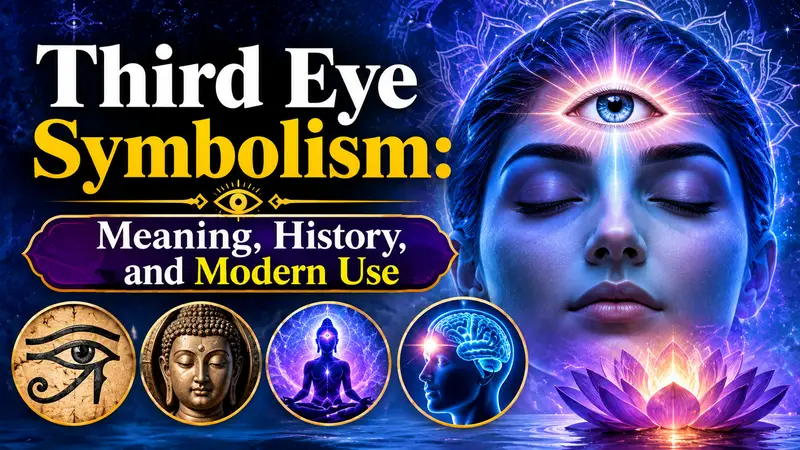
The third eye symbolism refers to the idea of seeing beyond ordinary physical sight through intuition, self-awareness, wisdom, and spiritual understanding. Usually represented as an eye positioned between the eyebrows, the third eye appears in religious imagery, meditation practices, jewelry, tattoos, and contemporary spiritual art. In modern American culture, it is particularly associated with personal growth, mindfulness, and the search for a deeper understanding of oneself.
Although the symbol has become popular in wellness culture and everyday design, its origins are connected to specific South Asian religious and philosophical traditions. Hindu representations of Shiva, yogic teachings about the Ajna chakra, and certain Buddhist interpretations of forehead markings have all contributed to the way people understand the image today.
Understanding its background helps distinguish its traditional religious meanings from newer interpretations involving intuition, consciousness, and personal transformation.
Quick Answer: What Does Third Eye Symbolism Mean?
Third eye symbolism commonly represents intuition, spiritual awareness, inner wisdom, and the ability to recognize truths beyond ordinary physical perception. Historically, it has been associated with Hindu depictions of Shiva, the Ajna chakra in yogic traditions, and spiritual insight, while modern American culture often connects it with mindfulness, self-discovery, and personal growth.
TL;DR
- Core meaning: Intuition, wisdom, awareness, and insight beyond physical sight.
- Hindu origins: Connected to Shiva’s divine vision and the Ajna chakra.
- Buddhist connections: Sometimes associated with the urna and enlightened awareness.
- American interpretation: Represents mindfulness, personal growth, and spiritual exploration.
- Modern applications: Appears in tattoos, jewelry, artwork, fashion, and wellness spaces.
- Common misunderstanding: The third eye is a spiritual concept, not a scientifically established hidden organ.
1. What Is the Third Eye Symbol?
The third eye is a symbolic or spiritual eye traditionally associated with the forehead, usually positioned between the two physical eyebrows. Unlike ordinary eyes, which receive information through light and vision, this imagined eye represents a different kind of perception.
In traditional religious imagery, it may appear as a vertically positioned eye on a deity’s forehead. In contemporary illustrations, artists often represent it as a simple eye, a decorative mark, or an eye surrounded by geometric patterns and lotus petals.
The symbol appears in several recognizable forms:
- Single forehead eye: An eye placed between the eyebrows, representing spiritual perception.
- Lotus design: A flower with two petals or additional decorative elements, commonly associated with the Ajna chakra.
- Geometric eye: An eye surrounded by circles, triangles, or symmetrical patterns.
- Meditation imagery: A glowing point between the eyebrows, representing focused attention.
- Decorative spiritual art: An eye combined with stars, moons, mandalas, or other symbolic elements.
The meaning depends on the tradition and context. An eye on a depiction of Shiva has a specific religious significance, while an eye used in a modern meditation illustration may communicate personal awareness.
The third eye is therefore not one universally standardized image. It is a group of related visual and spiritual ideas centered on perception beyond ordinary eyesight.
2. The Core Symbolic Meanings of the Third Eye
The third eye carries several connected meanings. Although different traditions explain it in different ways, the central theme is the development of awareness beyond immediate appearances.
Intuition and Inner Guidance
One of its most familiar modern meanings is intuition. Intuition refers to the ability to recognize patterns, impressions, or possibilities without consciously analyzing every detail.
People who use the symbol in this sense may associate it with trusting their judgment, recognizing personal needs, and becoming more attentive to subtle experiences.
For example, someone might choose a third eye pendant during a period of personal change because it reminds them to listen to their instincts.
Wisdom and Understanding
The third eye also represents wisdom, particularly the ability to understand situations from a broader perspective.
Ordinary vision reveals what is physically present. Symbolic inner vision suggests looking beyond appearances to consider motives, consequences, and deeper patterns.
This interpretation makes the symbol relevant to meditation, philosophical reflection, and personal development.
Spiritual Awareness
In spiritual contexts, the third eye represents awareness of dimensions of existence that cannot be understood through the physical senses alone.
This may involve religious devotion, meditation, contemplation, or a belief in spiritual perception.
Not everyone interprets spiritual awareness in the same way. For some, it involves religious experience; for others, it simply means becoming more conscious of their thoughts and behavior.
Self-Discovery
The symbol can also represent the process of understanding oneself.
A person may use it as a reminder to question assumptions, examine emotional reactions, and recognize personal habits. In this interpretation, opening the third eye is a metaphor for becoming more aware rather than gaining supernatural abilities.
3. Ancient Roots and Historical Origins
The third eye has several historical connections, especially within South Asian religious traditions. However, these connections should not be treated as one identical belief system.
Two particularly important influences are Hindu imagery associated with Shiva and yogic teachings about the Ajna chakra.
The Third Eye in Hindu Traditions
In Hinduism, the third eye is strongly associated with Shiva, one of the major deities within the Hindu religious tradition.
Shiva is frequently depicted with an additional eye positioned vertically on his forehead. This eye represents divine knowledge, extraordinary vision, and the ability to perceive beyond ordinary limitations.
Its meaning also includes destruction and transformation.
According to a well-known Hindu narrative, Shiva’s third eye releases destructive fire when opened. In one familiar version of the story, the eye burns the god of love, Kama, after he attempts to interrupt Shiva’s meditation.
This is not simply a symbol of anger. The destructive aspect also reflects the removal of ignorance and the ending of conditions that prevent spiritual understanding.
Shiva’s third eye therefore communicates two connected qualities: the ability to perceive ultimate truths and the capacity to destroy what must come to an end.
The Ajna Chakra in Yogic Traditions
Another major historical connection is the Ajna chakra.
In yogic traditions, the Ajna chakra is commonly described as the sixth of the seven principal chakras and is located around the space between the eyebrows.
The Sanskrit word Ajna is commonly translated as command or authority. In traditional chakra teachings, this center is associated with mental direction, perception, concentration, and insight.
It is often illustrated as a two-petaled lotus.
The Ajna chakra became especially important in later tantric and yogic descriptions of the subtle body. These teachings describe spiritual centers and channels that are part of a religious and contemplative understanding of human experience.
The modern idea of the third eye draws heavily on this association, although contemporary explanations sometimes simplify or combine teachings that developed in different historical settings.
4. Shiva’s Third Eye: Destruction, Knowledge, and Transformation
Shiva’s forehead eye deserves particular attention because it is one of the clearest traditional representations of the third eye.
In Hindu iconography, the third eye distinguishes Shiva from many other deities. It is generally shown vertically, between his two ordinary eyes.
Its symbolism is more complex than simply having greater awareness.
Divine knowledge: The eye represents Shiva’s ability to perceive what ordinary vision cannot reveal.
Destruction of ignorance: Its fire can represent the removal of falsehood, attachment, and spiritual blindness.
Transformation: Destruction in Shiva’s symbolism is connected to the continuing cycle of creation, preservation, and dissolution.
Disciplined consciousness: Shiva is also associated with meditation and ascetic practice, making the third eye an image of focused spiritual awareness.
This combination explains why the third eye can represent both wisdom and destruction without those meanings necessarily contradicting one another.
In modern American artwork, artists sometimes borrow Shiva’s forehead eye while emphasizing intuition and spiritual awakening. However, its original Hindu significance is broader and more specific than those simplified interpretations.
5. Third Eye Symbolism in Buddhism
Buddhist traditions also contain forehead imagery that is sometimes connected with the idea of a third eye.
One important example is the urna, a traditional mark found between the eyebrows in representations of the Buddha.
The urna is one of the recognized physical marks associated with an enlightened Buddha. It may appear as a small dot, spiral, curl, or jewel-like feature.
In some Buddhist artistic and interpretive traditions, it is understood as a sign of extraordinary wisdom or spiritual vision. Some educational interpretations also describe it as a third eye.
However, the urna and the Hindu concept of Shiva’s third eye are not identical symbols.
The urna traditionally represents a distinctive mark of the Buddha’s enlightened nature. It should not automatically be interpreted as the same chakra or forehead eye found in Hindu imagery.
This distinction matters because Buddhist and Hindu traditions developed their own religious teachings, artistic conventions, and understandings of spiritual perception.
For American audiences, the similarity between the images can make them appear interchangeable. Their historical meanings, however, deserve to be understood separately.
6. What Third Eye Symbolism Means in the United States
In the United States, the third eye is commonly understood through a combination of spirituality, wellness culture, personal development, and alternative approaches to self-understanding.
Many Americans encounter the symbol outside formal religious settings. It appears in yoga studios, meditation spaces, wellness products, independent clothing brands, tattoo designs, and social media illustrations.
Its modern interpretation generally emphasizes personal awareness rather than the specific religious responsibilities associated with traditional Hindu or Buddhist practice.
Several ideas shape its American cultural meaning.
Mindfulness and Meditation
The third eye is frequently associated with meditation and focused attention.
People may use the image to represent the practice of becoming more aware of thoughts, emotions, and reactions.
In yoga settings, it may also refer to concentration around the Ajna chakra.
Personal Growth
The symbol can communicate a desire to become more thoughtful, emotionally aware, or intentional.
Someone beginning a new stage of life might choose third eye artwork to represent a commitment to examining old habits and developing a clearer understanding of personal priorities.
Alternative Spirituality
The third eye is also common in contemporary American spiritual communities.
Some people associate it with energy work, chakra balancing, intuitive development, or metaphysical beliefs.
These interpretations vary considerably, and not everyone who uses the symbol follows the same spiritual philosophy.
Individual Identity
For some Americans, wearing the third eye is a way to communicate an interest in spirituality, creativity, independent thinking, or philosophical exploration.
It can function as a personal identity symbol without necessarily representing membership in a particular religious tradition.
7. The Third Eye and Its Connection to the Seven Chakras
The third eye is generally identified with the sixth chakra in the commonly presented seven-chakra system.
This system describes seven principal energy centers arranged along the body’s central axis, from the base of the spine to the crown of the head.
The Ajna chakra is positioned between the eyebrows and is commonly associated with insight, concentration, and perception.
The following table compares the principal chakra associations in contemporary popular presentations.
| Chakra | Common Location | Common Symbolic Association |
|---|---|---|
| Root (Muladhara) | Base of spine | Stability and security |
| Sacral (Svadhisthana) | Lower abdomen | Creativity and emotion |
| Solar Plexus (Manipura) | Upper abdomen | Confidence and personal will |
| Heart (Anahata) | Center of chest | Love and compassion |
| Throat (Vishuddha) | Throat | Communication and expression |
| Third Eye (Ajna) | Between eyebrows | Intuition and insight |
| Crown (Sahasrara) | Top of head | Spiritual awareness and transcendence |
In contemporary chakra artwork, the third eye is frequently represented by indigo or deep blue.
This color association has become particularly familiar in American wellness and meditation culture. However, color correspondences are not identical across every historical tradition or interpretation.
The Ajna chakra is often illustrated with a two-petaled lotus, sometimes containing additional sacred geometric or Sanskrit elements.
Its position between the eyebrows is one reason it has become closely associated with the modern third eye image.
8. Why Indigo and Purple Are Associated With the Third Eye
Color plays an important role in modern representations of the third eye.
Indigo and purple are particularly common in illustrations, jewelry, meditation graphics, and spiritual merchandise.
Indigo: Intuition and Reflection
Indigo is the color most frequently associated with the Ajna chakra in contemporary seven-chakra presentations.
Its dark blue appearance is often used to communicate concentration, reflection, and inward attention.
Designers may choose indigo backgrounds for meditation artwork because the color creates a calm, contemplative visual atmosphere.
Purple: Spirituality and Imagination
Purple is also frequently used in third eye designs.
In contemporary American visual culture, purple is often associated with imagination, spirituality, mystery, and creativity.
When combined with an eye symbol, it can suggest an interest in exploring ideas beyond everyday experience.
White and Gold: Clarity and Illumination
Some designs use white or gold rather than indigo.
White can suggest clarity, purity, or peaceful awareness, while gold can communicate sacred importance, illumination, and spiritual value.
These are modern visual associations rather than universal rules governing the symbol.
9. Emotional and Psychological Meaning of the Third Eye
Beyond religious teachings, the third eye can communicate several emotional and psychological ideas.
One of its most recognizable associations is the desire to understand oneself more honestly.
People often experience periods when their previous assumptions no longer explain their circumstances. They may reconsider relationships, priorities, ambitions, and personal beliefs.
In this context, the third eye can represent the willingness to examine life from a different perspective.
Awareness of Personal Patterns
The image may remind someone to recognize recurring emotional reactions and behaviors.
For example, a person might use a third eye symbol during a period of personal development to represent learning from previous decisions.
Confidence in Personal Judgment
The third eye is also associated with trusting one’s judgment.
This does not mean ignoring evidence or making decisions based entirely on feelings. Rather, it represents balancing thoughtful reasoning with awareness of personal experience.
Curiosity and Open-Mindedness
Another psychological association is intellectual curiosity.
People who identify with the symbol may value questioning assumptions, exploring unfamiliar ideas, and considering perspectives beyond their immediate experience.
Importantly, these are symbolic interpretations, not established psychological effects. Wearing or displaying the symbol does not automatically produce greater intuition or awareness.
10. Third Eye Symbolism in Tattoos and Personal Style
The third eye has become a recognizable design in American tattoo culture.
Its visual simplicity makes it suitable for different artistic approaches, from small minimalist tattoos to elaborate compositions incorporating religious and geometric imagery.
People choose these tattoos for different personal reasons.
Intuition: A reminder to trust personal judgment and recognize important details.
Spiritual development: A representation of meditation, religious exploration, or an interest in chakra traditions.
Personal transformation: A symbol of changing perspectives and moving beyond previous limitations.
Self-awareness: A reminder to examine thoughts, emotions, and behavior.
Popular design variations include:
- A simple eye between the eyebrows.
- An eye surrounded by a lotus flower.
- An indigo eye with geometric patterns.
- A third eye combined with a crescent moon.
- An eye incorporated into a mandala.
- A minimalist forehead eye with fine-line detailing.
Placement also influences the personal meaning. A small wrist tattoo may function as a private reminder, while a larger forehead or facial design can make the symbol a visible part of someone’s identity.
Because the image has religious associations, people interested in using traditional Hindu or Buddhist imagery may benefit from learning about its original context before choosing a design.
11. Modern Uses in Jewelry, Fashion, and Home Decor
The third eye is no longer limited to religious artwork or meditation illustrations. It has become a recognizable visual element in contemporary consumer design.
Jewelry
Third eye necklaces, pendants, rings, and bracelets are popular ways to wear the symbol.
Some people choose an eye-shaped pendant because it represents intuition or personal awareness. Others prefer designs incorporating lotus flowers, gemstones, or chakra-inspired colors.
The jewelry can be meaningful even when the wearer does not follow a specific religious practice.
Clothing and Accessories
The symbol appears on shirts, sweatshirts, bags, scarves, and fashion accessories.
In these settings, it may communicate an interest in alternative spirituality, creative expression, or independent personal style.
Home Decor
Third eye artwork is also found in meditation rooms, bedrooms, yoga spaces, and personal work areas.
Decorative representations may include framed illustrations, wall hangings, sculptures, and mandala designs.
For some homeowners, the symbol represents a peaceful environment for reflection. For others, it is simply an artistic expression of interest in spiritual imagery.
Digital Culture
On social media, the third eye frequently appears in illustrations, profile graphics, wellness content, and discussions about personal development.
It is often used as a visual shorthand for becoming more aware, questioning assumptions, or exploring spiritual ideas.
However, a social media image may reflect a modern interpretation rather than an accurate explanation of the symbol’s historical religious background.
12. Third Eye Symbolism Across Different Contexts
The same image can communicate different ideas depending on where and how it appears.
| Context | Common Meaning | Main Association | Important Distinction |
|---|---|---|---|
| Hindu religious imagery | Divine knowledge and destructive vision | Shiva | Connected to a specific deity |
| Yogic traditions | Insight and mental concentration | Ajna chakra | Part of a broader subtle-body system |
| Buddhist imagery | Enlightened qualities and wisdom | Urna | Not automatically identical to Shiva’s eye |
| American wellness culture | Intuition and self-awareness | Meditation and personal growth | Often uses simplified chakra interpretations |
| Contemporary fashion | Individuality and spirituality | Jewelry and clothing | May be decorative rather than religious |
This comparison shows why context matters. A traditional religious image, a meditation illustration, and a fashionable pendant may share similar visual elements without carrying exactly the same meaning.
13. Common Misunderstandings About the Third Eye
The popularity of the third eye has also created misunderstandings about its history and supposed abilities.
Separating established religious symbolism from modern speculation helps explain the image more accurately.
The Third Eye Is Not Scientifically Proven to Be a Hidden Physical Eye
Some modern spiritual explanations connect the third eye with the pineal gland, a small endocrine gland located in the brain.
The pineal gland has a recognized biological function, particularly its role in producing melatonin and helping regulate sleep-related biological rhythms.
However, there is no established scientific evidence that it functions as a supernatural eye or provides extrasensory perception.
The association between the pineal gland and spiritual vision became especially influential through nineteenth-century Theosophical writings.
It should therefore be understood as a modern esoteric interpretation rather than an established anatomical discovery.
Opening the Third Eye Does Not Have One Universal Meaning
Some contemporary spiritual communities describe opening the third eye as a process of increasing intuition or spiritual awareness.
Others connect it with meditation, concentration, or personal reflection.
There is no single universally accepted method or definition shared by every Hindu, Buddhist, yogic, or modern spiritual tradition.
The Third Eye Is Not the Same as the Evil Eye
These two symbols are sometimes confused because both involve an eye.
However, their meanings are different.
The third eye generally represents spiritual perception, wisdom, and awareness. The evil eye is associated with beliefs about harmful attention, envy, or protection against misfortune.
An eye-shaped design does not automatically belong to both traditions.
The Third Eye Is Not Exclusive to One Modern Spiritual Movement
Although it is especially popular in contemporary alternative spirituality, its religious and philosophical background predates modern wellness culture.
Its connections to Hindu traditions, Shiva imagery, and yogic teachings should not be erased simply because the symbol is widely used in modern fashion and design.
14. How Third Eye Symbolism Has Evolved Over Time
The meaning of the third eye has changed as religious traditions, philosophical ideas, and popular culture have interacted.
Its historical development can be understood through several broad stages.
Traditional Hindu imagery: The third eye became a recognizable feature of Shiva’s religious representation, communicating divine knowledge and destructive power.
Yogic and tantric teachings: The Ajna chakra developed as an important part of teachings about the subtle body, concentration, and spiritual perception.
Buddhist artistic interpretations: Forehead markings such as the urna appeared in Buddhist art as signs of the Buddha’s extraordinary qualities. Some later interpretations connected this imagery with the idea of an inner eye.
Nineteenth-century Western esotericism: Theosophical writers popularized new interpretations connecting the third eye with hidden spiritual faculties and the pineal gland.
Twentieth-century alternative spirituality: Chakra teachings and spiritual literature became increasingly visible in Western wellness and personal development communities.
Contemporary American culture: The image expanded into tattoo culture, fashion, jewelry, meditation products, online spirituality, and everyday decorative design.
Today, the third eye can communicate traditional religious beliefs, personal philosophy, or simply an appreciation for spiritual artwork.
Its modern popularity has made it more familiar to Americans, but it has also made historical distinctions more important.
FAQs
1. What does the third eye symbolize spiritually?
awarenessSpiritually, the third eye commonly symbolizes intuition, inner wisdom, , and the ability to perceive beyond ordinary physical appearances. In different traditions, it may also represent divine knowledge, meditation, or enlightenment.
2. What does a third eye tattoo mean?
A third eye tattoo often represents self-awareness, intuition, spiritual exploration, or personal transformation. Its exact meaning depends on the individual, especially when the design incorporates religious imagery, lotus flowers, or chakra symbols.
3. Is the third eye a Hindu or Buddhist symbol?
The third eye has important connections to Hindu traditions, particularly Shiva and the Ajna chakra. Buddhist art also includes the urna, a forehead mark sometimes interpreted as a third eye, although the two symbols have distinct historical meanings.
4. What does the third eye represent in American culture?
In contemporary American culture, it most commonly represents intuition, mindfulness, personal growth, and alternative spirituality. It frequently appears in yoga communities, meditation spaces, jewelry, tattoos, and wellness-related artwork.
5. What color represents the third eye?
Indigo is the most commonly used color for the Ajna chakra in modern chakra illustrations. Purple, blue, white, and gold also appear in contemporary designs, depending on the intended artistic or spiritual association.
6. Is the third eye associated with the pineal gland?
Some modern esoteric teachings associate the third eye with the pineal gland, but this is a spiritual interpretation rather than a scientifically established connection. The pineal gland is an endocrine organ involved in melatonin production and sleep regulation.
7. Is third eye symbolism positive or negative?
The third eye is generally associated with positive ideas such as wisdom, insight, and spiritual awareness. However, in Shiva’s traditional imagery, it also represents destructive fire, which symbolizes the removal of ignorance and the transformation of existing conditions.
Conclusion
Third eye symbolism represents intuition, wisdom, spiritual awareness, and the ability to look beyond ordinary physical appearances. Its historical background includes Shiva’s divine forehead eye in Hindu traditions, the Ajna chakra in yogic teachings, and related forehead imagery in Buddhist art.
In modern American culture, the symbol has become especially associated with mindfulness, personal development, alternative spirituality, and individual expression. It appears in tattoos, jewelry, clothing, meditation spaces, and digital artwork, often carrying personal meanings that extend beyond its traditional religious origins.
Ultimately, the third eye is best understood as a symbol of expanded awareness. Whether encountered in religious sculpture, a meditation practice, or a contemporary tattoo, it invites people to consider how they understand themselves and the world around them.