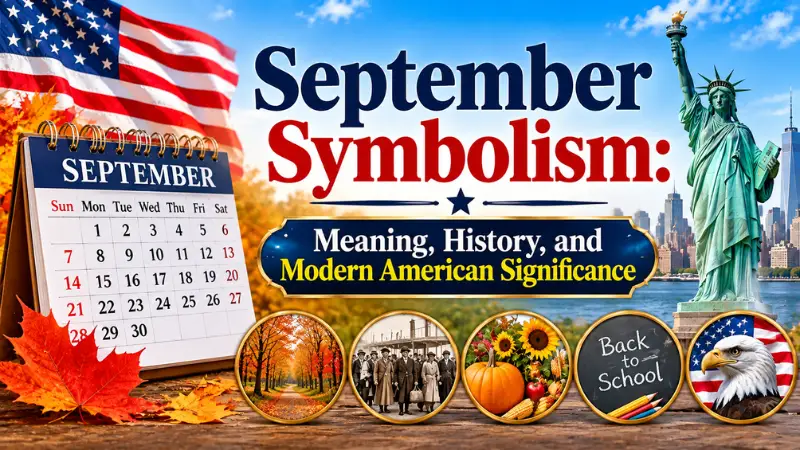
September is a month of transition, carrying associations with new beginnings, changing seasons, remembrance, and preparation. In September symbolism, these meanings come from the month’s position between summer and autumn, its historical calendar origins, and the cultural traditions Americans observe during this time of year.
For many people in the United States, September represents a fresh start. Children return to school, families adjust to new routines, summer vacations come to an end, and cooler weather gradually approaches. The month often feels like a second beginning to the year, even though January officially marks the calendar’s start.
September also carries more serious associations. The anniversary of September 11, Hispanic Heritage Month, and Constitution Day connect the month with remembrance, cultural identity, citizenship, and national history.
Understanding September’s symbolism means looking beyond its seasonal appearance. Its meaning combines ancient Roman history, agricultural traditions, personal milestones, and modern American experiences.
Quick Answer: What Does September Symbolize?
September commonly symbolizes transition, new beginnings, harvest, and personal growth in modern American culture. Historically, it represents the changing agricultural seasons and the seventh month of the early Roman calendar, while today it also carries associations with education, remembrance, cultural heritage, and preparation for autumn.
TL;DR: September Symbolism at a Glance
- Transition: The movement from summer toward autumn and cooler weather.
- New beginnings: Back-to-school routines, fresh goals, and renewed responsibilities.
- Harvest: Gratitude, abundance, completed work, and preparation.
- Remembrance: Reflection on September 11 and American history.
- Wisdom: Sapphire symbolism connects September with truth and sincerity.
- Balance: The autumn equinox represents changing daylight and seasonal equilibrium.
1. What September Represents Symbolically
September has several connected symbolic meanings, largely influenced by the natural and cultural changes that happen during the month.
Its most recognizable meaning is transition. In the Northern Hemisphere, September begins with summer still present but gradually moves toward autumn. This change provides a natural metaphor for moving from one stage of life into another.
The month also represents:
- Renewal: Starting new routines and reconsidering personal goals.
- Responsibility: Returning to education, work, and structured schedules.
- Harvest: Recognizing the results of previous effort.
- Reflection: Looking back on experiences and learning from them.
- Preparation: Getting ready for colder weather and upcoming responsibilities.
These meanings are not universal rules. Someone beginning college in September may associate the month with independence, while a farmer may connect it with agricultural work and seasonal preparation.
September’s symbolism is therefore closely connected to individual experiences as well as the calendar.
2. The Historical Origin of September
The name September comes from the Latin word septem, meaning seven.
This might seem unusual because September is the ninth month of the modern Gregorian calendar. However, the name makes sense when viewed through the history of the ancient Roman calendar.
In an early Roman calendar, the year traditionally began in March. September was therefore the seventh month, followed by October, November, and December.
Later calendar changes moved the beginning of the year to January. September consequently became the ninth month, but its original name remained.
The Julian calendar, introduced under Julius Caesar in 46 BCE, helped establish the calendar system that influenced the modern arrangement of months.
This history gives September an interesting symbolic connection with time, tradition, and continuity.
Its position changed, but its name survived. Symbolically, this can represent the preservation of identity during periods of change.
September is a reminder that something can move into a different position without losing its historical character.
3. September Symbolism in American Culture
In the United States, September is often associated with the end of summer and the return of everyday responsibilities.
Labor Day, observed on the first Monday of September, traditionally marks the unofficial end of summer for many Americans. Families may use the long weekend for travel, barbecues, outdoor gatherings, and final summer activities.
After Labor Day, many communities experience a noticeable change in their routines.
Schools reopen, college campuses become active, and businesses return to more regular schedules after the summer vacation period.
September also carries important cultural and historical associations.
For example:
- September 11 is observed as a day of remembrance for the terrorist attacks of 2001.
- National Hispanic Heritage Month begins on September 15.
- Constitution Day and Citizenship Day take place on September 17.
- National Public Lands Day is generally observed on the fourth Saturday.
These occasions give September a broader American identity.
It is not simply a month associated with changing weather. It also provides opportunities to remember national events, celebrate cultural contributions, and recognize the responsibilities of citizenship.
4. September as a Symbol of New Beginnings
Although January is traditionally considered the beginning of the year, September often feels like another opportunity to start fresh.
This association is particularly visible in American education.
Students return to classrooms, teachers introduce new lessons, and college students begin another academic year. For many families, September means adjusting schedules, organizing responsibilities, and establishing new habits.
The back-to-school season has also become a familiar cultural event.
New notebooks, backpacks, school supplies, clothing, and classroom decorations represent preparation for the months ahead.
Beyond education, September can symbolize personal renewal.
People may use the month to:
- Begin a fitness routine.
- Return to unfinished projects.
- Set professional goals.
- Organize their homes.
- Develop better daily habits.
- Prepare for important personal milestones.
Psychologically, a change in season can provide a convenient opportunity to reconsider priorities.
September’s new-beginning symbolism comes less from the calendar itself and more from the routines and decisions people associate with it.
5. September and the Symbolism of Autumn
In the Northern Hemisphere, September contains the transition from summer toward autumn.
The autumnal equinox usually occurs around September 22 or 23, although the exact date and time vary by year.
During the equinox, the Sun crosses the celestial equator, and daylight and nighttime are approximately equal in length.
This astronomical event has made September associated with balance, seasonal change, and the movement toward shorter days.
Autumn also introduces recognizable changes in the natural environment.
Leaves begin changing color in many regions, temperatures become more comfortable, and gardens and agricultural landscapes reflect the approaching end of the growing season.
Common autumn colors include:
- Orange, representing warmth and harvest.
- Yellow, associated with sunlight and maturity.
- Brown, representing the earth and natural stability.
- Red, often connected with changing foliage and seasonal richness.
- Gold, suggesting abundance and appreciation.
In American decoration, these colors frequently appear in September arrangements, seasonal wreaths, table settings, and outdoor displays.
The connection between September and autumn makes the month a natural symbol of accepting change rather than resisting it.
6. September as a Symbol of Harvest and Abundance
Harvest symbolism is another important part of September’s meaning.
In many agricultural regions of the United States, late summer and early autumn are associated with gathering crops and preparing for the next season.
The exact harvest calendar depends on the crop, location, and weather. Nevertheless, September is widely connected with agricultural abundance.
Corn, apples, pumpkins, grapes, and other seasonal produce frequently appear in American markets and seasonal celebrations.
Harvest carries several symbolic associations.
Gratitude: Gathering crops encourages appreciation for the resources that support daily life.
Achievement: Harvest represents the results of earlier work, patience, and careful planning.
Abundance: Full baskets and productive fields suggest nourishment and prosperity.
Preparation: Collecting food and organizing supplies reflect the importance of planning ahead.
These ideas extend beyond farming.
Someone completing a professional project may describe the experience as harvesting the results of months of effort. A family reaching an important milestone may see it as the reward for years of dedication.
September therefore represents a useful balance between celebrating what has been accomplished and preparing for what comes next.
7. September 11 and the Symbolism of Remembrance
September has a particularly significant place in modern American history because of the terrorist attacks of September 11, 2001.
The attacks on the World Trade Center in New York City, the Pentagon in Virginia, and United Airlines Flight 93 in Pennsylvania resulted in the deaths of thousands of people.
For Americans, September 11 is associated with remembrance, grief, courage, service, and national solidarity.
Each year, memorial ceremonies honor those who lost their lives, including victims, first responders, and people who helped others during the attacks and their aftermath.
The symbolism of this date is different from September’s seasonal associations.
It is not primarily about personal renewal or autumn decoration. Instead, it represents collective memory and the importance of recognizing the human consequences of historical events.
American flags, memorial lights, names of victims, and moments of silence are among the visual elements associated with September 11 commemorations.
The date also encourages reflection on community support, emergency service, and the experiences of families affected by the tragedy.
It is important to recognize that September’s association with remembrance should be approached respectfully rather than treated as a decorative theme.
8. September’s Birthstone: Sapphire Symbolism
The traditional birthstone for September is sapphire.
Sapphire belongs to the mineral family corundum and is especially recognized for its blue varieties. However, sapphires naturally occur in several other colors as well.
The gemstone has traditionally been associated with:
- Wisdom.
- Truth.
- Sincerity.
- Loyalty.
- Faithfulness.
- Nobility.
- Spiritual devotion.
Historically, sapphires appeared in royal jewelry and religious objects. Their association with dignity and spiritual significance developed through different cultural and religious traditions.
In medieval European traditions, blue sapphires were particularly associated with heaven and religious devotion.
Today, sapphire jewelry is frequently selected for September birthdays, anniversaries, and meaningful gifts.
Its durability and recognizable blue appearance also make it a popular choice for rings, necklaces, bracelets, and family jewelry.
Symbolically, the September sapphire represents honesty and commitment.
Someone choosing this gemstone may appreciate its traditional associations with trustworthy relationships, thoughtful decisions, and personal integrity.
Importantly, these are cultural and historical beliefs rather than scientifically established effects of wearing a gemstone.
9. September Birth Flowers and Their Meanings
September is commonly associated with asters and morning glories as birth flowers, although floral traditions and lists can vary.
Both flowers have distinctive appearances and symbolic associations.
Asters
Asters are flowering plants recognized for their star-shaped flower heads.
They are available in several colors, including purple, pink, white, and blue.
Asters traditionally symbolize:
- Love.
- Patience.
- Wisdom.
- Faith.
- Appreciation.
Their name comes from the Greek word associated with stars, reflecting the flower’s star-like appearance.
In floral arrangements, asters can communicate affection and appreciation without requiring an elaborate message.
Morning Glories
Morning glories are climbing plants with trumpet-shaped flowers that open in the morning.
Their daily opening and closing cycle makes them natural symbols of renewal, affection, and the temporary nature of time.
They are sometimes associated with:
- Fresh opportunities.
- Affection.
- Simplicity.
- Renewal.
- Appreciation of the present moment.
Together, September’s birth flowers provide two complementary interpretations.
Asters emphasize lasting affection and wisdom, while morning glories suggest new beginnings and the importance of appreciating each day.
10. September Zodiac Symbolism: Virgo and Libra
September includes two zodiac signs in Western astrology: Virgo and Libra.
These signs contribute additional symbolic interpretations to the month.
Virgo (August 23–September 22)
Virgo is traditionally represented by the maiden.
In astrology, Virgo is associated with practicality, organization, attention to detail, and service.
Its symbolic themes include:
- Careful planning.
- Responsibility.
- Analytical thinking.
- Personal improvement.
- Practical wisdom.
These qualities fit naturally with September’s associations with returning to work, organizing routines, and preparing for a new season.
Libra (September 23–October 22)
Libra is represented by the scales.
Its traditional associations include balance, fairness, cooperation, and relationships.
Libra’s appearance near the September equinox creates an interesting symbolic connection with the approximate equality of daylight and darkness.
However, the equinox and the zodiac sign have different origins; their association is primarily a symbolic parallel.
Virgo and Libra therefore offer two complementary interpretations of September: organized preparation and balanced relationships.
11. Religious and Cross-Cultural Meanings of September
September does not have one universal religious meaning.
Its significance changes according to cultural calendars, religious observances, and regional traditions.
In Judaism, Rosh Hashanah, the Jewish New Year, often falls in September, although it sometimes occurs in October.
The holiday marks the beginning of the Jewish High Holy Days and is associated with reflection, prayer, repentance, and the possibility of spiritual renewal.
Yom Kippur, the Day of Atonement, follows shortly afterward.
These observances give September particular significance for many Jewish communities, depending on the year.
In Chinese culture, the Mid-Autumn Festival sometimes falls in September. The celebration is associated with the full moon, family reunions, gratitude, and seasonal abundance. Its date follows the traditional lunar calendar and may also fall in October.
In Japan, September is connected with the transition toward autumn and the traditional observation of the autumn equinox. The equinox is also associated with the Buddhist observance of Higan, a period of remembrance and reflection.
These traditions demonstrate that September’s meaning is not limited to American seasonal experiences.
Across cultures, the month can provide an opportunity to reflect on family, spirituality, seasonal change, and gratitude.
12. The Emotional and Psychological Meaning of September
September often produces mixed emotions because it combines the excitement of a fresh start with the awareness that summer is ending.
For some people, the month brings anticipation.
Students may look forward to meeting classmates, entering a new grade, or beginning college. Adults may appreciate returning to a predictable routine after summer travel.
For others, September can bring nostalgia.
The end of summer may remind people of vacations, childhood memories, family gatherings, or time spent outdoors.
The changing weather can also encourage reflection.
Shorter days and cooler evenings may lead people to spend more time indoors, reconsider their schedules, and focus on personal responsibilities.
Several emotional associations are commonly connected with September:
| Emotional Association | Symbolic Meaning | Everyday Example |
|---|---|---|
| Hope | Opportunity and renewal | Starting a new course |
| Nostalgia | Memories and reflection | Remembering summer experiences |
| Gratitude | Appreciation and abundance | Celebrating a successful harvest |
| Responsibility | Structure and commitment | Returning to work or school |
| Acceptance | Understanding change | Adjusting to autumn |
| Remembrance | Respect for the past | September 11 memorial observances |
These feelings are not experienced by everyone in the same way.
September can be exciting for someone beginning a new chapter and difficult for someone dealing with a major life transition.
Its emotional meaning often depends on what a person is leaving behind and what they are preparing to embrace.
13. September Symbolism in Tattoos, Jewelry, and Home Decor
September-inspired symbols appear in personal style, jewelry, artwork, and seasonal decoration.
People often select these designs because they connect a month with a birthday, family memory, personal milestone, or important life experience.
September Tattoos
September tattoos frequently include:
- Sapphire gemstones.
- Aster flowers.
- Morning glory flowers.
- Autumn leaves.
- September birth dates.
- Virgo or Libra zodiac symbols.
A person born in September might choose an aster tattoo to represent affection or a sapphire design to symbolize loyalty and sincerity.
Others may choose autumn leaves to represent acceptance, maturity, or a major life transition.
September Jewelry
Sapphire jewelry is one of the most recognizable ways to celebrate a September birthday.
Blue sapphire rings, necklaces, earrings, and bracelets are popular choices.
Some people also select floral jewelry featuring asters or other September-inspired designs.
September Home Decor
American homes often incorporate September-inspired decorations as summer ends.
Popular choices include:
- Seasonal flower arrangements.
- Natural wooden decorations.
- Autumn-colored cushions.
- Corn and wheat displays.
- Apple-themed decorations.
- Decorative wreaths.
These objects communicate warmth, preparation, and appreciation for the changing season.
September decor often begins with lighter seasonal touches before more elaborate Halloween and Thanksgiving decorations appear later in autumn.
14. Common Misunderstandings About September Symbolism
Several misconceptions can make September’s meaning seem more complicated than it really is.
Misunderstanding 1: September means seven because it is the seventh month.
September is the ninth month in the modern Gregorian calendar. Its name preserves its position in an earlier Roman calendar.
Misunderstanding 2: September always marks the beginning of autumn.
In the Northern Hemisphere, astronomical autumn begins around the September equinox. Meteorological autumn begins on September 1 in many weather and climate conventions. In the Southern Hemisphere, September marks the transition toward spring.
Misunderstanding 3: September has only positive symbolism.
Although the month is associated with harvest and new beginnings, it also carries associations with grief, remembrance, and the end of summer.
Misunderstanding 4: Sapphire has scientifically proven spiritual properties.
Sapphire has a long history of symbolic and cultural associations, but claims that it protects against negative energy or changes a person’s destiny are traditional beliefs, not scientific facts.
Misunderstanding 5: Every September tradition comes from the same historical source.
The month includes Roman calendar history, agricultural customs, religious observances, and modern American commemorations. These traditions developed independently and should not be treated as one unified symbolic system.
Understanding these differences makes it easier to appreciate September without exaggerating or misrepresenting its history.
15. How September’s Symbolism Has Evolved Over Time
September’s meaning has changed as societies developed new calendars, agricultural systems, educational traditions, and cultural celebrations.
In ancient Rome, its name reflected its position in the calendar. The month was part of an agricultural and religious year shaped by seasonal cycles and civic traditions.
As the calendar developed, September became the ninth month, but its historical name remained.
In agricultural communities, the month continued to carry associations with harvesting, storing food, and preparing for colder weather.
In modern America, education and work routines added another layer of meaning. The beginning of the school year made September a recognizable period of renewed activity and responsibility.
National commemorations also influenced its modern identity.
September 11 became a date of national remembrance, while Hispanic Heritage Month and Constitution Day strengthened the month’s connections with cultural recognition and American civic life.
Today, September can represent several experiences simultaneously.
It can be a month of personal progress, family celebrations, historical reflection, seasonal appreciation, and preparation for change.
Its symbolism has expanded rather than replaced its earlier meanings.
FAQs
1. What is the main symbolic meaning of September?
September primarily symbolizes transition, new beginnings, harvest, and reflection. In the United States, it is especially associated with the return to school, the end of summer, and the beginning of autumn.
2. Why is September called the seventh month when it is actually the ninth?
The name comes from the Latin word septem, meaning seven. September was the seventh month in an early Roman calendar that began in March, but later calendar changes moved the beginning of the year to January.
3. What does September symbolize spiritually?
In spiritual and religious interpretations, September can represent reflection, gratitude, renewal, and preparation. Its meaning varies between traditions, particularly around Jewish High Holy Days and autumn observances.
4. What does a September birthday symbolize?
A September birthday is commonly associated with sapphire, asters, and morning glories. Symbolically, these represent sincerity, wisdom, affection, patience, and new opportunities.
5. Is September a symbol of change or new beginnings?
It can represent both. The transition from summer to autumn suggests change, while the beginning of a new academic year and renewed routines makes September a symbol of fresh opportunities.
6. What does September symbolize in American culture?
In American culture, September represents the end of summer, back-to-school season, Labor Day, and the beginning of autumn. It also carries important historical and cultural associations through September 11 remembrance, Hispanic Heritage Month, and Constitution Day.
7. What colors are associated with September?
Blue is commonly associated with September because of its sapphire birthstone. Orange, yellow, red, brown, and gold are also popular because of their connection with autumn leaves, harvest, and seasonal decoration.
Conclusion
September symbolizes transition, renewal, harvest, remembrance, and preparation. Its historical roots come from the ancient Roman calendar, while its modern meanings reflect changing seasons, educational routines, cultural traditions, and important events in American history.
For some people, September represents the excitement of starting something new. For others, it is a time to appreciate previous achievements, remember significant experiences, or prepare for a different stage of life.
Ultimately, September symbolism reminds us that change is a natural part of life. The month offers an opportunity to recognize what has been accomplished, appreciate the present, and approach the coming season with thoughtful preparation.