
Introduction
The white lotus is a water flower recognized by its clean white petals, golden center, and ability to rise above muddy water. In white lotus symbolism, this contrast between a pure-looking blossom and the conditions in which it grows represents purity, spiritual growth, wisdom, and the possibility of beginning again.
For many Americans, the white lotus appears in meditation spaces, wellness studios, jewelry, tattoos, artwork, and garden designs. Its simple appearance makes it attractive as decoration, but its meaning reaches beyond aesthetics. The flower has a long history in Asian religious traditions, particularly Buddhism and Hinduism, where it can represent spiritual awakening, divine qualities, and freedom from worldly attachment.
Understanding the white lotus requires some cultural context. Its meaning is not identical in every religion or country, and modern interpretations do not always reflect its historical significance. Exploring those differences helps explain why this flower continues to appeal to people seeking a visual expression of personal growth, inner peace, or a fresh start.
Quick Answer
White lotus symbolism commonly represents purity, peace, spiritual growth, and new beginnings in modern American culture, especially in wellness spaces, tattoos, and personal artwork. Historically, the flower has also represented spiritual awakening, divine presence, and the possibility of rising above worldly distractions in Buddhist and Hindu traditions.
TL;DR
- Core meaning: Purity, wisdom, peace, and personal growth.
- Historical roots: The flower has longstanding religious significance in South Asian traditions.
- Buddhist interpretation: It can represent awakening and freedom from attachment.
- Hindu interpretation: It is associated with deities, beauty, and spiritual qualities.
- Modern American use: Common in tattoos, meditation spaces, jewelry, and decorative art.
- Important distinction: Meanings vary by tradition, context, and the person using the symbol.
What Does a White Lotus Look Like?
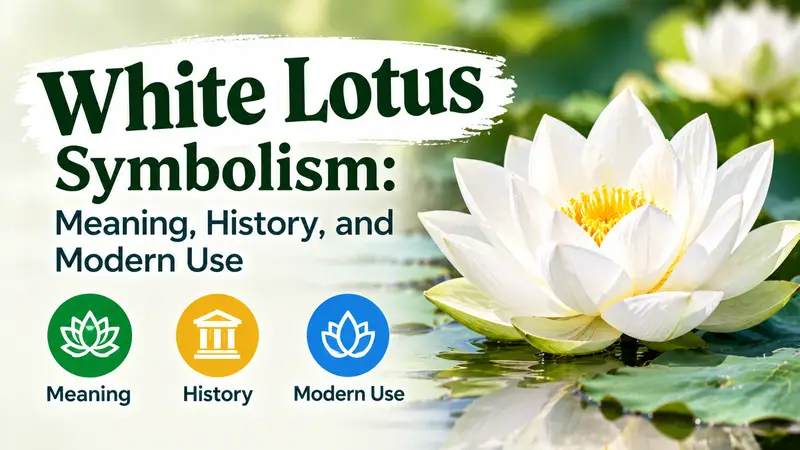
The white lotus is an aquatic flowering plant with broad floating leaves and pale petals arranged around a central seed-bearing structure. Its blossoms may appear creamy white or bright white, often with a yellow center. The flower rises above the water’s surface, creating a noticeable contrast with the pond or wetland environment beneath it.
The white lotus is commonly associated with Nelumbo nucifera, also called the sacred lotus or Indian lotus. Botanical names and common names can be used inconsistently, so not every flower described as a white lotus is necessarily the same species. White water lilies are sometimes confused with lotuses, although they belong to a different botanical group.
That visual distinction matters to its symbolism. The flower appears delicate and orderly, while its roots grow in submerged soil. This contrast provides a natural image for purity that does not depend on perfect surroundings.
The Core Meaning of White Lotus Symbolism
The white lotus is most often associated with purity, spiritual development, wisdom, and peace. These meanings overlap, but each emphasizes a different aspect of the flower.
Purity refers to clarity of intention or freedom from harmful influences. It does not necessarily mean physical cleanliness or a life without mistakes. Instead, the flower suggests that a person can maintain important values while living in a complicated world.
Spiritual growth focuses on gradual development. Just as a lotus grows from submerged roots and produces a flower above the water, a person may move from confusion toward greater understanding.
Wisdom reflects the ability to see circumstances more clearly. In religious settings, this can mean spiritual insight; in everyday life, it may mean thoughtful judgment and self-awareness.
Peace comes from the flower’s quiet appearance and its associations with meditation and sacred art. For some people, it serves as a reminder to pause, reflect, and respond rather than react.
The meaning depends on the setting. A lotus in a Buddhist image may communicate a specific religious idea, while the same flower on a necklace may express a personal commitment to calmness or growth.
Ancient Roots and Early Symbolism
The lotus has been represented in South Asian religious art and literature for many centuries. Its association with water, emergence, and flowering made it a useful image for discussing creation, life, purity, and spiritual order.
In ancient Egypt, the blue water lily—often loosely called a lotus—also appeared in religious imagery associated with creation and rebirth. However, Egyptian water-lily traditions should not be treated as identical to the South Asian sacred lotus tradition. Similar-looking aquatic flowers developed different meanings within different cultures.
In South Asia, the lotus became especially prominent in Hindu and Buddhist art. It appears in depictions of deities, sacred figures, and symbolic diagrams. Its importance developed through religious teachings, artistic conventions, and repeated use in worship and storytelling.
White petals can add an emphasis on purity or spiritual clarity, but historical interpretation should not be reduced to color alone. The meaning of a lotus image also depends on which figure holds it, how the flower is positioned, and the tradition in which the image appears.
White Lotus Symbolism in Buddhism
In Buddhism, the lotus is a widely recognized symbol of spiritual awakening. The plant’s growth from muddy water provides an analogy for the possibility of developing wisdom and compassion amid the difficulties of ordinary life.
The white lotus is often associated with purity and spiritual perfection. In some Buddhist artistic traditions, it represents a state of clarity or awakening, while other lotus colors may carry additional meanings depending on the school and context. These color associations are not entirely uniform across all Buddhist communities.
The image is meaningful because it does not suggest that growth requires a person to avoid every hardship. Instead, it points toward the possibility of responding to suffering with understanding rather than becoming controlled by it.
In Buddhist temples, paintings, sculptures, and devotional objects, lotus imagery may appear beneath a Buddha or bodhisattva. In such cases, it contributes to a visual language of spiritual attainment and sacred presence.
For Americans who practice Buddhism, the white lotus may have a direct religious meaning. For others, it serves as a more general reminder of mindfulness or personal development. Those uses can overlap, but they are not interchangeable.
White Lotus Symbolism in Hinduism
In Hinduism, the lotus is associated with several deities and with ideas of beauty, auspiciousness, spiritual unfolding, and divine presence. Lakshmi, commonly connected with prosperity and good fortune, is frequently depicted standing or sitting on a lotus. Brahma is also represented in traditional imagery with a lotus connected to creation.
The white lotus can be associated with purity and spiritual knowledge, although the significance of a particular lotus depends on the deity, text, ritual, and artistic tradition involved. Not every Hindu image of a lotus is intended to communicate the same message.
The flower’s position above the water also lends itself to an important distinction: participation in worldly life does not necessarily require attachment to every desire or distraction. In some Hindu philosophical contexts, the lotus helps express the ideal of acting in the world while maintaining spiritual discipline.
For modern readers, these associations explain why the flower can represent both spiritual aspiration and the pursuit of a balanced life. However, the religious meanings deserve recognition rather than being treated solely as a source of decorative inspiration.
What the White Lotus Means in Modern American Culture
In the United States, the white lotus is often used as a symbol of calmness, self-reflection, healing, and personal change. It appears in yoga studios, meditation rooms, wellness branding, stationery, home décor, and art intended to create a peaceful atmosphere.
Its popularity reflects a broader interest in mindfulness and visual symbols that communicate personal values without words. A white lotus may suggest that someone prioritizes reflection, wants to live more intentionally, or sees personal development as an ongoing process.
The flower can also communicate a fresh start after a difficult period. Someone who has changed careers, recovered from a setback, or adopted new habits might choose lotus imagery to mark that transition. In these cases, the symbol works as a personal reminder rather than a promise that life will become easy.
American interpretations often blend religious and secular meanings. A wellness brand might use the flower to suggest relaxation, while a Buddhist practitioner might understand it through a specific spiritual tradition. The image may look similar in both settings, but the intention behind it can be very different.
White Lotus Meaning by Context
The same flower can communicate different ideas depending on how it is used. This comparison highlights common interpretations without suggesting that every person or community understands it identically.
| Context | Common Meaning in the United States | Main Association | Important Note |
|---|---|---|---|
| Meditation and yoga | Calmness and self-awareness | Mindfulness | May have religious or secular intent |
| Tattoos | Growth and personal change | Resilience | The wearer’s story shapes the meaning |
| Buddhist art | Purity and spiritual awakening | Religious practice | Interpretations vary by tradition |
| Hindu art | Divine qualities and auspiciousness | Sacred imagery | The deity and context matter |
| Home décor | Peace and simplicity | A tranquil environment | Often used decoratively |
| Gifts and jewelry | Hope and a fresh start | Personal encouragement | Meaning depends on the relationship |
The Emotional and Psychological Meaning of the White Lotus
Symbols can influence how people interpret their experiences because they provide a visual form for ideas that are otherwise difficult to express. The white lotus is particularly suited to representing change because its growth offers a clear contrast between submerged roots and a visible flower.
For someone going through a difficult period, the flower may serve as a reminder that current circumstances do not have to define an entire life. It can represent patience, the effort required to change, or the decision to preserve one’s values under pressure.
Its white color may also suggest simplicity, quiet, or a desire for a less cluttered life. These associations are influenced by cultural conventions around color and are not universal psychological laws. White can have different meanings in different communities and situations.
The symbol’s usefulness is therefore personal rather than automatic. A lotus image does not create resilience or guarantee peace, but it can help someone remember an intention, celebrate progress, or express an experience that matters to them.
Why People Choose White Lotus Tattoos
White lotus tattoos often appeal to people who want to represent personal development without using words. Common intentions include marking recovery, remembering a major life change, expressing a spiritual commitment, or recognizing the value of patience.
Some designs show a fully open blossom, emphasizing clarity or a sense of arrival. Others depict a flower with closed or partially open petals, which may suggest growth still in progress. These interpretations are personal design choices rather than fixed rules.
A minimalist outline can create a subtle, understated effect, while a detailed botanical design can emphasize the flower’s natural form. Adding a date, name, or other motif may connect the image to a particular memory.
Anyone considering a lotus tattoo should also think about cultural context. Because the lotus has religious significance in Buddhism and Hinduism, it may communicate more than a general wellness aesthetic to some viewers. Learning about the tradition behind a chosen design helps avoid treating sacred imagery as an interchangeable fashion accessory.
White Lotus in Jewelry, Fashion, and Home Décor
In jewelry, the white lotus can represent a personal aspiration, a reminder of a meaningful transition, or an appreciation for spiritual imagery. Pendants and earrings make the design visible without requiring an explanation, although the wearer’s intention may not be obvious to others.
In fashion, lotus designs are used on clothing, accessories, prints, and embroidered details. The flower’s symmetrical shape makes it suitable for both simple graphic designs and intricate decorative patterns.
At home, lotus imagery often appears in wall art, candle holders, cushions, and meditation spaces. A white blossom can complement a restrained color palette and help establish a calm visual atmosphere. Some people use it as a reminder to make room for quiet reflection in a busy household.
Commercial products sometimes present the lotus as a generic symbol of balance or wellness. That is a common contemporary interpretation, but it does not fully capture the religious and philosophical meanings associated with the flower in its cultural origins.
White Lotus in Art, Literature, and Digital Culture
Artists and writers use lotus imagery to communicate growth, beauty, renewal, and the contrast between outward appearance and inner experience. The flower’s form makes it recognizable even when rendered as a simplified icon or abstract pattern.
On social media, lotus illustrations may accompany posts about mindfulness, journaling, meditation, self-improvement, or life transitions. In these settings, the flower often functions as a compact visual expression of an idea rather than as a detailed reference to a religious tradition.
The meaning can also shift according to the surrounding text. A lotus beside a message about recovering from a setback may emphasize resilience, while the same image in a devotional setting may point toward spiritual practice.
One distinction is especially useful: a symbol’s popularity online does not prove that its modern interpretation is historically universal. Digital culture encourages short, easily shared explanations, but religious symbols often carry more specific meanings than a caption can communicate.
White Lotus Compared With Other Lotus Colors
Lotus colors are often assigned different symbolic meanings in religious art and modern wellness culture. These associations can be useful for interpreting artwork, but they should not be treated as a single universal code.
White is frequently connected with purity, clarity, or spiritual qualities. Pink lotus imagery is especially prominent in some Buddhist contexts and may be associated with the Buddha or the highest spiritual attainment. Blue lotus imagery can represent wisdom or knowledge in certain traditions, while red lotus imagery is often connected with love, compassion, or the heart.
The exact meanings vary across texts, schools, and artistic settings. A flower’s color alone may not be enough to identify the intended message.
In contemporary American design, people may choose a lotus color simply because it fits their preferred appearance. Someone selecting a white design may value its simplicity rather than intend to communicate a formal religious concept.
Common Misunderstandings About White Lotus Symbolism
One frequent misunderstanding is that the white lotus has exactly the same meaning in every Asian religion. Although traditions share some visual associations, Buddhist and Hindu interpretations developed within different bodies of teaching and practice. Their symbols should not be treated as interchangeable.
Another misconception is that the flower represents a life untouched by difficulty. Its association with muddy water more often supports an interpretation of growth amid imperfect conditions, not the complete absence of hardship.
The color white is also sometimes described as universally positive. In reality, color symbolism varies across cultures, religious practices, ceremonies, and personal experiences. The flower’s meaning must be understood in context.
Finally, a lotus tattoo or decoration does not automatically indicate that its owner follows Buddhism or Hinduism. Some people choose it for its botanical beauty, while others attach personal, philosophical, or religious significance to it. The design alone cannot establish someone’s beliefs.
How White Lotus Symbolism Has Evolved Over Time
The lotus’s meaning has developed through centuries of religious art, storytelling, philosophy, and cultural exchange. In South Asian traditions, it became an established image of divine presence and spiritual development. As Buddhist art spread across Asia, lotus imagery took on important roles in different regional styles and schools.
In modern Western societies, including the United States, the flower increasingly appears outside explicitly religious settings. It is used in wellness businesses, personal accessories, contemporary art, and messages about resilience or mindful living.
This shift has broadened access to the symbol while sometimes simplifying its origins. A modern decorative image may preserve the idea of purity or growth without communicating the full religious context that gave the flower significance in earlier traditions.
Neither use automatically tells the whole story. The most accurate interpretation recognizes that symbols can acquire new meanings while retaining associations that remain important to the communities in which they developed.
FAQs
What does a white lotus symbolize spiritually?
Spiritually, the white lotus is commonly associated with purity, wisdom, clarity, and awakening. In Buddhist and Hindu traditions, its meaning depends on the specific teaching, deity, ritual, or artistic setting.
Is the white lotus a symbol of new beginnings?
Yes, it is often used to represent a fresh start or a new stage of personal development in contemporary American culture. This meaning draws on the flower’s growth from submerged roots to an open blossom, although it is not the only historical interpretation.
What does a white lotus tattoo mean?
A white lotus tattoo may express resilience, personal growth, spiritual commitment, or a desire for peace. Its precise meaning depends on the wearer’s experiences, design choices, and cultural or religious connections.
Is the white lotus a Buddhist or Hindu symbol?
It is significant in both Buddhism and Hinduism, but its interpretation is not identical in the two traditions. It appears in Buddhist imagery associated with awakening and purity and in Hindu imagery connected with deities, sacred beauty, and spiritual qualities.
Does the white lotus have a negative meaning?
The white lotus is generally associated with positive qualities such as purity and spiritual development, rather than with a standard negative meaning. However, interpretations can change with context, and not every culture assigns the same associations to white flowers.
What is the difference between a white lotus and a white water lily?
A true lotus, commonly associated with Nelumbo nucifera, belongs to a different botanical group from water lilies. Their flowers can look similar, but they differ in botanical structure and may carry different cultural associations.
Is it disrespectful to use a white lotus in jewelry or decoration?
Not necessarily. The flower is widely used in decorative art, but it also has religious significance, so learning about its cultural context and avoiding misleading or disrespectful representations is a thoughtful approach
Conclusion
White lotus symbolism brings together purity, spiritual awareness, resilience, and the possibility of personal growth. Its significance in Buddhist and Hindu traditions gives the flower a historical depth that extends beyond its modern use in American wellness culture, tattoos, jewelry, and home décor.
The flower’s central lesson is not that a person must avoid difficulty to become better. Rather, it offers an image of growth that remains possible even when circumstances are imperfect. Whether chosen for religious devotion, personal reflection, or its natural beauty, the white lotus can express a simple idea: where someone begins does not have to determine where they grow.


