
Introduction
White lily symbolism centers on purity, innocence, peace, renewal, and remembrance. With their smooth white petals, graceful shape, and distinctive fragrance, white lilies have become meaningful flowers for some of life’s most important moments, from weddings and religious ceremonies to funerals and memorial services.
In the United States, white lilies are especially recognizable in Christian imagery, formal floral arrangements, and expressions of sympathy. Their appearance can communicate respect, hope, or a wish for peace without requiring words. Yet the same flower can suggest celebration in one setting and loss in another.
Understanding the white lily means looking beyond its appearance. Its associations developed through ancient Mediterranean traditions, biblical poetry, Christian art, European flower symbolism, and changing American customs. Today, its meaning depends on the occasion, the people involved, and the message they want the flower to convey.
Quick Answer
White lily symbolism most commonly represents purity, innocence, peace, and sympathy in modern American culture, especially in religious ceremonies, weddings, and funeral arrangements. Historically, the flower became closely associated with the Virgin Mary in Christian art and also carried meanings connected to fertility, love, and spiritual devotion in earlier Mediterranean traditions.
TL;DR
- White lilies commonly symbolize purity, innocence, peace, and remembrance.
- Christian art connected the white lily with the Virgin Mary and chastity.
- American weddings use white lilies to express commitment and new beginnings.
- Funeral arrangements use them to convey sympathy, respect, and hope.
- Tattoos and home decor give the flower more personal interpretations.
- The occasion and cultural background determine which meaning matters most.
1. What Does a White Lily Look Like?
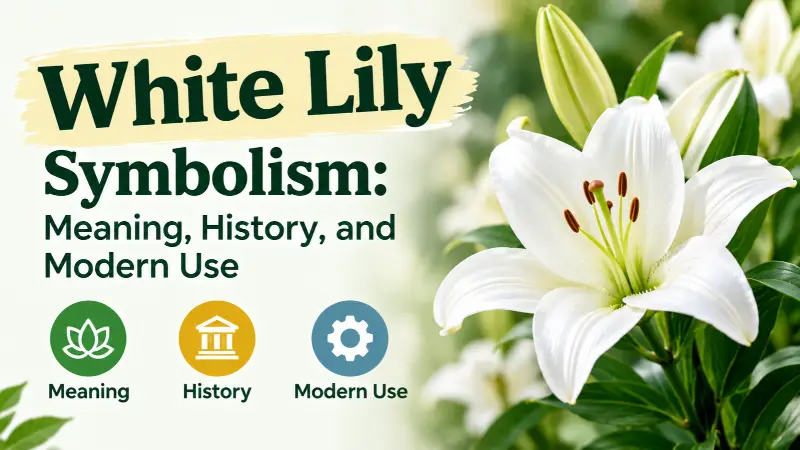
A white lily is generally recognized by its large, pale petals, prominent reproductive structures, and elegant, open flower shape. Depending on the variety, its blossoms may resemble trumpets, upward-facing cups, or broad stars. Many varieties also have a noticeable fragrance.
The name covers several cultivated lilies rather than one single plant. The Madonna lily (Lilium candidum), for example, has a particularly important place in European Christian art. Easter lilies (Lilium longiflorum), with their long, trumpet-shaped white flowers, are especially familiar in American religious and seasonal displays.
White lilies are often arranged with roses, greenery, and other white flowers. Their clean appearance makes them suitable for formal events, while their fragrance and prominent petals give them enough visual presence to stand alone.
The distinction between lily species matters when discussing history. The white Madonna lily has a particularly strong association with traditional religious imagery, while the Easter lily is prominent in modern American customs. Not every flower commonly called a lily belongs to the same botanical group.
2. The Main Symbolic Meanings of White Lilies
White lilies have several connected meanings, but their interpretation is not fixed. The most common associations arise from the flower’s color, its use in religious art, and the occasions on which people display it.
Purity and innocence: White has long been used in many Western traditions to communicate cleanliness, moral innocence, and sincerity. The lily’s unmarked petals reinforce that visual association.
Peace and serenity: The flower’s restrained color and graceful form can suggest calm, making it appropriate for quiet ceremonies and spaces intended for reflection.
Spiritual devotion: In Christian imagery, the white lily can represent holiness, chastity, and devotion to God. This interpretation is especially familiar in depictions of the Virgin Mary.
Love and commitment: White lilies can appear in weddings and anniversary arrangements, where their formal appearance complements themes of fidelity, respect, and a shared future.
Remembrance and sympathy: In funerals and memorials, the flower communicates care for the bereaved and respect for the person who has died. For some mourners, it also suggests spiritual hope.
These meanings overlap, but they are not interchangeable. A wedding bouquet emphasizes commitment and a new beginning, while a funeral arrangement emphasizes remembrance and consolation.
3. Ancient Roots and Early Symbolism
The lily’s symbolic history predates its modern use in American floral arrangements. Lilies appeared in ancient Mediterranean cultures, including Egyptian and Minoan artistic traditions, where floral imagery could be associated with fertility, abundance, beauty, and status.
In ancient Greek and Roman contexts, lilies were connected with love, reproduction, and glory. Their use in ceremonial and decorative settings helped establish the flower as more than a botanical ornament.
The precise meanings of ancient lily images are not always certain. Artists did not necessarily intend every flower to communicate one universal message, and identifying the exact species represented in an old painting can be difficult.
Biblical poetry also contributed to the lily’s later symbolism. The Song of Songs uses flower imagery to describe beauty, love, and desire. These passages became especially influential when Christian writers interpreted poetic descriptions as illustrations of spiritual relationships.
Over time, the lily’s associations with beauty and love were joined by a more specific religious meaning: the white flower as a sign of purity. That development became particularly important in medieval European art.
4. White Lilies in Christianity and Religious Art
The white lily is one of the most recognizable floral symbols in traditional Christian art. Its association with the Virgin Mary developed through centuries of religious interpretation, particularly in medieval and Renaissance Europe.
Artists frequently placed lilies in scenes of the Annunciation, the biblical episode in which the angel Gabriel tells Mary that she will bear Jesus. The angel may hold a lily, or the flower may stand in a vase near Mary.
Within this visual tradition, the lily represents Mary’s purity and chastity. Some Christian interpretations also connect its white petals with the purity of her body and its golden center with the radiance of her soul.
The flower can therefore communicate more than general innocence. In a religious painting or church arrangement, it may refer specifically to devotion, holiness, and the sacred character of the scene.
White lilies are not a universal requirement for Christian worship, and individual churches differ in their floral customs. Nevertheless, the association remains recognizable in Catholic art and in many other settings influenced by historic European Christian imagery.
Outside Christianity, the flower may be appreciated for its beauty without carrying these theological meanings. Its religious interpretation depends on the tradition and context in which it appears.
5. What White Lilies Mean in American Culture
In the United States, white lilies are familiar in churches, funeral homes, wedding venues, gardens, and seasonal decorations. Their symbolism often comes from established Western customs rather than a single national tradition.
Three settings are especially important.
At weddings, white lilies complement the formal atmosphere of the ceremony. Their color can suggest sincerity, respect, and the beginning of a shared life, although roses and other flowers may communicate similar ideas.
At funerals, white lilies are widely used in sympathy arrangements. They can express condolences, reverence, and hope for peace. In Christian services, they may also carry an explicit religious meaning; in secular services, the same flowers can simply convey care and remembrance.
At Easter, the Easter lily has a recognizable place in many American churches and homes. Its seasonal appearance is associated with the Christian celebration of Jesus Christ’s resurrection, making the flower a sign of hope and renewed life in that setting.
These uses explain why the flower can appear both joyful and solemn. Americans do not necessarily interpret it differently in each setting; rather, the occasion emphasizes a different part of its broader symbolism.
6. White Lily Symbolism at Funerals and Memorials
White lilies are particularly associated with funerals because their appearance suits the purpose of honoring the dead and comforting surviving family members.
Their white petals can suggest peace, dignity, and the wish that a person’s memory be held with respect. In Christian contexts, they may also express a hope for resurrection or eternal life. The exact message depends on the beliefs of the family and the character of the service.
Florists may use white lilies in standing sprays, casket arrangements, wreaths, and bouquets sent to the bereaved. They are often combined with white roses, carnations, or greenery to create a restrained and formal display.
However, sending white lilies is not always appropriate for every person or family. Some people associate strongly scented flowers with discomfort, and some households prefer different flowers for religious, cultural, or personal reasons. A thoughtful choice considers the recipient rather than relying on symbolism alone.
A white lily does not mean that someone has died, nor is it exclusively a funeral flower. Its association with mourning is contextual, and the same variety can be used for a celebration.
7. White Lilies in Weddings and New Beginnings
White lilies can bring a sense of formality and simplicity to weddings. Their open petals make them visually striking in bouquets, centerpieces, and ceremony decorations, while their color fits a traditional white wedding palette.
Symbolically, they may represent sincerity, commitment, and the hope for a peaceful marriage. Christian couples may also appreciate the lily’s connection with religious purity and devotion.
The flower’s meaning should not be reduced to the idea of virginity. Although chastity is part of its historical Christian symbolism, modern couples may choose white lilies simply because they like their appearance or want a clean, elegant floral design.
White lilies can also appear at engagements, anniversaries, housewarmings, and other transitions. In these settings, their associations with renewal and thoughtful celebration are often more relevant than their historical religious meanings.
One practical consideration is fragrance. Some lily varieties have a strong scent, which may be overwhelming in enclosed venues or for guests sensitive to perfume. Couples can ask florists about varieties and placement before choosing arrangements.
8. White Lily Symbolism in Other Cultural and Religious Traditions
The lily does not have one meaning across all cultures. Its associations vary according to religious history, local customs, and the way people use flowers in everyday life.
In Jewish traditions, biblical references to lilies have been interpreted in different ways, including as images of beauty, faithfulness, and spiritual devotion. The exact plant intended in ancient texts is sometimes uncertain, so modern interpretations should be made cautiously.
In European Christian traditions, the white lily is especially associated with the Virgin Mary and chastity. That meaning became prominent through religious painting, devotional writing, and church decoration.
In Japan and other East Asian settings, the meaning of a lily depends on the species, the occasion, and local floral conventions. Some lilies may appear in formal or memorial arrangements, but it would be inaccurate to assume that all white lilies carry the same message throughout the region.
More broadly, white flowers can signify reverence or mourning in some communities and celebration in others. A person’s cultural or religious background is therefore a better guide than color alone.
When giving lilies across cultural boundaries, it is sensible to consider the recipient’s customs and preferences. A flower that seems elegant and comforting to one person may have a different association for another.
9. The Emotional and Psychological Meaning of White Lilies
White lilies can communicate emotions that people find difficult to express directly. Their visual simplicity may suggest sincerity, while their formal appearance suits occasions that call for respect and restraint.
In a memorial setting, the flower can help create an atmosphere of quiet reflection. At a wedding, the same qualities can contribute to a feeling of dignity and anticipation. In a home, a vase of white lilies may simply create a peaceful focal point.
Color plays a role in these impressions, but it does not determine them. White is associated with cleanliness and simplicity in many Western design traditions, yet it can also feel cold, formal, or distant depending on the surroundings.
Personal memories matter just as much. Someone who remembers white lilies from a grandparent’s garden may associate them with affection and family history. Another person may connect them with a funeral and experience sadness when seeing them.
For this reason, the psychological meaning of a white lily is best understood as a combination of cultural associations and personal experience. There is no universal emotional response to the flower.
10. White Lilies in Tattoos, Jewelry, and Personal Style
White lilies can inspire tattoos and jewelry because their shape is recognizable and their symbolism accommodates several personal interpretations.
A white lily tattoo may represent:
- Personal growth: A reminder of a fresh start or a change in direction.
- Family remembrance: A tribute to a relative or loved one who has died.
- Faith: An expression of Christian devotion or spiritual commitment.
- Innocence and sincerity: A preference for honesty and straightforward relationships.
- Beauty and resilience: An appreciation of natural elegance and the ability to continue after hardship.
The meaning often becomes more specific when the design includes additional details. A lily alongside a date may commemorate a particular person, while a cross may communicate an explicitly Christian interpretation. A stem with unopened buds might suggest anticipation or a future beginning, although that meaning is a personal interpretation rather than a fixed historical convention.
In jewelry, lily motifs can appear on pendants, rings, brooches, and engraved keepsakes. They may be chosen as memorial gifts, wedding accessories, or simply decorative designs.
A tattoo does not need to follow traditional flower symbolism. Someone may choose a lily because it was a favorite flower, appeared in a meaningful place, or reminds them of a particular relationship. Personal significance can be more important than established cultural meaning.
11. White Lilies in Home Decor, Fashion, and Social Media
White lilies fit easily into modern design because their color works with many palettes. They are commonly displayed in neutral interiors, formal dining rooms, entryways, and event spaces.
In home decor, a white lily arrangement can create a focal point without introducing a strong color contrast. Paired with greenery, it can feel natural and understated; arranged in a polished vase with minimal foliage, it can look formal and contemporary.
Fashion and accessories use floral imagery more flexibly. A lily printed on fabric or included in an embroidered design may represent elegance, romance, nature, or a connection to a particular memory. The context of the garment matters more than any assumed universal message.
On social media, white lily photographs may accompany wedding announcements, remembrance posts, religious celebrations, or messages about a new chapter in life. Captions and accompanying images often determine the intended meaning.
A photograph of lilies beside a memorial message communicates something different from the same flower pictured with a wedding dress. Digital culture reinforces the importance of context: the flower provides a visual cue, while the surrounding words explain the message.
12. White Lily Symbolism Compared Across Occasions
The following table shows how the flower’s interpretation changes depending on where it appears.
| Context | Common meaning in the USA | Typical associations | Important distinction |
|---|---|---|---|
| Christian art and worship | Purity and devotion | The Virgin Mary, holiness, faith | Meaning is rooted in Christian tradition |
| Weddings | Sincerity and commitment | Marriage, celebration, new beginnings | Couples may choose lilies for appearance alone |
| Funerals | Sympathy and remembrance | Peace, respect, consolation | Spiritual meanings depend on the family |
| Easter celebrations | Hope and renewal | Resurrection, seasonal renewal | Most closely associated with Christian observance |
| Tattoos and jewelry | Personal significance | Memory, faith, growth, elegance | The wearer’s intention defines the message |
| Home decor | Calm and sophistication | Simplicity, beauty, natural design | Decorative use may have no symbolic intention |
The table illustrates an important distinction: the flower’s established associations can guide interpretation, but they do not dictate what every individual means by choosing it.
13. Common Misunderstandings About White Lily Symbolism
Several misconceptions arise when a flower with a long symbolic history becomes a familiar part of modern life.
Misunderstanding 1: White lilies are only for funerals.
Funeral arrangements are a prominent use, but white lilies also appear at weddings, Easter celebrations, formal events, and in ordinary home decoration. Their association with mourning does not prevent them from representing celebration or renewal.
Misunderstanding 2: Every white lily represents the Virgin Mary.
This association is specific to a Christian artistic and devotional tradition. A lily in a secular bouquet or a personal tattoo may have no religious meaning at all.
Misunderstanding 3: White lilies always mean innocence.
Purity and innocence are well-established associations, particularly in Western and Christian contexts. However, love, peace, remembrance, beauty, and renewal may be more relevant in other situations.
Misunderstanding 4: The flower’s meaning is universal.
Flower symbolism varies across cultures, religions, and individuals. Assuming that every recipient shares the same associations can lead to misunderstandings.
Misunderstanding 5: Every flower called a lily has identical symbolism.
The common name covers different species and horticultural varieties, and some plants with lily in their common names are botanically unrelated to true lilies. Historical artwork and modern customs may also feature different flowers.
The safest interpretation considers the actual flower, the setting, and the intention behind its use.
14. How White Lily Symbolism Has Changed Over Time
The white lily’s meaning has developed through successive layers of cultural interpretation. Ancient Mediterranean societies associated lilies with beauty, fertility, love, and abundance. Christian writers and artists later emphasized purity and chastity, particularly through depictions of the Virgin Mary.
By the nineteenth century, European and American interest in the language of flowers added another way to interpret floral gifts. Victorian flower guides assigned meanings to different species and colors, allowing bouquets to function as carefully arranged expressions of sentiment. These meanings varied between publications and were not a universal code.
In modern America, white lilies are often recognized through familiar social customs rather than detailed knowledge of their history. Someone sending a sympathy arrangement may be following a florist’s recommendation, while someone choosing a lily tattoo may be expressing a private memory.
Commercial floristry, religious practice, popular art, and personal style have all contributed to the flower’s continuing relevance. The result is not one unchanged definition but a set of related meanings that people emphasize differently.
The white lily remains recognizable because its established associations are adaptable. Purity can become sincerity at a wedding, peace at a memorial, or a personal ideal in a tattoo. The flower retains its historical background while taking on new meanings in individual lives.
FAQs
1. What does a white lily symbolize spiritually?
A white lily can symbolize purity, faith, spiritual devotion, and peace. In Christian traditions, it is particularly associated with the Virgin Mary and the ideal of holiness, although spiritual interpretations vary among individuals and religious communities.
2. Is a white lily a symbol of death?
A white lily is often used at funerals and memorials, where it expresses sympathy, respect, and remembrance. It is not exclusively a symbol of death and also appears at weddings, Easter celebrations, and other occasions associated with hope or renewal.
3. What does a white lily tattoo mean?
A white lily tattoo can represent personal growth, faith, innocence, elegance, or the memory of someone important. Its specific meaning depends on the wearer’s experiences and on any additional elements in the design.
4. What does giving someone a white lily mean?
Giving someone a white lily may express respect, sympathy, affection, sincerity, or a wish for peace. The occasion matters: a bouquet sent after a bereavement communicates something different from flowers presented at a wedding or celebration.
5. Why are white lilies associated with the Virgin Mary?
Medieval Christian writers and artists connected the white lily’s appearance with Mary’s purity and chastity. The flower became a recurring feature in Annunciation paintings, where the angel Gabriel or a vase of lilies helped identify the religious significance of the scene.
6. Are white lilies a good choice for a wedding?
Yes. White lilies can complement wedding flowers because they suit formal arrangements and are commonly associated with sincerity, commitment, and new beginnings. Couples should consider fragrance, the venue, and their personal preferences when choosing a variety.
7. Do white lilies have negative meanings?
White lilies are not generally associated with negative meanings in mainstream American floral customs, but their connection with funerals may evoke sadness for some people. In historical literature, lilies could also be used to explore the contrast between apparent purity and physical decay, showing that their symbolism has never been entirely simple.
Conclusion
White lily symbolism brings together purity, innocence, peace, devotion, and remembrance. Its historical associations developed through ancient Mediterranean culture and Christian art, while modern American customs have made the flower familiar at weddings, funerals, Easter celebrations, and personal commemorations.
The meaning ultimately depends on the setting and the person choosing the flower. A white lily can honor a loved one, mark a new beginning, express religious faith, or simply add elegance to a room.
Its lasting appeal lies in this flexibility: the white lily offers a recognizable expression of care and sincerity without requiring every person to interpret it in exactly the same way.


