
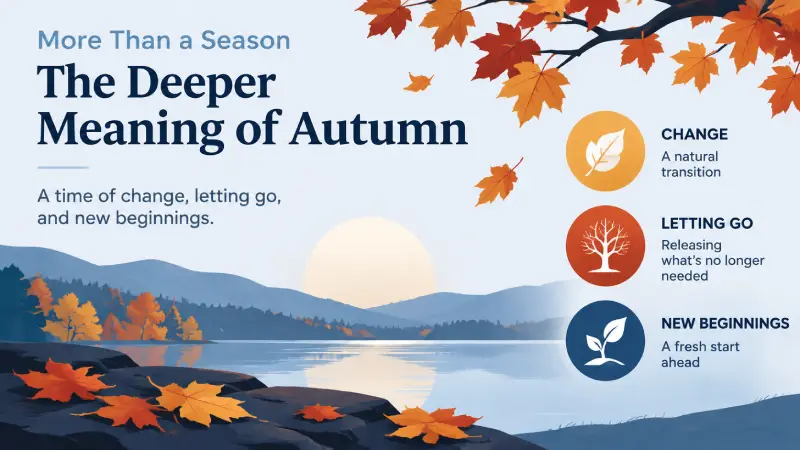
Autumn symbolism is commonly associated with change, transformation, maturity, gratitude, release, and the beauty of impermanence. As summer fades and leaves change color, autumn creates a natural reminder that every stage of life has its own purpose.
The season is known for falling leaves, cooler temperatures, harvest celebrations, and shorter days. These characteristics connect autumn with personal growth, reflection, emotional healing, and preparation for a new chapter.
In different cultures, autumn can represent abundance and gratitude, while its falling leaves may symbolize endings and letting go. In modern American culture, autumn is also associated with family gatherings, cozy traditions, Halloween, Thanksgiving, and seasonal renewal.
This guide explores autumn symbolism, spiritual meanings, dreams, love, personal growth, cultural connections, and modern interpretations.
Quick Answer: What Does Autumn Symbolize?
Autumn commonly symbolizes:
- Change and transformation
- Maturity and wisdom
- Letting go
- Renewal and preparation
- Gratitude
- Harvest and abundance
- Reflection
- Emotional growth
- The temporary nature of life
- Balance and acceptance
Autumn is not only a symbol of endings. It also represents the results of earlier growth and the preparation for a new beginning.
Autumn Symbolism Meaning
Autumn is a season of transition. Trees lose their leaves, crops are harvested, and nature begins preparing for winter.
These seasonal changes provide several symbolic meanings. Autumn can remind us to appreciate what we have, accept what is changing, and recognize the value of slowing down.
1. Change and Transformation
One of the strongest meanings of autumn is change. Green leaves turn yellow, orange, red, and brown before falling from the trees.
This transformation represents the natural movement of life. It reminds us that change can be beautiful, even when it feels unfamiliar.
Autumn symbolism may encourage you to:
- Accept new circumstances
- Adapt to different situations
- Learn from past experiences
- Welcome personal development
- Understand that change is natural
The season shows that transformation does not always happen suddenly. Sometimes, it develops gradually.
2. Letting Go
Falling leaves are a powerful symbol of release. Trees let go of their leaves as part of their natural seasonal cycle.
Symbolically, this can represent releasing old habits, painful memories, unhealthy relationships, or unrealistic expectations.
Letting go does not mean that the past had no value. It means accepting that something may no longer belong in your present life.
Autumn may encourage you to release what prevents you from moving forward.
3. Maturity and Wisdom
Autumn follows the active growth of spring and summer. In this way, it can symbolize maturity, experience, and the lessons gained over time.
The season may represent a stage in life when a person becomes more thoughtful and understands the importance of patience.
Autumn symbolism can be connected with:
- Emotional maturity
- Life experience
- Self-awareness
- Patience
- Practical wisdom
- Acceptance
Like a tree moving through different seasons, people also develop through different stages of life.
4. Harvest and Abundance
Autumn is traditionally connected with harvesting crops and gathering the results of earlier work.
This makes it a symbol of abundance, achievement, gratitude, and preparation.
A harvest can represent more than food. It may also symbolize the results of your efforts, such as:
- Career progress
- Strong relationships
- Personal achievements
- New knowledge
- Emotional growth
- Long-term goals
Autumn encourages people to recognize what they have developed instead of focusing only on what is still missing.
5. Gratitude
Autumn is closely associated with gratitude, especially through harvest traditions and Thanksgiving celebrations in the United States.
The season encourages appreciation for family, food, nature, shelter, friendship, and personal progress.
Gratitude does not require life to be perfect. Autumn symbolism suggests that people can recognize meaningful blessings while still experiencing challenges.
6. Reflection and Self-Awareness
As nature becomes quieter, autumn can create a symbolic connection with reflection and introspection.
The season may encourage you to look back at the experiences of the year and consider what you have learned.
Autumn reflection can involve:
- Reviewing personal goals
- Understanding past decisions
- Recognizing emotional patterns
- Appreciating important memories
- Planning for the future
This reflective quality makes autumn a meaningful symbol of self-awareness.
7. Beauty in Impermanence
Autumn leaves are beautiful partly because their colors and appearance are temporary.
Their short seasonal display reminds us that beauty does not have to last forever to be valuable.
This symbolism encourages appreciation of the present moment. It also shows that endings can contain their own form of beauty.
Autumn may remind you to enjoy experiences while they are happening instead of waiting for them to become permanent.
8. Preparation
Autumn is a period of preparation before winter. Animals, plants, and people respond to changing temperatures and environmental conditions in different ways.
Symbolically, this can represent planning, patience, and preparing for the future.
Autumn may encourage you to:
- Organize your priorities
- Save resources
- Prepare for challenges
- Build emotional strength
- Create healthier routines
Preparation is not always about expecting something negative. It can also help you feel more confident about the next stage.
9. Balance
Autumn exists between summer and winter. It is neither the intense growth of summer nor the deepest dormancy of winter.
This transitional position makes it a symbol of balance and adjustment.
Autumn may encourage you to balance:
- Work and rest
- Social life and solitude
- Ambition and patience
- Holding on and letting go
- Action and reflection
The season reminds us that life requires different forms of energy at different times.
10. Emotional Healing
Autumn can symbolize healing through acceptance. Its changing landscape reminds us that life continues even when circumstances shift.
For someone experiencing emotional difficulty, autumn may represent the process of understanding pain, releasing old expectations, and gradually developing a new sense of peace.
Healing does not always happen quickly. The seasonal cycle offers a metaphor for giving yourself time and allowing growth to happen naturally.
What Does Seeing Autumn Mean?
Seeing autumn may symbolize a period of transition, reflection, maturity, or personal change.
The meaning depends on the specific scene and your emotional reaction.
For example, colorful leaves may represent beauty and gratitude, while bare branches may suggest release or preparation.
Possible interpretations include:
- Colorful autumn leaves: Beauty, maturity, and transformation
- Falling leaves: Letting go and acceptance
- An autumn forest: Reflection and personal discovery
- An autumn harvest: Achievement and abundance
- A cold autumn evening: Solitude and preparation
- Sunlight through autumn trees: Hope and appreciation
- A bare tree: Rest, transition, and renewal
These are symbolic interpretations, not guaranteed messages about the future.
What Does Autumn Symbolize Spiritually?
Spiritually, autumn is often interpreted as a symbol of transformation, acceptance, gratitude, release, and the natural cycles of life.
The season can encourage people to reflect on what they have learned and consider what they need to release.
Autumn may spiritually represent:
- Accepting the changes in life.
- Releasing emotional burdens.
- Appreciating the present moment.
- Recognizing the results of personal growth.
- Preparing for a new stage.
- Finding meaning in temporary experiences.
Different spiritual traditions interpret seasonal symbolism in different ways. Autumn does not have one universal spiritual meaning, and its symbolism should be understood within the relevant cultural or personal context.
Autumn Symbolism in Dreams
Dreaming about autumn may reflect change, nostalgia, emotional maturity, or the closing of a particular life chapter.
The meaning depends on the dream’s setting, events, and emotional atmosphere.
Dreaming of Colorful Autumn Leaves
Colorful leaves may symbolize beauty, personal transformation, and appreciation of life.
The dream could reflect a positive transition or your ability to notice meaningful experiences during a period of change.
Dreaming of Falling Leaves
Falling leaves may represent letting go, endings, or the acceptance of change.
If the dream feels peaceful, it may reflect emotional acceptance. If it feels sad, it may connect with fear of losing someone or something important.
Dreaming of an Autumn Forest
An autumn forest may symbolize self-discovery, reflection, and uncertainty about the future.
Walking through the forest could represent exploring your emotions or trying to understand a personal decision.
Dreaming of an Autumn Harvest
An autumn harvest may represent achievement, reward, and the results of your hard work.
It may also suggest that you are recognizing the value of your previous efforts.
Dreaming of a Bare Autumn Tree
A bare tree may symbolize rest, vulnerability, loss, or preparation.
The meaning depends on whether the tree appears damaged or simply follows its natural seasonal cycle.
Dreaming of a Beautiful Autumn Day
A beautiful autumn day may represent peace, gratitude, and emotional balance.
It can reflect an appreciation for the present, even when you understand that circumstances will eventually change.
Autumn Symbolism in Love
Autumn symbolism in love is often connected with maturity, commitment, appreciation, and the changing stages of relationships.
Unlike the energetic symbolism sometimes associated with spring, autumn often represents deeper emotional understanding and realistic affection.
Autumn Meaning for Singles
For someone who is single, autumn may symbolize self-reflection and emotional readiness.
It can encourage you to understand your needs, learn from past relationships, and develop a stronger relationship with yourself.
Autumn does not guarantee that a new relationship will appear. Its symbolic meaning is more closely connected with personal preparation and emotional maturity.
Autumn Meaning in a Relationship
In a relationship, autumn may represent lasting affection, shared experiences, and a deeper understanding between partners.
The season can remind couples to appreciate each other and recognize that relationships change over time.
Healthy love requires patience, communication, and the willingness to grow together.
Autumn Meaning After a Breakup
After a breakup, autumn may symbolize acceptance and emotional release.
Falling leaves can represent letting go of a relationship, while the season’s gradual changes may reflect the slow process of healing.
Autumn reminds us that an ending can also create space for a different beginning.
Autumn Spirit Animal Meaning
Autumn is a season rather than an animal. However, some modern spiritual interpretations connect autumn with animals that are active during this time of year.
Symbolically, autumn may be associated with qualities such as:
- Preparation
- Patience
- Adaptability
- Awareness
- Resourcefulness
- Transition
- Endurance
Animals such as squirrels, deer, birds, and bears may appear in autumn symbolism because of their seasonal behavior. However, each animal has its own cultural and ecological significance.
The phrase “autumn spirit animal” is best understood as a metaphorical or personal spiritual concept, not a literal classification.
Autumn Symbolism in Different Cultures
Autumn has different meanings across cultures, depending on seasonal traditions, agricultural practices, religion, and local environments.
Autumn in American Culture
In the United States, autumn is associated with harvest celebrations, Thanksgiving, Halloween, football, family gatherings, and changing foliage.
Common modern associations include:
- Gratitude
- Family
- Community
- Harvest
- Seasonal beauty
- Reflection
- Preparation
The meaning of autumn varies across American communities and individual experiences.
Autumn in Japanese Culture
Autumn is often appreciated in Japan for its changing leaves, especially the red and orange foliage known as kōyō.
Seasonal appreciation can be connected with awareness of nature and the temporary quality of life. Japanese autumn traditions and interpretations vary across regions and historical periods.
Autumn in Harvest Traditions
Many communities around the world connect autumn with harvesting crops and preparing for colder weather.
These traditions often emphasize gratitude, shared work, food, and the relationship between people and the land.
Harvest symbolism is not identical across cultures, so specific meanings should be considered within their cultural context.
Autumn Symbolism by Color
Autumn is known for its changing colors. These colors can create different modern symbolic associations.
| Autumn Color | Possible Symbolic Meaning | Modern Interpretation |
|---|---|---|
| Red | Passion, strength, transformation | Courage and emotional intensity |
| Orange | Energy, warmth, creativity | Optimism and enthusiasm |
| Yellow | Happiness, hope, awareness | Appreciation and positive change |
| Brown | Stability, grounding, maturity | Connection with nature and simplicity |
| Gold | Abundance, achievement, value | Gratitude and success |
| Deep purple | Mystery, reflection, depth | Introspection and emotional awareness |
These meanings are modern interpretations and are not universal symbolic rules.
Autumn Symbolism in Nature
Autumn provides many natural examples of change and preparation.
Trees lose their leaves, animals may change their behavior, and daylight becomes shorter. These processes show that nature responds to seasonal conditions.
From a symbolic perspective, autumn can represent:
- Adaptation
- Natural cycles
- Resource management
- Rest
- Transformation
- Environmental awareness
Understanding the science of autumn can deepen its symbolism without requiring supernatural explanations.
Autumn Symbolism in Tattoos
Autumn tattoos often represent change, maturity, personal growth, and appreciation of life’s temporary nature.
Autumn Leaves Tattoo
An autumn leaves tattoo may symbolize transformation, letting go, or a meaningful period of change.
Autumn Tree Tattoo
A tree with colorful leaves may represent personal development, family roots, and the different stages of life.
Falling Leaves Tattoo
Falling leaves can represent acceptance, emotional release, and the closing of an important chapter.
Autumn Forest Tattoo
An autumn forest may symbolize reflection, exploration, solitude, and connection with nature.
Pumpkin and Autumn Tattoo
Pumpkins and other autumn symbols may represent harvest, celebration, comfort, family traditions, and seasonal memories.
The tattoo’s meaning ultimately depends on the wearer’s personal story.
Autumn Symbolism in Different Situations
| SituationPossible Symbolic Meaning | |
|---|---|
| Seeing colorful leaves | Beauty and transformation |
| Watching leaves fall | Letting go and acceptance |
| Visiting an autumn forest | Reflection and self-discovery |
| Celebrating a harvest | Gratitude and abundance |
| Feeling the autumn breeze | Change and renewal |
| Dreaming of autumn | Emotional transition |
| Seeing a bare tree | Rest and preparation |
| Decorating for autumn | Comfort, family, and tradition |
Positive Autumn Symbolism
Autumn can represent many positive ideas, including:
- Gratitude
- Beauty
- Maturity
- Growth
- Reflection
- Abundance
- Acceptance
- Renewal
- Wisdom
- Emotional healing
The season encourages people to appreciate their progress and recognize the value of change.
Negative Autumn Symbolism
Autumn can also represent challenging emotional experiences.
Possible negative or difficult meanings include:
- Loss
- Sadness
- Endings
- Fear of change
- Nostalgia
- Emotional distance
- Uncertainty
- Letting go
These interpretations do not make autumn a negative season. They reflect the fact that change can involve both beauty and emotional difficulty.
What Does Autumn Mean in Your Personal Life?
Autumn symbolism may become more meaningful when connected with your current experiences.
If you are finishing an important chapter, autumn may represent closure. If you are preparing for a new opportunity, it may symbolize patience and planning.
Ask yourself:
- What is changing in my life right now?
- Is there something I need to release?
- What results of my hard work can I appreciate?
- Am I learning to accept a new stage of life?
- What memories does autumn bring to mind?
- How can I prepare for the future while appreciating the present?
These questions can help you develop a personal interpretation based on your experiences.
Frequently Asked Questions About Autumn Symbolism
1. What is the main meaning of autumn symbolism?
Autumn commonly symbolizes change, transformation, maturity, gratitude, letting go, harvest, and the temporary nature of life.
2. What does autumn symbolize spiritually?
Spiritually, autumn may represent acceptance, renewal, reflection, emotional release, and the natural cycles of life. The meaning varies among individuals and traditions.
3. What do falling autumn leaves symbolize?
Falling leaves often symbolize letting go, endings, change, and acceptance. They can also represent the beauty of temporary experiences.
4. Is autumn a symbol of new beginnings?
Yes. Although autumn is associated with endings, it also represents preparation and renewal. Releasing the past can create space for a new stage of life.
5. What does autumn mean in a dream?
Autumn in a dream may symbolize personal change, reflection, maturity, emotional release, or the closing of a life chapter. The dream’s details and emotional tone influence its interpretation.
6. What do autumn colors symbolize?
Autumn colors may symbolize transformation, warmth, gratitude, maturity, energy, and abundance. The meaning depends on the color and personal context.
Final Thoughts on Autumn Symbolism
Autumn symbolism represents change, maturity, gratitude, transformation, release, and the beauty of impermanence. The season reminds us that life moves through different stages, and every stage can offer meaningful lessons.
Falling leaves can teach us about letting go, while the harvest can remind us to appreciate the results of our efforts. The season’s changing colors also show that transformation can be beautiful.
Whether you experience autumn through nature, dreams, cultural traditions, or personal reflection, its meaning depends on your circumstances and beliefs. Its central message is simple: appreciate what you have, accept what is changing, and prepare for the next chapter with patience and hope.