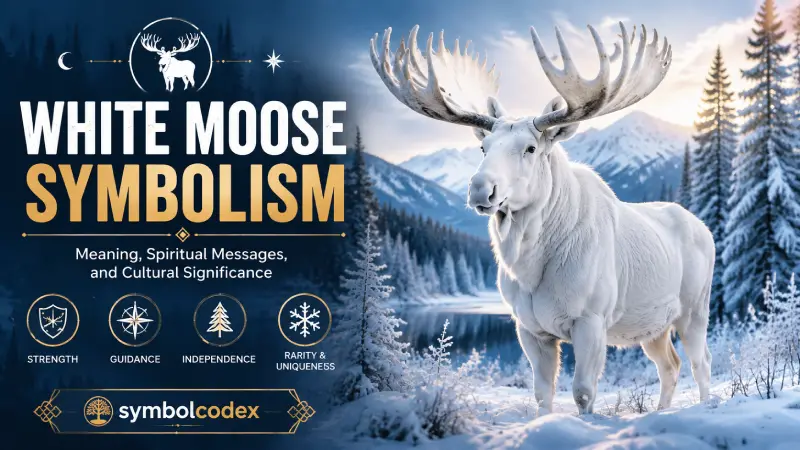
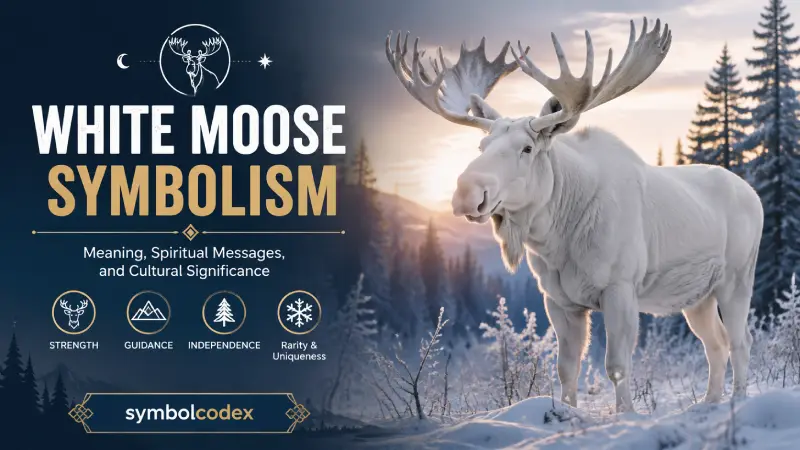
Moose are among the largest land mammals in North America, recognized for their long legs, broad antlers, and ability to survive harsh northern environments. A white moose is especially unusual, making it visually striking and culturally memorable. White moose symbolism commonly represents strength, rarity, independence, resilience, renewal, and a strong connection with nature.
The meaning comes from two main elements. Moose naturally suggest endurance, self-reliance, and wilderness, while white is often associated with purity, peace, clarity, and new beginnings.
For people in the United States, the white moose can also represent the extraordinary side of the natural world. Because genuinely white moose are extremely uncommon, seeing one may feel significant even without attaching a supernatural explanation to the experience.
Quick Answer
White moose symbolism commonly represents strength, rarity, independence, resilience, renewal, and connection with nature, especially in modern American wildlife and spiritual interpretations. Historically and culturally, moose symbolism is also connected with survival, wilderness, protection, and adapting to demanding environments.
TL;DR
- White moose symbolize rare strength, independence, and resilience.
- Moose naturally represent survival in challenging northern environments.
- White coloring can suggest purity, peace, and renewal.
- Their large antlers add themes of growth and maturity.
- American symbolism often connects moose with wilderness and self-reliance.
- Modern interpretations appear in dreams, tattoos, art, and nature culture.
What Does a White Moose Symbolize?
The symbolism of a white moose combines the characteristics of the animal with the associations of its unusual coloring.
Moose are powerful animals capable of living in cold forests, wetlands, and northern landscapes. They are generally solitary outside certain seasonal interactions, which contributes to their association with independence.
White, meanwhile, commonly suggests:
- purity
- peace
- clarity
- innocence
- renewal
- new beginnings
- rarity
Together, these qualities create a symbol that can represent:
- Strength
- Independence
- Resilience
- Rarity
- Renewal
- Dignity
- Patience
- Self-reliance
- Wilderness
- Personal transformation
The exact interpretation depends on the setting and the person’s own associations with moose.
Why Moose Symbolize Strength
The moose is an exceptionally large animal.
Its size, powerful shoulders, long legs, and broad antlers make it one of the most imposing mammals in North American forests. It can also move through deep snow, water, and dense vegetation.
These characteristics naturally support symbolism related to strength and endurance.
A moose can represent someone who:
- withstands difficult circumstances
- remains independent under pressure
- moves steadily rather than quickly
- protects personal boundaries
- has confidence without needing constant attention
This is different from the symbolism of a predator.
Moose strength is often associated with presence and endurance rather than aggression.
White Moose Symbolism and Rarity
A genuinely white moose is uncommon.
Very pale moose can result from genetic variations affecting pigmentation. Some may have leucism, which can produce reduced pigmentation while generally leaving the eyes normally pigmented. True albinism is different and much rarer.
Because unusual white animals attract attention, the white moose has become a natural symbol of rarity.
It can represent:
- individuality
- uniqueness
- uncommon opportunities
- exceptional experiences
- standing apart from the crowd
- recognizing something unusual
This interpretation does not require a supernatural explanation.
A rare animal is memorable simply because it is rarely seen.
White as a Symbol of Purity and Peace
White carries strong symbolic associations in modern American culture.
It frequently appears in contexts involving weddings, religious ceremonies, memorials, clothing, architecture, and visual design.
Common associations include:
- peace
- purity
- innocence
- clarity
- simplicity
- fresh beginnings
When these meanings are combined with the physical power of a moose, the result is an interesting contrast.
The animal remains enormous and imposing, but its white appearance can make it seem calm, otherworldly, or ceremonial.
This creates a symbolic image of strength without unnecessary aggression.
Moose Symbolism and Independence
Moose are often associated with independence because adults commonly spend substantial time alone outside certain social and reproductive periods.
Their behavior is therefore different from animals that depend heavily on large permanent groups.
This makes the moose a natural metaphor for self-reliance.
White moose symbolism can represent someone who:
- values personal freedom
- makes independent decisions
- feels comfortable alone
- maintains strong boundaries
- does not need constant approval
- follows a personal path
This does not mean isolation is always positive.
The same symbolism can become negative if independence turns into emotional distance or unwillingness to accept help.
White Moose and Resilience
Moose live in environments where winter can be severe.
Cold temperatures, deep snow, changing food availability, and difficult terrain require physical adaptation.
This contributes to the moose’s symbolic association with resilience.
A white moose can represent:
- surviving difficult periods
- adapting to change
- remaining steady under pressure
- conserving energy
- accepting seasonal transitions
- rebuilding after setbacks
The symbolism is especially relevant during periods when someone is trying to recover from a difficult experience.
The moose does not symbolize rushing through hardship.
It suggests moving forward at a sustainable pace.
Moose Antlers and Renewal
Male moose grow enormous antlers each year.
The antlers develop during the warmer months and are eventually shed, after which a new set grows.
This annual cycle provides a strong natural metaphor for renewal.
Antlers can therefore symbolize:
- growth
- maturity
- strength
- regeneration
- changing identity
- seasonal cycles
A white moose with large antlers combines two visually distinctive features.
The white body suggests rarity and renewal, while the antlers emphasize growth and maturity.
For this reason, the image can work particularly well as a symbol of personal development.
White Moose Symbolism in the United States
Moose have a strong connection with northern American landscapes.
In the United States, they are especially associated with states such as Alaska, Maine, New Hampshire, Vermont, Montana, Wyoming, and parts of the northern Rocky Mountain region.
For many Americans, moose imagery immediately suggests:
- wilderness
- forests
- lakes
- mountains
- outdoor recreation
- wildlife conservation
- independence
- northern landscapes
The white moose adds an unusual quality to this familiar American wildlife symbol.
Instead of representing ordinary wilderness, it can represent the unexpected beauty found within it.
White Moose and the American Wilderness
The American wilderness has long been represented through large native animals.
Moose are particularly effective symbols because they are strongly associated with remote forests and northern ecosystems.
A white moose can therefore represent the idea that nature contains experiences that cannot be fully controlled or predicted.
This interpretation fits modern American interests in:
- hiking
- wildlife photography
- camping
- national and state parks
- conservation
- outdoor education
The symbol can encourage respect for natural environments rather than treating wildlife as decoration.
White Moose in Indigenous Traditions
Moose have important cultural and practical relationships with several Indigenous peoples of North America.
However, there is no single universal Indigenous meaning of the moose.
Different nations have distinct languages, histories, stories, ceremonies, and relationships with animals.
In some traditions, moose may be connected with food, clothing, tools, hunting knowledge, family, survival, or spiritual teachings. The exact significance varies considerably.
It is especially important not to claim that all Indigenous peoples regard a white moose as a universal sacred messenger.
Some communities may attach special significance to unusually colored animals, while others may not.
Respectful discussion requires identifying the specific cultural tradition rather than creating a single generalized “Native American meaning.”
White Moose in Folklore and Storytelling
Rare animals often become memorable figures in folklore.
A white moose is particularly suited to storytelling because its appearance is unusual enough to stand out from ordinary wildlife.
Stories about rare white animals may emphasize:
- good fortune
- exceptional circumstances
- transformation
- spiritual significance
- protection
- mystery
- connection with nature
But folklore and biology should remain separate.
A white moose can be culturally meaningful without being evidence of a supernatural event.
The rarity of the animal is enough to explain why people may remember the encounter for years.
White Moose Symbolism in Dreams
Dreaming about a white moose can symbolize strength, independence, renewal, or an unusual opportunity.
A calm white moose standing in a forest may suggest stability and confidence.
A white moose walking away may represent independence, change, or something difficult to hold onto.
A charging moose may reflect pressure, conflict, or a situation that feels overwhelming.
A white moose with large antlers may emphasize maturity, achievement, or personal growth.
The emotional tone of the dream is important.
If you feel peaceful, the moose may represent reassurance.
If you feel frightened, the same animal may symbolize a challenge or an intimidating situation.
Seeing a White Moose in a Dream
If the white moose simply watches you, the dream may encourage observation and patience.
You may be facing something that requires careful consideration rather than immediate action.
If the moose approaches you, the dream may represent a new responsibility, opportunity, or realization coming into focus.
If you follow the moose into a forest, the imagery may suggest exploration of an unfamiliar part of your life.
If the moose disappears, you may be processing uncertainty or the feeling that something rare has passed out of reach.
These are possible interpretations, not universal dream rules.
White Moose Symbolism in Love and Relationships
In relationships, the white moose can symbolize independence, loyalty, stability, protection, and emotional maturity.
Its solitary tendencies can also represent the importance of maintaining personal identity within a relationship.
A white moose may therefore suggest:
- healthy independence
- mutual respect
- emotional strength
- loyalty
- personal boundaries
- long-term stability
A negative interpretation is possible as well.
If the moose is distant or unreachable, it may represent emotional separation.
If it behaves aggressively, the dream or artwork may be expressing conflict, stubbornness, or a struggle over boundaries.
White Moose Symbolism in Spirituality
Modern spiritual interpretations often connect white moose with protection, renewal, inner strength, independence, and connection with the natural world.
For some people, encountering an unusual animal can become a moment of personal reflection.
A white moose may serve as a reminder to:
- trust your ability to handle change
- maintain personal boundaries
- remain patient
- respect natural cycles
- value individuality
- stay grounded during uncertainty
These are reflective interpretations rather than proven supernatural messages.
There is no scientific evidence that a white moose encounter predicts a particular future event.
A person can still find spiritual or emotional meaning in the experience without treating the animal as a supernatural messenger.
White Moose Symbolism in Tattoos
A white moose tattoo can express strength while avoiding the more aggressive imagery sometimes associated with predators or weapons.
Common meanings include resilience, independence, wilderness, personal growth, rarity, and renewal.
| Tattoo Design | Common Meaning in the USA | Main Association | Typical Interpretation |
|---|---|---|---|
| White moose head | Strength | Antlers | Confidence and resilience |
| White moose with mountains | Wilderness | Landscape | Independence and adventure |
| White moose with trees | Nature | Forest | Connection with the outdoors |
| White moose with flowers | Renewal | Growth | Personal transformation |
| White moose with moon | Reflection | Night | Solitude and inner growth |
The design can become more personal through the choice of landscape, plants, geometric elements, or other symbols.
White Moose Symbolism in Art and Photography
A white moose is visually unusual enough to become the central focus of an image.
Artists and photographers can use the contrast between the pale animal and its environment to communicate different ideas.
A white moose against dark trees may symbolize individuality.
A white moose in snow can emphasize adaptation and seasonal change.
A white moose beside a lake may emphasize peace and wilderness.
A white moose surrounded by green forest can highlight the contrast between ordinary nature and an extraordinary encounter.
The background is therefore an important part of the symbol.
Positive and Negative White Moose Symbolism
White moose symbolism is generally positive, but it can have more complicated meanings.
Positive meanings include:
- strength
- independence
- resilience
- rarity
- renewal
- patience
- dignity
- protection
- individuality
- connection with nature
Negative meanings can include:
- isolation
- stubbornness
- emotional distance
- excessive independence
- intimidation
- vulnerability
- difficulty accepting help
The same characteristic can support opposite interpretations.
Independence can mean confidence, but it can also mean loneliness.
Strength can represent resilience, but it can also create intimidation.
Rarity can symbolize individuality, but it can also suggest feeling separated from others.
Common Misunderstandings About White Moose
One common misconception is that every white moose is an albino.
That is not correct.
Leucism and other genetic variations can produce very pale animals, while albinism involves a specific lack of melanin and often affects eye pigmentation.
Another misconception is that every white moose has a supernatural origin.
Its unusual appearance may inspire folklore, but rarity is not proof of supernatural significance.
It is also inaccurate to claim that white moose have one universal Indigenous meaning.
Indigenous cultures are diverse, and their interpretations should be understood within specific traditions.
Finally, symbolic interpretations should not be confused with animal behavior.
A moose is not consciously trying to symbolize independence or renewal. Humans create symbolic meaning by interpreting its characteristics.
How White Moose Symbolism Has Evolved
The moose originally had practical importance for people living in areas where the animal was hunted and observed.
Its meat, hide, and other materials contributed to survival and daily life.
Over time, its physical characteristics created symbolic associations with strength, endurance, independence, and wilderness.
The annual growth and shedding of male antlers added a natural example of renewal and regeneration.
Modern American culture has expanded these meanings through wildlife photography, outdoor recreation, conservation, and nature tourism.
The rare white moose adds another layer by representing something unusual within an already powerful animal.
Its modern symbolism therefore brings together strength, independence, rarity, renewal, and respect for nature.
What White Moose Symbolism Means Today
Today, the white moose is best understood as a symbol of rare strength, independence, resilience, renewal, and connection with the wilderness.
Its symbolism is grounded in real characteristics of the animal.
Moose are large, adaptable northern mammals with strong associations with forests, wetlands, seasonal change, and self-reliance. Their antlers provide a visible cycle of growth and renewal.
The white coloration adds ideas of rarity, purity, peace, and individuality.
For many Americans, the image also represents the beauty of wildlife and the importance of protecting natural habitats.
The meaning changes with context. A white moose in a dream may represent personal growth, while a tattoo may express independence. A photograph may simply celebrate an extraordinary wildlife encounter.
Frequently Asked Questions
What does a white moose symbolize spiritually?
A white moose can symbolize renewal, protection, independence, resilience, and connection with nature in modern spiritual interpretations. These meanings are personal or tradition-specific rather than universal supernatural facts.
Is seeing a white moose a good sign?
Many people interpret a white moose positively because its rarity can represent opportunity, individuality, renewal, or strength. However, there is no universal rule that seeing one guarantees good luck.
What does a white moose mean in a dream?
A white moose in a dream may represent independence, resilience, personal growth, or an unusual opportunity. A calm animal can suggest stability, while an aggressive moose may reflect pressure or conflict.
What does a white moose tattoo symbolize?
A white moose tattoo can represent strength, independence, wilderness, rarity, resilience, and personal transformation. Mountains, forests, flowers, and antlers can add more specific meanings.
What do moose antlers symbolize?
Moose antlers can symbolize growth, maturity, strength, renewal, and changing life stages. Their annual growth and shedding provide a natural metaphor for regeneration.
Are white moose albino?
Not necessarily. Some very pale moose have genetic conditions such as leucism rather than true albinism. The two conditions are biologically different.
Are white moose considered sacred?
Some cultural traditions may give unusual animals special significance, but white moose are not universally considered sacred. Indigenous beliefs and practices differ among nations and should be understood within their specific cultural contexts.
Conclusion
The white moose combines the natural symbolism of one of North America’s largest mammals with the cultural associations of unusual white coloring. The moose contributes strength, independence, resilience, endurance, and wilderness, while white can suggest purity, peace, rarity, and renewal.
In American culture, the image can evoke northern forests, outdoor life, wildlife conservation, and the value of independence. Its unusual appearance also explains why people may attach special meaning to an encounter without needing to describe it as supernatural.
At its core, white moose symbolism represents the ability to remain strong and independent while adapting to changing circumstances. It is an image of rare beauty, steady resilience, and the kind of strength that does not need to be loud to be noticed.