Introduction
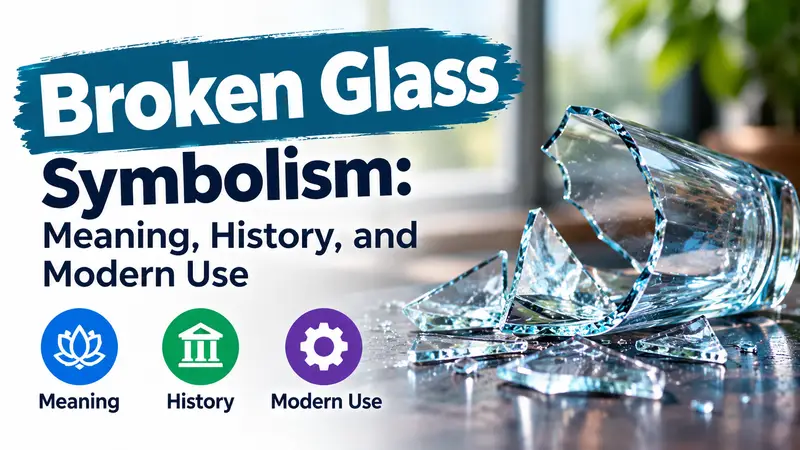
Broken glass symbolism explores the meanings people attach to shattered glass, from sudden change and emotional vulnerability to freedom, transformation, and the end of an old chapter. A broken glass can be an ordinary accident, but in art, folklore, religious customs, and personal experiences, it can also represent something changing in a person’s life.
In the United States, people often associate broken glass with disruption, lost opportunities, fragile relationships, or the need to move forward. Others interpret it more positively, seeing a shattered object as a sign of release, renewal, or a fresh beginning. The circumstances surrounding the break often determine which interpretation feels most appropriate.
The meaning also changes across cultures. In Jewish wedding traditions, breaking a glass is an established ritual with several historical and religious interpretations. In everyday American life, however, accidentally dropping a drinking glass may have no symbolic meaning at all. Understanding these differences helps separate cultural traditions from personal beliefs and popular superstitions.
Quick Answer
Broken glass symbolism commonly represents change, fragility, emotional disruption, and the possibility of a new beginning in modern American culture. Historically, broken glass has also appeared in religious rituals, protective folk beliefs, and ceremonies that acknowledge loss, remind people of life’s uncertainties, or mark an important transition.
TL;DR
- Fragility: Broken glass represents vulnerability and the delicate nature of relationships.
- Transformation: Shattering can symbolize an ending that makes room for change.
- Emotional meaning: It may reflect disappointment, anger, grief, or release.
- Good luck: Some folk beliefs interpret accidental breakage as a favorable sign.
- Religious tradition: Breaking a glass is an established Jewish wedding custom.
- Modern use: Artists and designers use shattered glass to express conflict, freedom, and renewal.
What Does Broken Glass Look Like as a Symbol?
Broken glass can appear as scattered shards, a cracked window, a shattered drinking glass, a fractured mirror, or a damaged glass ornament. Each form can suggest a different idea because people associate different objects with different experiences.
A broken window may suggest exposure, lost security, or a boundary that has been violated. A shattered drinking glass can represent an accident, an emotional outburst, or the end of a gathering. Broken glass in a painting or photograph may communicate tension, danger, or a life that has been disrupted.
The condition of the glass matters, too. A small crack suggests damage that has begun but may not yet be complete. A completely shattered object conveys a more dramatic change, particularly when the pieces cannot easily be restored to their original arrangement.
These interpretations are not universal rules. An artist might use broken glass to express freedom from expectations, while another might use it to represent grief. The surrounding situation provides the context that makes the symbol understandable.
The Core Meaning of Broken Glass Symbolism
The most common interpretations of broken glass center on vulnerability, disruption, endings, and transformation. These meanings arise partly from the physical properties of glass: it can be transparent and attractive, yet it can also fracture suddenly and become dangerous.
Fragility and vulnerability are among the clearest associations. Glass can represent something valuable that requires care, making its destruction a natural metaphor for trust, relationships, or personal security.
Endings and disruption reflect the fact that a shattered object no longer serves its original purpose in the same way. Symbolically, this can represent a relationship ending, a plan falling apart, or an unexpected event that changes someone’s direction.
Transformation offers a different interpretation. Breaking an object can mark a point after which circumstances cannot simply return to how they were. That change may be painful, necessary, or even welcome.
Freedom and release appear in some artistic and personal interpretations. Shattering glass may represent breaking away from restrictions, rejecting expectations, or finally expressing emotions that have been suppressed.
The important distinction is that broken glass does not have one fixed meaning. It may represent damage, but it can also mark a transition. The interpretation depends on what was broken, how it happened, and what the event means to the person observing it.
Historical Origins and Cultural Beliefs About Broken Glass
People have attached meaning to broken objects in many societies, particularly when breakage occurs during a ceremony or an important life event. The action can be memorable because it creates a sudden sound, permanently changes an object, and interrupts what was happening before.
In some traditional customs, breaking an object has marked the conclusion of an agreement or a transition into a new stage of life. Other practices have associated loud noises with protection against harmful spirits or misfortune. These beliefs belong to particular cultural settings rather than representing a universal explanation for broken glass.
One well-documented example is the breaking of a glass at a Jewish wedding. The custom has several interpretations, including remembrance of the destruction of the ancient Temple in Jerusalem and the idea that relationships require care because they are vulnerable. Historical explanations also include the belief that a sudden noise could ward off harmful spirits.
The origins and development of these customs are not always certain. Different communities and religious authorities have offered different explanations over time. It is therefore more accurate to understand broken glass as a symbol whose meaning developed through particular traditions than to claim that every broken object carries an ancient spiritual message.
What Broken Glass Means in Modern American Culture
In the United States, broken glass frequently appears as a metaphor for something that has been damaged or interrupted. People use expressions involving shattered glass to describe lost trust, disappointed expectations, broken promises, or plans that no longer seem possible.
The image is particularly effective because glass can look strong while remaining vulnerable to sudden impact. A cracked drinking glass may be a useful metaphor for a relationship in which trust has weakened, even if the people involved are still together.
In visual culture, broken glass can communicate conflict, danger, or a turning point. A photograph of a shattered window may suggest a burglary or an act of vandalism, while a fictional scene involving a broken mirror may signal that a character’s life is becoming unstable.
However, Americans do not necessarily interpret accidental breakage symbolically. Most people will see a dropped glass as an everyday mishap that requires cleanup. Symbolic interpretations become more likely when the event coincides with an emotional experience, a personal belief, or a culturally meaningful ceremony.
This distinction matters because an ordinary accident does not automatically predict a future event. The symbolism comes from the meaning people assign to the experience, not from evidence that the broken object has revealed what will happen next.
Broken Glass and Emotional Vulnerability
Glass often represents emotional vulnerability because it can be transparent, delicate, and difficult to restore after severe damage. When people compare a person or relationship to broken glass, they are usually describing something that has been hurt or exposed.
A broken glass may symbolize the loss of trust after a disagreement, betrayal, or disappointing experience. The image suggests that an important connection has been damaged and that restoring it may require time, patience, and effort.
It can also represent grief. Someone who loses a loved one, leaves a long-term relationship, or experiences a major disappointment might use the image of shattered glass to describe the feeling that life no longer fits together as it once did.
Anger is another possible association. In films and literature, a character who smashes a glass may be expressing frustration that cannot be communicated calmly. The broken object becomes visible evidence of an emotional state.
Still, the symbol does not always indicate permanent damage. Some people use it to acknowledge a difficult moment before beginning the process of recovery. Recognizing that something has broken can be the first step toward deciding what deserves repair and what needs to be left behind.
Does Breaking Glass Symbolize Good Luck?
In some folk beliefs, breaking glass is considered a sign of good luck, the release of negative circumstances, or the beginning of a more favorable period. These interpretations are especially likely when breakage happens during a celebration or a ritual.
However, there is no universal tradition that assigns good luck to every broken glass. In some situations, people interpret the same event negatively because it represents damage, unexpected expense, or the loss of something valuable.
It is also important to distinguish ordinary broken glass from the familiar superstition about a broken mirror. In American folklore, breaking a mirror is commonly associated with seven years of bad luck. That belief should not automatically be applied to drinking glasses, windows, or other glass objects.
A person who views an accidental break as good luck may find the interpretation reassuring, particularly during a period of uncertainty. Someone else may regard it as meaningless coincidence. Neither reaction establishes that the event predicts the future.
In practical terms, an accidental break is not reliable evidence that good fortune or misfortune is approaching. Its symbolic value depends on personal belief and cultural context.
The Meaning of Breaking Glass at a Jewish Wedding
One of the best-known ceremonial uses of broken glass occurs at Jewish weddings. Near the conclusion of many traditional wedding ceremonies, a glass is placed underfoot and broken, after which guests commonly call out congratulations, including “Mazel tov!”
The ritual has multiple interpretations. One prominent explanation connects the breaking of the glass with the destruction of the ancient Temple in Jerusalem. It reminds the couple and their guests that even at a moment of great happiness, historical suffering and the brokenness of the wider world should not be forgotten.
Another interpretation focuses on the vulnerability of marriage. Glass can break suddenly, making it an appropriate reminder that relationships require patience, responsibility, and ongoing care.
Some explanations emphasize the finality of the action. Just as the glass cannot immediately return to its original condition, marriage marks a significant transition in the lives of the partners.
The custom has evolved, and Jewish communities do not necessarily explain it in the same way. For many couples, the moment combines remembrance, reflection, celebration, and the beginning of a new household.
This tradition illustrates why context matters when interpreting broken glass. Within a Jewish wedding, the act is a culturally grounded ritual with established historical meanings. It is not simply a sign of bad luck or a prediction about the marriage.
Broken Glass in Spirituality and Personal Reflection
Outside formal religious ceremonies, some people interpret broken glass through a spiritual or reflective lens. They may see it as a reminder to reconsider their priorities, recognize an ending, or pay attention to an area of life that needs care.
For example, someone who accidentally breaks a treasured object during a period of major change might associate the event with letting go of the past. Another person might use the image in a journal entry or piece of artwork to represent a decision to stop repeating an unhealthy pattern.
These interpretations can help people organize their thoughts and express difficult emotions. Symbols often provide a language for experiences that are hard to describe directly.
However, there is no established universal spiritual rule that broken glass means negative energy has left a room, that a relationship is destined to end, or that a supernatural warning has been delivered. Such claims belong to particular personal beliefs or contemporary spiritual interpretations, not to a verified explanation of accidental breakage.
A grounded approach is to use the experience as an opportunity for reflection without treating it as a command or prediction. If the event prompts a useful question about personal priorities, that reflection can have value regardless of whether the break itself carries any special meaning.
Broken Glass in Dreams: What Could It Represent?
Dreams involving broken glass can be interpreted in several ways, but no single interpretation applies to everyone. The setting, the dreamer’s emotions, and personal experiences all influence what the image might mean.
Dreaming about shattered glass may reflect a recent disappointment or concern about a relationship. A cracked window might bring to mind privacy, personal boundaries, or a feeling of being exposed. Walking around broken glass could suggest anxiety about making a difficult decision or navigating an uncomfortable situation.
The emotional tone of the dream is important. Someone who feels frightened by broken glass may be processing stress, while someone who feels relieved after a window shatters may associate the scene with release or escape.
Dreams can incorporate memories, worries, and ordinary experiences without carrying a hidden message. A broken glass in a dream does not reliably predict betrayal, financial loss, or an approaching life crisis.
Rather than assuming a fixed spiritual meaning, consider what the object reminds you of and what was happening in your life when the dream occurred. That approach keeps dream interpretation personal and reflective rather than fear-based.
Broken Glass in Art, Literature, and Popular Culture
Artists and storytellers often use broken glass because it creates an immediate visual contrast between order and disorder. A single shattered object can suggest that something important has happened without requiring a long explanation.
In films, broken windows may signal a crime, an invasion of privacy, or the aftermath of violence. A character who breaks a glass during an argument may communicate anger more directly than dialogue could. In a quieter story, a damaged keepsake may represent a memory that has become painful.
Photographers and visual artists also use glass to explore themes of perception and identity. Cracks distort reflections, while shards divide a familiar image into separate pieces. These effects can suggest confusion, fractured identity, or the difficulty of seeing a situation clearly.
In contemporary American design, shattered-glass imagery may appear in album artwork, posters, fashion graphics, and digital illustrations. It can communicate rebellion, urgency, or a rejection of established expectations.
These uses are artistic choices rather than evidence of a shared supernatural meaning. The symbol works because viewers can connect its physical qualities with recognizable human experiences, including conflict, loss, and change.
Broken Glass in Tattoos, Jewelry, and Personal Style
Broken-glass imagery is less conventional than flowers, hearts, or other familiar tattoo motifs, but it can carry a distinctive personal message. People may choose it to represent survival after a difficult experience, the end of an old identity, or a refusal to remain trapped by past expectations.
A design featuring a cracked heart may suggest heartbreak or damaged trust. Shattered glass around a figure can represent escape from restrictions, while fragments arranged into a new shape may suggest rebuilding after adversity.
In jewelry and fashion, glass fragments can be represented through angular patterns, transparent materials, or geometric designs. These choices can create a visual contrast between delicacy and strength.
The interpretation depends on the person wearing or displaying the design. One individual may associate broken glass with a painful memory, while another may view it as a sign of independence or creative freedom.
Anyone using real glass in jewelry or art should also consider physical safety. Sharp fragments can cause cuts, so symbolic designs are best created with properly finished materials or safer alternatives when appropriate.
Kintsugi and the Idea of Repairing What Is Broken
The Japanese art of kintsugi offers a useful comparison when thinking about broken objects and recovery. Kintsugi is a traditional technique for repairing broken pottery with lacquer, often highlighting the repaired seams with metallic materials such as gold.
Rather than concealing every sign of damage, the repair can make the object’s history visible. This has inspired modern interpretations centered on acceptance, restoration, and the idea that damage does not necessarily eliminate value.
Kintsugi is specifically associated with pottery repair, not a general traditional method for repairing shattered glass. It should therefore be treated as a related cultural concept rather than a direct historical explanation for broken-glass symbolism.
The comparison is nevertheless meaningful. A shattered glass often represents something that cannot be restored to its previous state, while the broader idea of repair invites questions about what can be recovered, changed, or given a new purpose.
In personal terms, recovery does not always mean returning to an earlier version of life. Sometimes it means acknowledging what happened and creating a different future. That is a contemporary interpretation, not a claim that every broken object contains a lesson.
Common Misunderstandings About Broken Glass Symbolism
One common misconception is that broken glass always brings bad luck. This confuses different folk beliefs and ignores the fact that interpretations vary widely. The familiar seven-years-of-bad-luck superstition concerns broken mirrors, not every glass object.
Another misunderstanding is that every accident has a spiritual message. People may find personal meaning in an unexpected event, but there is no reliable evidence that a dropped glass predicts a relationship ending or signals an invisible force at work.
It is also inaccurate to assume that breaking glass always represents destruction. In a wedding ritual, the action can carry religious, historical, and communal meanings that go well beyond damage to an object.
Finally, broken glass should not be confused with the symbolism of repaired pottery in kintsugi. Both can inspire reflections on change, but their material histories and cultural contexts differ.
The most responsible interpretation considers the setting first. An accident, a work of art, a dream, and a religious ceremony are different situations, even when each includes the same visual image.
Broken Glass Symbolism by Context
| Context | Common Symbolic Meaning | Important Distinction |
|---|---|---|
| Everyday accidents | Disruption or inconvenience | May have no symbolic meaning |
| Relationships | Vulnerability or damaged trust | Repair depends on people’s actions |
| Folk beliefs | Good luck or misfortune | Beliefs differ across communities |
| Jewish weddings | Remembrance and reflection | An established cultural and religious ritual |
| Art and literature | Conflict, change, or rebellion | Meaning depends on the creative context |
| Personal reflection | Endings and new possibilities | An individual interpretation, not a prediction |
FAQs
What does broken glass symbolize spiritually?
Some people interpret broken glass as a sign of transition, release, or the need to reconsider their priorities. These interpretations vary, and there is no universal spiritual rule that defines every broken-glass incident.
Is broken glass a sign of good luck or bad luck?
It can be interpreted either way in different folk beliefs, but an accidental break does not reliably predict future events. The seven-years-of-bad-luck superstition is specifically associated with breaking a mirror in popular American folklore.
What does broken glass mean in a relationship?
Broken glass can symbolize damaged trust, emotional vulnerability, or a relationship undergoing a major change. It does not automatically mean a relationship must end; the meaning depends on the circumstances and the people involved.
Why do Jewish couples break a glass at weddings?
The ritual has several interpretations, including remembering the destruction of the ancient Temple in Jerusalem and acknowledging the fragility of relationships. It also marks the transition from the formal ceremony to the celebration.
What does dreaming about broken glass mean?
A dream involving broken glass may reflect stress, disappointment, concerns about boundaries, or a recent change. Dreams have no single universal interpretation, so personal circumstances and emotions are more useful than fixed predictions.
Does broken glass symbolize new beginnings?
It can represent a new beginning when the break marks the end of an old situation or the decision to move forward. This is a common personal and artistic interpretation rather than a meaning shared by every culture.
What is the difference between broken glass and a broken mirror symbolically?
Broken glass can represent disruption, vulnerability, or transformation, depending on the context. Broken mirrors have a more specific association with the popular superstition about seven years of bad luck, although they can also appear in art as symbols of identity or distorted self-perception.
Conclusion
Broken glass symbolism reflects the many ways people understand fragility, endings, emotional disruption, and change. In modern American culture, it may represent a damaged relationship, an unexpected setback, a moment of release, or an opportunity to reconsider what comes next. Historical customs, including the breaking of a glass at Jewish weddings, demonstrate how the same physical action can carry a more specific cultural meaning.
A shattered object does not automatically predict good luck, bad luck, or a future event. Its significance depends on the circumstances, the traditions involved, and the meaning a person chooses to draw from the experience.
Sometimes broken glass is simply an accident that needs careful cleanup. At other times, it becomes a useful reminder that when something changes permanently, the next step is deciding what deserves repair and what can be left behind.