Introduction
Wallflower symbolism connects two different images: a fragrant flower growing among old walls and a person who remains on the sidelines of a social gathering. Together, these meanings suggest quiet beauty, patience, faithfulness, and the experience of feeling overlooked. The wallflower offers a way to think about people who do not seek attention but still have something valuable to contribute.
In the United States, the word wallflower most commonly describes someone who hangs back at a party, feels uncomfortable in a crowd, or watches rather than participates. The expression can sound affectionate, critical, or self-deprecating, depending on the situation. Yet the actual flower carries a more positive association in the traditional language of flowers, where it represents faithfulness in adversity.
Understanding both meanings makes the wallflower an interesting symbol of the tension between visibility and worth. It raises a simple question: does being overlooked mean someone lacks value, or can quietness represent a different way of moving through the world?
Quick Answer
Wallflower symbolism most commonly represents shyness, quiet individuality, and feeling overlooked in modern American culture, while the flower itself traditionally symbolizes faithfulness in adversity. Its history connects fragrant blossoms growing on old walls with the image of a person standing apart from a crowd, giving it associations with resilience, patience, and understated beauty.
TL;DR
- Core meaning: Shyness, quiet individuality, and overlooked beauty.
- Traditional symbolism: Faithfulness in adversity and enduring affection.
- Historical origin: The flower’s name refers to plants growing on old walls.
- American interpretation: A wallflower may be shy, observant, or socially excluded.
- Emotional meaning: The symbol can express sensitivity, independence, and a desire to belong.
- Modern use: Wallflowers appear in literature, personal identity, floral imagery, and popular culture.
1. What Is a Wallflower?
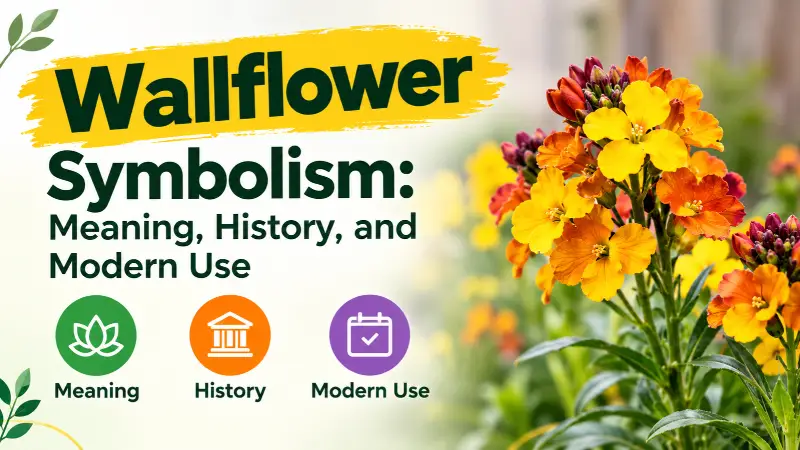
A wallflower is both a real flowering plant and a familiar English expression for a person who stays at the edge of a social gathering. The botanical wallflower, commonly identified as Erysimum cheiri, belongs to the mustard family, Brassicaceae. Its fragrant flowers typically appear in shades of yellow, orange, reddish brown, and other cultivated colors.
The plant’s name reflects its tendency to grow in rocky places, crevices, and old walls. Its ability to flourish in such settings provides a natural image of life continuing in an unlikely location.
The figurative wallflower is someone who stands or sits apart while other people dance, socialize, or compete for attention. Although the word is often associated with shyness, it can also describe someone who has been excluded or simply prefers to observe.
These two definitions create the foundation for the symbol. One concerns a flower growing in a difficult setting; the other concerns a person whose qualities may go unnoticed in a busy social environment.
2. The Core Symbolic Meanings of Wallflowers
Wallflowers do not have one universal meaning. Their symbolism depends on whether someone is referring to the plant, the social expression, or a personal interpretation.
Quiet individuality is one of the clearest modern associations. A wallflower does not need to dominate a room to have a recognizable presence. The image can represent people who express themselves thoughtfully rather than loudly.
Feeling overlooked is another central meaning. A person standing against a wall may be present without feeling included. In this sense, the wallflower represents the difference between being physically present and genuinely belonging.
Resilience and endurance emerge from the plant’s growth in rocky places and old masonry. The image suggests the ability to persist in circumstances that might appear inhospitable.
Faithfulness in adversity comes from traditional flower symbolism, especially Victorian-era floral dictionaries. This association presents the wallflower as a sign of loyalty that survives hardship rather than disappearing when circumstances become difficult.
Taken together, these meanings make the wallflower a symbol of understated worth: something or someone can be easy to overlook without being insignificant.
3. Historical Origins of Wallflower Symbolism
The word wallflower entered English as the name of a flowering plant during the sixteenth century. Its name describes a flower associated with walls and rocky places, particularly in parts of Europe. The plant was cultivated for its colorful, sweet-smelling blossoms.
The expression later acquired a social meaning. By around 1820, English usage recorded the figurative sense of a person, particularly a woman at a dance, who remained by the wall because she lacked a dancing partner or was not invited to dance.
The social customs of formal dances help explain why this image became recognizable. In settings where dancing depended on invitations and partners, remaining on the sidelines could make someone’s social position visible. A person might be shy, overlooked, or simply unwilling to participate.
The metaphor eventually expanded beyond dances. Today, a wallflower can be anyone who remains at the edge of an activity, including someone who rarely speaks in meetings or avoids becoming the center of attention.
The historical development is important because the social meaning did not replace the botanical one. Both remain in use, and each contributes a different dimension to the symbol.
4. The Traditional Meaning: Faithfulness in Adversity
In nineteenth-century flower symbolism, the wallflower was associated with faithfulness in adversity. During this period, the language of flowers became a popular way to communicate feelings through carefully selected blossoms.
Floral dictionaries assigned meanings to individual plants, allowing people to express affection, admiration, longing, or disapproval without stating those emotions directly. The meanings were not universal rules; they varied across publications and traditions.
The wallflower’s association with loyalty during difficult circumstances fits the image of a plant growing among stones and old walls. Its blossoms suggest that beauty and continuity can persist where conditions are less than ideal.
As a symbol of relationships, the wallflower can therefore suggest remaining devoted during separation, uncertainty, or hardship. As a broader personal symbol, it can represent holding on to one’s principles when recognition or encouragement is limited.
This traditional meaning differs from the modern social definition. Someone described as a wallflower at a party may feel awkward or excluded, but a wallflower used in a traditional floral message may communicate steadfast affection.
5. What Wallflowers Symbolize in the United States
In contemporary American culture, the social meaning of wallflower is especially familiar. The term appears in everyday conversations about parties, dating, school, work, and group activities.
A person who attends a party but spends much of the evening listening rather than talking might jokingly call themselves a wallflower. At school, the word might describe someone who watches a dance instead of joining it. In the workplace, it can refer to a colleague whose contributions go unnoticed in a meeting.
The term is not always negative. Some Americans use it affectionately to describe someone who is reserved, thoughtful, or slow to feel comfortable around strangers. Others use it critically when they believe a person should participate more.
The distinction between chosen solitude and unwanted exclusion matters. Someone may prefer a quiet corner because they enjoy observing conversations. Another person may stand in that same corner because nobody has welcomed them into the group.
American interpretations increasingly allow room for both possibilities. Introversion and social confidence are not the same thing, and a person who speaks less is not necessarily unhappy or lacking social ability.
In this context, wallflower symbolism can encourage a more careful understanding of social behavior: quietness alone does not reveal whether someone is content, anxious, independent, or lonely.
6. Wallflower Symbolism in Literature and Popular Culture
Writers often use the wallflower as a character type because the image communicates social position quickly. A character who stands apart from a crowd may be shy, observant, misunderstood, or waiting for an opportunity to participate.
In coming-of-age stories, the wallflower frequently represents the experience of growing into one’s identity. A character may begin as an outsider, struggle to find a place among peers, and gradually develop confidence or discover relationships that feel more authentic.
The 2012 American film The Perks of Being a Wallflower, adapted from Stephen Chbosky’s novel, helped make the expression recognizable to a modern generation of viewers. Its title draws on the idea of a person who watches life and relationships from the margins rather than feeling fully involved in them.
However, the wallflower is not always a character who eventually becomes outgoing. Sometimes the observer’s perspective is the point. A quiet character may notice details that more socially dominant people miss, making observation a form of insight rather than weakness.
This literary use broadens the symbol beyond a party or dance. The wallflower becomes a figure for the outsider who is still learning how to relate to the world.
7. The Emotional and Psychological Meaning of a Wallflower
Emotionally, the wallflower can represent the gap between wanting connection and feeling comfortable enough to pursue it. Someone may want to make friends but struggle to enter an ongoing conversation. Another person may be content to listen and feel no need to become more visible.
Several feelings can therefore exist within the same symbol:
- Self-consciousness: Worry about being judged or making a social mistake.
- Loneliness: Wanting companionship but feeling left out.
- Observation: Preferring to understand a situation before participating.
- Independence: Feeling comfortable without constant attention or approval.
- Hope: Believing that a more welcoming connection may develop with time.
The word itself cannot tell us which experience a person is having. It is a metaphor, not a psychological assessment.
This distinction is useful because people sometimes confuse quiet behavior with low confidence or assume that a reserved person needs to be changed. In reality, temperament, familiarity, culture, circumstances, and personal preference all influence how people participate in social life.
The wallflower can symbolize vulnerability, but it can also remind us that a quieter presence deserves the same respect as a louder one.
8. Wallflower Colors and Their Symbolic Associations
The wallflower plant produces several colors, and people may interpret those colors through broader cultural associations. These interpretations are general color symbolism, not fixed meanings exclusive to the wallflower.
| Color or feature | Common symbolic association | Interpretive note |
|---|---|---|
| Yellow | Warmth, optimism, and friendship | Suggests a welcoming presence despite the plant’s modest setting. |
| Orange | Enthusiasm, creativity, and vitality | Can contrast with the wallflower’s reputation for social reserve. |
| Red or reddish brown | Affection, devotion, and emotional intensity | May suit a message about loyalty or enduring attachment. |
| Fragrance | Subtle presence and understated appeal | Suggests qualities that can be appreciated without a dramatic display. |
| Growth among stones | Persistence and resilience | Connects the plant with endurance in difficult circumstances. |
These associations are interpretive rather than universal. A particular flower’s color does not automatically determine its message, and personal experiences can matter more than conventional color meanings.
The contrast between vivid petals and the plant’s name is part of its appeal. A wallflower can be colorful and fragrant even when its surroundings are plain, making it a fitting image of qualities that do not immediately attract attention.
9. Cross-Cultural and Religious Interpretations
The wallflower does not have one established symbolic meaning shared by every religion or culture. Its best-documented associations come from European botanical naming and the nineteenth-century language of flowers.
In Persian cultural and botanical writing, the wallflower is known by names including khiri. The plant has a history of cultivation and recognition, but that fact alone does not establish that every Persian tradition assigns it the same symbolic message.
More broadly, flowers have played important roles in many cultural practices, including celebrations, mourning, courtship, and religious observances. However, the meanings assigned to roses, lotuses, lilies, and other familiar flowers should not automatically be transferred to the wallflower.
Likewise, the wallflower is not a standard, universally recognized religious emblem in Christianity or other major faiths. An individual may use it in a personal spiritual reflection about patience, loyalty, or finding beauty in difficult circumstances, but that is different from claiming an official religious meaning.
A respectful interpretation separates documented traditions from personal associations. The wallflower can be meaningful without needing to belong to a single sacred system.
10. What a Wallflower Represents in Relationships
In romantic and personal relationships, wallflower symbolism can communicate loyalty, hesitation, or the wish to be noticed without having to demand attention.
The traditional association with faithfulness in adversity makes the flower suitable for reflecting on commitment through challenging periods. Someone might choose a wallflower illustration to represent a relationship that endured distance, uncertainty, or an extended period of change.
The social meaning creates a different interpretation. A wallflower at a dance may represent someone who hopes to be approached but feels unable to initiate contact. In a modern setting, the image can reflect the uncertainty of dating or the pressure to appear confident around new people.
It is important not to romanticize unwanted isolation. Being ignored is not proof of devotion, and someone who struggles socially should not have to wait indefinitely for another person to recognize their worth.
At its most constructive, the wallflower represents the hope of being understood without pretending to be someone else. It can also remind people to notice those who are present but have not yet found an easy way into the conversation.
11. Wallflower Symbolism in Tattoos, Jewelry, and Decor
The wallflower can be used in personal design to express a range of identities and experiences. Its meaning depends on the design, the person’s intentions, and the context in which it appears.
Tattoos: A wallflower tattoo may represent introversion, resilience, feeling different, or learning to value oneself without external approval. Someone drawn to the traditional floral meaning might use it to commemorate loyalty during a difficult period.
Jewelry: A pendant, charm, or floral motif can act as a private reminder of a relationship, a personal quality, or a preference for quiet individuality. A flower’s appearance alone does not communicate a fixed message, so an accompanying inscription or personal story may clarify its meaning.
Home decor: Wallflower prints, botanical illustrations, and floral patterns can bring a vintage or garden-inspired atmosphere to a room. In this context, the plant may be appreciated for its appearance rather than for any symbolic statement.
Fashion and personal style: Calling oneself a wallflower can be a playful way to acknowledge being reserved or uncomfortable with social attention. Some people use the term proudly, while others reject it because it suggests passivity.
In each case, the symbolism works best when it reflects the owner’s own experience instead of relying on assumptions about what a quiet person must feel.
12. Misunderstandings and Negative Stereotypes
The most common misunderstanding is that a wallflower is necessarily weak, boring, unpopular, or socially incapable. These judgments confuse a person’s visibility with their abilities and character.
The original social expression developed around the experience of standing aside at dances, but modern usage covers many different situations. Someone may be shy, unpartnered, uninterested in dancing, unfamiliar with the group, or deliberately observing rather than participating.
Another misconception is that everyone who calls themselves a wallflower secretly wants to become the center of attention. Some people want closer friendships but prefer small gatherings; others genuinely enjoy quiet social settings.
The plant’s traditional symbolism can also be distorted if its association with faithfulness in adversity is treated as an instruction to tolerate harmful relationships. Loyalty is a recognizable symbolic theme, but it does not require someone to accept disrespect or neglect.
Finally, a wallflower should not be treated as a clinical label. Introversion, social discomfort, loneliness, and social anxiety are distinct experiences, and a casual metaphor cannot establish which one applies to a particular person.
A balanced interpretation recognizes the possibility of exclusion without assuming that all reserved people are unhappy or that all forms of solitude need to be corrected.
13. How Wallflower Symbolism Has Evolved
The wallflower’s meaning has developed through several overlapping stages. Its earliest familiar English meaning was botanical: a flower associated with walls and rocky places. Its later social meaning drew on the visible experience of being left at the edge of a dance.
During the nineteenth century, floral dictionaries gave the plant a more deliberate emotional role by associating it with faithfulness in adversity. At the same time, the figurative wallflower became a recognizable social type.
Modern literature and film have expanded the image further. The wallflower may now represent an outsider, a thoughtful observer, a person discovering their identity, or someone navigating the difference between solitude and loneliness.
Contemporary attitudes toward personality also influence how the word is understood. In some settings, the term remains a criticism of someone who does not participate. In others, it is a neutral or affectionate description of a reserved person.
The central tension remains recognizable: a wallflower can be present without being noticed. What has changed is the range of interpretations available to that experience, from exclusion and insecurity to independence and quiet confidence.
14. How to Interpret Wallflower Symbolism in Your Own Life
If the wallflower feels personally meaningful, start by identifying which aspect of the image speaks to you. The plant, the social expression, and the traditional floral meaning offer different starting points.
Consider these questions:
- Do you identify with being observant rather than immediately joining a group?
- Does the flower’s growth among old walls remind you of adapting to difficult circumstances?
- Does its traditional association with faithfulness reflect a relationship or commitment?
- Does the image capture the feeling of being overlooked despite having qualities worth knowing?
- Do you see the wallflower as a description of your personality, or as a temporary stage in your life?
Your answers can help distinguish chosen quietness from unwanted exclusion. They can also reveal whether the symbol represents a trait you value, an experience you are working through, or a relationship you want to remember.
There is no requirement to choose between being reserved and becoming more socially engaged. A person can value quiet observation while still taking opportunities to connect, speak up, or enter a new setting when it feels worthwhile.
The most useful personal interpretation is the one that describes your experience accurately rather than forcing it into a ready-made story.
FAQs
What does a wallflower symbolize spiritually?
A wallflower may symbolize patience, endurance, loyalty, and the ability to find beauty in difficult circumstances. These are personal or interpretive associations rather than a universal religious doctrine.
Is wallflower symbolism positive or negative?
It can be either, depending on context. The social expression may suggest loneliness or exclusion, while the plant’s traditional association with faithfulness in adversity gives it a more hopeful meaning.
What does a wallflower tattoo mean?
A wallflower tattoo may represent introversion, individuality, resilience, or the experience of feeling overlooked. For someone familiar with traditional flower symbolism, it may also express loyalty through hardship.
Why is a shy person called a wallflower?
The expression comes from the image of someone standing beside a wall at a dance instead of participating. The figurative meaning was recorded by around 1820 and later expanded to describe people who remain on the sidelines of social activities.
What did the wallflower mean in Victorian flower language?
In nineteenth-century floral symbolism, the wallflower was associated with faithfulness in adversity. This meaning reflected the period’s practice of assigning emotional messages to particular flowers, although such associations varied between floral dictionaries.
Does being a wallflower mean someone is an introvert?
Not necessarily. Introversion describes a personality tendency, whereas wallflower is an informal expression for someone who remains on the edge of a social activity, whether by choice or circumstance.
What is the difference between a wallflower and a person who enjoys solitude?
A wallflower may be shy, excluded, or simply observant, while someone who enjoys solitude actively values time alone. The two experiences can overlap, but being quiet in a crowd does not reveal whether a person wants more social contact.
Conclusion
Wallflower symbolism brings together quiet individuality, the experience of being overlooked, and the traditional meaning of faithfulness in adversity. Its botanical origins explain the image of a flower growing among walls, while its social history explains why the word became associated with people who remain at the edges of gatherings.
In modern American culture, the wallflower can represent loneliness, thoughtful observation, resilience, or a comfortable preference for less attention. Its meaning depends on the circumstances and on the person using the symbol.
Ultimately, wallflower symbolism offers a grounded reminder that visibility and value are not the same thing. Sometimes a person needs an invitation to feel included; sometimes they simply need the freedom to participate in their own way.